Innerwick Castle: A Scottish Spur Castle and Noble Stronghold


Site at a Glance
- Rating
- 4.3
- Popularity
- Very Low
- Country
- United Kingdom
- Primary era
- Medieval
- Eras represented
- Medieval
- Civilizations
- Kingdom of Scotland
- Site type
- Military
- Remains
- Castle
On this page10 sections
History
Innerwick Castle is a ruined fourteenth-century Scottish stronghold near Dunbar in the United Kingdom. Built on the edge of a steep glen, it became a residence and defensive base of the Stewart and Hamilton families, and its position helped guard routes leading from the south.
Fourteenth and Fifteenth Centuries
By 1406, Innerwick Castle was sufficiently important to be targeted by Robert Stewart, Duke of Albany. He besieged it to drive out forces commanded by the Earl of Northumberland. Timber beams were purchased for the attack, perhaps for a siege engine or for an attempt to force entry into the castle.
Conflict with England
Innerwick was drawn into the violence of the Rough Wooing, a series of sixteenth-century conflicts in which England sought to compel Scotland to accept a marriage between Mary, Queen of Scots, and Henry VIII’s son, the future Edward VI. In November 1542, after the English Somerset Herald Thomas Trahern was murdered near Dunbar, his companion Henry Ray, Berwick Pursuivant, a junior heraldic officer, took refuge at Innerwick. Sir James Hamilton of Innerwick and twenty servants recovered Trahern’s body and buried it at Dunbar church, while Hamilton sent a surgeon to treat Trahern’s servant.
James Hamilton of Innerwick was later captured by the English and held for ransom by Ralph Eure. In March 1545, his son Alexander Hamilton captured the Englishman Robert Constable and hoped to arrange an exchange of prisoners. The castle had already been enlarged several times when Edward Seymour, 1st Duke of Somerset, captured and destroyed it in September 1547. English troops directed by Peter Meutas entered through the basement and set the building on fire.
Reformation and Crown Control
Innerwick and nearby Thornton Castle retained strategic value because they guarded routes from the south. In a letter dated 27 April 1560, Mary of Guise referred to the house of Innerwick while discussing soldiers from Dunbar Castle. At the time, French forces were fighting the English at the siege of Leith.
In May 1568, Alexander Hamilton of Innerwick signed a bond at Hamilton in support of Mary, Queen of Scots, and joined her army at the Battle of Langside. After Mary’s defeat by forces commanded by Regent Moray, who governed Scotland on behalf of its monarch, Hamilton was captured. In April 1584, the laird of Innerwick, the landed proprietor of the estate, was ordered to surrender the castle to the Crown. The keepers of Tantallon and Fast castles received the same order.
Seventeenth-Century Use and Later Ownership
During the 1590s, Alexander Hamilton, laird of Innerwick, employed the Edinburgh tailor Patrick Nimmo. Nimmo recorded clothing made for Hamilton, his wife Christian, their children, and their son Alexander Hamilton of Fenton. The garments included silk and woollen gowns, a purple fustian doublet and breeches, a green cloak, and a Spanish felt hat made in 1599.
Margaret Whitelaw, Lady of Innerwick, divorced Alexander Hamilton of Innerwick and married Sir John Ker of Littledean. She died in 1627. David Calderwood wrote that she died in torment and repeated allegations that she had practised witchcraft and consulted witches.
In the seventeenth century, when the castle remained habitable enough to serve as a base, the Covenanters used Innerwick with Dirleton and Tantallon castles to harass Oliver Cromwell’s lines of communication during the Wars of the Three Kingdoms. The Covenanters were Scottish opponents of royal interference in Presbyterian church government. James Maxwell of Innerwick later became Earl of Dirleton, while the land around the castle was sold to the Nisbet family in 1663.
Protection
Innerwick Castle is a Scheduled Monument, a legally protected archaeological or historic site recognized for national importance, under designation SM773, which dates from 1936. The castle lies within the Barony of Innerwick. Its last baron was Colonel Victor Charles Vereker Cowley of Crowhill, who lived from 1918 to 2008.
Remains
Castle and Crag
Innerwick Castle
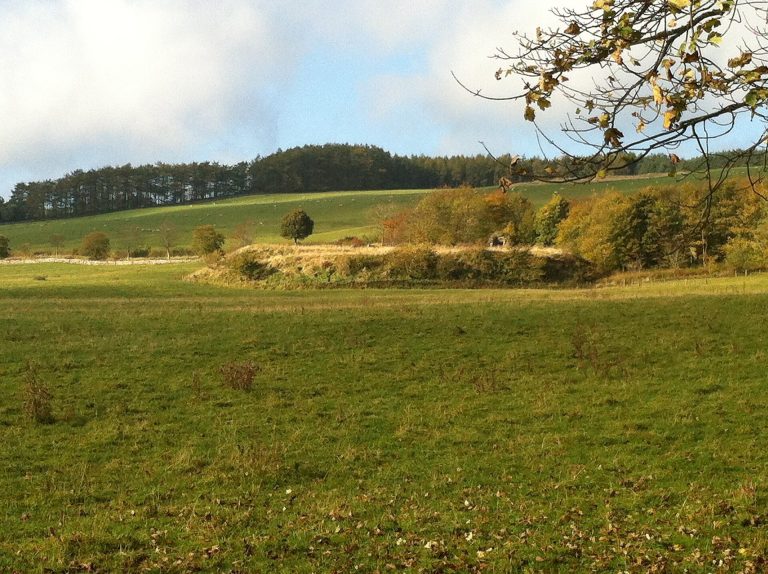
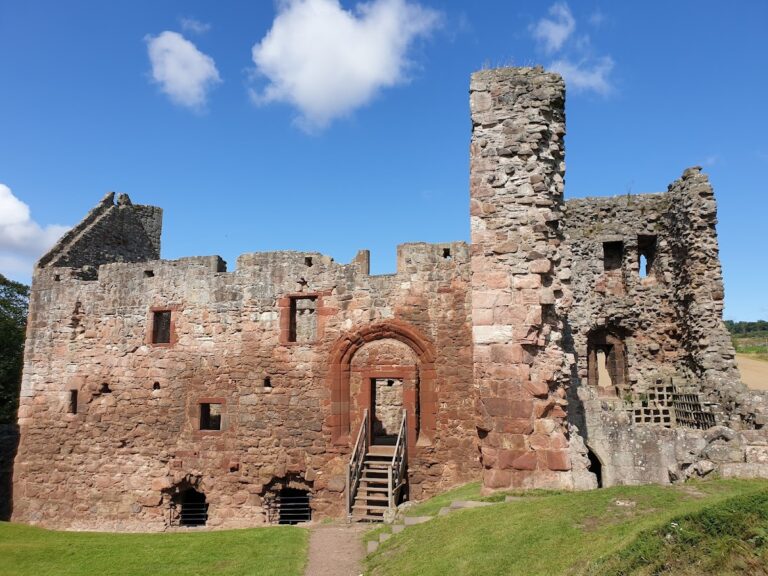
The ruins occupy a projecting ridge of high ground above Thornton Burn and overlook Thornton Glen. This setting makes Innerwick a spur castle, a fortified structure that uses a narrow high ridge for defence. The building was constructed from rubble stone and belonged to the Scottish noble tradition of fortified residences. Several enlargements altered the castle before its destruction in 1547, and the surviving fabric retains the physical evidence of a stronghold that was expanded before being burned during the English assault. The crag associated with the ruins is also used by climbers.
Thornton Glen
Thornton Glen forms the immediate natural setting of the castle. The glen is part of the Crowhill Estate and is managed by the Scottish Wildlife Trust. Its vegetation is considered important for fern species that are rare in Scotland, adding a natural dimension to the landscape surrounding the masonry remains.