Norham Castle: A Medieval Border Fortress on the River Tweed


Site at a Glance
- Rating
- 4.5
- Popularity
- Low
- Country
- United Kingdom
- Primary era
- Medieval
- External website
- Open
- Eras represented
- Medieval
- Civilizations
- English
- Site type
- Military
- Remains
- Castle
On this page14 sections
History
Norham Castle is a ruined medieval fortress in the United Kingdom, founded by the Bishopric of Durham in 1121 to protect its northern Northumberland estates from Scottish incursions. Built during the medieval period on the Anglo-Scottish border, it became a contested stronghold under both episcopal and royal control.
Foundation and episcopal rebuilding
Ranulf Flambard, Bishop of Durham from 1099 to 1128, ordered the castle’s construction in 1121. David I of Scotland captured it in 1136, but it was soon returned to the bishopric. Scottish forces seized it again in 1138 and heavily damaged the structure. Norham then stood derelict until Hugh de Puiset, Bishop of Durham from 1153 to 1195, rebuilt it, probably under the direction of his architect Richard of Wolviston.
Hugh de Puiset later supported rebels against Henry II while William the Lion of Scotland invaded Northumberland in 1174. After the rebellion failed, Hugh surrendered Norham to the Crown. A Crown-appointed constable governed the castle, and royal soldiers formed its garrison until 1197, when it was returned to Hugh’s successor, Philip of Poitou. Philip’s death in 1208 brought Norham back under royal control.
Royal control and Scottish sieges
In 1209, Norham received both King John of England and William the Lion when the Scottish king paid homage for his English lands. Between 1208 and 1211, John strengthened the castle’s defences and maintained a substantial garrison. Alexander II of Scotland, William’s son, besieged Norham for forty days in 1215 but failed to take it. The Crown returned the castle to the Bishopric of Durham in 1217.
Edward I visited Norham several times. In 1292, John Balliol, the newly chosen King of Scotland, paid homage to Edward at the castle. Four years later, Edward stayed there during his campaign against Scotland, while his queen, Marguerite of France, remained at Norham.
The fortress endured repeated attacks during the early fourteenth century. Robert the Bruce besieged it for nearly a year in 1318, and Scottish troops occupied the outer ward for three days before they were expelled. Further sieges in 1319 and 1322 lasted seven months and an unspecified period, and both failed. Sir Thomas Grey of Heton commanded Norham throughout these three attacks. He had been captured by the Scots at the Battle of Bannockburn in 1314 and was the father of the chronicler Sir Thomas Grey.
A Scottish army finally captured Norham in 1327. After peace was declared, the castle was restored to Lewis de Beaumont, Bishop of Durham.
Late medieval conflict
Norham experienced fewer violent episodes during the first half of the fifteenth century, although its defences continued to be maintained. During the Wars of the Roses, the fifteenth-century dynastic struggle between the Yorkist and Lancastrian branches of the English royal house, Yorkist forces held the castle for Edward IV in 1462. A Lancastrian army besieged it for eighteen days in 1463, until Yorkist forces relieved the garrison. The garrison changed sides in 1464 and supported the Lancastrians, but the Yorkists forced it to surrender.
Richard Foxe, Bishop of Durham from 1494 to 1501, strengthened Norham’s defences later in the century. James IV of Scotland besieged the castle for two weeks in 1497 and used artillery against its walls. An English army relieved the garrison, and Norham was repaired after the attack.
Tudor invasions and repairs
James IV invaded England again in 1513 and bombarded Norham’s outer defences for several days. Scottish forces captured the outer ward, and the castle soon surrendered after most of its outer walls had been destroyed. Norham returned to English control after James was defeated and killed at the Battle of Flodden near Branxton in Northumberland.
William Frankelayn, chaplain to Cardinal Thomas Wolsey, inspected Norham on 29 August 1515 and considered it well fortified. His report described a wall extending from the keep towards the kitchen as approximately 9 metres thick. Thomas Ruthall, Bishop of Durham, inspected the castle and began restoration work that continued until 1521. William Dacre, 3rd Baron Dacre, served as its captain in 1522 and 1523.
During another invasion scare in September 1523, the Earl of Surrey, William Frankelayn, Sir William Bulmer, and the Sheriff of Durham examined Norham’s defences. Surrey ordered new earthwork platforms and ramparts, which were raised defensive banks and firing positions made from earth and turf. Damaged sections were also repaired with those materials.
In September 1528, Roger Lascelles, steward of the Earl of Northumberland, negotiated across the Tweed with the Earl of Angus and William Douglas, Abbot of Holyrood. Angus requested rooms at Norham for his daughter Margaret Douglas, her governess Isobel Hoppar, and the young Earl of Huntly, and said that he would seek refuge there if necessary. Margaret Douglas was received at the castle in October, although the Earl of Northumberland assured Wolsey that members of the refugee Douglas family would not enter the inner ward.
Decline and abandonment
Norham retained a strong garrison during the sixteenth-century conflicts with Scotland. In 1542, Captain Brian Layton reviewed its security after hearing rumours that insiders might surrender it to the Scots. He later invaded Scotland during the Rough Wooing, the Anglo-Scottish war in which England attempted to force a marriage alliance between the heirs of the two kingdoms, and was killed at the Battle of Ancrum Moor in February 1545.
Sir Richard Lee, Sir Thomas Palmer, and Sir Robert Bowes surveyed Norham in 1550, and Bishop Tunstall carried out repairs in 1554. Prolonged peace later reduced the need for a large garrison, and the defences deteriorated. In 1574, Lord Hunsdon had the floors of the hall, parlour, and kitchen supported by ship’s masts. Cuthbert Armourer organised further repairs in 1590, but by the end of the century the castle was in serious disrepair. In 1596, Queen Elizabeth I told the captain, Sir Robert Carey, that she would provide no money for the castle. A meeting of border wardens at Norham’s west ford ended in a gunfight across the River Tweed in October 1597.
Norham took no further part in fighting. After James VI of Scotland succeeded to the English throne, he granted the castle and manor to George Home, 1st Earl of Dunbar. Norham was subsequently abandoned and fell into ruin. Until 1844, the surrounding area formed an outlying part of the County Palatine of Durham, a county whose ruler exercised certain powers normally reserved for the Crown. Together with areas including Holy Island, the Farne Islands, and Bedlington, it was known as North Durham.
During the nineteenth century, the ruined castle became widely known through the paintings of J. M. W. Turner, who first painted Norham in 1797 and returned to it repeatedly. His associated works include Norham Castle: Colour Study from 1797 to 1798, Norham Castle on the River Tweed from 1822 to 1823, a probable watercolor from around 1830 in the England and Wales series, and Norham Castle, Sunrise from around 1845. William Miller engraved Norham Castle, Moonrise after Turner in 1836. Examples of Turner’s works are held at Tate or Tate Britain in London.
Norham Castle is a Grade I listed building and a Scheduled Ancient Monument. These designations identify it as a structure of exceptional architectural or historic interest and an archaeological or historic site protected by law. The castle is in the care of English Heritage.
Remains
Norham Castle occupies high ground above the River Tweed on its south bank, at the Anglo-Scottish border. Its natural and artificial defences shaped the site: a steep slope protected the north, a deep ravine lay to the east, and a moat defended the west and south. The fortress was divided into an inner ward, the more heavily defended central enclosure, and an outer ward, the outer enclosed area. The inner ward stood on a mound and was separated from the outer ward by a moat crossed by a drawbridge.
Outer defences and entrances
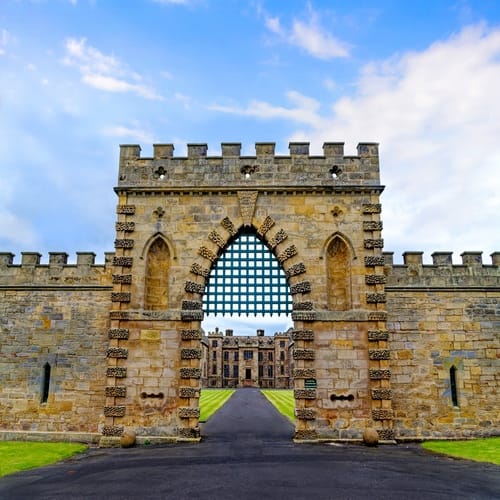
West Gate
The principal approach entered through the strongly fortified West Gate, also known as Marmion’s Gate. It led into the outer ward across a stone causeway and drawbridge. A second entrance, the Sheep Gate, stood on the south side of the outer ward. The outer defences suffered heavy destruction during James IV’s bombardment in 1513, when Scottish forces captured the outer ward.
Inner ward entrance
Access to the inner ward required crossing a drawbridge over its moat and passing through a fortified gate on the western side. The historic drawbridge has been replaced by a wooden bridge. The entrance connected the central stronghold with the outer enclosure while preserving the defensive separation between them.
Inner ward buildings
Bishop’s hall
The bishop’s hall stood on the north side of the inner ward. It measured approximately 18.3 by 9.1 metres and survives as a ruin. Its position within the central enclosure reflects the importance of the episcopal residence within a fortress administered for the Bishopric of Durham.
Keep
The keep, the principal fortified tower within a castle, occupies the east side of the inner ward. Traditionally attributed to Hugh de Puiset, it measures approximately 25.6 by 18.3 metres and rises 26.8 metres high. A wall extending from the keep towards the kitchen was described in 1515 as approximately 9 metres thick, illustrating the massive construction of the central defensive complex.
Siege evidence
Norham’s military history is also connected with the use of heavy artillery. Mons Meg, a cannon with a calibre of approximately 51 centimetres, was used during James IV’s 1497 siege to attack the castle walls. The cannon is now preserved at Edinburgh Castle, while the surviving fortress remains provide the physical setting for the medieval and Tudor campaigns that shaped its form.