Javornicí Castle: A Medieval Fortification in Czechia
Site at a Glance
- Rating
- 5
- Popularity
- Very Low
- Country
- Czechia
- Primary era
- Medieval
- Eras represented
- Medieval
- Civilizations
- Holy Roman Empire, Kingdom of Bohemia
- Site type
- Military
- Remains
- Fort
On this page8 sections
History
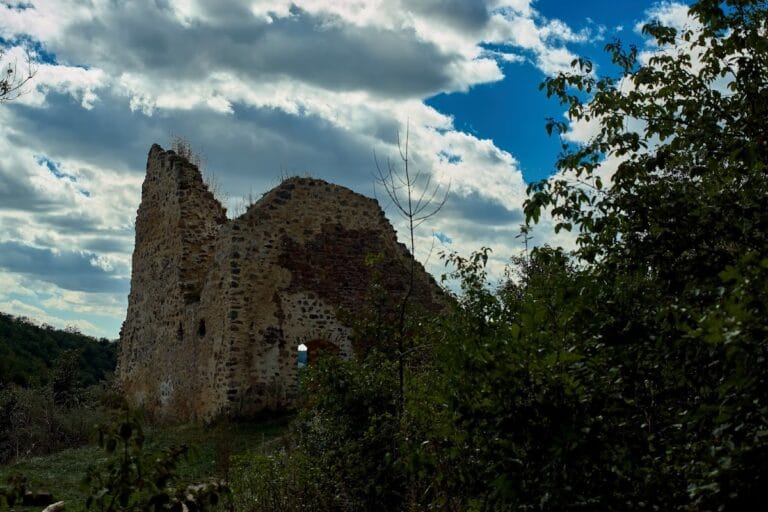
Javornicí Castle is a ruined medieval fortification in Czechia, situated on Hradiště Hill near Lhota. The site occupies a forested summit and is also known as Hradiště nad Javornicí and Deliba. Its precise origins and purpose remain uncertain, although archaeological evidence connects the surviving remains with the second half of the fifteenth century.
Early Identifications
The fortification was identified with Deliba in 1921 by Václav Kočka, who associated it with a story about people from Hedčany captured during Duke Bretislav I’s campaign in Poland in 1038. Bretislav I ruled as duke of Bohemia during the first half of the eleventh century. This proposed identification has not been demonstrated by historical or archaeological evidence.
August Sedláček suggested that the site might have been the residence of a minor noble family from nearby Slatina. Another theory proposed a closer relationship with Krakovec Castle, about 3 kilometres north on the opposite bank of the Javornice. Neither interpretation has been established.
Archaeological Investigations
Matyáš Kalina of Jäthenstein and Václav Krolmus investigated the hill in 1833. They recorded a dry-laid wall that formed the foundations of a square building, and traces of fire were found inside the structure. The finds associated with this investigation have not survived.
In 1992, the medieval archaeologist Tomáš Durdík conducted a visual survey and micro-probing, a limited investigation of subsurface features. He identified an oval fortification surrounded by a ditch and proposed that it was not a lordly residence but a military strongpoint. In his interpretation, the site may have been created during the Hussite Wars, fifteenth-century religious and political conflicts in Bohemia that involved extensive military activity and temporary fortifications, or during the later Wars of George of Poděbrady, conflicts connected with George’s rule and the political struggles surrounding his kingdom. Artefacts from this investigation were dated to the second half of the fifteenth century.
Javornicí Castle has been protected as a cultural monument since 1964. The combination of its physical form and the fifteenth-century artefacts supports a military interpretation, while the site’s earlier proposed associations remain unresolved.
Remains
The fortification occupies the summit of forested Hradiště Hill, which rises to approximately 446.3 metres. The Slatinsky Stream borders the hill to the west, the Javornice River lies to the north and northeast, and the ground descends gently southward toward Lhota. The surviving site is defined chiefly by terrain traces, including ditches and ramparts arranged around an elongated oval enclosure oriented from east to west.
Defensive Enclosure
Western and Eastern Defences
At the western end, a ditch cut into the rock is accompanied by an outer rampart. These defences diminish toward the eastern part of the enclosure, where the summit is protected by a separate ditch and rampart. Together, the earthworks preserve the outline of a fortified hilltop position whose defensive form is more clearly visible in the terrain than in standing masonry.
Central Building
Square Structure
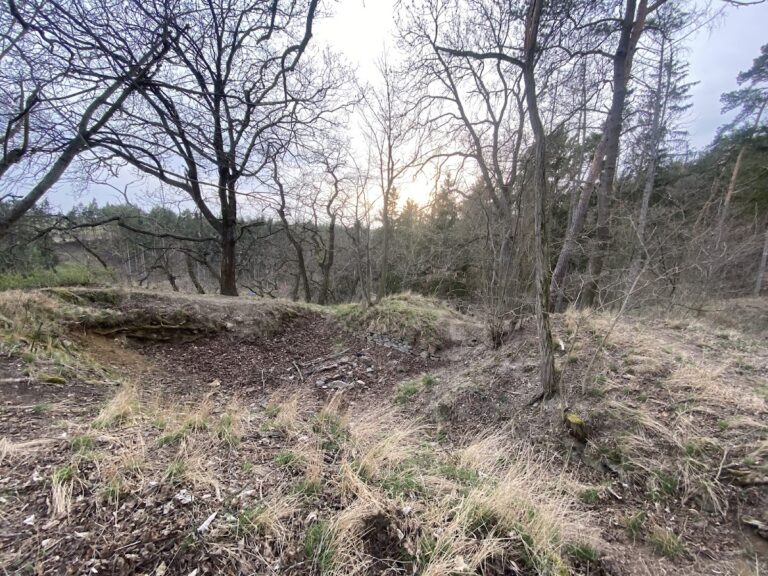
A depression at the centre of the northern side marks the position of the excavated square building. Each side measured 6.6 metres. The structure had foundations formed by a dry-laid wall, and traces of fire were found within it. Its surviving evidence consists primarily of the depression and foundation traces recorded during the 1833 investigation.