Bečov nad Teplou Castle: A Historic Medieval Fortress and Noble Residence in the Czech Republic


Visitor Information
Google Rating: 4.6
Popularity: Medium
Official Website: zamek-becov.cz
Country: Czechia
Civilization: Unclassified
Site type: Military
Remains: Castle

History
Bečov nad Teplou Castle is situated in the town of Bečov nad Teplou in the modern Czech Republic. Its origins trace back to the medieval period, likely founded by local nobles of the Bohemian lands during the late 13th or early 14th century.
The earliest remnants connected to the castle include 13th-century ceramics and remains of a bergfrit, a type of fortified tower, suggesting its construction in or near that period. While no surviving parts can be conclusively dated precisely to the 1200s, historical evidence points to Boreš III of Rýzmburk as the probable founder. The castle first appears in written records in 1346 in a document issued by Boreš V and Slavko of Rýzmburk, confirming its role as a strategic toll station located at a crossroads in an area well known for tin mining.
Over the 14th and 15th centuries, the castle changed hands among several noble families, including the Rýzmburk, Hazmburk, Plauen, and Šlik families. During this time, it underwent various expansions while serving a military purpose, particularly during conflicts related to the Hussite wars and local noble rivalries.
In 1495, the castle was purchased by the Pluh family of Rabštejn, who undertook significant rebuilding in the early 1500s. They connected the main defensive towers and redesigned parts of the residential areas with late Gothic architectural features. After Kaspar Pluh led a revolt against the ruling estates in 1547, the castle was confiscated, although some rights were later restored to his family. Subsequently, ownership shifted among noble families, including the Šliks, the nearby town of Horní Slavkov, and from 1624, the influential Questenberg family.
The Thirty Years’ War (1618–1648) brought hardship to the castle, including occupation by Swedish troops in 1647 and 1648. After this turbulent period, the castle was deemed militarily outdated and fell into disrepair by the 18th century.
Between 1701 and 1714, Johann Adam of Questenberg commissioned the construction of a Baroque chateau in the castle’s forecourt. This new residence was embellished with terraced gardens, greenhouses, and a private theater, reflecting evolving tastes and the decline of the medieval fortress’s military importance.
In the 19th century, plans were made for extensive Romantic-style renovations inspired by historicism, led by notable architects Josef Zítek and Josef Mocker. These mostly remained unrealized, except for the conversion of the castle chapel within one of the towers. Noteworthy additions at this time included the incorporation of Gothic and early Renaissance portals brought in from other locations and installed in the castle’s courtyard façade.
A remarkable discovery occurred in 1985 when the St. Maurus reliquary, a precious 13th-century Christian artifact, was found hidden in the castle chapel. Following restoration, it has been displayed at the castle since 2002, relocated to a modern exhibition space within the castle complex in 2021.
Remains
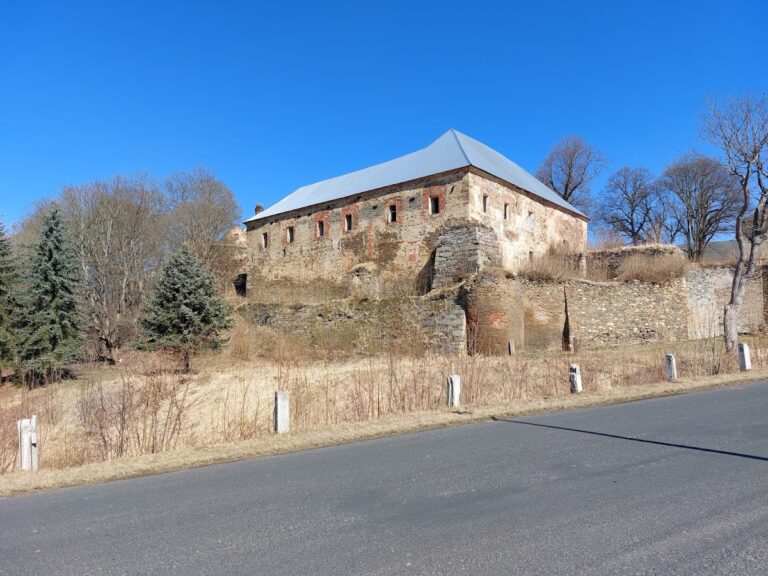
Bečov nad Teplou Castle is perched on a rocky promontory that stretches from southeast to northwest, with steep slopes descending on its southwestern side and gentler terrain to the northeast. It is naturally defended on two sides by the Teplá River and separated on the third by a smaller watercourse, the Dolský stream.
The medieval core of the castle includes the ruins of a large round tower roughly 11 meters across, originally set on solid rock at the southern edge of the main complex. This tower once stood behind a flexible system of defensive walls, but over time it was partly demolished due to structural decay, notably in 1623, and further reduced in the 18th century. What remains today is a fragment about six meters high, featuring a Gothic base and bearing the coat of arms shared by the Kounice and Questenberg families.
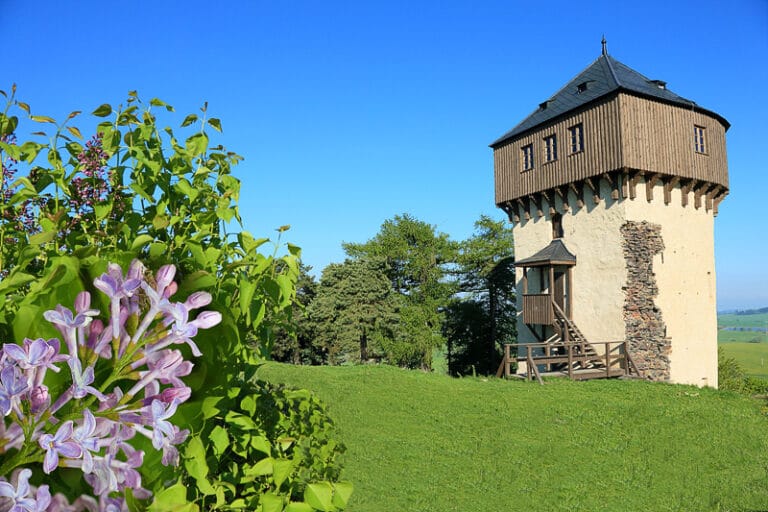
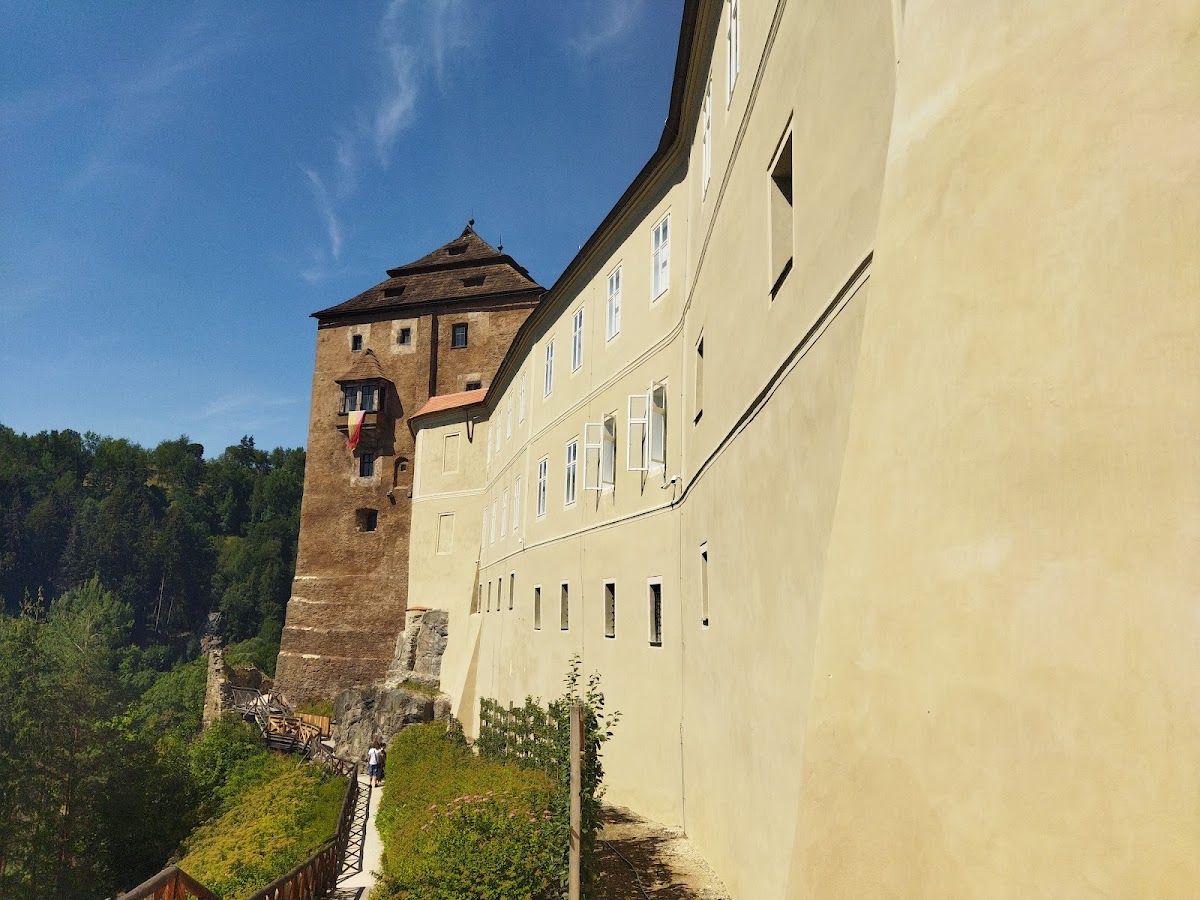
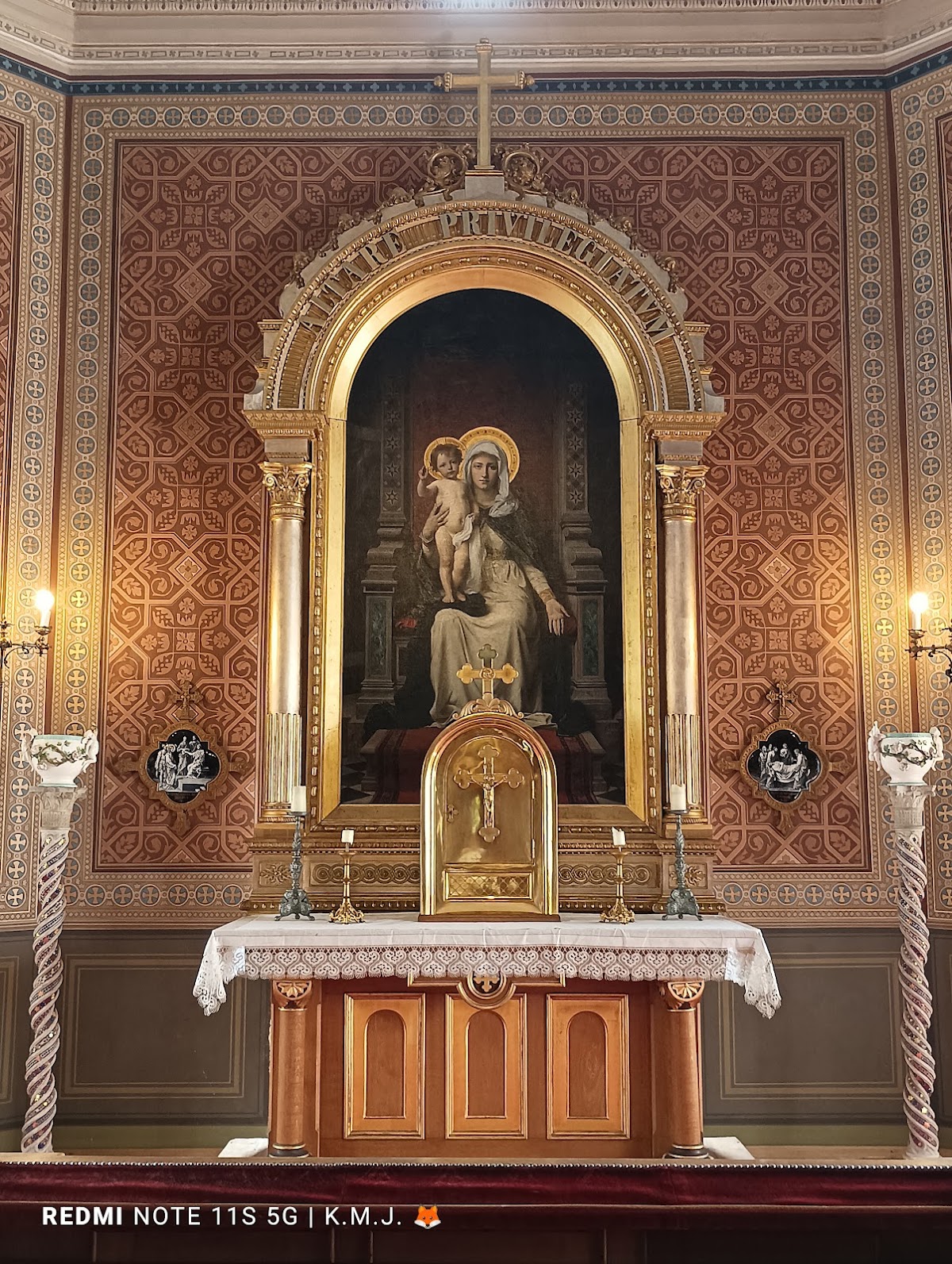
On the highest point of the promontory stand two rectangular towers constructed from finely dressed stone. These prismatic towers are linked by a lower wing that contains a cellar with a barrel-vaulted ceiling partially carved into the rock beneath. The eastern tower houses the castle chapel, dedicated to the Visitation of the Virgin Mary and consecrated on May 14, 1400. This chapel is notable for its ribbed cross vaults, a type of architectural support forming intersecting ribs that divide the ceiling into bays, enhancing both structure and decoration.
Inside the chapel, vibrant wall paintings from circa 1400 illustrate seventeen biblical scenes such as the Annunciation, Nativity, Calvary, Adoration of the Magi, and St. Christopher. The vault is painted with celestial motifs including the sun, moon, and stars, as well as symbolic representations of the four Evangelists. Heraldic details appear throughout the chapel, with the coat of arms of the Rýzmburk family and ornamental four-leaf designs decorating the keystones—the central stones at the intersections of the vault ribs.
The western tower contains multiple living quarters with late Gothic stone elements such as door portals and traces of painted decoration, pointing to its residential use during the castle’s peak period. In the early 16th century, the Pluh family connected these two main towers, creating a larger living space. They expanded the adjacent residential buildings known today as the Pluhovské domy, which included grand halls influenced by Renaissance style. These halls featured pairs of large windows that brought ample light into the interiors.
Recent archaeological research has identified that the northern section of the Pluhovské domy housed the castle kitchen. To the southwest of the primary complex stand stables built in the Classicist style, reflecting later evolutionary phases of the estate’s layout.
The Baroque chateau constructed in the forecourt at the beginning of the 18th century stands as a testament to the castle’s changing role from military fortress to noble residence. This chateau was complemented by formal terraced gardens, greenhouses, and a theater, all designed under the patronage of Johann Adam of Questenberg.
During the 19th century, although wide-ranging planned renovations were largely not completed, the conversion of the chapel within the tower was carried out. Gothic portals bearing the Pluh family crest and richly detailed ribbed vaults with painted keystones survive in this area. Furthermore, certain late Gothic and early Renaissance doorways, transported from other sites, were integrated secondarily into the courtyard façade of the main residential wing.
Today, Bečov nad Teplou Castle is protected as a national cultural monument. Restoration work that began in the 1970s continues intermittently, focusing on preserving the Pluhovské domy among other parts of the castle. Since 2002, the prestigious St. Maurus reliquary, a medieval treasure uncovered within the chapel, has been exhibited on the site, recently moved to a dedicated modern space inside the main residence building.
Nearby sites