Argos: An Ancient City in the Northeastern Peloponnese
Table of Contents


Visitor Information
Google Rating: 4.5
Popularity: Medium
Google Maps: View on Google Maps
Official Website: ancienttheatrearchive.com
Country: Greece
Civilization: Byzantine, Greek, Ottoman, Roman, Venetian
Remains: City

Context
Argos is situated in the northeastern Peloponnese, within the modern town bearing the same name. The site occupies a fertile plain bordered by the prominent Larisa and Aspis hills, which historically provided natural fortifications and vantage points. This landscape, enriched by nearby water sources and arable land, supported continuous human settlement from the Neolithic period onward.
History
Argos stands among the oldest continuously inhabited urban centers in Greece, with archaeological evidence tracing its origins to the Neolithic era. Its location in the northeastern Peloponnese positioned it as a significant player in regional political, cultural, and military developments over millennia. The site’s history encompasses the rise of Mycenaean civilization, the formation of classical city-state institutions, and transformations under Hellenistic, Roman, Byzantine, Crusader, Venetian, and Ottoman dominions. Despite numerous conquests and political upheavals, Argos maintained an unbroken urban presence, adapting its social and architectural fabric to successive historical circumstances.
Neolithic and Bronze Age
Human occupation at Argos dates back to approximately 5000 BCE, as evidenced by a Neolithic settlement located at the base of Aspis hill. This early village represents one of the earliest known continuous habitations in the region, marking the beginning of nearly seven millennia of uninterrupted settlement. During the Late Bronze Age, Argos emerged as a notable Mycenaean center, occupying the hills of Aspis and Larissa. Although smaller than neighboring Tiryns and Mycenae, Argos held strategic and cultural importance, featuring prominently in Homeric epics as the home of the hero Diomedes.
The city reached its apogee in this period, with fortified palatial complexes and extensive cemeteries attesting to its status. However, like many Mycenaean centers, Argos experienced decline around 1100 BCE during the widespread Bronze Age Collapse, leading to a reduction in urban complexity and population.
Archaic Period
The 7th century BCE witnessed a resurgence of Argos under the leadership of King Pheidon, who implemented significant political and military reforms. Pheidon is credited with introducing standardized weights and measures and pioneering hoplite warfare tactics, which enhanced Argos’s military capabilities. His victory over Sparta at the Battle of Hysiae (dated to either 669 or 698 BCE) established Argos as a dominant city-state in Greece and enabled it to preside over the Olympic Games, underscoring its regional prestige.
During this period, Argos developed into a cultural center renowned for its pottery workshops, bronze sculpting schools, tanneries, and textile production. The city hosted numerous festivals and exhibitions celebrating local products. Religious life was marked by the establishment of a sanctuary dedicated to Hera approximately 10 kilometers from the urban center, reflecting Argos’s mythological association with the goddess and the figure Argus Panoptes.
Classical Period
In the 5th and 4th centuries BCE, Argos underwent significant political and military transformations. The city suffered a decisive defeat by Sparta at the Battle of Sepeia in 494 BCE, which precipitated internal political reforms. These reforms introduced democratic institutions, including an Assembly (aliaia), a Council (bola), and a governing body known as ‘The Eighty.’
Argos maintained neutrality during the Persian Wars, resulting in diplomatic isolation but enabling territorial expansion through the absorption of neighboring city-states such as Mycenae, Nemea, and Tiryns. The city assumed responsibility for organizing the biennial Panhellenic games originally held at Nemea. In 462 BCE, Argos entered a tripartite alliance with Athens and Thessaly, though its military contributions were limited. Subsequent defeats, notably at Tegea in 421 BCE, weakened Argos’s regional influence. Despite internal strife and civic violence, the city expanded territorially under Philip II of Macedon around 337 BCE, acquiring disputed Spartan lands including Thyreatis and parts of Mount Parnon, thereby becoming one of the largest territorial states in the Peloponnese.
Hellenistic Period
Following the death of Alexander the Great, Argos participated in the anti-Macedonian coalition during the Lamian War but played a limited military role. In 316 BCE, Cassander imposed a pro-Macedonian oligarchy and stationed a garrison within the city. A violent purge ensued after Argive betrayal of Polyperchon’s supporters, resulting in the execution of approximately 500 individuals by immolation in the prytaneion. This event severely disrupted the city’s political leadership and diminished its regional prominence.
In 272 BCE, during King Pyrrhus’s invasion of the Peloponnese, Argos was politically fragmented; Pyrrhus was killed in a confused battle within the city. Despite political decline, the 3rd century BCE saw the construction of a large theatre with a seating capacity of around 20,000, one of the largest in ancient Greece, indicating sustained cultural activity amid shifting power dynamics.
Roman Period
From the 1st century BCE, Argos was incorporated into the Roman province of Achaea, retaining cultural prestige linked to its mythological heritage. Emperor Hadrian notably contributed to the city’s infrastructure by funding the construction of Roman baths and an aqueduct, enhancing urban amenities. The city flourished architecturally with Roman additions and maintained its cultural significance within the imperial system.
However, the 3rd century CE brought instability during the Crisis of the Third Century, including raids by Gothic and Herulian groups. In 396–397 CE, Visigoths led by Alaric I sacked Argos, causing damage to key structures such as the Hypostyle hall, sections of the agora, the odeion, and the Aphrodision temple, marking a period of decline and disruption.
Byzantine Period
Argos remained continuously inhabited throughout the Byzantine era, integrated into the Themes of Hellas and later the Peloponnese. In the 12th century CE, the construction of Larisa Castle on the city’s highest hill provided a fortified stronghold reflecting the city’s strategic importance. Christianity was firmly established early, with bishops from Argos documented at major ecclesiastical councils in the 5th century, indicating an active religious hierarchy.
Following the Fourth Crusade, Argos became a Latin bishopric in 1212. The Larisa Castle underwent successive expansions and fortifications under Venetian and Ottoman rule, underscoring the city’s continued military and administrative significance in a contested frontier region.
Crusader and Venetian Period
After the Crusader conquest, Argos served as the center of the lordship of Argos and Nauplia. The city experienced multiple changes in control during the late 14th century, including brief governance by the Despot of the Morea before Venetian authority was reestablished in 1394. Venetian rule persisted until 1463, interrupted by Ottoman conquest.
The Venetians repopulated Argos with Albanian settlers, granting them agrarian tax exemptions in exchange for military service as stratioti (light cavalry). The urban fabric during this period was organized into four distinct mahalas (quarters), each characterized by specific ethnic and social groups. These quarters included mosques, Turkish baths, and a Turkish school, reflecting the city’s multicultural composition under Venetian administration.
Ottoman Period
The Ottoman Empire captured Argos in 1463, having previously plundered the city in 1397 and enslaved portions of its population. The city was administratively divided into four quarters: the Greek (Rûm) mahala, the Albanian-dominated Liepur mahala, and two others housing prominent Turkish residents and Islamic institutions. The open market area was reorganized during this period, likely replacing a former mosque site.
Urban expansion was largely unregulated, resulting in a street system characterized by narrow alleys and a complex network typical of Ottoman cities. Housing ranged from modest dwellings to prominent residences of officials. Argos grew significantly in population and area, maintaining its role as a regional center with a diverse ethnic and religious composition.
Remains
Architectural Features
The archaeological remains of Argos encompass a broad chronological spectrum, illustrating continuous occupation from prehistoric times through the Ottoman period. The city’s topography is defined by the fortified hills of Larisa and Aspida, which historically enclosed the urban core. Construction techniques vary, including prehistoric stone fortifications, classical ashlar masonry, and Roman concrete structures. The urban fabric reveals phases of expansion and contraction, with Ottoman-era narrow alleys and complex street patterns superimposed on earlier grids.
Preserved remains include military fortifications, public entertainment venues, civic buildings, religious sanctuaries, and infrastructure such as aqueducts and baths. Byzantine, Venetian, and Ottoman modifications overlay earlier structures, reflecting the city’s evolving functions. The surviving fabric predominantly represents civic and military architecture, with some religious and economic buildings partially excavated or conserved.
Key Buildings and Structures
Larisa Castle
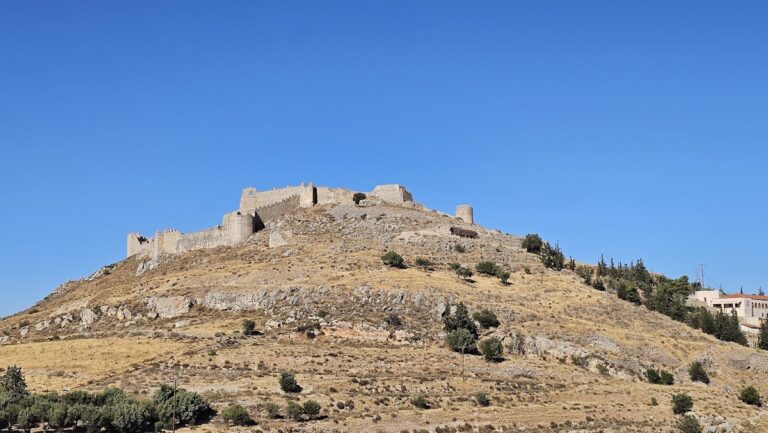
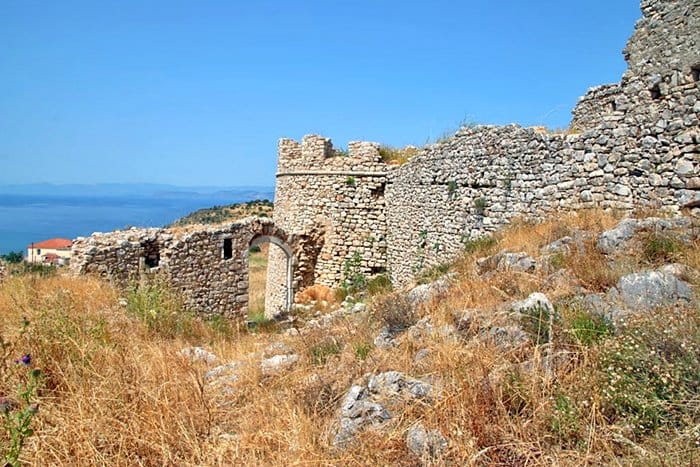
Perched atop Larisa Hill, the highest elevation in Argos at 289 meters, Larisa Castle was initially constructed in the 12th century CE during the Byzantine period. Archaeological evidence indicates earlier fortifications on the site dating to prehistoric and classical times. The castle underwent successive repairs and expansions under Venetian and Ottoman rule, featuring stone walls and defensive towers commanding extensive views over the city and surrounding plain. It played a strategic role during Venetian domination and was swiftly captured by Greek forces led by Dimitrios Ypsilantis in 1821 during the Greek War of Independence after Ottoman elites abandoned the city.
Aspida Hill Castle
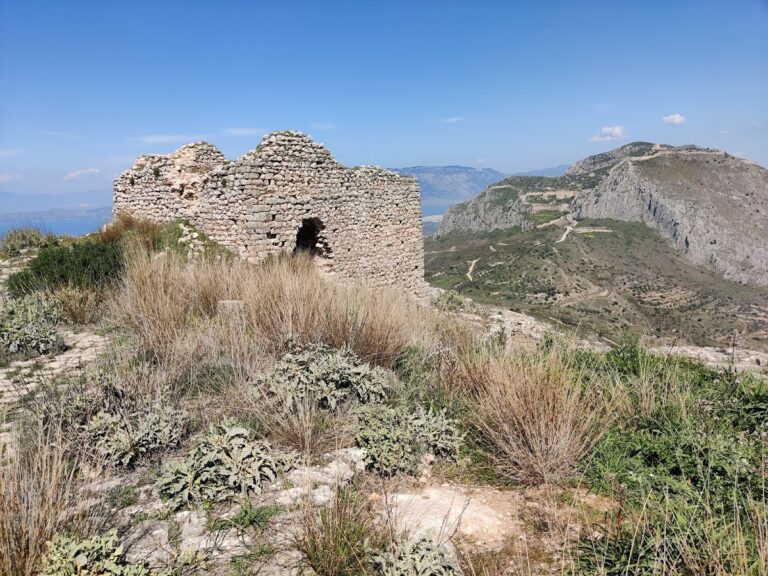
A secondary fortification occupied Aspida Hill, also known as Prophetes Elias Hill, forming a complementary defensive system with Larisa Castle. Remains include fortification walls and foundations, though less extensive than those on Larisa. The hill also contains prehistoric chambered tombs, indicating its long-term significance for burial and defense.
Ancient Theatre of Argos
Constructed in the 3rd century BCE, the theatre replaced an earlier 5th century BCE structure associated with the Panhellenic Nemea games. It is among the largest ancient Greek theatres, with 81 rows of stone seating arranged semicircularly and an estimated capacity of approximately 20,000 spectators. The theatre’s location allows visibility from much of the ancient city and the Argolic Gulf. It is connected to the adjacent ancient agora by a paved path. Excavations began in 1890 and continued intermittently through the 20th century, with major restoration completed in 2004. The theatre’s stone seating, orchestra, and stage foundations remain well preserved.
Ancient Agora of Argos
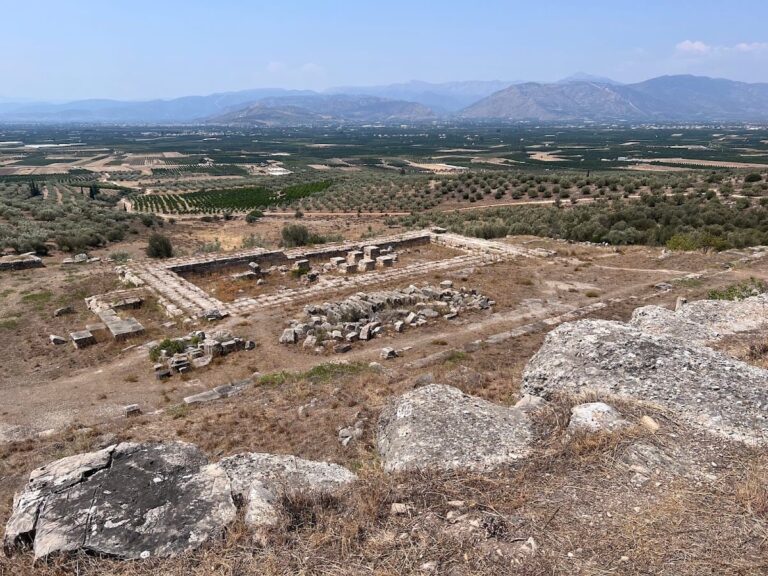
The agora developed in the 6th century BCE and is situated adjacent to the theatre at the junction of roads from Corinth, Heraion, and Tegea. Excavations have uncovered a bouleuterion (council chamber) dating to 460 BCE, coinciding with Argos’s democratic reforms. The complex also includes the Sanctuary of Apollo Lyceus and a palaestra (wrestling school). Remains consist of foundation walls, column bases, and paved surfaces, attesting to its role as a political and social center during classical times.
Criterion of Argos
Located on the southwestern side of the town at the foot of Larisa Hill, the Criterion dates from the 6th to 3rd centuries BCE. It functioned as a judicial building analogous to Athens’ Areopagus. The structure includes stone foundations and a fountain installed under Emperor Hadrian to circulate water supplied by the Hadrianic aqueduct. The Criterion is connected to the ancient theatre by a paved path. Surviving elements include masonry walls and water channels associated with the fountain.
Hadrianic Aqueduct
Constructed in the 2nd century CE under Emperor Hadrian, the aqueduct supplied water to Argos, including the Criterion fountain. Remains of channels and supporting structures have been identified in the northern part of the city. This aqueduct formed part of a broader Roman infrastructure network that included baths and public water facilities.
Roman Baths (Thermae)
Dating to the 2nd century CE and funded by Emperor Hadrian, the Roman baths complex includes rooms for hot and cold bathing, hypocaust (underfloor heating) systems, and water supply channels. Excavations have revealed foundation walls, mosaic floors, and remnants of heating installations. The baths represent a significant component of Roman-era urban development and public amenities in Argos.
Barracks of Kapodistrias
Originally constructed in the 1690s during Venetian rule as a hospital operated by the Sisters of Mercy, this large stone building with multiple rooms and courtyards later served various functions. Under Ottoman administration, it functioned as a market and post office. In the 19th and 20th centuries, it was used as cavalry barracks, a school, exhibition space, refugee shelter, and during World War II, as an interrogation and torture site. Today, it houses the Byzantine Museum of Argos and local organizations.
Temple of Agios Konstadinos
Dating to approximately 1570–1600, this building is among the few surviving Ottoman-period structures in Argos. Originally constructed as a mosque with an attached minaret and cemetery, it was converted into a Christian temple in 1871. Located in the Karamoutza mahala, the structure features stone masonry and Ottoman architectural elements. The surrounding area formerly contained a Turkish cemetery, baths, a school, and the serail of Ali Nakin Bei.
Hellinikon Pyramid
The Hellinikon Pyramid, dating to the late 4th century BCE, is a stone-built monument with a pyramidal shape constructed from large ashlar blocks. Its function remains debated, with hypotheses including a tumulus or fortress. Archaeological dating supports a late classical period origin. The pyramid stands isolated on the plain near Argos.
Other Remains
Remnants of a hypostyle hall, parts of the agora, the odeion, and the Aphrodision temple were reportedly destroyed during Visigothic invasions in the late 4th century CE. The ancient city was fortified by walls connecting Larisa and Aspida hills, with surviving masonry walls and towers. The city’s street layout includes long, narrow alleys characteristic of Ottoman urban planning. An open market area north of Kapodistrias’ barracks has been in continuous use since Ottoman times, likely replacing a former mosque site. Chambered tombs on Aspida Hill represent notable prehistoric funerary remains.
Preservation and Current Status
The theatre of Argos is among the best-preserved ancient structures, with seating and stage foundations largely intact. It underwent major restoration in 2004, combining original stonework with conservation materials. Larisa Castle’s walls and towers remain visible, though some sections are fragmentary. The agora and Criterion survive as foundation remains and partial masonry. Roman baths retain structural elements such as hypocaust floors and mosaic fragments. Ottoman and neoclassical buildings like the Barracks of Kapodistrias and the Municipal Market are preserved and repurposed. The Temple of Agios Konstadinos retains its main structure but shows signs of alteration. Many ancient remains beneath the modern town are fragmentary or disturbed by urban development. Excavations have been limited by overbuilding, but ongoing conservation efforts focus on key monuments.