Larissa Fortress: The Ancient and Medieval Acropolis of Argos


Site at a Glance
- Rating
- 4.5
- Popularity
- Medium
- Country
- Greece
- Primary era
- Medieval
- External website
- Open
- Eras represented
- Classical, Medieval, Early Modern
- Civilizations
- Ancient Greek, Byzantine, Crusader, Ottoman, Venetian
- Site type
- Military
- Remains
- Castle
On this page12 sections
History
Larissa Fortress is the ancient and medieval acropolis of Argos, Greece, rising above the modern town on a high rocky hill. Ancient Greek communities established the settlement and fortifications, while later Byzantine, Frankish, Venetian, and Ottoman rulers altered the stronghold. The site was continuously used for approximately nineteen centuries and served as the defensive, political, and religious center of Argos.
Origins and Classical Argos
The name Larissa was associated by the ancient geographer and historian Strabo with a group known as the Pelasgians, a name used for peoples believed to have lived in Greece before or alongside communities later identified as Greek. Dionysius of Halicarnassus preserved a tradition that Pelasgians expelled to Italy founded another Larissa in memory of this acropolis. The tradition reflects the importance of the hill in the historical identity of Argos, although the precise identity of the Pelasgians remains uncertain.
During the Mycenaean period, the principal settlement and temple lay on Aspis Hill, north of Larissa. In the Late Bronze Age, Dorians settled the eastern slope of Larissa and the level ground to its east. Their settlement and temple became the nucleus of Classical Argos, while later fortifications linked Larissa with Aspis and enclosed the important parts of the city.
Around 421 BC, Athenian masons began constructing long walls between Argos and Nauplion. The Argives, fearing a Spartan invasion, assigned unskilled men, women, and slaves to the work. The project remained incomplete when the Spartan king Agis II attacked Argos and his troops demolished the walls. Before 272 BC, Argos had obtained renewed walls and gates. During the attack by Pyrrhus of Epirus, the king was killed after his forces became trapped when the corpse of a slain war elephant blocked their retreat gate.
Hellenistic and Roman-era conflicts
The later fortifications around Larissa and Aspis played a part in the conflicts between pro-Roman and anti-Roman factions during the second century BC. One clash took place beneath Larissa between Ainesidemos and Macedonian forces commanded by Philokles.
In 198 BC, Philip V of Macedon transferred Argos to Nabis, the reforming king and tyrant of Sparta. Nabis occupied both Larissa and Aspis and sent many Argive aristocrats into exile or to Sparta as hostages. After Philip’s defeat at the Battle of Cynoscephalae in 197 BC, which ended his major challenge to Roman power in Greece, Titus Quinctius Flamininus and forces of the Achaean League besieged Argos. Nabis surrendered the city only after Flamininus marched against Sparta. Roman troops initially occupied Larissa and Aspis but withdrew from them in 194 BC.
Late antique and Byzantine periods
Larissa fell to the Ostrogoths under Alaric I in AD 395, and many inhabitants were sold into slavery. A Slavic incursion reached the site in AD 600. In the twelfth century, the Byzantines, the medieval Roman state centered on Constantinople, founded a new castle on the acropolis.
Frankish, Venetian, and Ottoman rule
Leon Sgouros, ruler of Nauplion, captured the castle in 1203. After his death, Theodore Angelos administered it. In 1212, the Crusader Geoffrey of Villehardouin seized the stronghold and transferred it to Otto de la Roche, Duke of Athens, in return for military assistance. Larissa then became one of the principal fortresses of the Lordship of Argos and Nauplia, a Crusader-ruled feudal territory established in the Peloponnese after the Fourth Crusade.
The castle’s foundations were repaired in the fourteenth century. Under the bailiffs Walter and Francis Foucherolles, it resisted the depredations of the Catalan Company, which had conquered the Duchy of Athens and threatened the Argolid.
In 1388, Maria of Enghien, the last heiress of Argos and Nauplia, sold the territories to Venice. Before Venice could take possession, Theodore I Palaiologos, Despot of the Morea, and his ally and father-in-law Nerio I Acciaioli seized them with Ottoman assistance under Evrenos. Argos remained under Theodore for six years. Under pressure from Sultan Bayezid I, he ceded it to the Ottomans and later agreed to sell it to Venice. Venetian troops occupied the city on 11 June 1394.
Ottoman troops sacked Argos in 1395 after their victory at the Battle of Nicopolis. Argos and Larissa remained Venetian until the Ottomans conquered them at the beginning of the First Ottoman-Venetian War in 1463. The Ottomans held the castle from the fifteenth century into the early nineteenth century, apart from the period from 1686 to 1715, when Venice controlled it under Francesco Morosini.
Greek independence and archaeological study
During the Greek War of Independence, Demetrios Ypsilantis captured the summit castle in 1821. The fortress played little or no subsequent part in military operations. A women’s monastery had been built on the slopes in the eighteenth century, followed by a men’s monastery in the nineteenth century. During the War of Independence, the men’s monastery was briefly used as a national mint for the provisional government before minting moved to a facility on Aegina. It is now a church.
Excavations began in the early twentieth century under the Dutch archaeologist Wilhelm Vollgraff and focused mainly on the castle interior. The foundations were strengthened, while the outer fortifications and gate were reinforced by Greece’s 25th Ephorate of Byzantine Antiquities, a regional branch of the archaeological service. Larissa Fortress is protected in Greece as an archaeological monument and as a legally protected historic building.
Remains
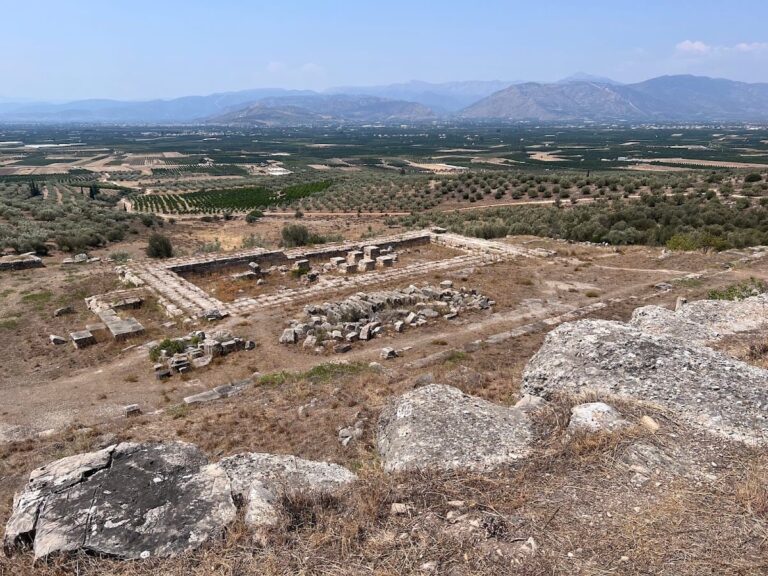
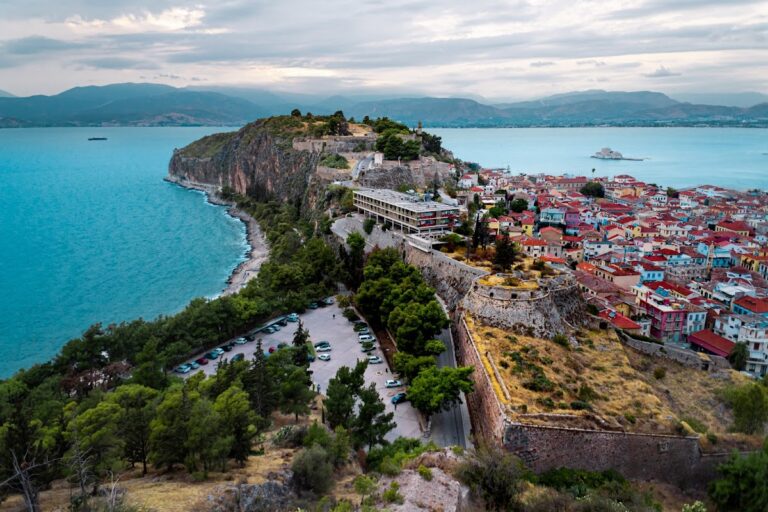
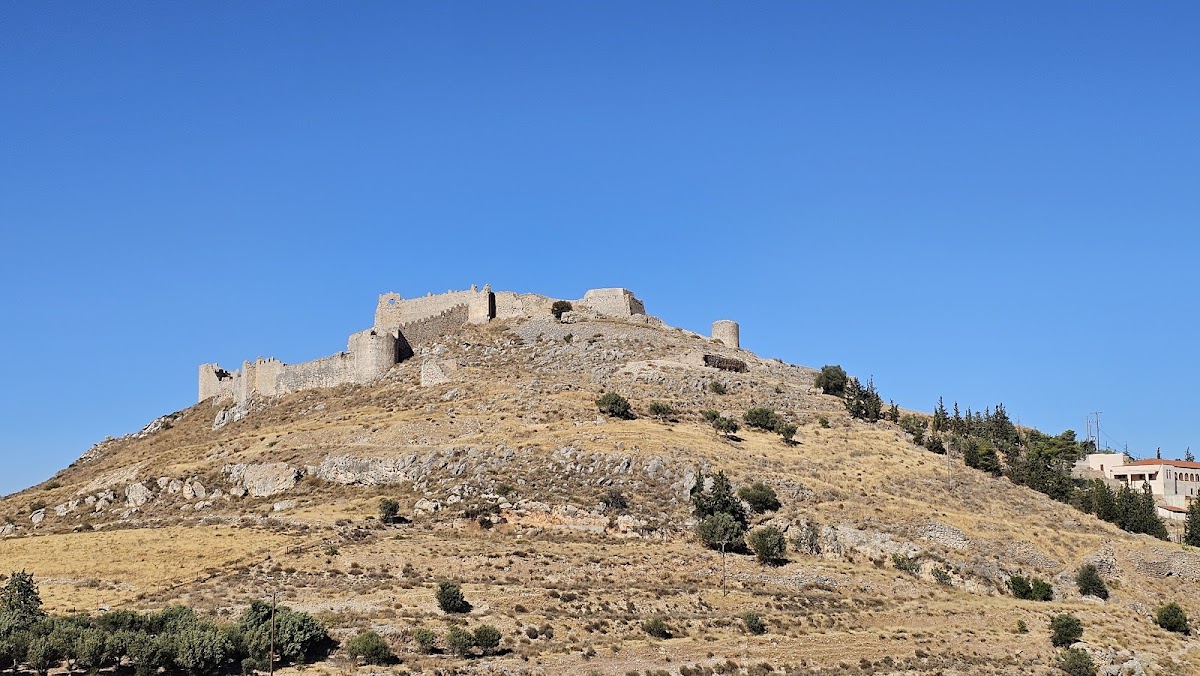
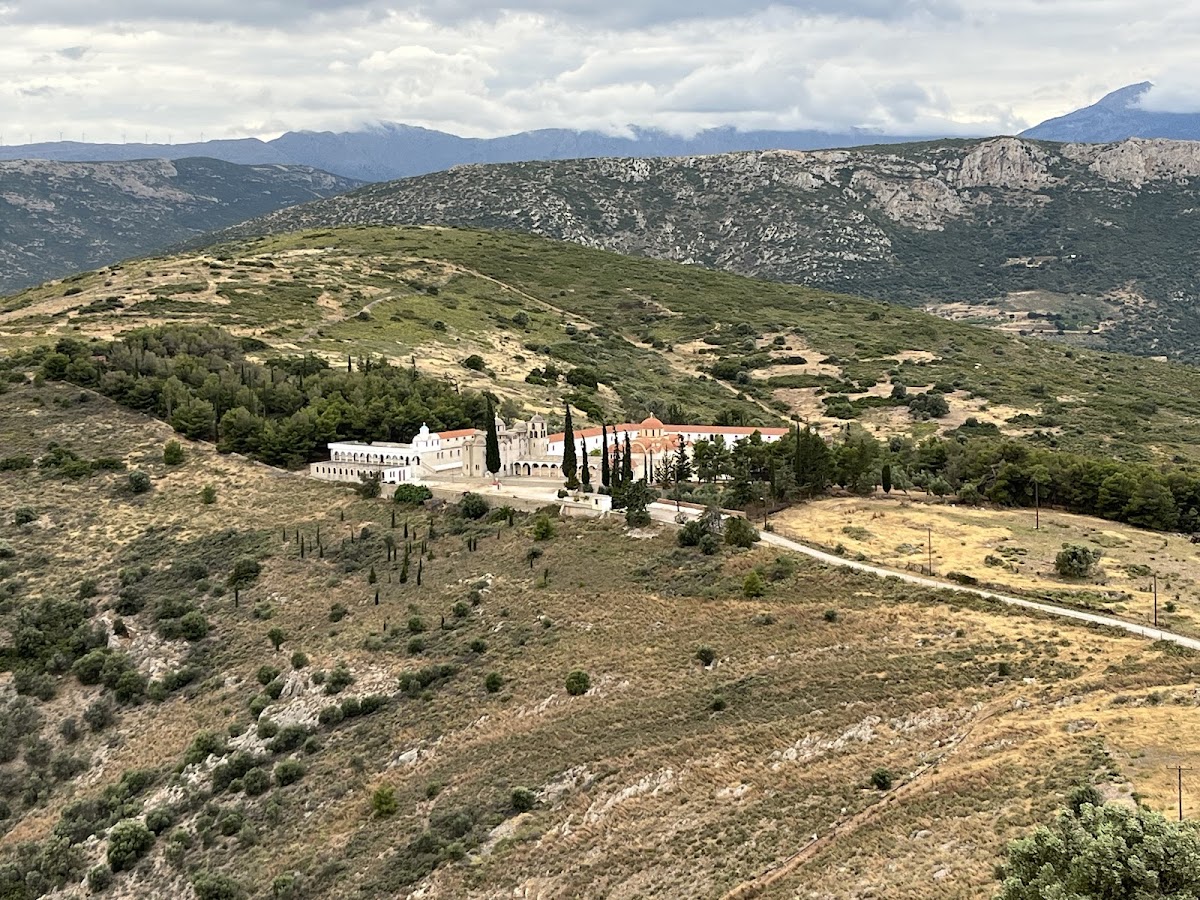
Larissa Fortress occupies a rocky hill approximately 289 metres high. The summit contains the ruins of a Byzantine and Venetian castle, while the Panagia Katakekrymeni-Portokalousa monastery lies about halfway down the slope and the Agia Marina nunnery stands opposite the castle entrance. The surviving construction is predominantly stone, and the ruined complex incorporates Hellenistic, Frankish, Byzantine, Venetian, and Ottoman masonry.
Summit castle
Citadel and perimeter walls
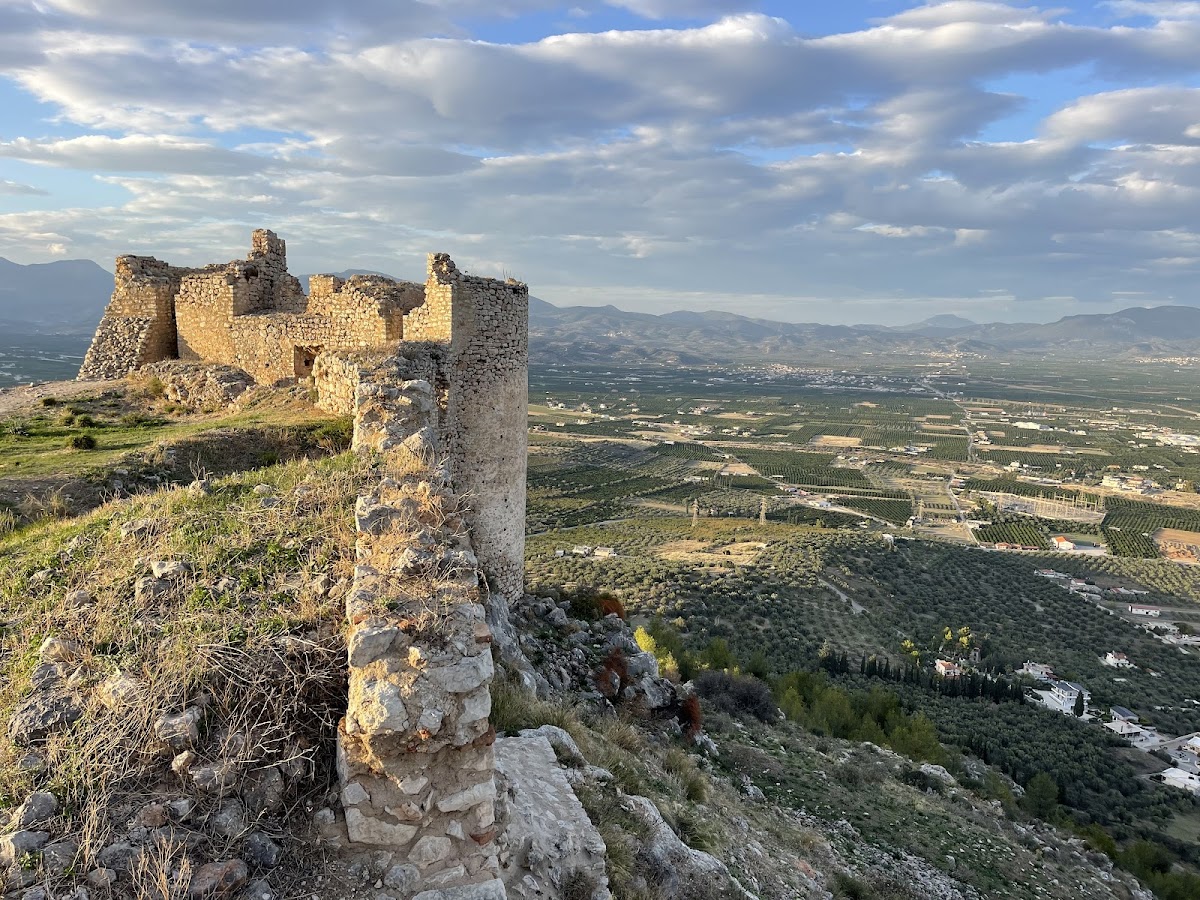
The castle was arranged around a summit citadel enclosed by perimeter walls strengthened with towers. Surviving features include crenellated outer walls and towers with square, circular, triangular, and octagonal forms. A small Byzantine church remains north of the inner fortifications. Sections of Hellenistic and Frankish fortification survive within the later masonry, while a Venetian polygonal bastion stands behind a Turkish circular bastion.
Artillery defenses and inner courtyard
Artillery warfare led to major strengthening in the fifteenth century. Cylindrical bastions containing water cisterns were added, the southern part of the outer castle was divided, the walls were raised, and Byzantine-period gates were blocked. New gates were constructed farther west. In the sixteenth century, another wall was built south of the citadel gate, dividing the castle and forming an inner courtyard. A passage with double gates was placed at the eastern end of this wall.
A central cylindrical tower in the southwest corner of the citadel served as a gunpowder store. An explosion destroyed it around 1700, and a bastion was built on its site. That bastion survives as part of the castle’s later defensive fabric.
Ancient city fortifications
The later ancient walls joined the Larissa and Aspis citadels and continued around their eastern slopes. Their gates connected the fortified city with surrounding routes and sanctuaries. The Deiras Gates opened west toward Mantinea, the Nemean Gate faced the road to Nemea, and the Eileithuian Gate led toward the Heraion of Argos and Epidaurus, the Heraion being a sanctuary dedicated to Hera. The Kylabris Gate stood on the road to Nauplia, while a southern gate led toward Tegea. These walls enclosed the significant parts of Classical Argos and extended no more than about 300 metres east of Larissa before turning north toward Aspis.
Monastic remains
The Panagia Katakekrymeni-Portokalousa monastery occupies the slope roughly halfway between the summit and the modern town. The Agia Marina nunnery stands opposite the castle entrance. A men’s monastery built in the nineteenth century survives as a church, adding a later religious layer to the fortified hill.