Aarwangen Castle: A Historic Fortress in Switzerland


Visitor Information
Google Rating: 4.4
Popularity: Very Low
Google Maps: View on Google Maps
Official Website: schloss-aarwangen.ch
Country: Switzerland
Civilization: Medieval European
Remains: Military

History
Aarwangen Castle stands in Aarwangen, Switzerland, near an important crossing over the Aare River. It was built in the 13th century by the Lords of Aarwangen, who served as ministeriales—unfree knights—under the Kyburg dynasty. The first known lord was Knight Burkart of Aarwangen. The castle’s location secured control of the river crossing and surrounding lands.
Throughout the late 13th and early 14th centuries, the Aarwangen family held the castle and played a significant role in the Oberaargau region and at the Kyburg court in Burgdorf. After Johann von Aarwangen died in 1350, ownership passed to the Grünenberg family, marking a shift in local power.
In 1432, following Bern’s territorial expansion after acquiring Burgdorf in 1384 and conquering Aargau from the Habsburgs in 1415, the city of Bern purchased Aarwangen Castle and its lordship from Wilhelm von Grünenberg. The castle then became the seat of a Bernese bailiwick, an administrative district governed by a bailiff. This role lasted until 1798, with 75 bailiffs residing there over the centuries.
During the 1653 Peasants’ War, the castle served as a horse-changing station for Bernese couriers and functioned as an armory, supporting military communication and defense efforts. After the fall of Bern’s city-state in 1798, the castle was sold to private owners. However, Bern repurchased it in 1805 when Aarwangen regained administrative importance. The castle then housed the chancery, court, and prison for the Bernese administration.
In the 20th and early 21st centuries, judicial reforms led to the consolidation of courts. The Aarwangen court was moved to Burgdorf in 2012, leaving the castle vacant. In 2020, the Stiftung Schloss Aarwangen (Aarwangen Castle Foundation) was established to preserve the site and promote its use as a cultural and public meeting place. Renovations began in 2023, with plans to reopen the castle in 2025 featuring exhibitions, educational programs, and cultural events.
Remains
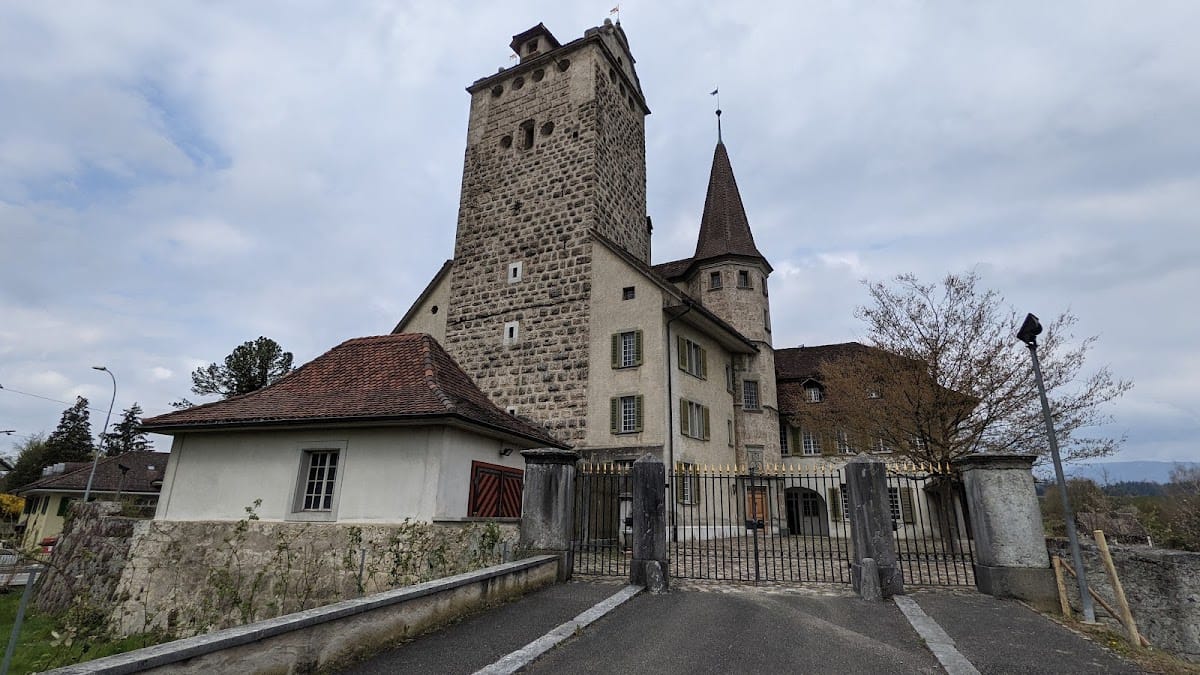
Aarwangen Castle is a large complex centered on a nine-story main tower built in the 13th century. This tower, constructed from finely dressed bossage stone blocks—stones with raised edges and a smooth center—was originally a defensive structure and not intended for living quarters. In 1624, an upper floor and baroque-style volute gables were added, blending later architectural styles with the medieval core.
The castle was originally a water castle, positioned on the south bank of the Aare River near the bridge at Aarwangen. It featured a horseshoe-shaped ring wall and a moat open toward the river. Today, parts of the southern and western ring wall and a corner tower near the bridge remain visible.
Surrounding the main tower on three sides are residential buildings whose medieval cores have been altered multiple times up to the 20th century. A stair tower was added in 1643. Inside, furnishings include elements from the 17th and 18th centuries, reflecting the castle’s long use as a residence and administrative center.
The castle’s defenses included a moat about 15 meters wide, separating the ring wall from the foreland. On the uphill side, a series of large ponds provided additional protection. The main keep had walls up to 2.5 meters thick, emphasizing its role as a stronghold rather than living space.
Originally, the castle was open to the east, where a square tower guarded the entrance. The palas, or main residential building, stood parallel to the river north of the tower, separated by a narrow courtyard that was roofed over in the 18th century.
Today, Aarwangen Castle is well preserved and recognized as a Swiss heritage site of national significance. The former prison cells have been converted into escape rooms, integrating the castle’s historical use with modern cultural activities.
Nearby sites