Aggstein Castle: A Medieval Spur Fortress in Austria


Site at a Glance
- Rating
- 4.7
- Popularity
- Medium
- Country
- Austria
- Primary era
- Medieval
- External website
- Open
- Eras represented
- Medieval, Early Modern
- Civilizations
- Duchy of Austria, Habsburg, Holy Roman Empire
- Site type
- Military
- Remains
- Castle
On this page13 sections
History
Aggstein Castle is a ruined medieval spur castle in Austria, above the right bank of the Danube in the Wachau of Lower Austria. Its origins reach back to the twelfth century, and it was probably built at the beginning of that century by Manegold III of Acchispach, associated with Aggsbach. The castle stands within the municipality of Schönbühel-Aggsbach and developed through repeated periods of conflict, rebuilding, neglect, and preservation.
The Kuenring period
In 1181, Aggstein passed to the Kuenrings, a powerful medieval noble family whose possessions and political conflicts shaped the castle’s early history. During the revolt of Hadmar III and his vassals against Duke Frederick II, the fortress was besieged and captured in 1230–1231. The castle was again attacked after Leutold I of Kuenring-Dürnstein joined the Austrian nobles’ revolt against Duke Albert I. That siege ended with its capture in 1295–1296.
Leutold II was the last Kuenring owner, holding Aggstein from 1348 to 1355. After his period of ownership, the fortress increasingly fell into decay. Its early history later became surrounded by stories of impregnable walls. Hadmar III was said to have considered the castle impossible to capture, although its historical captures appear to have resulted from starvation or other measures rather than a storming assault.
Rebuilding and control of the Danube
In 1429, Duke Albert V removed Aggstein from the Maissau ministerial family, a noble administrative and military lineage serving a ruler, and granted it to his chamberlain Jörg Scheck von Wald. Scheck was required to rebuild the deteriorated fortress in order to secure navigation on the Danube. Between 1429 and 1436, the castle was enlarged and reconstructed with compulsory labor from the surrounding population.
In 1438, Scheck received the right to levy tolls on vessels traveling upstream. The toll was connected with his responsibility for maintaining towpaths, riverside routes used to haul ships against the current. He later became associated with violent river robbery and was reportedly given the nickname “Schreckenwald.” A local legend tells that Hadmar III had once stretched an iron chain across the Danube to seize downstream vessels. In the story, Duke Frederick used a Vienna merchant named Rüdiger to lure Hadmar onto a heavily armed ship disguised as a merchant vessel. Hadmar was captured and the castle taken, with his release supposedly made conditional on returning stolen goods and compensating those who had suffered losses.
Georg von Stain besieged Aggstein in 1463, defeated Scheck von Wald, and took possession of the castle as a pledge for debts owed to him by the duke. Ulrich Baron von Graveneck expelled Stain in 1476 and controlled the fortress until 1477, when he was forced to surrender it. That year, the duke resumed direct control and installed tenants and custodians, bringing the period of raids to an end.
Fire, decline, and changing ownership
During the first Ottoman siege of Vienna in 1529, Ottoman forces burned Aggstein. The fortress was subsequently rebuilt and adapted for artillery defense, with openings through which firearms and artillery could be used while defenders remained protected.
Anna Baroness von Polheim and Parz, widow of the last tenant, acquired the castle in 1606. She renovated the complex and added Renaissance-style chancery buildings to its central section. After her death, Aggstein was neglected. In 1685, it passed together with Schönbühel Castle to Count Konrad Balthasar von Starhemberg. Count Ludwig Josef Gregor von Starhemberg sold the estates to Count Franz von Beroldingen in 1819. They remained with the Beroldingen family until 1930, when the Schönbühel estate, including the ruins of Aggstein, was sold to Count Oswald von Seilern-Aspang. His descendants continue to own it.
Legends and preservation
The best-known story connected with Aggstein concerns Jörg Scheck von Wald and the Rosengärtlein. According to the legend, prisoners were confined on a projecting stone slab and faced starvation or a fatal leap. Two prisoners supposedly escaped by landing in the crowns of nearby trees. The tale also says that the ringing of church bells in the valley drove Scheck mad and contributed to his defeat by Georg von Stain. The stone platform survives, but its historical use for imprisonment remains uncertain.
During a journey through the Wachau, the nineteenth-century Austrian mountaineer Joseph Kyselak is said to have left his signature on the rock at Aggstein. The poet Joseph Victor von Scheffel later wrote the poem Der Aggstein, whose 1917 version refers to Kyselak’s inscription.
The Beroldingen family began the first measures to secure and preserve the ruins, and the work was completed under Oswald von Seilern-Aspang. A major conservation campaign in 2003–2004 repaired defective masonry, installed sewage, water, and other technical systems, altered the entrance area, and redesigned and roofed the Knights’ Hall. These interventions helped maintain the surviving fabric while preserving the complex as a ruin.
Remains
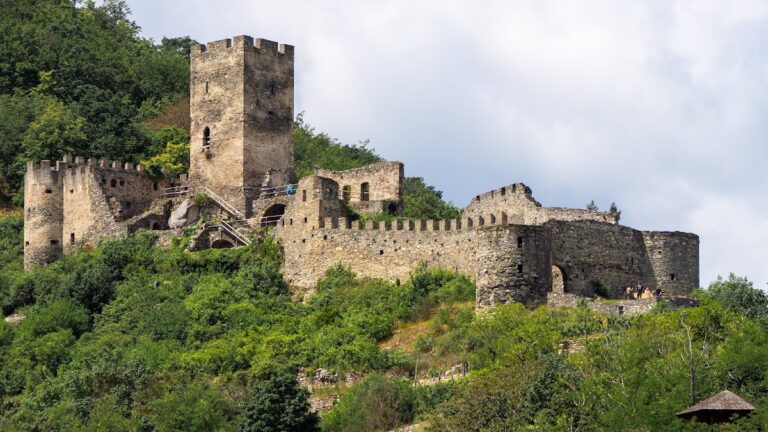
Aggstein occupies an east–west-running rocky spur approximately 300 metres above the right bank of the Danube and about 480 metres above sea level. The ruined high-altitude fortress extends for approximately 150 metres, with a rocky elevation at each end. Most of the surviving fabric belongs to the rebuilding and enlargement of 1429–1436, while foundations on the eastern rock called the Bürgel and the western formation called the Stein belong to the earlier Kuenring phase.
Early foundations and fifteenth-century fortress
Bürgel and Stein
The eastern spur known as the Bürgel and the western rock formation called the Stein retain foundations attributed to the earliest phase of Aggstein. That phase was destroyed at least twice during the period of Kuenring control. These foundations preserve the physical evidence of the fortress before its large-scale fifteenth-century reconstruction.
Frauenturm and residential buildings
The fifteenth-century rebuilding survives in the remains of the three-storey Frauenturm, traditionally called the Women’s Tower, together with the Palas, the principal residential and representational building of a medieval castle. The complex also retains the Gothic castle chapel. The Rosengärtlein, a projecting stone slab beside the castle walls, was established during the same rebuilding phase and functioned as a balcony-like platform.
Later alterations and associated buildings
Artillery defenses and central buildings
After the fire of 1529, Aggstein was rebuilt for artillery defense. The surviving fortifications include loopholes and embrasures, openings in the walls for firearms and artillery. The central section was later altered when Anna von Polheim and Parz added Renaissance-style chancery buildings during her ownership after 1606.
Danube toll house
A toll house built by Jörg Scheck von Wald on the bank of the Danube survives as a building now used as a forester’s house. It remains physically associated with the period when Scheck held the right to collect charges from vessels traveling upstream and was responsible for the towpaths used to move them against the current.
Condition and conservation
Aggstein is now a ruin whose surviving masonry reflects successive construction, fire damage, alteration, and the removal of building materials. After the complex declined, stones and timber elements were taken for reuse in the nearby Servite monastery of Maria Langegg. The Servites are a Roman Catholic religious order. Conservation in 2003–2004 repaired defective masonry, installed water and sewage infrastructure and other technical systems, modified the entrance area, and redesigned and roofed the Knights’ Hall.