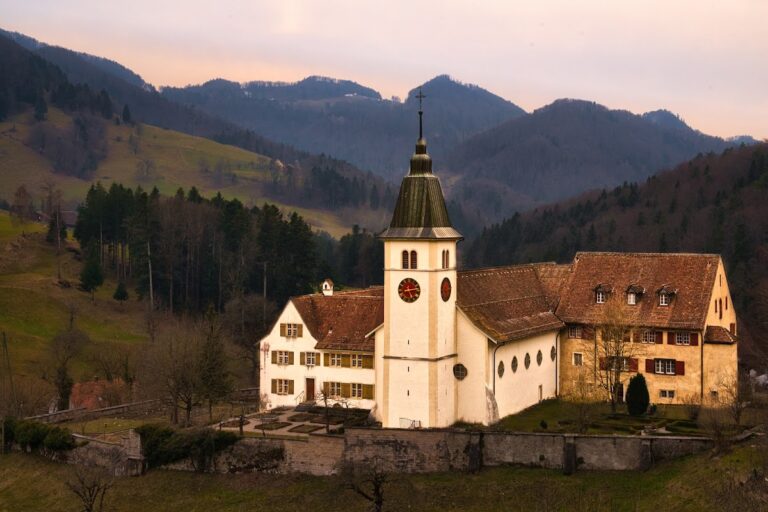
Neu-Falkenstein Castle: A Medieval Hill Castle in Switzerland


Site at a Glance
- Rating
- 4.7
- Popularity
- Low
- Country
- Switzerland
- Primary era
- Medieval
- External website
- Open
- Eras represented
- Medieval, Early Modern
- Civilizations
- Holy Roman Empire
- Site type
- Military
- Remains
- Castle
On this page9 sections
History
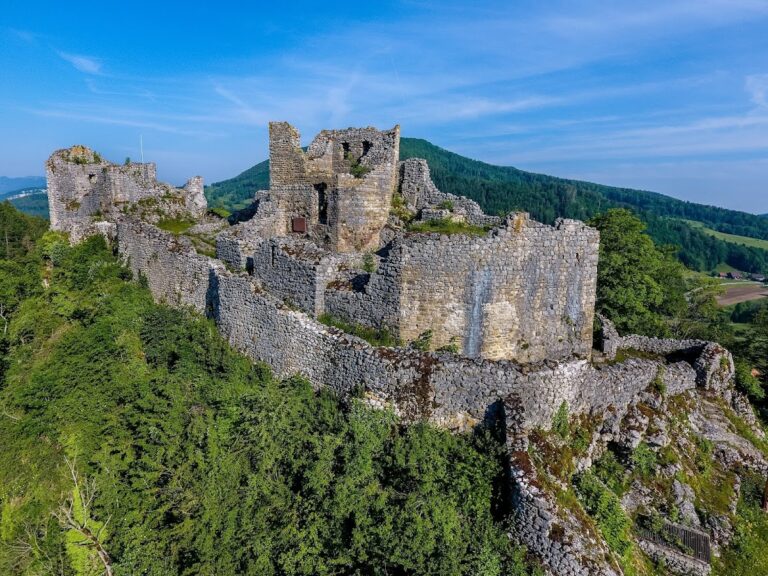
Neu-Falkenstein Castle is a medieval hill castle ruin in Switzerland, in the municipality of Balsthal, probably established around 1100 or in the early twelfth century by a local noble family as the political centre of its lordship. Its foundation remains uncertain, but the castle later became part of a network of fortifications controlling the southern approach to the Upper Hauenstein. Despite its name, Neu-Falkenstein may be older than Alt-Falkenstein, which stands on the opposite side of the valley.
Origins and the Bechburg lords
A disputed document from 1145 mentions the brothers Welf and Ulrich von Falkenstein, although their connection with the family that founded the castle cannot be established with certainty. From the late twelfth century, the Freiherren von Bechburg held Neu-Falkenstein as a fief of the Bishop of Basel. The bishop was a medieval ecclesiastical prince with territorial and feudal authority in the region, while a fief was land or jurisdiction granted by a superior lord in return for loyalty or service.
The Bechburgs retained Neu-Falkenstein separately from their own estates, using a group of surrounding castles to control access through the southern route to the Upper Hauenstein. In the early thirteenth century, a branch of the family settled at Falkenstein and adopted the title Counts of Falkenstein. The castle was then substantially remodelled. A large fortified residential palace was built in the eastern part of the complex, together with a new round defensive keep.
Rudolf von Falkenstein, the son of Rudolf von Bechburg, is the first recorded owner of Neu-Falkenstein. During the second quarter of the thirteenth century, the Counts of Frohburg granted him the Buchsgau region as a fief. Around 1250, Rudolf built Alt-Falkenstein and the fortified outer bailey at the foot of the castle rock. Before 1300, Neu-Falkenstein returned from the Falkenstein branch to the main Bechburg line. Until 1305, part of the castle was also held by Rudolf III von Wart, a relative of the Bechburgs.
Conflict and rebuilding
Rudolf III von Wart became involved in the assassination of King Albrecht I in 1308. Albrecht was a medieval German king, and his murder prompted the pursuit of those connected with it. Rudolf temporarily took refuge at Neu-Falkenstein, then sold his shares in the castle to his cousins Heinrich and Markwart von Bechburg in 1309. He was later captured and executed by breaking on the wheel.
The Basel earthquake of 1356 severely damaged Neu-Falkenstein. The repairs that followed were so extensive that they approached a complete rebuilding and probably helped give the castle its misleading “Neu” designation. Further major work may have been required after damage during the Saffron War, a 1374 conflict caused by Henmann von Bechburg’s seizure of Basel merchants’ saffron after a dispute over unpaid military compensation.
Henmann attacked the merchant convoy near St. Wolfgang after Bishop Johann of Vienne failed to compensate him for military assistance. Forces from Bern, Basel, Neuchâtel-Nidau, Neu-Kyburg, and Thierstein-Farnsburg then besieged Neu-Falkenstein for fourteen weeks. The castle was captured after a determined defence and partly destroyed. The defeated nobles paid a large indemnity, while sixteen mercenaries who had defended the castle were beheaded in the courtyard. The merchants did not recover all of the saffron, since some was distributed among the victors to meet the costs of the war.
Henmann, the last member of the Bechburg line, received 5,800 guilders after making peace with Basel and used the payment to repair the damage. Financial problems later forced him to pledge the castle to Rutschmann von Blauenstein in 1380. Henmann died at the Battle of Sempach in 1386, a major fourteenth-century conflict between the Swiss Confederates and Habsburg forces. Neu-Falkenstein then passed to von Blauenstein.
Transfer to Solothurn and later history
After Henmann’s death, his sister Margarete von Heidegg and the Counts of Thierstein also claimed the lordship. The Thiersteins had succeeded the Counts of Frohburg in the region. Hans von Blauenstein inherited the castle from his father and sold his rights to the city of Solothurn in 1402. Solothurn gained possession in 1417 after paying Margarete von Heidegg 500 guilders, while the Thierstein family abandoned its claims. The Bishop of Basel remained the highest feudal lord until 1669.
Neu-Falkenstein served as the seat of Solothurn’s landvogt, or appointed territorial governor, of the Falkenstein lordship until 1798. Several alterations were made during this administrative period. In July 1798, during the Helvetic Revolution, an upheaval that replaced the old Swiss Confederation with the centralized Helvetic Republic, an enraged rural population led by Johann Brunner, the son of the Rössli innkeeper, set the castle on fire. The ruins were abandoned and gradually decayed.
Conservation began in 1900, when the Tuesday Society of Balsthal initially concentrated on restoring the keep. Clearance work in 1938 and 1939 was carried out improperly, and many archaeological finds were lost. Excavations later identified at least four construction phases. Three datable phases belong to the eleventh and twelfth centuries, the end of the thirteenth century, and around 1640. The site is a Swiss cultural property of national significance.
Remains
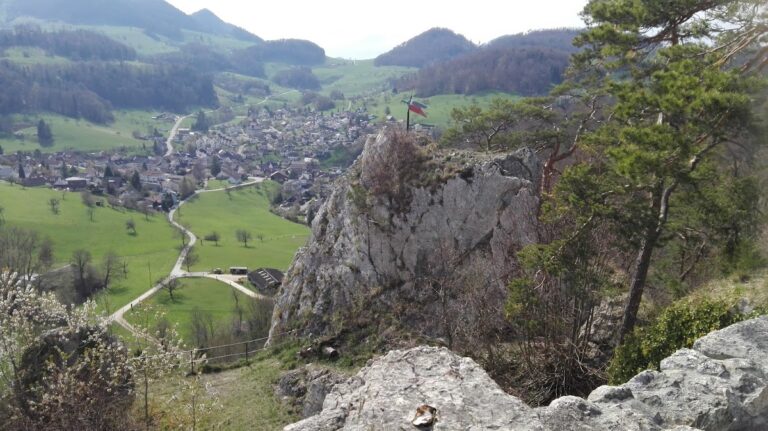
Neu-Falkenstein occupies an eastern mountain ridge north of St. Wolfgang, at the Klus leading toward Mümliswil. The ruin stands at approximately 595 metres above sea level. Its complex is arranged in two core areas, supplemented by an enclosed defensive passage, approach obstacles, a forecourt, and later landscape and artillery features. The two core areas began as separate, self-contained castles and were later joined together.
Core areas
Western tower
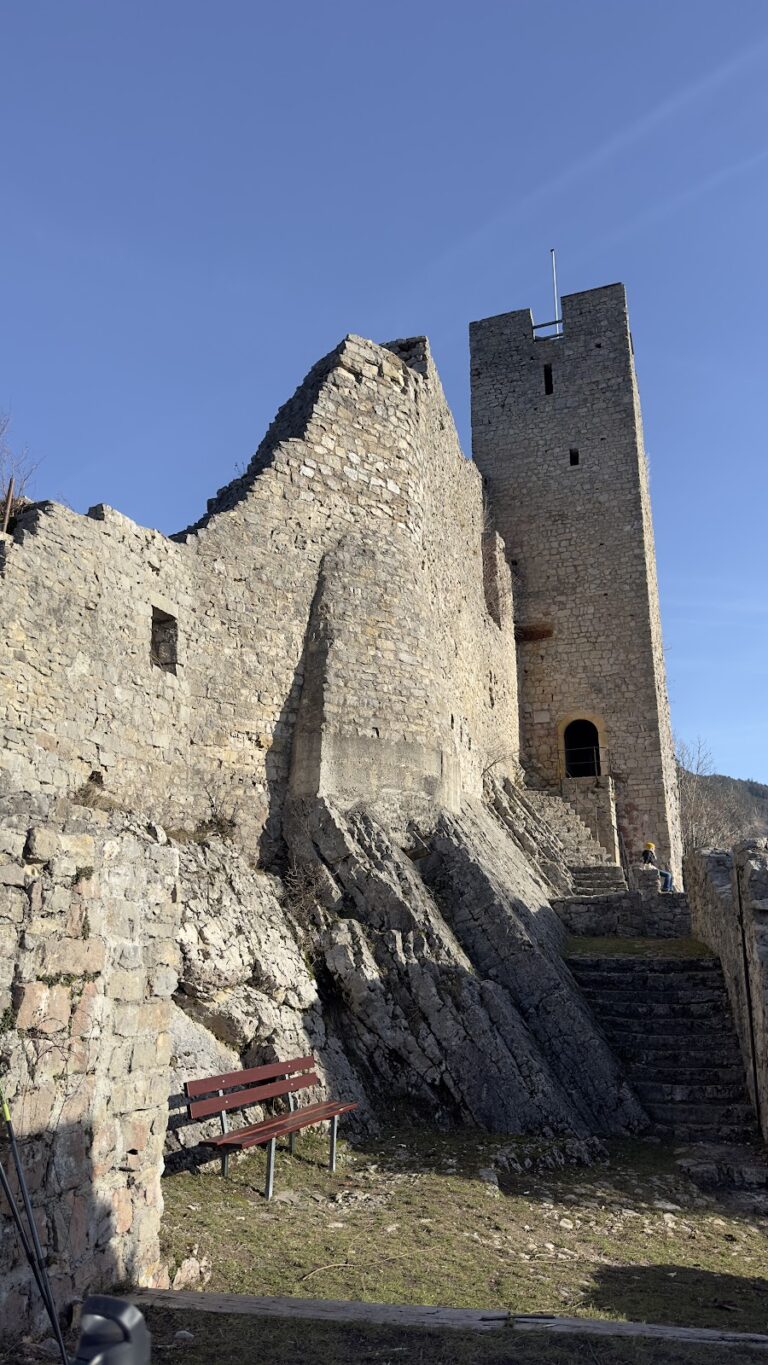
The western core is dominated by a round principal tower, probably the castle’s main defensive keep. The tower has been restored and now serves as an observation tower. Its platform rises 15 metres above the surrounding ground and is reached by 62 steps. The view from this elevated structure extends across Balsthal toward the Holzflue rock and several Jura hills and valleys.
Eastern residential area
The oldest surviving elements include the foundations of a trapezoidal residential wing in the eastern part of the complex. This area also preserves the remains of a chapel and several residential and service buildings. The large fortified residential palace built during the thirteenth-century remodelling formed part of this eastern core, which was later connected with the western castle area.
Defensive and approach features
At an uncertain date, the approach was expanded with a forecourt, gatehouse, and zwinger, a fortified outer passage between defensive lines that exposed attackers to fire from the castle. The complex also contains approach obstacles and garden terraces. Traces of a later artillery bastion survive in the foreground, reflecting a subsequent adaptation of the castle’s defensive setting.