Villa Gordiani: A Roman Villa Complex and Archaeological Park in Rome


Site at a Glance
- Rating
- 4.1
- Popularity
- Medium
- Country
- Italy
- Primary era
- Classical
- Eras represented
- Classical, Medieval
- Civilizations
- Papal States, Roman
- Site type
- Domestic
- Remains
- Villa
On this page15 sections
History
Villa Gordiani is an archaeological park in Italy along the third mile of the Via Prenestina in Rome. Its ancient remains are traditionally identified with a large Roman patrician villa associated with the Gordian imperial family, although the complex may predate the family’s occupation and its precise origins remain uncertain. The Gordians included the third-century Roman emperors Gordian I, Gordian II, and Gordian III.
The Gordian villa
The villa was rebuilt and enlarged repeatedly, and its complete chronology has not been established because a systematic study of the entire complex has never been completed. The Historia Augusta, a late Roman collection of imperial biographies containing historical and anecdotal material about the emperors, describes a portico with 200 columns. It assigns 50 columns each to Carian marble, red porphyry, Phrygian marble, and Numidian marble. The same account mentions three basilicae centenariae, each about 100 Roman feet long, and baths described as among the finest in Rome and without equal in the Empire.
Other parts of the complex belong to later phases between the second and fourth centuries. The monumental entrance was added or developed during works probably carried out between the late third and early fourth centuries, during the reigns of Diocletian and Constantine I, Roman emperors whose rule covered this period. These works introduced further monumental elements to the villa.
Medieval occupation
In the thirteenth century, a medieval tower was built above an ancient octagonal structure. In 1347, troops of the Colonna family camped in the area while traveling from Palestrina toward Rome to fight Cola di Rienzo, a fourteenth-century Roman political leader who briefly established a popular government in the city. The Colonna acquired the property in 1422. In 1571, the tower passed to the family of Vincenzo Rossi dello Schiavo, whose name gave rise to the designation Tor de’ Schiavi.
Archaeological park
The park was established through Rome’s 1931 master plan, formally inaugurated as a park in 1954, and redeveloped during the 1960s. The Via Prenestina divides the archaeological area into two sectors. A small catacomb discovered in 1953 lies in the eastern part of the park, while excavations carried out in the early 1980s examined the fourth-century chronology of the basilica, its possible connection with the mausoleum, and its possible Christian character. Those investigations also brought to light early medieval graves within and around the basilica’s perimeter. The catacomb’s religious affiliation remains uncertain, since it may be pagan or Christian. The park is managed by Rome’s municipal cultural-heritage administration.
Remains
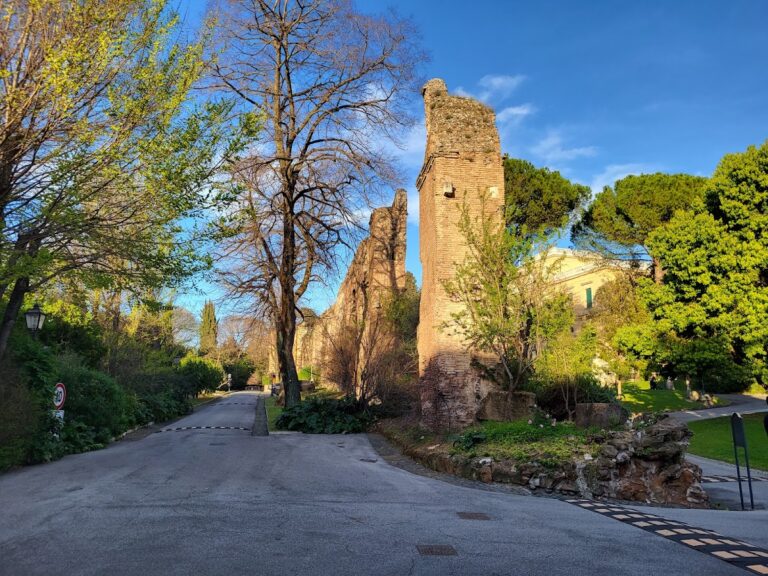
The surviving complex is spread across the two sectors divided by the Via Prenestina. The ancient villa forms the oldest nucleus and is preserved largely below ground. Its remains reflect successive rebuilding and enlargement phases, while the visible monuments include the monumental entrance, water infrastructure, funerary buildings, a basilica, and a small catacomb.
Villa structures and entrance
Buried villa complex
The ancient villa is almost entirely buried for preservation and appears to represent the earliest physical nucleus of the park. Its surviving remains belong to several construction phases, but the chronology of those interventions has not been fully resolved.
Octagonal entrance
The monumental entrance on the Via Prenestina is an octagonal aula, or large formal hall, with round openings that admitted light to the interior. It was probably built in the third century and may have served a thermal purpose. Another interpretation identifies it as a possible original nymphaeum, a monumental fountain or water installation associated with Roman villas and public complexes. Its rounded dome was lightened with amphorae, ceramic vessels incorporated into the construction.
Tor de’ Schiavi
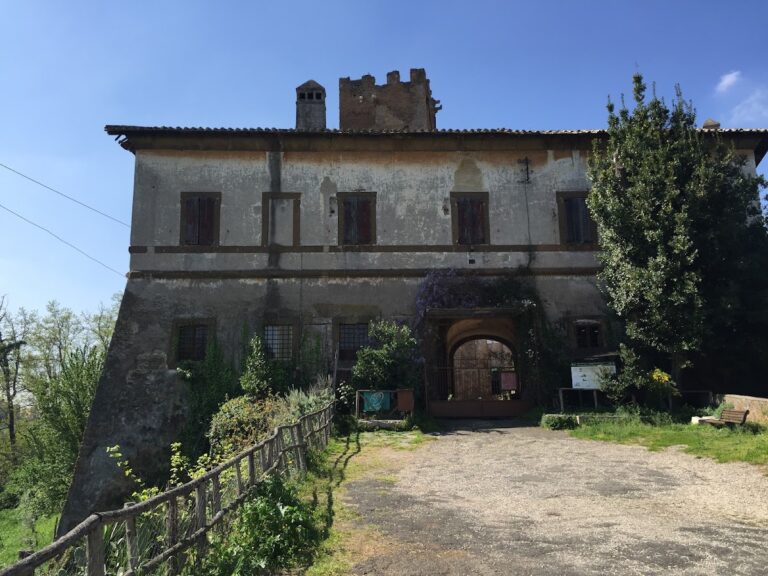
The medieval Tor de’ Schiavi was built above the octagonal structure in the thirteenth century. A large cylindrical pillar supported the tower, and a staircase resting on that pillar led to its upper levels. The building served as a defensive or observation tower. Its name derives from the dello Schiavo family and does not refer to enslaved people.
Cistern
A two-level cistern from the second century contains two reservoirs with vaulted ceilings. It belongs to the later development of the complex and forms part of the water infrastructure associated with the villa.
Columbarium
A columbarium, a funerary building containing niches for cremation urns or other burial remains, stands on the right side of the Via Prenestina at the corner of Via Olevano Romano. It dates from between the first century BC and the first century AD and was discovered in 1958.
Funerary and Christian buildings
Mausoleum
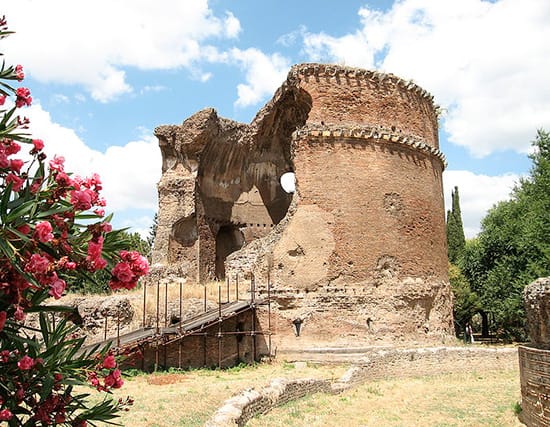
The mausoleum is a circular funerary building of brickwork arranged on two levels. Its upper floor was covered by a vaulted dome and used for funeral ceremonies. The walls originally carried frescoes, most of whose decoration has disappeared. Four circular openings at the base of the dome, called oculi, provided light to the upper level.
The lower floor was a funerary chamber formed by an annular corridor with a barrel vault carried centrally on a substantial pillar. Sarcophagi were placed in niches cut into the walls, while narrow vertical openings near ground level supplied light and ventilation. A portico preceded by a staircase stood on the facade facing the Via Prenestina; both structures collapsed in the mid-eighteenth century.
The mausoleum dates to the age of Diocletian in the fourth century, or possibly to a later period. Imperial stamps impressed on its bricks support the dating, as does comparison with the Mausoleum of Helena on the Via Casilina and the Mausoleum of Costantia on the Via Nomentana.
Early Christian basilica
The remains of an early Christian basilica lie a short distance from the mausoleum. Its plan was circus-shaped, comparable to ambulatory basilicas, which had a passage or circuit around the central sacred area and were often built near the tombs or memorials of martyrs. The surviving fabric includes pillars with arches and a perimeter wall defining a plan about 67 metres long. Early medieval graves were found both within and outside this perimeter.
Catacomb
The small catacomb along Via Rovigno d’Istria is cut into the natural outcrop and has two storeys. It contains burial niches and two arcosolia, recessed tombs covered by arched vaults. Its simple form preserves evidence of underground burial practice, while its pagan or Christian character remains undetermined.
Nearby sites