Catacombs of Vigna Randanini: A Jewish Cemetery of Ancient Rome
Site at a Glance
- Rating
- 4.8
- Popularity
- Very Low
- Country
- Italy
- Primary era
- Classical
- External website
- Open
- Eras represented
- Classical
- Civilizations
- Roman
- Site type
- Burial
- Remains
- Catacomb
On this page13 sections
History
The Catacombs of Vigna Randanini are a Jewish underground cemetery in Rome, Italy, developed by the Jewish community of ancient Rome between the late second and fifth centuries CE. Located between the second and third miles of the Appian Way, near the Christian Catacombs of Saint Sebastian, the cemetery expanded gradually as additional burial space was needed. Its extensive painted decoration and unusually well-preserved remains make it an important source for understanding Jewish symbolism and funerary customs in the ancient Mediterranean.
Discovery and development
The catacombs were discovered accidentally in May 1859. Their name comes from the former owners of the land and its use as a vineyard. By the time of their discovery, evidence of earlier pillaging showed that the burial complex had already lost some of its furnishings. The cemetery’s precise chronology is difficult to establish, but its greatest expansion appears to have taken place during the fourth century.
The complex may first have served a limited group of families before becoming a cemetery for the wider Jewish population of ancient Rome. Its irregular and discontinuous arrangement points to successive expansions and acquisitions rather than a single construction project. This gradual development reflects the changing needs of the community over several centuries.
Community and later history
Funerary inscriptions from Vigna Randanini and Rome’s other Jewish catacombs provide evidence for at least eleven Jewish communities in ancient Rome. Together, they help illuminate the diversity of Jewish life in the city and the ways in which Jewish families and groups marked burial places.
Burial furnishings continued to be removed during antiquity. The galleries were later used as a refuge during the Second World War, a period that caused further disturbance to the underground complex. The catacombs are privately owned and managed as an archaeological site by Rome’s Special Superintendency for Archaeology.
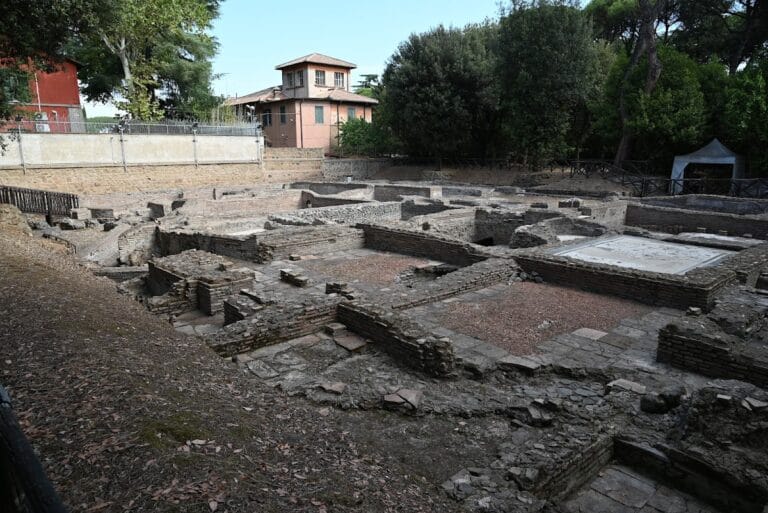
The entrance incorporated an earlier pagan building that may have been adapted for use as a synagogue. Its separation from urban areas, two internal units, apses, a well, and a mosaic floor support this interpretation. The building therefore offers a possible connection between the cemetery and the communal life of Rome’s Jewish population, although its precise function remains uncertain.
Remains
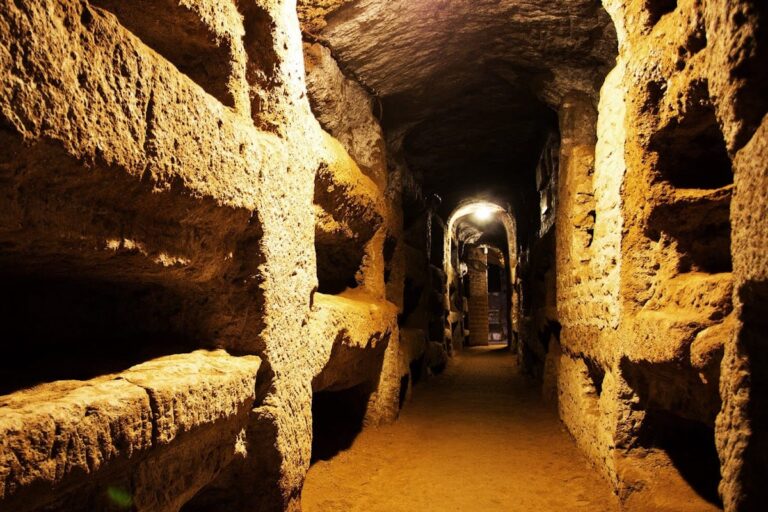
The catacombs occupy about 18,000 square metres on the slope of a hill between the Via Appia Antica and Via Appia Pignatelli. Entrances open toward both roads, and part of the complex lies beneath a private villa. The two-level hypogeum extends from roughly 5 to 16.3 metres below ground, while its galleries and tunnels run for about 700 metres. Approximately 400 metres are currently accessible. Two principal galleries divide into many branches and separate sectors, producing an irregular plan shaped by successive additions.
Burial galleries and chambers
Loculi and family chambers
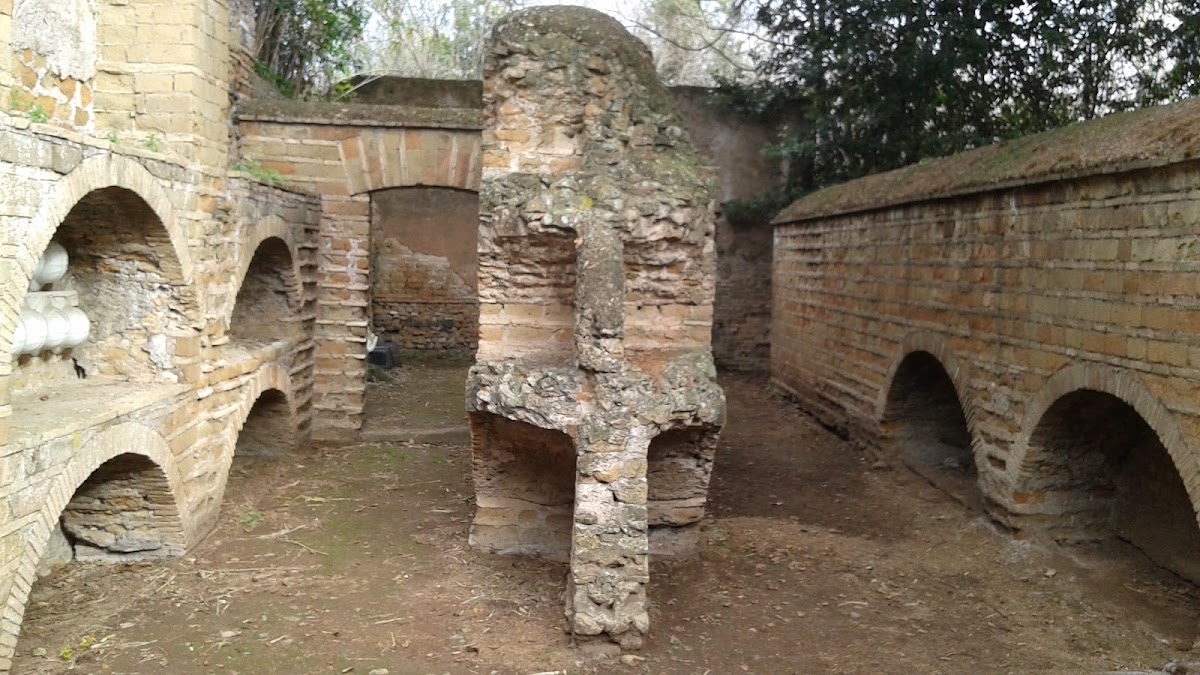
Most burials occupy loculi, small recesses cut into the gallery walls. The cemetery also contains cubicula, burial chambers often used by families, with arcosolia, or arched recesses containing tombs. Other graves were cut directly into the volcanic bedrock. Several chambers probably belonged to individual families, while a group of the oldest graves follows the kokhim type. These shaft-like Jewish burial niches extend perpendicularly from the walls of a gallery and have parallels in Roman Palestine, especially around Jerusalem. A recent count identified 1,737 tombs.
Entrance building
The building at the entrance was altered with an added vaulted roof and a black-and-white floor made from small stone or glass cubes, known as tesserae. A well received water from the exterior mosaic. Together with the building’s two internal units and apses, these features have contributed to the interpretation that it may have served a communal religious purpose before or during its association with the catacomb.
Painted burial chambers
Menorah Cubiculum
The Menorah Cubiculum lies beside the main gallery and dates to the late third century. Its decoration includes the menorah, the seven-branched Jewish ritual lampstand. The painted symbol identifies a Jewish element within the cemetery’s visual program and connects the chamber with wider traditions of Jewish funerary imagery.
Palm Cubiculum
The Palm Cubiculum takes its name from date palms painted at its four corners. The palm was associated with the Jewish Diaspora, the worldwide dispersion of Jewish communities. Loculi were later cut into the chamber walls, partly destroying an elaborate painted scheme dated from the late third to the early fourth century.
Pegasus Cubiculum
The Pegasus Cubiculum was probably a pagan underground burial chamber that was later incorporated into the Jewish necropolis. Its wall paintings use cinnabar red, green, and brown. At the centre of the vault, Nike, the ancient Greek personification of victory, holds a palm branch in her left hand and offers a laurel wreath to a young man with her right hand. The combination of pagan imagery with the chamber’s later place within the Jewish cemetery reflects the varied visual traditions present at Vigna Randanini.
Other painted chambers
Additional paintings show peacocks, birds, baskets of flowers, Pegasus, roosters, chickens, and other birds. One composition includes Fortuna, the Roman goddess associated with fortune and fate, together with a hippocampus, a mythological creature with a horse’s forepart and a fish’s tail, and two dolphins. Other painted chambers contain Jewish symbols, including the menorah. At the final part of the route, a pagan burial chamber is entirely covered with fantastic figures, animals, and floral designs.
Inscriptions and funerary evidence
The catacomb contains 195 identified inscriptions in Greek and Latin. Some were engraved on marble slabs, while others were painted or scratched into plaster. Their lettering is often irregular and includes spelling and grammatical errors. Many inscriptions were fragmentary or had been displaced into fill when the catacombs were discovered, showing that the original collection was larger.
Greek predominates among the surviving funerary texts. About 64.7 percent are in Koine Greek, 23.5 percent in vulgar Latin, and 11.8 percent in both languages. This distribution has been interpreted as evidence of a substantial immigrant population within the cemetery’s community. The inscriptions, painted chambers, burial forms, and Jewish symbols together make Vigna Randanini an important source for the study of ancient Jewish identity and funerary practice in Rome.