Circus of Maxentius: An Imperial Chariot-Racing Complex on the Via Appia


Site at a Glance
- Rating
- 4.6
- Popularity
- Low
- Country
- Italy
- Primary era
- Classical
- External website
- Open
- Eras represented
- Classical
- Civilizations
- Roman
- Site type
- Entertainment
- Remains
- Circus
On this page14 sections
History
Construction under Maxentius
The Circus of Maxentius is a Roman chariot-racing venue in Italy, located on the Via Appia in Rome. Emperor Maxentius built it between AD 306 and 312 during Late Antiquity, the later period of the Roman Empire, as part of a large imperial and commemorative complex. The complex included the circus, Maxentius’ villa, an audience hall, and family mausoleums.
This arrangement represented an imperial version of elite residences that became prominent in Rome and the provinces during Late Antiquity. These residences combined large halls for receiving audiences, monumental family tombs, and structures shaped around circus layouts. The complex on the Via Appia can be compared with the Villa Gordiani in Rome and the complex at Piazza Armerina in Sicily. Its imperial parallels included the contemporary complex of Galerius at Thessaloniki and Diocletian’s Palace at Split, while the Palatine complex in Rome provided an earlier model. Maxentius also altered the Palatine palace.
Funerary transformation
The circus appears to have been used only for its inaugural games, which probably had a funerary purpose. They were likely held in honour of Valerius Romulus, Maxentius’ son, who died at a very young age in AD 309 and was probably buried in the adjacent Tomb of Romulus. Romulus was deified after his death, meaning that he was elevated to divine status.
The death of Romulus may have changed the purpose and character of the whole complex. The mausoleum, probably first intended for Maxentius himself, became the burial place of his only son. The inaugural games took on the character of funeral games, and both the games and the circus were dedicated to the deified Romulus. The emphasis on death and apotheosis, or the elevation of a deceased ruler or imperial family member to divine status, has led to the interpretation that the complex became overwhelmingly funerary after Romulus’ death. Its memorial references may also have extended symbolically toward the centre of Rome.
Defeat, abandonment, and identification
Maxentius was defeated by Constantine the Great at the Battle of the Milvian Bridge in AD 312. This battle brought Maxentius’ rule to an end, and he died during the conflict. Constantine subsequently expropriated Maxentius’ property, and the complex was probably no longer used. Archaeological excavation indicates that the circus tracks had already been covered with sand in antiquity, supporting the view that the site was abandoned after Maxentius’ death.
Until the nineteenth century, the monument was known as the Circus of Caracalla. During the nineteenth-century excavation of the track, Antonio Nibby uncovered an inscription dedicated to the “divine Romulus.” The inscription made it possible to identify the structure securely as the circus associated with Maxentius rather than the previously assumed Circus of Caracalla.
The complex lies between the second and third milestones of the Via Appia, between the basilica and catacombs of San Sebastiano and the late Republican Tomb of Caecilia Metella. It forms part of the Appian Way Regional Park and is under the care of the Archaeological Superintendence of Rome.
Remains
The circus and its racing structures
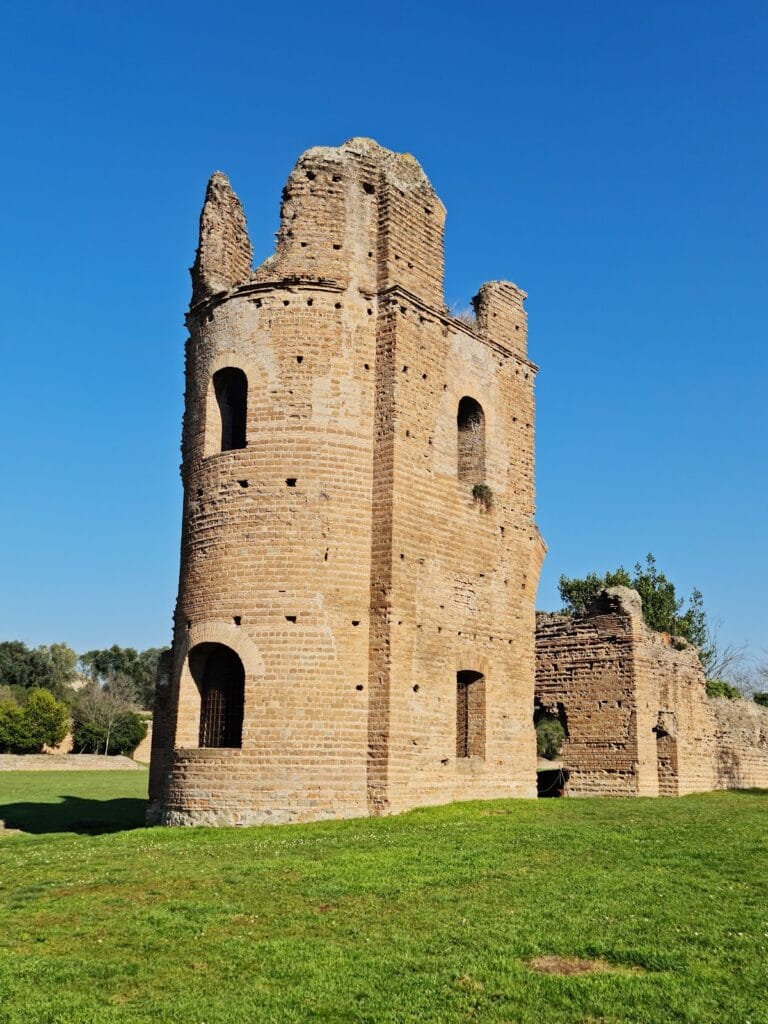
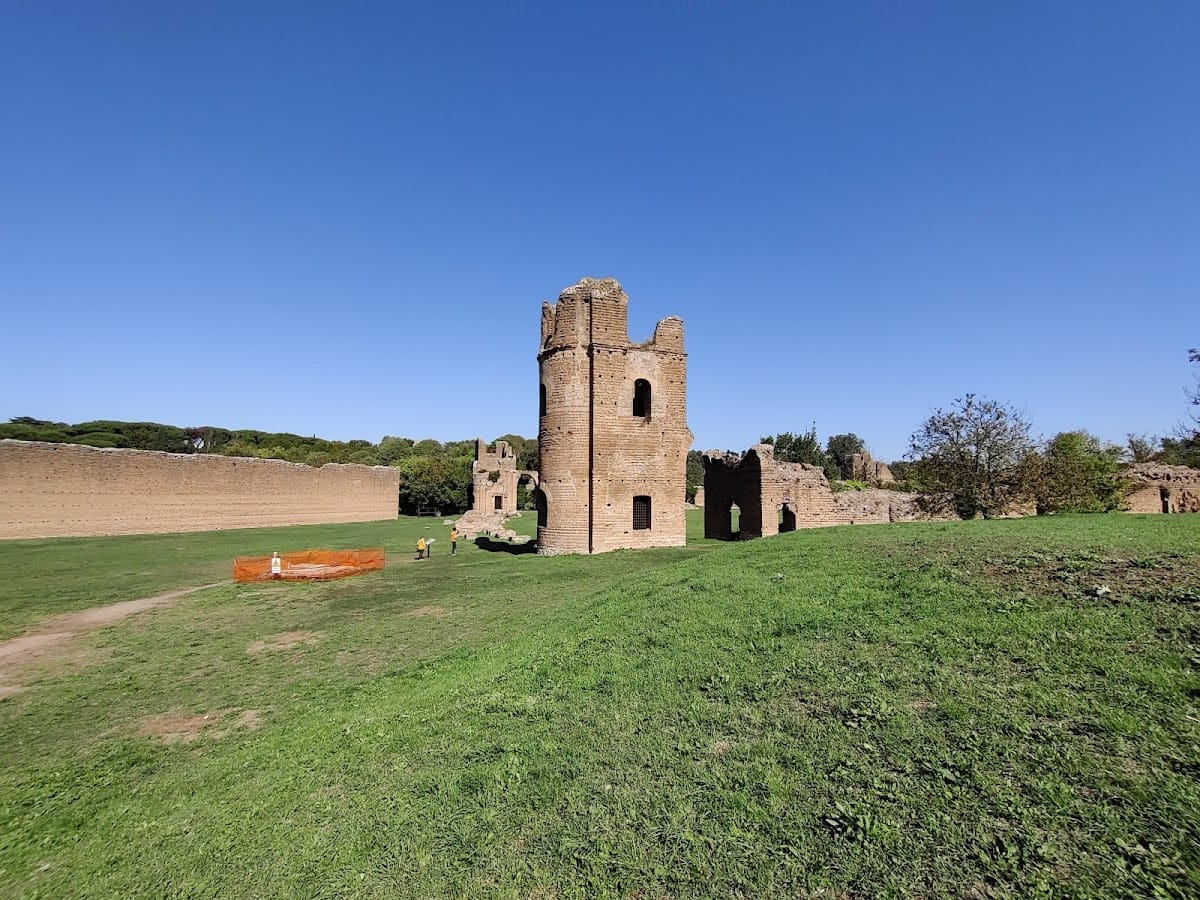
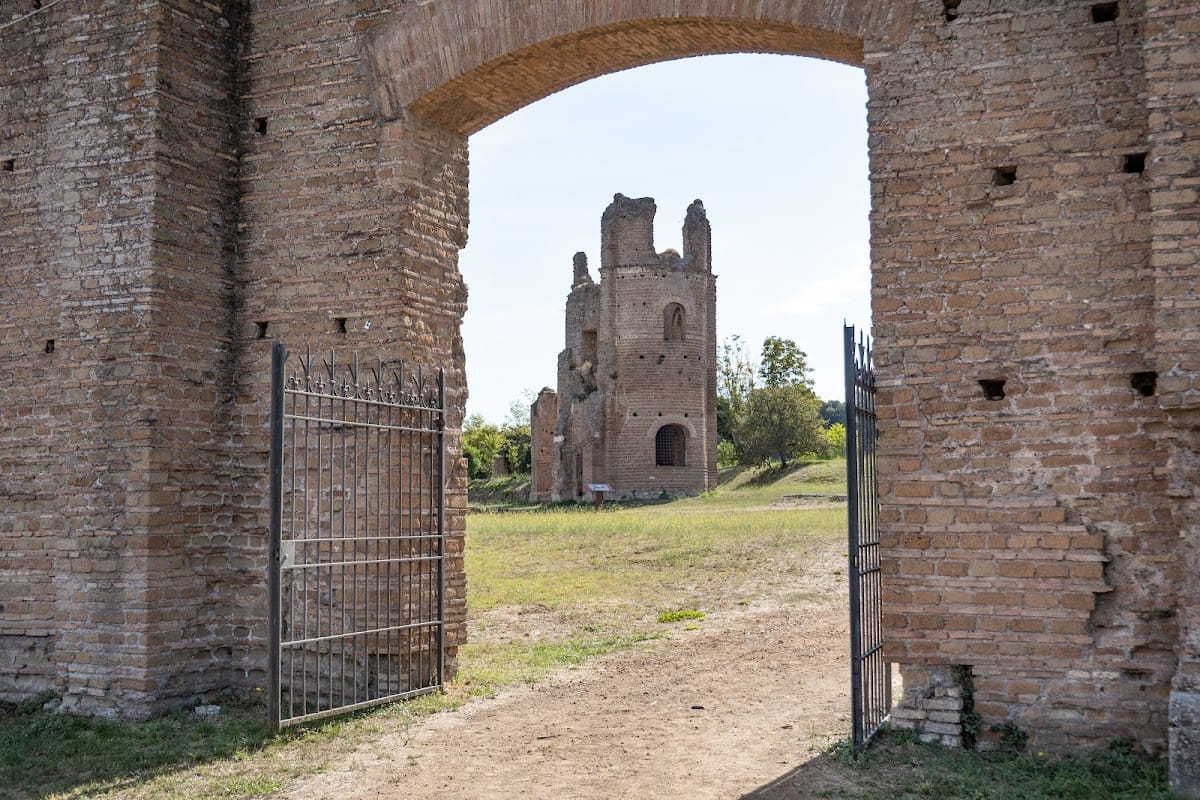
The Circus of Maxentius is the best-preserved circus in the Rome area and is second in size only to the Circus Maximus, Rome’s principal and largest ancient chariot-racing venue. The structure was built with a concrete core faced in opus vittatum, a Roman technique using horizontal courses of small stone blocks and bricks. Numerous putlog holes, openings left for scaffolding during construction, remain visible in the walls, which reach several metres in height in places.
Starting towers and gates
Two large towers survive at the western end of the circus. They probably housed the mechanisms used to raise the starting gates, known as carceres. These gates were arranged along a curved course between the towers, forming the starting area for the races.
Track and central barrier
The racing track measures 503 metres in length, and its remains are still visible. Its outer walls were wider near the starting area, where charioteers could spread out before reaching the central barrier. They widened again at the turning point to accommodate the circle followed by the chariots as they turned.
The central barrier, or spina, ran lengthwise through the track for exactly 1,000 Roman feet, equivalent to 296 metres. It was probably faced with marble and carried numerous ornaments, including cones, turning markers called metae, and obelisks. At its centre stood the Obelisk of Domitian, which Maxentius presumably transferred from the Isaeum, a temple dedicated to Isis, as part of the commemoration of Romulus.
Obelisk of Domitian
The obelisk was covered with hieroglyphs and had broken into five pieces. Its fragments attracted considerable attention during the Renaissance and were engraved by Étienne du Pérac and others. In the 1630s, the Collector Earl of Arundel paid a deposit for the pieces and attempted to transport them to London. Pope Urban VIII prohibited their export. His successor, Innocent X, ordered the fragments to be reassembled and erected in Piazza Navona by Bernini.
Triumphal arch and judges’ box
A small triumphal arch survives at the eastern end of the track, where the exposed opus vittatum remains visible. On the southern side, about two-thirds of the way along the circuit, stood the judges’ box. Its position provided a clear view of the finishing line.
Imperial and funerary buildings
Imperial box and villa
The identifiable remains of the imperial box occupied a position intended to provide dramatic views of the races. In Roman circuses, this viewing seat was called a pulvinar. A covered portico connected the box to Maxentius’ villa. Only scant remains of the villa are visible because of dense foliage, although the apse, or curved end, of the basilical audience hall rises above the tree canopy.
View toward the Tomb of Caecilia Metella
Directly opposite the imperial box, a small arch in the southern wall of the track provides a view of the Tomb of Caecilia Metella. The tomb would have been fully visible from the imperial box. The circus may therefore have been deliberately skewed so that the existing late Republican tomb could be incorporated into Maxentius’ architectural scheme.
Tomb of Romulus
The adjacent Tomb of Romulus is a cylindrical mausoleum, or monumental tomb, probably associated with the burial of Valerius Romulus. Its position alongside the circus reflects the relationship between the racing venue, the imperial residence, and the family burial places that formed Maxentius’ complex on the Via Appia.