Olbia Archaeological Site: A Greek and Roman Port near Hyères, France

Archaeological Site of Olbia - Town of Hyères

Visitor Information

Google Rating: 4.3

Popularity: Low

Official Website: hyeres.fr

Country: France

Civilization: Greek, Roman

Site type: Burial, City, Civic, Domestic, Economic, Entertainment, Infrastructure, Military, Religious, Sanitation

Context

The Archaeological Site of Olbia is situated near the contemporary town of Hyères in southeastern France, along the Mediterranean coastline. It occupies a coastal plain adjacent to the Rte de l’Almanarre, characterized by sandy beaches and proximity to the Giens Peninsula, a natural landform that provided sheltered maritime access. The surrounding landscape includes wetlands and salt marshes, which influenced settlement patterns and economic activities such as fishing and salt extraction. Olbia’s location at the interface of land and sea made it a strategic point for maritime navigation and trade in antiquity.

Established during the Greek colonization of the western Mediterranean in the 4th century BCE, Olbia initially functioned as a fortified trading post. The site later came under Roman control, maintaining occupation into the early Imperial period. Archaeological evidence indicates a gradual decline in urban activity from the late Roman era, culminating in abandonment by the early medieval period.

Systematic archaeological investigations, initiated in the 20th century, have focused on mapping the urban layout and recovering artifacts. Conservation efforts address threats from coastal erosion and modern development, aiming to preserve the site’s integrity. Ongoing research continues to refine understanding of Olbia’s role within the broader historical and geographic framework of southeastern Gaul.

History

The Archaeological Site of Olbia near Hyères represents a significant example of Greek colonial expansion in the western Mediterranean during the 4th century BCE. Founded by settlers from Massalia (modern Marseille), Olbia served as a fortified maritime outpost and relay station along key trade routes connecting Italy and the Iberian Peninsula. Over subsequent centuries, the site underwent Roman conquest and integration, evolving into a modest urban center with public infrastructure and defensive works. Its prominence diminished from the late Roman period onward, as neighboring ports such as Toulon gained regional importance. By the early medieval era, Olbia was largely abandoned as a residential settlement, though religious institutions later reutilized parts of the site. Archaeological and epigraphic data situate Olbia within the shifting political, economic, and religious landscape of southeastern Gaul from Classical antiquity through the early Middle Ages.

Greek Colonization (4th century BCE)

In the 4th century BCE, Greek colonists originating from Massalia established Olbia on the western arm of the Giens tombolo near present-day Hyères. The settlement was strategically positioned to function as a fortified port safeguarding Massaliote maritime commerce across the western Mediterranean basin. The site’s natural defenses included the hills of Costebelle and Mont des Oiseaux, as well as the protective landform of the Giens peninsula, which created multiple sheltered anchorages. The urban plan adhered to a regular grid, forming a square approximately 165 meters on each side, subdivided into 40 rectangular habitation blocks (îles) separated by narrow streets about 2.2 meters wide. Each block was further divided into three family-sized lots of roughly 120 square meters, reflecting an organized colonial land distribution system.

The initial population is estimated at around 700 inhabitants, comprising soldiers-colonists, fishermen, and farmers. Olbia’s primary function was military and commercial, serving as a port-fortress that provided shelter and logistical support for Massaliote vessels engaged in trade between Italy and Spain. Religious life centered on sanctuaries such as the “Grand Sanctuary of the West,” likely dedicated to Artemis, and another sanctuary devoted to Aphrodite near the northern rampart. Epigraphic evidence attests to the veneration of an anonymous “Hero” and “Mother Goddesses,” fertility symbols integral to local cult practices. A sculpted phallus, probably adorning the city gate as a protective emblem, was recovered reused in later constructions. The city lacked a formal agora; however, a central public well square may have functioned as a communal gathering space.

Roman Conquest and Administration (1st century BCE – 3rd century CE)

Following Julius Caesar’s capture of Massalia in 49 BCE, Roman authority extended over Olbia and its environs, resulting in administrative separation from its Greek mother city. Under Roman rule, Olbia underwent urban modernization, including the construction or significant enhancement of a port facility that remained operational for several centuries. Archaeological remains from this period include residential houses, commercial shops, public baths, paved streets with drainage systems, and fortified walls incorporating reused Greek masonry. A Roman thermal complex near the waterfront attests to the presence of leisure and hygiene amenities within the urban fabric.

The settlement expanded beyond its original Greek boundaries, with evidence of artisanal production such as oil and wine pressing located outside the city walls. Literary sources from the Roman era, including Pomponius Mela and the Itinerary of Antoninus, reference Olbia or its vicinia Pomponiana, situating it geographically between Athenopolis and Tauroentum. A 3rd-century Latin inscription found on a statue fragment honors the “Genius of the Castellum of the Olbians,” dedicated by Lucius Rupilius Iacchus and his family, indicating the presence of local elite participation in civic cults. Despite these developments, Olbia’s port gradually lost prominence to the nearby harbor of Toulon, which emerged as a regional economic and ecclesiastical center.

Late Antiquity and Early Medieval Period (3rd – 7th centuries CE)

From the late 2nd century CE onward, Olbia experienced a marked decline in urban vitality, as evidenced by the abandonment of several quarters and storage facilities. The ascendancy of Toulon as an episcopal see in the early 5th century further diminished Olbia’s administrative and religious significance, incorporating its territory into the Toulon diocese. Archaeological data reveal a reorganization of the urban space during the 5th century, with formerly dense residential blocks replaced by open areas used for gardens or artisanal activities. The population contracted, and social structures became less formalized.

By the early 7th century, the settlement was largely deserted, likely due to environmental factors such as port submersion caused by rising sea levels and increased coastal insecurity during the Merovingian period under King Gontran I. The inhabitants appear to have relocated to higher ground for safety. This decline corresponds with broader demographic contractions and settlement restructuring across the Var region during Late Antiquity, reflecting shifting political, economic, and environmental conditions.

Medieval Period (11th – 15th centuries CE)

Between the 11th and 15th centuries, the site of Olbia was repurposed for religious functions with the establishment of a priory and subsequently an abbey on the ancient ruins. These ecclesiastical institutions persisted until the late medieval period, leaving extant architectural remains. Excavations of the abbey’s cemetery uncovered cremation tombs predominantly dating to the 1st and 2nd centuries CE, demonstrating continuity in funerary practices from the Roman period. The cemetery’s location outside the ancient city walls aligns with Roman and early medieval burial customs. Although the urban settlement had vanished, the site maintained a sacred function through these religious foundations, reflecting the persistence of spiritual significance despite demographic and structural decline.

Archaeological Discoveries and Modern Research (19th century – Present)

Olbia has been known to scholars since the 19th century, with initial surveys conducted during the Second Empire. Systematic archaeological excavations in the mid-20th century, notably under Jacques Coupry, mapped the city’s Greek urban plan and fortifications, identifying 40 habitation blocks and the defensive enclosure. Subsequent campaigns led by Michel Bats in the 1980s and early 2000s focused on detailed study of residential blocks and the Roman thermal complex. More recent preventive excavations have uncovered new funerary contexts and evidence of artisanal activities beyond the city limits.

The discovery in 1909 of a 3rd-century Latin inscription on a statue fragment confirmed the site’s identification as Olbia. Conservation efforts address threats from coastal erosion and urban encroachment, including stabilization of ancient walls and the development of visitor facilities. An underwater archaeological trail has been established to document the submerged remains of the ancient port, providing a unique resource for maritime archaeological study. Ongoing research continues to refine understanding of Olbia’s historical trajectory and cultural heritage within the Mediterranean context.

Daily Life and Importance by Period

Greek Colonization (4th century BCE)

During its foundation around 325 BCE, Olbia’s population consisted primarily of soldiers-colonists, fishermen, and farmers, estimated at approximately 700 individuals. The social organization was based on family units occupying standardized housing lots within a rigorously planned grid, reflecting the structured nature of Massaliote colonial governance. Men were engaged in military defense, fishing, and agricultural activities, while women managed domestic responsibilities and participated in religious rites. The community’s religious practices centered on deities such as Artemis and Aphrodite, with sanctuaries serving as focal points for fertility and protective cults integrated into daily life.

Economically, Olbia functioned as a fortified maritime relay supporting Massaliote trade between Italy and the Iberian Peninsula. Residents exploited the fertile surrounding lands for small-scale farming and the rich coastal waters for fishing. The presence of a central well square suggests a communal gathering place for water collection and social interaction. Domestic interiors were modest, likely featuring simple furnishings, functional layouts with courtyards, and storage spaces. Clothing consisted of typical Greek garments such as tunics and cloaks, adapted to the Mediterranean climate and maritime activities. Trade goods included locally produced fish, grain, and possibly olive oil, while imports arrived via established sea routes. Religious festivals and communal gatherings punctuated the social calendar, although no formal agora existed; the well square may have served as a civic meeting place. Olbia’s role was primarily military and commercial, acting as a strategic port-fortress within the Massaliote colonial network rather than a fully developed polis with extensive civic institutions.

Roman Conquest and Administration (1st century BCE – 3rd century CE)

Following Roman annexation after 49 BCE, Olbia’s population diversified to include Roman settlers alongside the original Greek inhabitants, as indicated by Latin inscriptions referencing local elites such as Lucius Rupilius Iacchus. The social hierarchy incorporated civic officials involved in cultic and administrative functions, though the settlement remained modest in scale. Family structures persisted, with evidence of expanded urban housing beyond the Greek grid, reflecting gradual Romanization. Gender roles adapted to Roman customs, with men participating in artisanal production, trade, and local governance, while women maintained domestic and religious duties.

Economic life intensified with the construction of a Roman port and thermal baths, indicating increased leisure and urban amenities. Artisanal activities such as oil and wine pressing occurred outside city walls, pointing to household and workshop-scale production supporting local consumption and export. Archaeological remains of shops, baths, and paved streets with drainage systems reveal a well-organized urban environment. Diet included bread, olives, fish, and wine, consistent with Mediterranean staples. Domestic spaces featured mosaic floors and painted walls, enhancing interior comfort and status display. Markets likely offered a range of goods imported via Mediterranean trade routes, including ceramics and luxury items. Transportation combined maritime shipping with local road networks connecting Olbia to neighboring settlements. Religious life integrated Roman and Greek traditions, with sanctuaries maintained and new cults introduced, as attested by inscriptions. Olbia functioned as a municipium-level settlement with fortifications and civic cults, serving as a regional relay port before its decline in prominence due to competition from Toulon.

Late Antiquity and Early Medieval Period (3rd – 7th centuries CE)

From the late 2nd century CE, Olbia’s population diminished, with abandonment of urban quarters and a shift toward more dispersed habitation patterns. Social organization became less formalized, with fewer public buildings and a transition from dense residential blocks to gardens and artisanal zones. The community likely consisted of a reduced number of families adapting to economic contraction and environmental challenges. Gender roles remained traditional but were influenced by broader Late Antique transformations, including the rise of Christianity.

Economic activities contracted, focusing on subsistence agriculture, small-scale crafts, and limited maritime trade as the port suffered from silting and submersion. Archaeological evidence of restructured urban space and fewer monumental constructions reflects this decline. Diet remained Mediterranean but with reduced variety due to economic hardship. Domestic decoration and public amenities deteriorated, with many buildings falling into disuse. Religious practices shifted as Olbia lost its episcopal status to Toulon, with Christian worship likely replacing earlier pagan cults. The site’s sacred function persisted in a diminished form, but educational or cultural institutions are not attested. Transportation and trade routes increasingly favored neighboring centers. Olbia’s role evolved from a municipium to a marginal settlement, eventually abandoned by the early 7th century due to environmental and political instability during the Merovingian period.

Medieval Period (11th – 15th centuries CE)

After centuries of abandonment, the site was reoccupied primarily for religious purposes with the establishment of a priory and later an abbey. The population consisted mainly of clerics and monastic communities, with social life centered on ecclesiastical functions. Family structures were replaced by monastic orders governed by abbots and priors. Gender roles were defined by religious vocation, with men serving as monks and priests.

Archaeological Discoveries and Modern Research (19th century – Present)

Modern archaeological efforts have revealed extensive details about Olbia’s daily life and importance across its history. Excavations have documented the urban grid, domestic architecture, artisanal zones, and religious sanctuaries, enabling reconstruction of social and economic patterns. Conservation and research have clarified Olbia’s role as a Greek colonial port evolving into a Roman municipium and later a declining settlement with medieval religious reuse. These findings contribute to understanding regional settlement dynamics along the Mediterranean coast of southeastern Gaul.

Remains

Architectural Features

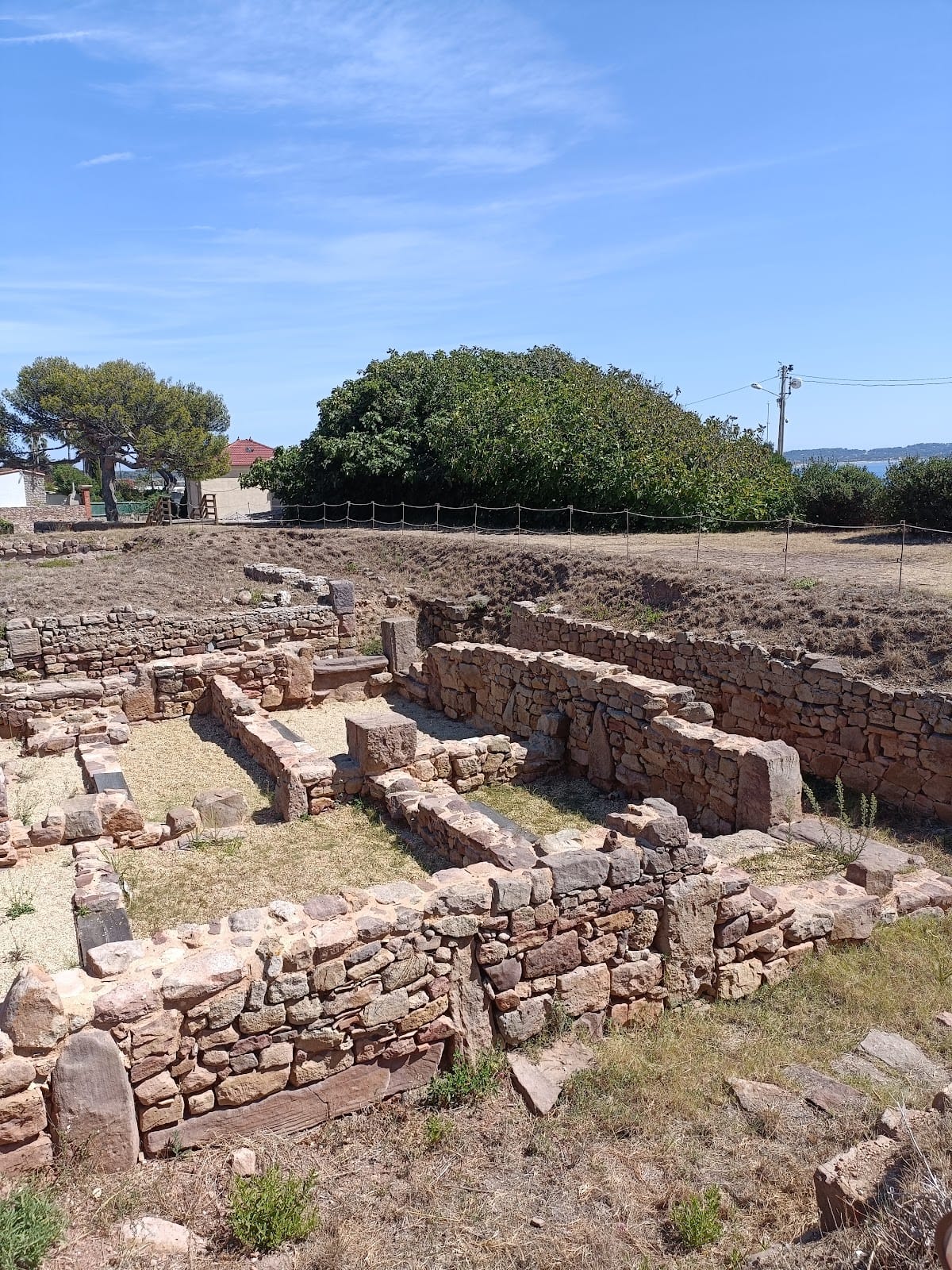
Olbia is enclosed by a substantial fortification wall forming a near-perfect square approximately 165 meters on each side. Constructed in the mid-4th century BCE by Greek colonists from Massalia, the walls were built of large ashlar blocks and reinforced with towers at the corners and along the curtain walls. The eastern gate, aligned with the main east-west street axis, served as the sole entrance and likely featured a sculpted phallus as a protective symbol, fragments of which were found reused in later construction phases. Roman modifications to the fortifications include an exterior facing (parement) applied during the 1st century BCE or later, incorporating reused materials such as a stone press and concrete floor fragments, possibly linked to artisanal activities outside the original enclosure. Portions of the western and northern ramparts were excavated in the mid-20th century, with some sections preserved within medieval structures. Coastal erosion has caused partial collapse, notably the western walls, which fell into the sea by the 1970s.

The urban layout follows a pre-planned grid established during the Greek foundation, comprising 40 rectangular housing blocks (îles). Each block measures roughly 11 meters wide by 34.5 meters long and is subdivided into three equal family-sized lots of about 120 square meters each. Streets between blocks are narrow, approximately 2.2 meters wide. Excavations have uncovered paved streets with drainage and sewage systems, wells, and pavements, indicating a well-developed urban infrastructure maintained from the 4th century BCE through the early 7th century CE.

Olbia’s port, originally established as a fortified maritime harbor, was constructed or significantly modernized during the Roman period after 49 BCE. The port facilities extended along the coast and were operational for several centuries before abandonment. Today, the remains of the ancient port lie partially submerged beneath the sea, with some structures buried under several meters of water and others just below the surface. An underwater archaeological trail has been created to document these submerged remains.

Key Buildings and Structures

City Walls and Fortifications

The city’s defensive walls date to circa 325 BCE, built by Greek settlers as a fortress city. Constructed of large ashlar blocks, the walls formed a square enclosure with towers at each corner and along the curtain walls. The eastern gate, aligned with the main street, served as the sole entrance and likely featured a sculpted phallus as a protective symbol, fragments of which were found reused in later construction. Roman modifications to the fortifications include an exterior facing of the walls and incorporation of reused materials such as a stone press and concrete floor fragments, possibly linked to artisanal activities outside the original enclosure. The western rampart remains partially preserved within the medieval enclosure known as Pomponiana, while other sections have been lost to coastal erosion.

Residential Blocks

Excavations have revealed multiple domestic structures within the city’s grid, including a fully excavated residential block known as île VI. These houses date from the Hellenistic period through the Roman era and into the early medieval period. The Greek houses originally uncovered were backfilled and are no longer preserved in situ. The Roman-era houses display typical construction techniques with stone foundations and walls, internal divisions, and associated shops and workshops. The residential areas include evidence of continuous occupation and urban development over nearly a millennium, with some blocks showing conversion of living spaces into gardens or artisanal zones during Late Antiquity.

Sanctuaries and Religious Structures

The “Grand Sanctuary of the West,” located at the terminus of the main street axis near the city gate, is attributed to the goddess Artemis based on ancient literary sources and archaeological context. This sanctuary dates to the Greek period and includes structural remains consistent with a religious precinct. Another sanctuary dedicated to Aphrodite was discovered adjacent to the northern city wall. Stone inscriptions found on site attest to the veneration of an anonymous “Hero” and “Mother Goddesses,” fertility symbols. The city lacks a formal agora; however, a central public well square may have functioned as a communal gathering place.

Baths and Thermal Complex

Between 2010 and 2013, excavations uncovered a Roman thermal complex near the seafront, constructed in the 1st century CE. The complex includes typical features of Roman baths such as heated rooms, bathing pools, and service areas. The baths demonstrate the presence of leisure and hygiene facilities within the urban fabric during the Roman occupation. The construction employs stone masonry and Roman concrete, with evidence of hypocaust heating systems beneath the floors.

Necropolis and Burial Sites

A necropolis located outside the city walls near the Almanarre area was first identified in the 1990s and has been under excavation since. Covering approximately 800 square meters, it contains at least 24 cremation tombs dating primarily to the 1st and 2nd centuries CE. The tombs include both primary cremations, where the body was burned on a pyre and buried, and secondary cremations containing only remains. Grave goods such as Gaulish amphorae and libation conduits were placed in some tombs, and one tomb was covered with flat tiles, a funerary practice typical of Roman customs. The necropolis is well preserved due to sandy soil and woodland cover.

Archaeological Discoveries

Excavations at Olbia have yielded a variety of artifacts spanning from the Greek foundation in the 4th century BCE through the Roman and early medieval periods. Pottery finds include locally produced and imported amphorae, tableware, and cooking vessels, with Gaulish amphorae notably present in funerary contexts. Numerous inscriptions have been recovered, including a 3rd-century CE Latin dedication to the “Genius of the Castellum Vicinity” by Lucius Rupilius Iacchus, indicating local civic cult activity. These inscriptions also reference fertility cults and anonymous heroes.

Coins from various Roman emperors have been found within habitation layers and the necropolis, providing chronological markers for occupation phases. Tools related to artisanal production, such as stone presses and concrete floor fragments, have been discovered outside the city walls, suggesting economic activities like oil or wine pressing. Domestic objects including lamps and cooking vessels have been recovered from residential blocks, while religious artifacts such as altars and ritual vessels were found in sanctuaries. These finds collectively illustrate the economic, domestic, and religious life of Olbia’s inhabitants over several centuries.

Preservation and Current Status

The city walls and fortifications survive in varying states of preservation. The western walls notably fell into the sea by the 1970s. Excavated residential blocks, including île VI, are preserved in situ but some Greek-period houses were backfilled after excavation. The Roman thermal complex near the waterfront is preserved as archaeological ruins with visible structural elements such as walls and hypocaust remains.

The necropolis is actively excavated and well preserved due to favorable soil conditions. Conservation efforts have stabilized exposed walls and structures to prevent further erosion. Some areas have undergone restoration using original materials where possible, while others remain stabilized but unrestored to preserve archaeological integrity. The submerged port remains are protected underwater, with an archaeological trail established for documentation. Ongoing preventive excavations and research continue under local heritage authorities to monitor and conserve the site.

Unexcavated Areas

Several parts of Olbia remain unexcavated or only partially studied. Surface surveys and geophysical investigations suggest additional housing blocks and artisanal zones beyond the currently excavated sectors. The area surrounding the necropolis and the western outskirts of the city walls contain architectural fragments and surface traces indicating buried remains. Urban development and coastal changes limit excavation in some zones, while conservation policies restrict intrusive work in others. Future excavations are planned selectively, focusing on areas threatened by erosion or construction, but large portions of the ancient city remain unexplored beneath modern terrain and vegetation.

Nearby sites

Book Tours & Activities Nearby

Powered by GetYourGuide
Scroll to Top