Castelporziano Presidential Estate: Italy’s Presidential Country Estate and Nature Reserve
Site at a Glance
- Rating
- 4.7
- Popularity
- Low
- Country
- Italy
- Primary era
- Medieval
- External website
- Open
- Eras represented
- Classical, Medieval, Modern
- Civilizations
- Italian, Papal States, Roman
- Site type
- Domestic
- Remains
- Palace
On this page16 sections
History
Castelporziano Presidential Estate is a historic coastal estate and protected natural reserve in Italy, extending across part of the ancient Laurentine territory. Its history reaches from prehistoric settlement and Roman villas to a medieval stronghold, a royal hunting domain, and its present role as part of the official estate of the President of the Italian Republic.
The Laurentine territory and Roman occupation
The estate lies within the coastal region traditionally associated with Laurentum, an ancient Latin center linked in Roman legend with the arrival of Aeneas, the Trojan hero said to have reached Latium. Human activity began in prehistory, while more structured settlements developed from the first Iron Age, particularly from the ninth century BC. During the Archaic period, these communities became increasingly urban in character.
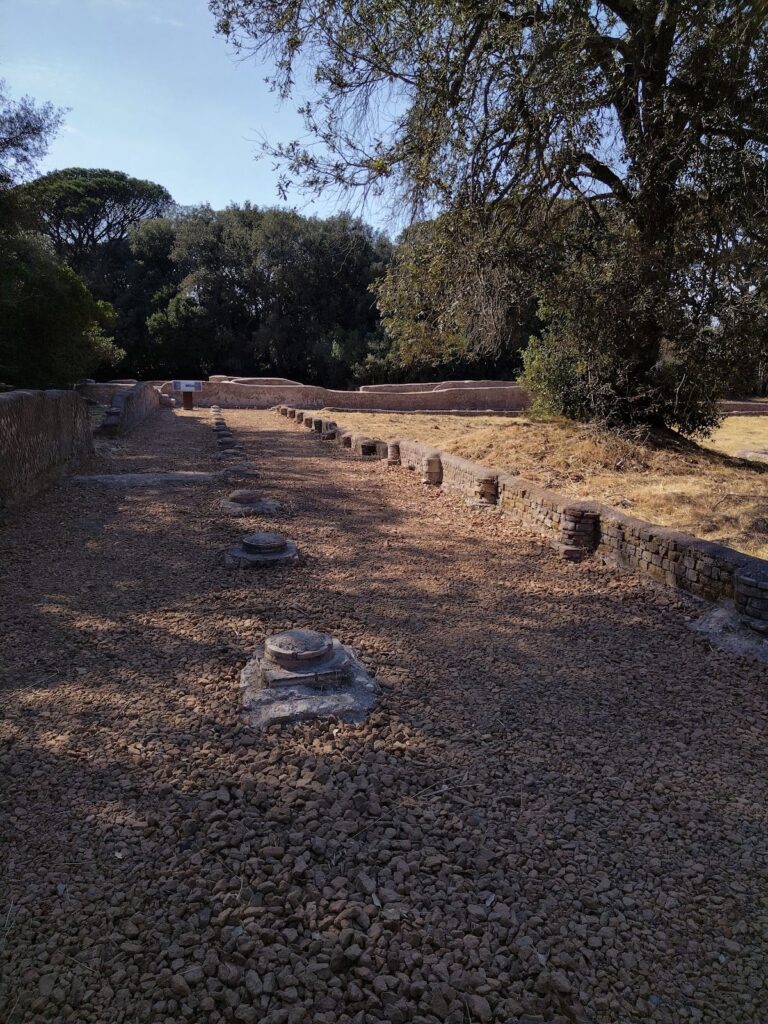
Roman expansion changed the territory from the fourth and third centuries BC onward. Rural buildings, agricultural estates, and villas appeared alongside major roads such as the Via Laurentina and Via Ostiense. From the Second Punic War, the long conflict between Rome and Carthage that ended with Roman victory in 201 BC, and especially during the late Republic, wealthy Romans developed maritime residences near the coast and the port of Ostia.
Under the Roman Empire, the area contained several elite residences, including a villa belonging to the imperial family and another associated with Pliny the Younger, a Roman author and public official. These coastal properties depended on Vicus Augustanus, an Augustan-period service settlement that remained active until late antiquity. Roads including the Via Ostiense, Via Laurentina, their branches, and the Via Severiana connected the villas with Rome and other coastal settlements.
The position of ancient Laurentum remains debated. It has been placed near Tor Paterno and at other locations within the estate. In 1984, the architect and archaeologist Eugenia Salza Prina Ricotti identified remains at Villa Magna near Grotte di Piastra as the Laurentine villa of Pliny the Younger. Pliny himself regarded his villa as having been built over the ruins of Laurentum.
Ecclesiastical possession and the fortified settlement
After the Roman Empire, the territory became church property. From the fifth century it was associated with the Basilica of Santa Croce in Gerusalemme, and by the tenth century it belonged to the monks of San Saba. An early fortified center was established on the site of the present castle during the tenth or eleventh century.
The property remained connected with San Saba until 1561. Following the suppression of the abbey by Pope Pius IV, ownership passed to the Hospital of Santo Spirito. During the sixteenth century, the Florentine Del Nero family acquired the estate and retained it until 1823, when Duke Vincenzo Grazioli purchased it and transformed it into a sumptuous residence.
Royal estate and presidential property
In 1872, the Italian minister of finance Quintino Sella helped arrange the transfer of Castelporziano to the Italian state for King Vittorio Emanuele II, the first king of unified Italy. The estate then served the House of Savoy as a royal hunting ground, agricultural holding, and setting for official representation. The Grazioli alterations carried out between 1823 and 1872 also reshaped the castle and enlarged its perimeter.
Since 1948, Castelporziano has formed part of the official endowment of the President of the Italian Republic, alongside the Quirinal Palace and Villa Rosebery. It was initially used as a country and holiday residence for the president. Its representative role has included bilateral meetings and state visits, including the visit of United States President Ronald Reagan in 1987.
The estate’s public and environmental role expanded during the republican period. In 1966, President Giuseppe Saragat transferred roughly two kilometres of coastline to the Municipality of Rome, creating a public beach. President Giovanni Leone ended presidential hunting throughout the estate in 1977. In 1985, President Sandro Pertini added approximately 1,000 hectares at Capocotta after the area had been threatened by building speculation.
Protection, research, and environmental management
A fire damaged about twenty hectares of the park in 1997. Recurrent fires affecting Castelporziano and the wider Roman Coast nature reserve led to the estate’s inclusion in woodland fire-prevention and protection planning under Italy’s forest-fire legislation of 2000.
In 1999, during the presidency of Oscar Luigi Scalfaro, Castelporziano became a State Nature Reserve and entered the protective system applied to protected natural areas. Its habitats and biodiversity also brought inclusion in the Natura 2000 network, the European Union framework for conserving important habitats and species, as Special Areas of Conservation and Special Protection Areas.
Environmental management has developed through a scientific council, an interinstitutional coordination committee, and a monitoring programme operating since 1995. The programme examines pollutants, soil organic matter, groundwater levels and salinity, forest health, wildlife populations, temperature, rainfall, and the movement of carbon dioxide, water, and energy between the forest and atmosphere. The resulting data are shared with the scientific community, allowing the estate to function as a Mediterranean living laboratory.
In 2020, Castelporziano received PEFC certification for sustainable forest management and became the first certified forest in Lazio. From 2026, it holds both FSC and PEFC certification for sustainable forest management and ecosystem services. The estate also preserves Maremman horses and cattle, including breeds described as nearly extinct. They are raised free-ranging and tended by butteri, the traditional mounted cattle herders of the Roman and Maremman countryside. Genetic selection and the preservation of characteristic genomes form part of this management.
Since 2015, the estate has hosted a summer center for people with disabilities, established on the initiative of President Sergio Mattarella. In 2016, Mattarella authorized the estate’s first opening to the public, adding a social dimension to its presidential, environmental, and historical functions.
Remains
Coastal landscape and woodland
Castelporziano covers approximately 5,900 hectares, or about 59 to 60 square kilometres, roughly 24 to 25 kilometres from central Rome. It incorporates the historic hunting estates of Trafusa, Trafusina, Riserve Nuove, and Capocotta. The grounds are bounded by Via Cristoforo Colombo to the northwest, the Pontina state road to the northeast, Via Pratica di Mare to the southeast, and the Tyrrhenian Sea along the remaining side. About three kilometres of relatively undisturbed beach form part of the coast.
From the sea inland, the estate contains sandy beaches, recent dunes, stabilized ancient dunes with wetlands behind them, Mediterranean scrub, holm-oak woodland, mixed lowland forest, cork-oak woodland, wetlands, pastures, and cereal fields. Much of the property consists of moisture-loving lowland forest. Evergreen and deciduous oaks grow with poplars, narrow-leaved ashes, maples, and white and oriental hornbeams in wetter areas. Holm oak, cork oak, and crenate oak, a hybrid of Turkey oak and cork oak, are among the evergreen trees.
The undergrowth includes strawberry tree, rockrose, heath, juniper, mastic, myrtle, phillyrea, laurel, mock privet, and broom. Less accessible woodland contains old-growth specimens and monumental trees. A 2025 census identified 22 monumental trees belonging to five species.
Wetlands, wildlife, and agricultural areas
Natural pools, locally called piscine, preserve traces of former wetlands, flooded forests, and marshes. These permanent or temporary water bodies support wetland reptiles, amphibians, aquatic insects, crustaceans, ducks, waders, shorebirds, and grebes. The woodland and wetlands also support woodpeckers, jays, wood pigeons, owls, tawny owls, barn owls, buzzards, kestrels, and sparrowhawks. Woodcock, turtle doves, and black kites occur among the migratory or wintering birds, while herons and other waterbirds use the wetland environments.
Wild boar, fallow deer, roe deer, and smaller numbers of red deer inhabit the estate, together with foxes, hedgehogs, pine martens, beech martens, badgers, porcupines, Italian hares, rabbits, and polecats. Wolves have returned in recent years and have been increasingly observed since 2016. The roe deer population is attributed to the Italian subspecies, distinct from the European roe deer. The fallow deer are described as descended from a medieval population that reached central Italy, while the red deer derive from a postwar introduction from La Mandria Regional Park near Turin.
A bird-ringing and migratory-bird analysis station operates within the estate. Conservation work monitors the Kentish plover and supports the safe hatching of loggerhead-turtle nests relocated from heavily urbanized areas to the estate’s coast. Agro-pastoral land covers 867 hectares, including 600 hectares of open pasture, 267 hectares of grazed woodland, and 143 hectares of arable land. These cultivated areas remain part of the historic agricultural landscape of the Roman countryside.
A former 1,000-hectare stone-pine forest, once made up of pure and mixed stands, has been severely reduced by the spread of Toumeyella parvicornis, commonly known as tortoise scale. A continuing restoration project is re-establishing mixed oak woodland suited to local soils.
The Borgo and the castle complex
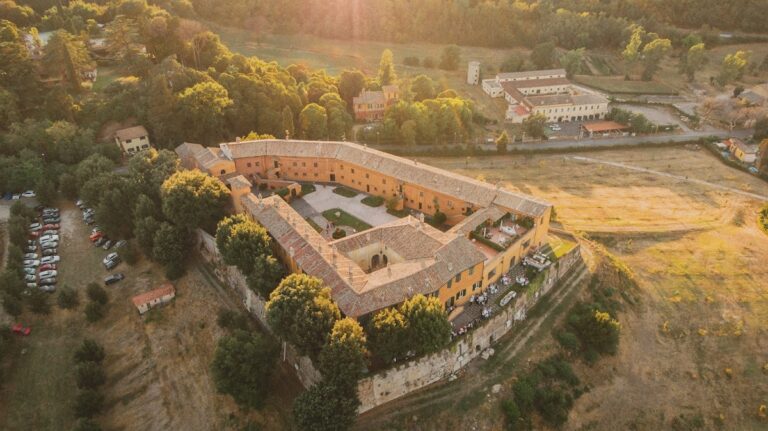
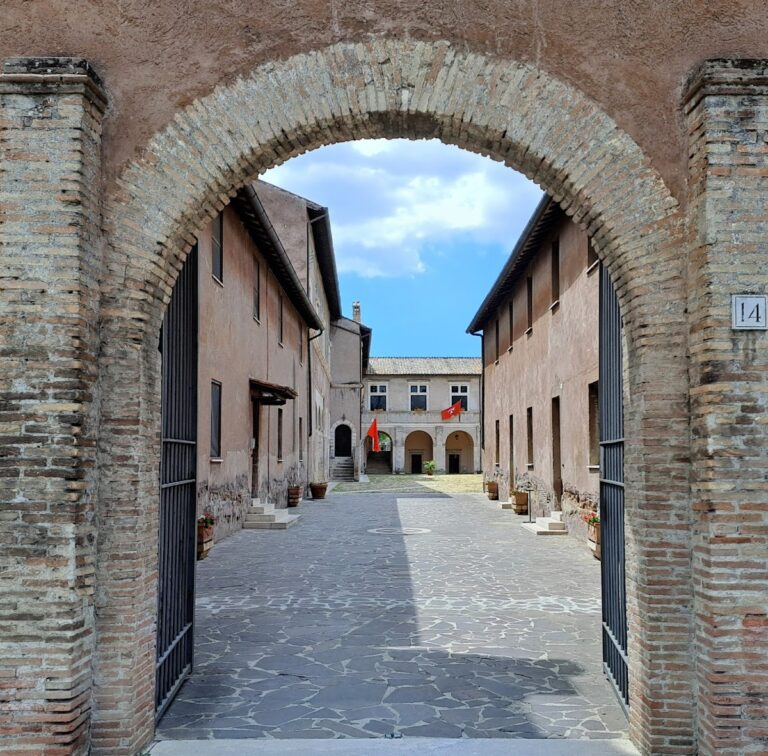
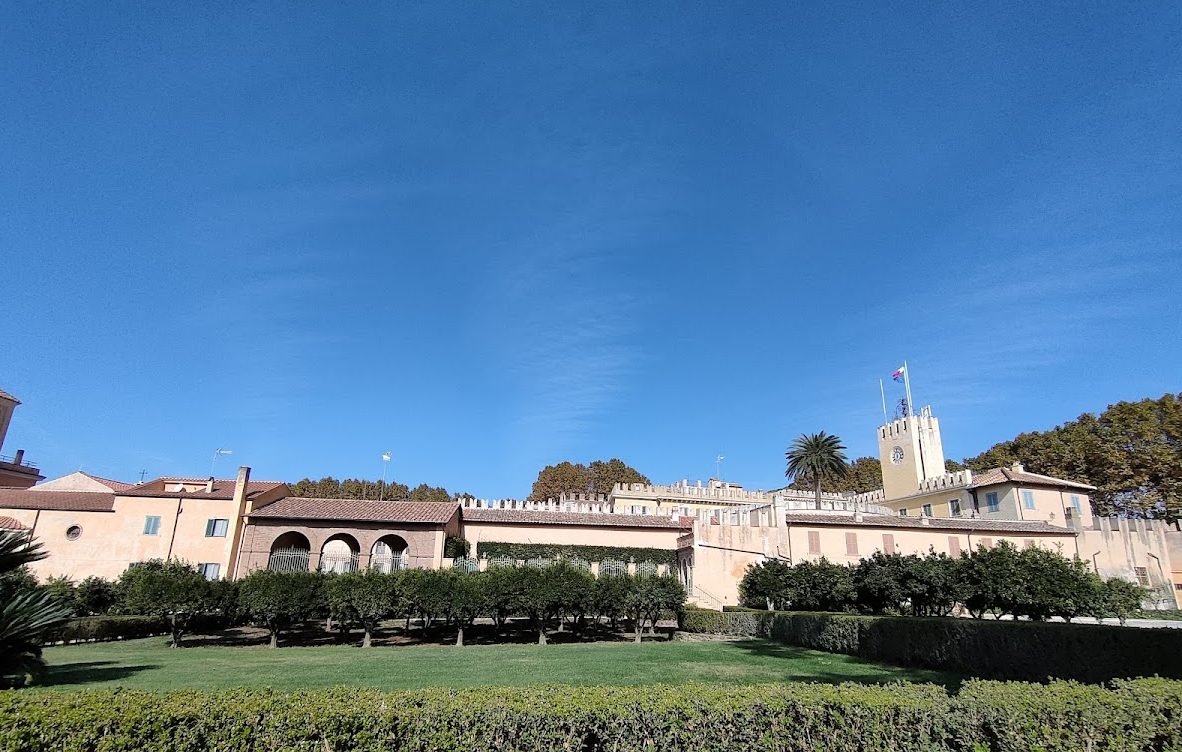
The central settlement, known as the Borgo, brings together the castle, a church, a small archaeological museum, and buildings connected with historic transport. The settlement began as a tower enclosed by a defensive perimeter, with additional buildings gradually gathered around it. By the fourteenth century, it was recognized as a castrum, meaning a fortified settlement or stronghold.
Castello Grazioli
A seventeenth-century map shows a quadrangular fortress with corner towers, a double entrance gate, crowning elements, and battlements. The Grazioli family substantially altered the castle between 1823 and 1872, and its perimeter is now nearly twice the size of the earlier complex. The principal building, Castello Grazioli, contains reception rooms decorated with hunting trophies and the President’s study. Its piano nobile, the principal residential floor, retains furnishings from the Savoy period, much of them transferred from the Quirinal Palace and former royal residences. Hunting and the history of the House of Savoy are recurring themes in the interiors.
Horti della Regina
The Borgo also contains the Horti della Regina, a formal Italian garden. Its upper area includes a large second-century AD mosaic centered on a monumental horse by Mario Ceroli, installed through the Quirinale contemporaneo project. The garden contains a citrus grove, a lemon house with trees trained against its walls, and a small mound associated with periods when the queen withdrew there. Donated trees and shrubs carry commemorative plaques that also describe their principal botanical characteristics.
Archaeological museum
The archaeological museum occupies a building within the castle and displays more than 200 objects from excavations carried out in the estate since the second half of the nineteenth century. The exhibits are arranged by archaeological context and in chronological order. Among the principal pieces are two eighth-century BC tombs with rich funerary assemblages from the necropolis of Castel di Decima, together with part of a Roman painted ceiling from the imperial villa at Tor Paterno, where substantial remains have been identified.
Historic vehicles and Capocotta buildings
Loggia delle Carrozze and carriage pavilion
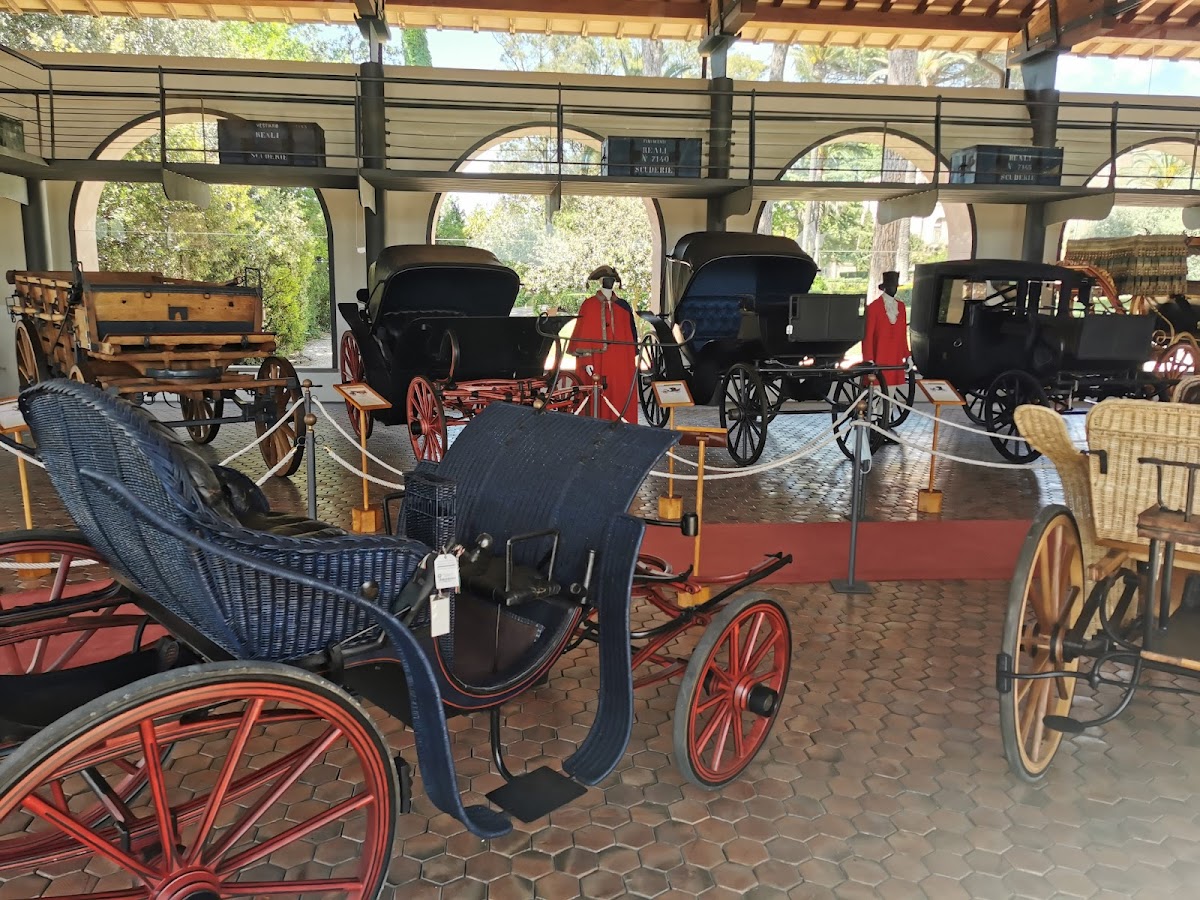
The Loggia delle Carrozze and the Pavilion of Carriages and Historic Cars preserve vehicles used by the Savoy court for royal hunts, carriage journeys through the estate, agricultural work, and transport to archaeological sites. The collection includes Breaks and Hunting-breaks, Phaetons, Spider-Phaetons, Break wagonettes, calèches, Vis-à-Vis carriages, field-work vehicles, and carts designed to carry game. It also contains the Fiat 513 Mod. 4, known as the “Saetta del Re,” and a Lancia Flaminia 335 built by Pininfarina for the Presidency of the Republic.
Villa Jolanda
Near Capocotta, Villa Jolanda houses the Museum of History and Nature. The villa formerly belonged to the House of Savoy and was the residence of Princess Jolanda.
Contemporary works in the estate
Since 2020, the Quirinale contemporaneo project has placed six contemporary artworks and three design works in the estate’s outdoor areas, buildings, and museum spaces. The works include a painting by Gillo Dorfles, sculptures by Mario Ceroli and Davide Rivalta, a photograph by Massimo Listri, land art by Michelangelo Pistoletto, and design objects by Paola Navone and Mario Trimarchi.
In 2021, the collection expanded with a mosaic by Corrado Cagli, sculptures by Nino Caruso, Giuliana Cunéaz, and Gino Marotta, and design objects by Luigi Caccia Dominioni, Piero Castiglioni, Ferruccio Laviani, Nicolò Morales, Mario Nanni, and Francesco Rota. These works form a modern layer within an estate whose surviving buildings, archaeological collections, managed landscape, and royal furnishings preserve successive phases of its long history.