Castello dei Naselli: A Noble Residence and Historic Castle in Comiso



Site at a Glance
- Rating
- 4.2
- Popularity
- Very Low
- Country
- Italy
- Primary era
- Medieval
- Eras represented
- Medieval, Early Modern
- Civilizations
- Byzantine, Crown of Aragon, Habsburg, Kingdom of Sicily, Spanish
- Site type
- Domestic
- Remains
- Elite Residence
On this page11 sections
History
Castello dei Naselli, also known as Palazzo del Conte, is a historic noble residence in Comiso, Italy, whose origins lie in the medieval castle and fortified settlement of the town. Documents from the thirteenth and fourteenth centuries describe Comiso as a fief with fortifications and buildings. Before the end of the fourteenth century, walls enclosed the town’s entire perimeter, with towers, a castle, and a moat.
Medieval castle and the Naselli family
Around 1392, ownership of the castle passed from Federico Speciaro to the Cabrera counts, a noble family that held the property before its acquisition by the Naselli. In 1453, the castle was sold to Periconio Naselli, Baron of Mastra. His descendant Gaspare Naselli was appointed Count of Comiso by Filippo I of Sicily in 1571.
The castle then became the permanent residence of the Naselli family for many centuries. Their ownership and title shaped the building’s later identity as the residence of the counts of Comiso.
Earthquake, palace, and later uses
The earthquake of 1693 caused most of the castle to collapse, although the tower remained standing. Restoration continued until the beginning of the eighteenth century. Afterward, the complex was transformed into a noble palace following a visit by the viceroy Cristoforo Fernandez de Cordova, a governor who ruled a territory on behalf of a monarch. He stayed there for a period with his entire retinue.
During the Bourbon period, the castle was abandoned. In 1841, part of the building was converted into a theatre, which later passed to the municipality. The lower section was used as a district prison, meaning a prison serving a local administrative jurisdiction.
Ownership and tradition
On 14 May 2024, the Nifosì family, descendants of the Barons of Canalazzi, sold the castle to Multifidi of Comiso, represented by its president of the board of directors, Roberto Biscotto. The transfer was completed on 15 July 2024 after the cultural-heritage authority did not exercise its right of pre-emption. Castello dei Naselli is recognized as Italian national heritage.
A local legend tells of a count besieged in the castle while his food supplies dwindled. Saint Blaise, a Christian martyr traditionally associated with healing and protection, is said to have appeared and advised him to fast, escape through an underground channel, buy ricottas from a shepherd, and throw them one by one at the besiegers. Believing that the tower could not be taken through starvation, the besiegers lifted the siege. According to the legend, the ruse saved both the castle and the town.
Remains
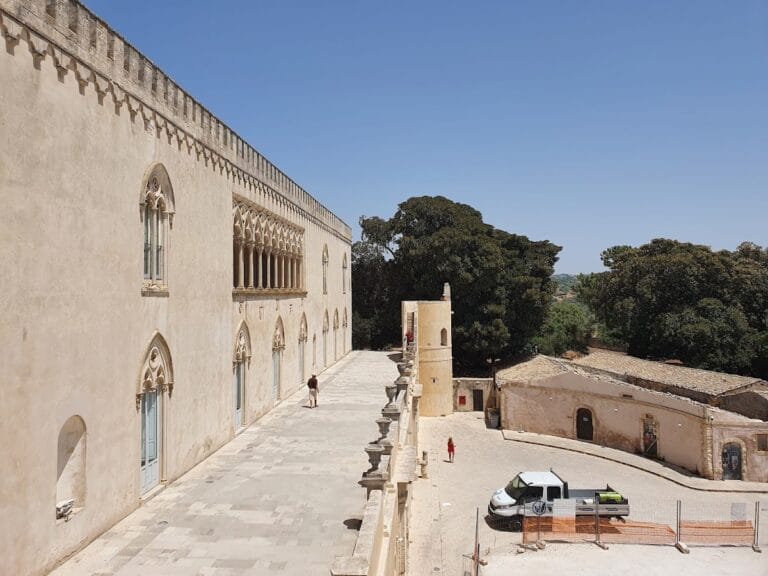
The surviving complex combines medieval defensive elements, an older religious structure, and additions made when the castle became a noble palace. Its remains include the eastern baptistery, the northern loggia, pointed-arch entrances, and fountains made from local stone or incorporated into the walls.
Religious and reception spaces
Saint Gregory the Great Baptistery
The eastern side contains the oldest part of the complex, a baptistery dedicated to Saint Gregory the Great, a sixth-century pope and Christian theologian whose cult spread widely in medieval Europe. Dating approximately to AD 1000, the baptistery preserves remains of Byzantine-period frescoes. Its lower section is octagonal, changing to a cylindrical form above and ending in an elegant dome.
The Loggetta
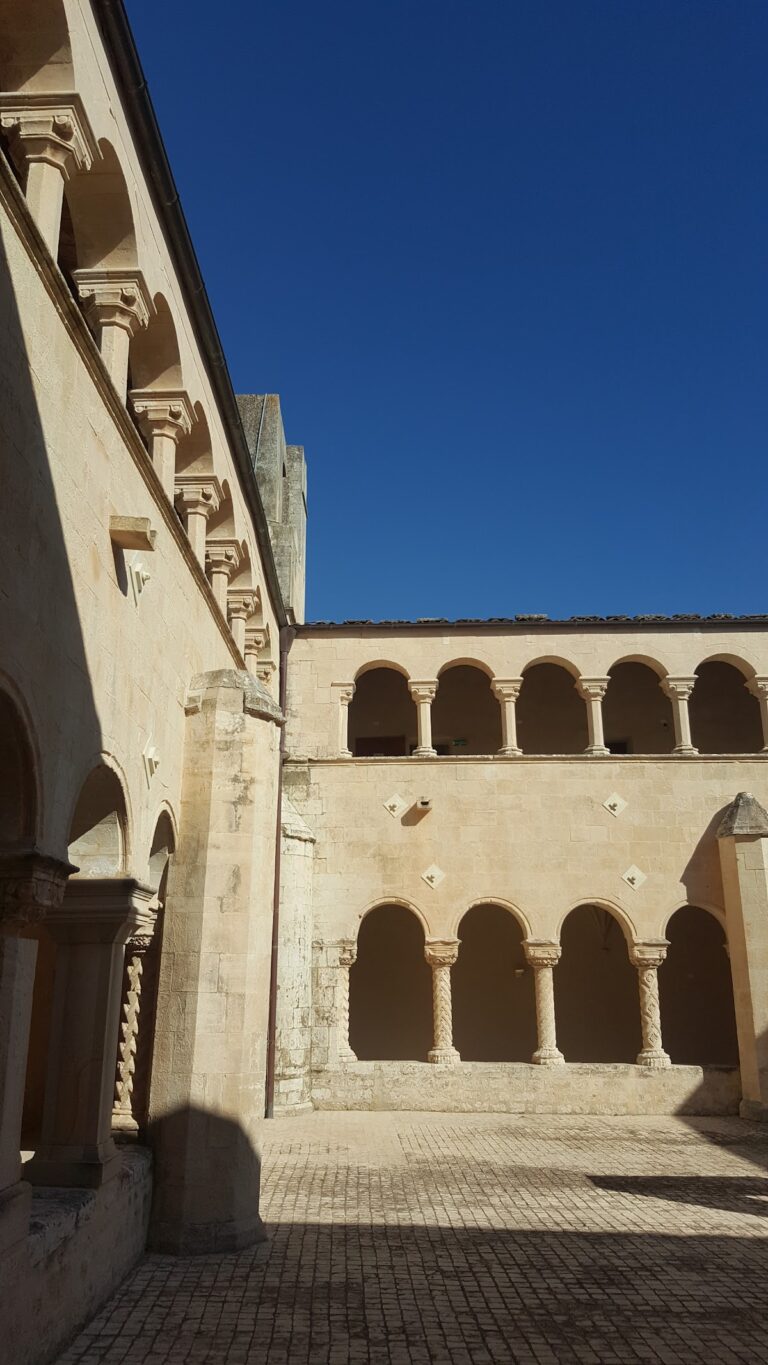
On the northern side, the Serlian loggia, commonly called the Loggetta, presents a three-part composition with a taller central opening flanked by two lower side openings. It recalls sixteenth-century architectural design, while its frescoed walls show landscapes and birds in flight. The loggia was added in 1728 to a design by Michelangelo Canepa, a Genoese architect.
Entrances and water features
Pointed-arch portals
Two pointed-arch portals provide access through the castle’s surviving fabric. One is closed by a massive iron-studded door with large bosses, or rounded metal projections, dating from the fifteenth century.
Wall and courtyard fountains
A small sixteenth-century fountain is set into one of the walls and is attributed to Gagini or his workshop. The inner courtyard contains a fountain shaft dating approximately to the seventeenth century. Made of local stone, it is richly carved and remains part of the complex’s architectural fabric.