Castle of Aguilar de la Frontera: A Medieval Hispano-Muslim Fortress in Spain


Site at a Glance
- Rating
- 4.5
- Popularity
- Very Low
- Country
- Spain
- Primary era
- Medieval
- External website
- Open
- Eras represented
- Medieval
- Civilizations
- Crown of Castile, Order of Calatrava, Umayyad
- Site type
- Military
- Remains
- Castle
On this page9 sections
History
The Castle of Aguilar de la Frontera is a ninth-century Hispano-Muslim fortress in Aguilar de la Frontera, Córdoba, Spain. Built within the Islamic architectural and political traditions of medieval Iberia, it was also known as the Castle of Poley or the Castle of Pontón. Its early complex included a parade ground and a defensive line.
Early medieval fortress
The earliest references place the castle within the sphere of Umar ibn Hafsun, a major Andalusi rebel leader who opposed the ruling Umayyad government in the late ninth century. On 16 April 891, Umar ibn Hafsun was defeated at the Battle of Poley by the forces of Abd Allah I, the Umayyad emir who ruled Córdoba from 888 to 912. The castle continued to exist into the twelfth century.
During the Islamic period, the fortress formed part of the cora of Cabra, an administrative district in al-Andalus. Its definitive Christian conquest took place in 1240, when it was captured by Ferdinand III, the Castilian king responsible for major Christian conquests in al-Andalus.
Castilian lordship and rebuilding
In 1352, Alfonso Fernández Coronel, who had recently received the lordship of Aguilar, rebelled against King Pedro I. Royal troops attacked the castle and restored it to the Crown the following year. Fernández Coronel was executed, and the sculpted eagles associated with him were removed.
In 1356, Pedro I granted the castle to Martín López de Córdoba, master of the Order of Calatrava. The Order of Calatrava was a military religious institution founded in Castile to defend Christian territories and support the Christian conquest of Iberia. Under Martín López de Córdoba, the fortress was reinforced with additional walls, gates, and towers.
After the Castilian civil war, a conflict between rival supporters of Pedro I and Enrique II, Enrique’s victory in 1369 brought another change of lordship. The castle passed to Gonzalo Fernández de Córdoba in recognition of his loyalty during the war and his participation in defending the capital during Pedro I’s siege.
Destruction and later preservation
The circular Tower of the Chain was destroyed by the Lisbon earthquake of 1755. Its name came from sculpted chain links associated with the tower.
The most extensive destruction followed in the mid-nineteenth century, when Juan Vila Cordón, the town’s corregidor, or royal or municipal governor, authorized the demolition of the castle. Stone from the fortress was reused mainly in municipal roads, while other materials went into private houses and the Córdoba-Málaga railway. Red Cabra marble from the parade ground was among the dismantled materials.
The surviving fortress was declared a Property of Cultural Interest in the Monument category on 29 June 1985. An interpretation centre opened within the enclosure on 27 December 2010, presenting the castle’s history alongside the landscape and history of Aguilar de la Frontera. Earlier occupation of the site also includes Neolithic, Chalcolithic, Bronze Age, Late Bronze Age, La Tène, and Roman-period settlement, with graves attributed to the La Tène and ancient Roman periods.
Remains
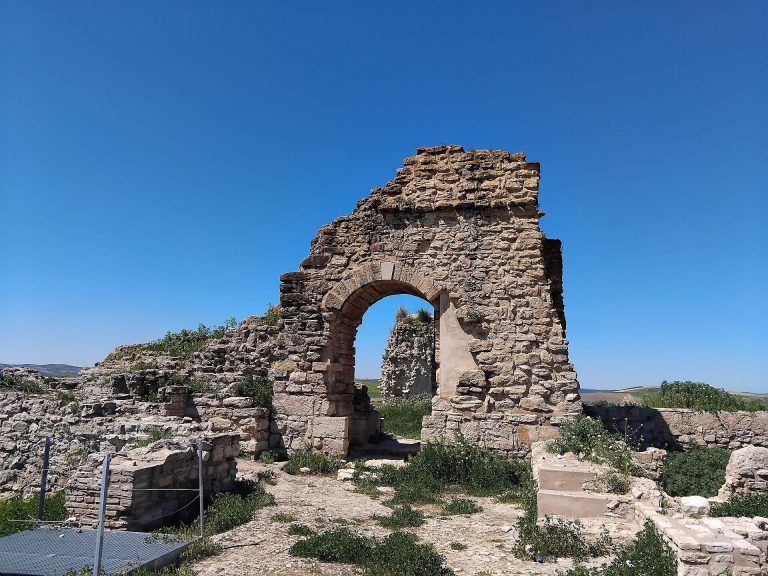
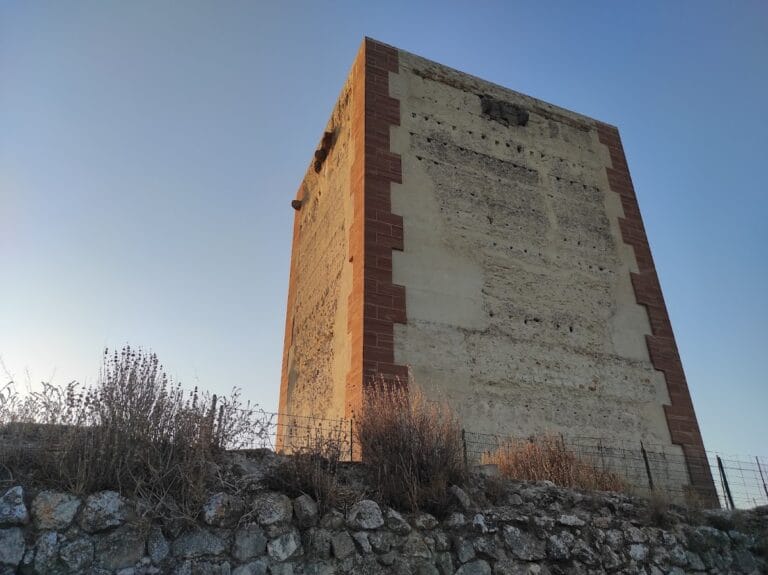
The surviving site is a fragmentary fortified enclosure whose ninth-century Hispano-Muslim origins were supplemented by later medieval defenses. Its remains include a tower, sections of walls, a moat, the former cemetery, and a small amphitheatre. The medieval fortifications added or strengthened in 1356 included multiple walls, gates, and towers, linking the surviving elements to the castle’s later Christian phase.
Fortifications and enclosure
Walls, gates, and towers
The principal physical remains consist of a tower together with surviving wall lines, gates, and other defensive towers. These elements belong to a fortified complex that began in the ninth century and was strengthened in 1356 under Martín López de Córdoba. The moat formed part of the defensive arrangement around the enclosure.
Former cemetery and amphitheatre
The enclosure also contains the former cemetery, which was later relocated, and a small amphitheatre. Together with the walls, tower, and moat, these features make up the remaining archaeological and architectural fabric of the castle.
Lost tower and reused materials
The circular Tower of the Chain was a named feature of the fortress. Sculpted chain links gave it its name, but the tower was demolished after the Lisbon earthquake of 1755. Red Cabra marble from the parade ground was later dismantled during the nineteenth-century demolition, when stone and other materials were reused in roads, houses, and the Córdoba-Málaga railway.