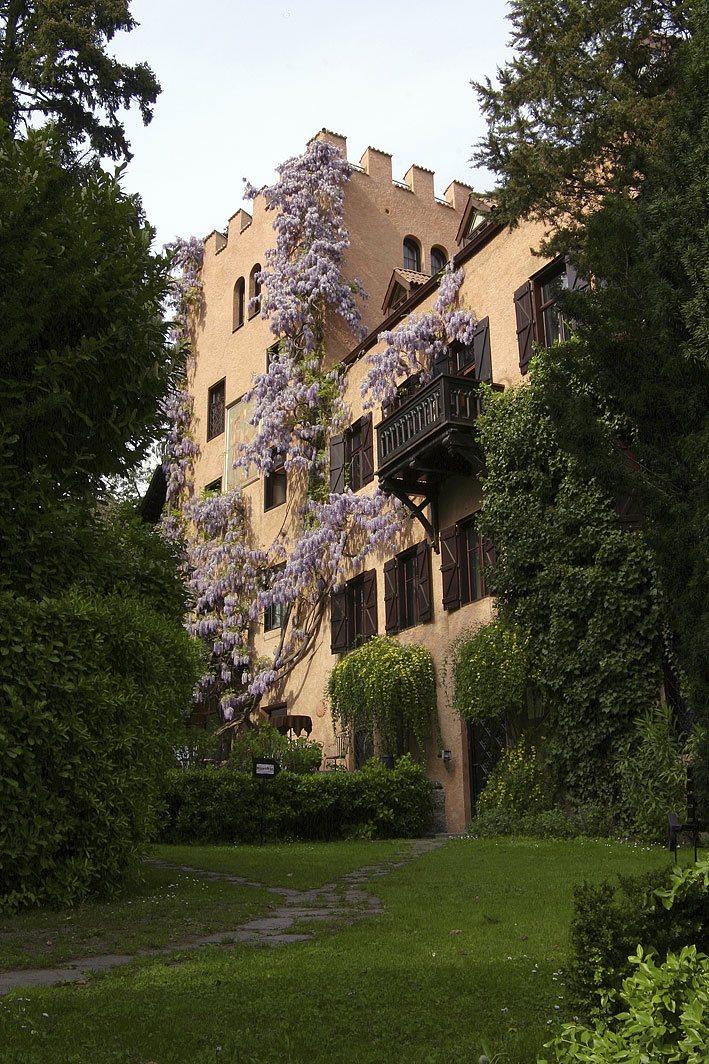
Landesfürstliche Burg: A Late-Gothic Urban Residence in Merano, Italy


Site at a Glance
- Rating
- 4.3
- Popularity
- Medium
- Country
- Italy
- Primary era
- Medieval
- External website
- Open
- Eras represented
- Medieval, Modern
- Civilizations
- Habsburg, Holy Roman Empire
- Site type
- Domestic
- Remains
- Castle
On this page8 sections
History
Landesfürstliche Burg, also known as Castello Principesco, is an urban fortified residence in Merano, Italy, built around 1470 in the late-Gothic period at the behest of Duke Sigmund of Austria-Tyrol. Standing in the historic center at the foot of Mount Benedetto, it served both as the private residence of the high-noble Tyrolean territorial ruler and as an administrative center for the town and surrounding territory.
Foundation and territorial administration
Work on some of the cellars began in the mid-fifteenth century, while the main building was erected from around 1470. The complex housed the Kelleramt, an office responsible for economic and fiscal management, together with the offices of the local land judge and town judge. It also accommodated the Kellner, the administrator and tax collector. These functions made the residence part of the political and economic organization of Tyrol as well as a noble household.
A Habsburg residence
The castle remained a noble residence during the sixteenth century. Emperor Maximilian I, the Habsburg ruler, stayed there in 1516 and visited it on several other occasions. His presence reflected the building’s role as a high-status territorial residence connected with the ruling dynasty.
The original building was altered during the sixteenth century. Later changes of ownership contributed to its decline, and by the seventeenth century the chapel was the only part specifically recorded as still being used for religious services. The complex nevertheless retained its association with residential use throughout its history.
Transfer, threatened demolition, and restoration
During the Napoleonic Wars, the castle came under the control of the Bavarian government. It was then transferred as compensation to the princes of Thurn und Taxis, who used it as an administrative headquarters. In 1815, the municipality of Merano acquired the building and planned to demolish it to make way for a school.
A citizens’ petition prevented the demolition with the support of the art historian David von Schönherr. Between 1878 and 1880, the architect and cathedral builder Friedrich von Schmidt restored and redesigned the castle in a historicist manner. This intervention gave the complex much of its present late-Gothic character, and the building reopened to the public in 1880.
Today, the municipality of Merano owns Landesfürstliche Burg. The building houses the Landesfürstliche Burg museum and is also used for civil wedding ceremonies, continuing its long connection with residential and civic functions.
Remains
Urban residence and courtyard
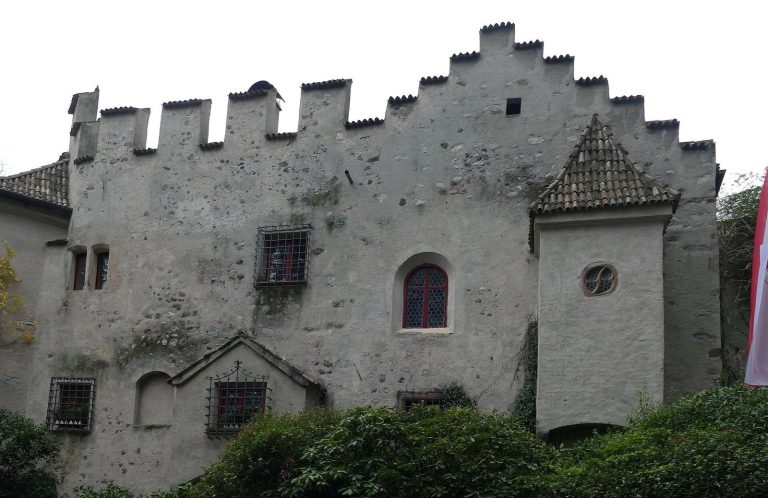
Landesfürstliche Burg is an urban fortified residence rather than a fully developed fortress. Its design resembles an artistically planned fortified house with only a weak surrounding enclosure. The surviving architectural character is late Gothic, although the nineteenth-century restoration substantially shaped the building seen today.
The courtyard contains naturalistic frescoes in which plants and animals are entwined with human figures. These painted scenes form one of the complex’s principal decorative features and belong to the artistic character of the residence rather than to a purely military design.
Chapel and princely room
The chapel contains a fifteenth-century statue of Saint George with the dragon, a Christian image of the mounted saint defeating the monster, as well as several frescoes. The chapel’s continued religious use in the seventeenth century gives this part of the building a direct connection with the castle’s later history.
The prince’s room contains a fifteenth-century maiolica-tiled stove, probably the oldest surviving example of its kind. The room is also part of the group of high-quality wood-panelled interiors and furnishings dating from the late Middle Ages.
Historic interiors and collections
The interior includes wood-panelled rooms and furnishings from the late Middle Ages. After the restoration, period items were added, including chests, weapons, and paintings characteristic of the castle’s original era. Several rooms contain historic musical instruments, weapons, and kitchen utensils. The weapons include lances and halberds.
Two large rooms that had originally served as storage areas were adapted after the restoration for civil wedding ceremonies. They contain numerous paintings, including works that came from the Merano Civic Museum. The collection includes portraits of Empress Maria Theresa and Emperor Francis I, as well as Fruit Seller, Game Seller, and portraits of the Strellin sisters.
Among the named paintings are works by Franz Anton Zeiler and a group by Simon Ybertrachter. The group includes Martin Langenmantl and Catharina Langenmantl, both dated 1726; Johann Anton Seeler and Anna Maria Seeler, both dated 1762; and Caterina Ingrambin, dated 1759.