Castro da Cola: A Fortified Archaeological Settlement in Portugal


Site at a Glance
- Rating
- 4.4
- Popularity
- Low
- Country
- Portugal
- Primary era
- Medieval
- Eras represented
- Medieval
- Civilizations
- Almohad, Almoravid, Portuguese
- Site type
- Military
- Remains
- Fortified Town
On this page18 sections
History
Castro da Cola is a fortified archaeological settlement and Marian sanctuary landscape in Portugal, near Ourique, whose occupation extended from the Neolithic to the Middle Ages. The hill was used especially intensively during the Iron Age and Islamic period, when its position supported both defensive activity and a settled agricultural community.
Early occupation and the Roman period
The earliest settlement is attributed, with some uncertainty, to the late Neolithic or early Chalcolithic period. Occupation continued through the Copper and Bronze Ages into the Iron Age, when the hill formed part of a wider landscape of settlement and resource use. A bronze sword was found near the site, while later Iron Age material includes a short sword with an antenna-shaped hilt, ceramic urns, glass beads of Phoenician or Punic types, and gold beads.
Castro da Cola was also occupied during the Roman period, although the limited Roman material does not establish the extent of Roman influence on the settlement. Some evidence has been interpreted as pointing to Phoenician or Carthaginian activity. The site was later Christianized, apparently through the adaptation of an earlier pagan religious tradition.
The hill offered several reasons for repeated occupation. It stood about 200 meters above sea level, controlled views across the surrounding area, provided access to the Mira River and fertile land, and lay close to copper-bearing mineral resources. Watercourses and steep ravine edges also strengthened its natural defenses.
The Islamic settlement
The most important medieval phase was Islamic. From at least the eighth century, Castro da Cola supported a substantial community whose economy relied mainly on agriculture and pastoralism, with textile production also playing a role. The settlement may have been an hisn, a small Islamic fortified settlement that could serve defensive and local administrative purposes, within a network protecting maritime and inland frontiers.
During the eleventh century, the area lay between the taifa kingdoms of Seville and Silves. Taifas were independent or semi-independent Muslim kingdoms that emerged in Iberia after the weakening of central caliphal authority. Cola probably already had a military function at this time and was later incorporated into the territories of the Almoravids and Almohads, successive Islamic dynasties that ruled substantial parts of the western Mediterranean, including Iberia.
The settlement may have been known in the Islamic period as Marjiq, a name later Christianized as Marachique. This identification remains tentative and is partly connected with the nearby names Marchicão and Marchica. The name Cola may itself derive from the Arabic term qal’a, meaning a fortification. Secondary defensive positions in the surrounding hills probably formed part of the settlement’s wider military system.
Christian rule and abandonment
In the twelfth century, the settlement became the seat of a municipality. It received a charter in the thirteenth century, when it was known as Marachique and lay within the sphere of influence of Silves. Portuguese rule was established during the reign of King Afonso III, who is reported to have ordered repairs to the walls. The fortification retained a military purpose during part of the fifteenth century and was modified while preserving some Islamic elements.
The settlement entered serious decline during the fourteenth century and was completely abandoned in the fifteenth century, when the municipal seat moved to Ourique. Beside the ruins, a Christian sanctuary dedicated to Nossa Senhora da Cola developed into one of the principal pilgrimage centers of the Lower Alentejo. Marian devotion is the Christian veneration of the Virgin Mary, and the sanctuary remains a regional center of this tradition, with an annual pilgrimage held in September.
Local traditions explain the sanctuary through a story in which an image of Nossa Senhora da Cola repeatedly returned to the place where it had first appeared and became too heavy for those trying to carry it elsewhere. Other traditions connect the hill with a bell heard on Saint John’s Day during the Islamic, or “Moorish,” period and with a natural sliding stone believed to assist childbirth. On feast days, local people traditionally slid down the stone.
Investigation and protection
The ruins had been known to Portuguese scholars since at least the sixteenth century. André de Resende, a Portuguese humanist, is said to have visited in 1573, possibly with King Sebastian of Portugal. Nearly two centuries later, Manuel do Cenáculo, a Portuguese cleric and bishop, visited the site, made a map, and described its walls, cistern, graves, and outlying fortifications.
José Leite de Vasconcelos investigated Castro da Cola in 1897 and recorded Roman remains, graves, a plastered and painted vaulted space, and defensive structures beyond the main enclosure. Abel Viana carried out the first systematic archaeological studies between 1958 and 1964. His work revealed extensive Islamic evidence and shifted the interpretation of the site from one focused mainly on Lusitanian and Roman occupation to one recognizing a major Islamic fortification.
Archaeological cleaning and topographical surveying followed in 1988, with restoration and maintenance work in 1989. Archaeological monitoring accompanied the installation of an interpretation center in 2000. Excavation, maintenance, and conservation in 2002 confirmed settlement areas beyond the walls and identified a military structure on the northern side. Further work in 2004 and 2005 produced proposals for safeguarding the monument.
Castro da Cola was classified as a National Monument by a decree published on 23 June 1910. Under Decree-Law 22/2019, responsibility for management and conservation passed from the Portuguese government to the municipality of Ourique, and operation of the archaeological site was formally transferred on 15 March 2022. The settlement is the central site of the Cola Archaeological Circuit, which includes fourteen other points of interest representing the region’s history from the Neolithic to the Middle Ages.
Remains
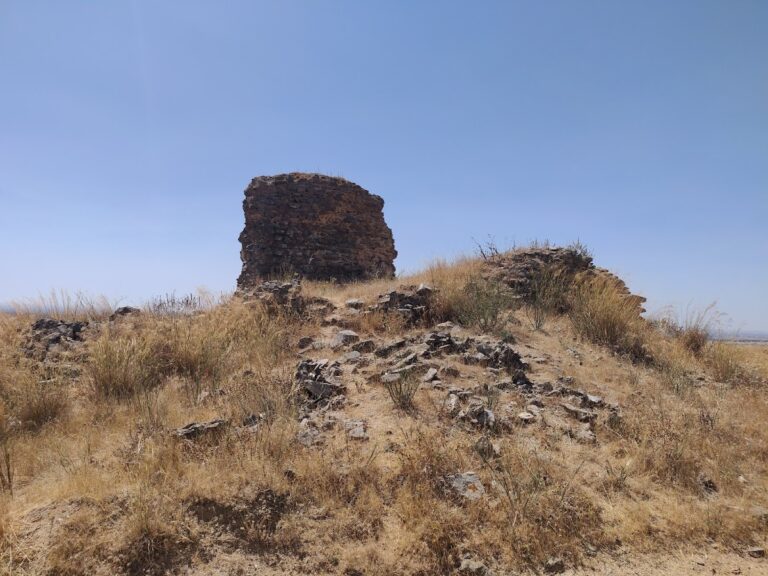
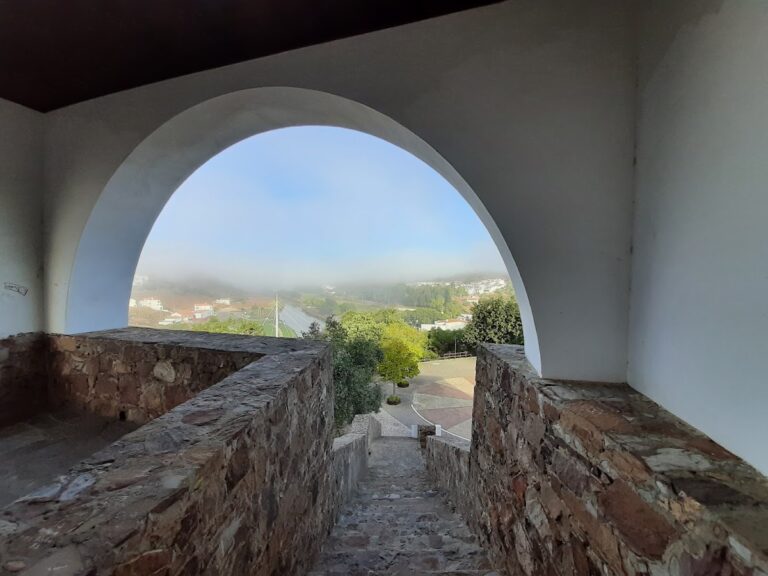
Castro da Cola occupies a large schist hill surrounded on three sides by watercourses. The Barranco do Burdo lies to the west, the Barranco da Horta do Marchecão, also called Marchicão, to the north, and the Mira River to the south. The fortified enclosure follows an irregular polygonal plan with a perimeter of approximately 330 meters. Its walls use locally obtained schist bonded with earth mortar, and some stretches contain herringbone masonry, a technique in which stones are laid in a V-shaped pattern. Several construction campaigns shaped the surviving fortification.
Fortified enclosure
Walls and towers
Several square-plan towers formed part of the enclosure walls. The fortification’s irregular outline follows the hilltop, while high ravine edges and the surrounding watercourses add to its defensive setting. Sections of the walls preserve the herringbone technique, described as a late adaptation of opus spicatum, a masonry method using stones or bricks arranged like a fish skeleton.
Eastern entrance
The principal entrance stood on the eastern side and followed an elbow-shaped, or bent, plan. A tower protected the approach, although only its foundation survives. This type of bent entrance was common in regional fortifications, particularly from the eleventh century onward.
Islamic military and urban areas
Military sector
The Islamic settlement was divided into a military sector and a larger urban sector. The military area centered on a courtyard that contained the settlement entrance. Supporting buildings included stores and stables, reflecting the practical requirements of a fortified community. A narrow passage connected this area with the urban sector.
Urban sector
The urban area was organized around two streets, one central and another running beside part of the northern wall. Houses, stores, shops, workshops, ovens, wells, and at least one cistern occupied this space. Some houses were arranged around central courtyards. Excavated traces extend beyond the enclosure toward the Mira River and the Marchicão watercourse, including urban areas on the southwestern slopes and a structure of military function along the northern side.
Burials and outlying defenses
Graves and cemetery area
The platform supporting the sanctuary may have been the former Islamic cemetery. Graves were also found beside one of the watercourses and on the hillside. Manuel do Cenáculo described six graves on the slope, some measuring approximately 25 palms square. Muslim funerary slabs bearing inscriptions form part of the medieval material from the settlement.
Hilltop earthworks
Additional earthworks and small forts, locally called castelinhos, were described around the main enclosure. These included large earthworks on the hilltop and a ruin known as Castelinho do Pedaço da Parede. Other possible outlying forts, called Castelinhos d’além da Terra do Azinhal, were recorded some distance from the sanctuary and may have belonged to the wider defensive system.
Archaeological finds and sanctuary complex
Objects from successive periods
Early material includes two concave grinding stones and a rounded stone interpreted as a hammerstone. A groove around the latter’s diameter was probably made by a leather strap or cord used to fasten it to a handle. Iron Age objects include the antenna-hilted sword, urns, glass beads of Phoenician or Punic types, and gold beads. Roman finds comprise two limestone column-shaft fragments, dressed stones, thick bricks, roof tiles, an ornamented neck, and at least two oil-lamp fragments.
Medieval objects consist chiefly of pottery, much of it from the final phase of Islamic rule. Spindle needles and lead spindle whorls point to textile production; a spindle whorl is a weighted tool that helps turn fibers into thread. Manuel do Cenáculo also reported a capital, funerary stones with characters he identified uncertainly as Phoenician or Turdetanian, and long steel or bronze thrusting swords that were heavily calcined and had blunt blades, slightly thickened handles, and flat projections.
Sanctuary buildings
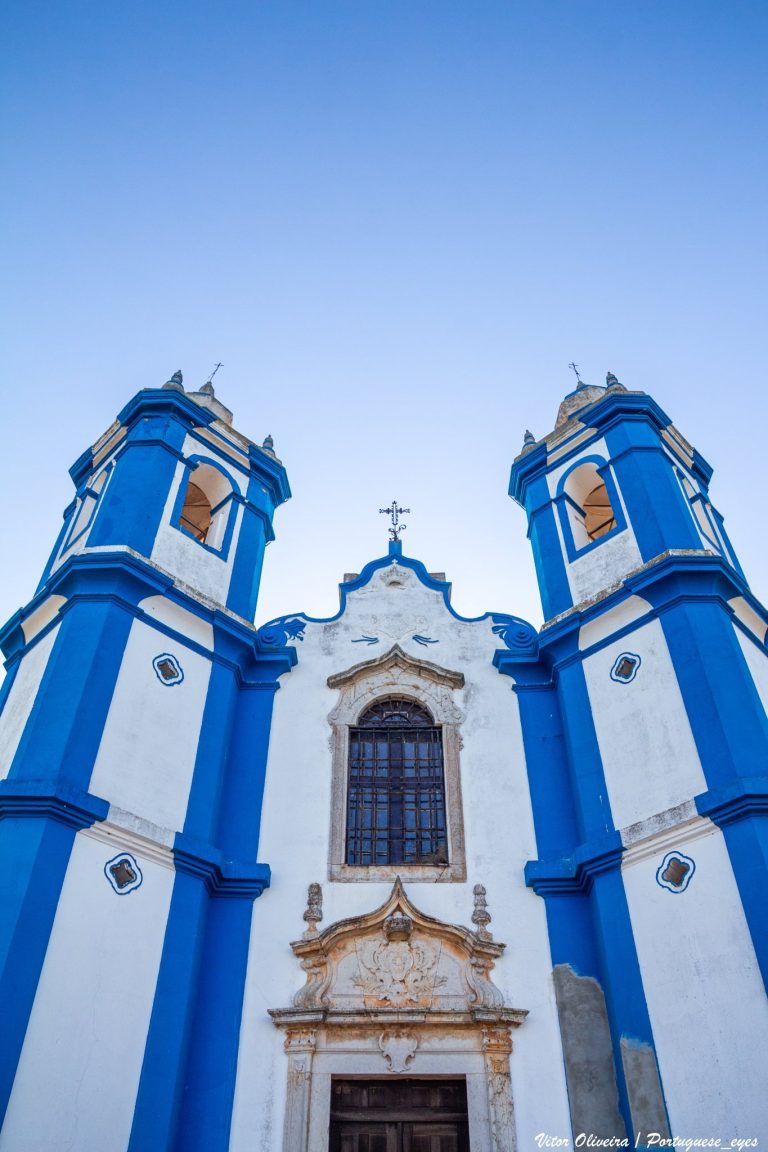
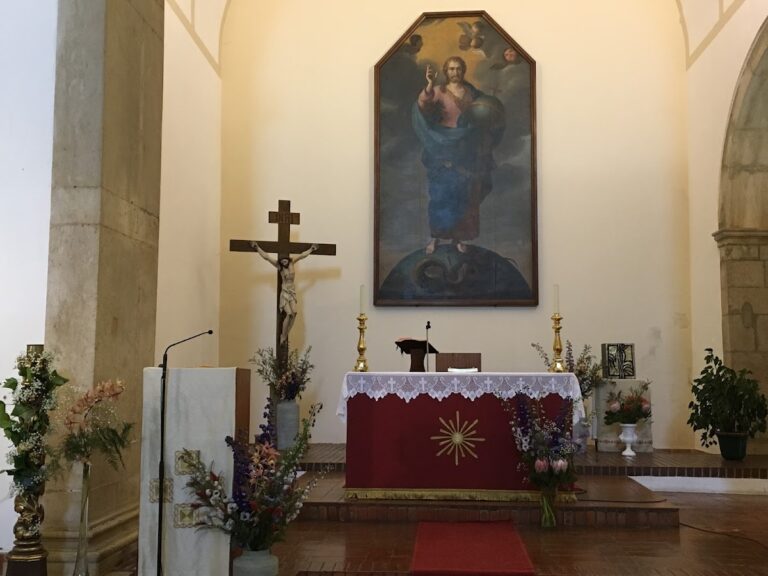
The sanctuary complex beside the archaeological site includes the Sanctuary of Nossa Senhora da Cola, the Casa dos Romeiros for pilgrims, and a spring dedicated to Nossa Senhora da Cola. A building west of the sanctuary has traditionally been identified as an older chapel. Among the ruins, a vaulted opening or chamber had plastered and painted walls, and some of its plaster was taken to the Ethnological Museum.