Belvelly Castle: A Tower House in County Cork


Site at a Glance
- Rating
- 4.5
- Popularity
- Low
- Country
- Ireland
- Primary era
- Medieval
- External website
- Open
- Eras represented
- Medieval, Modern
- Civilizations
- Norman
- Site type
- Domestic
- Remains
- Castle
On this page7 sections
History
Belvelly Castle is a 14th- or 15th-century tower house in Ireland, built as a fortified stone residence for the Anglo-Norman Hodnett family. The Anglo-Normans were descendants of Norman settlers who established lordships and estates in Ireland after the 12th-century invasion. The castle stands beside Belvelly and later became associated with several influential families and military phases in the history of County Cork.
Hodnett and Roche Possession
During the 14th century, the De la Roch, or Roche, and De Barra, or Barry, families took possession of the castle. The Hodnetts later leased their lands back, preserving their connection with the estate while control of the castle had passed to other local powers.
Sixteenth- and Seventeenth-Century Use
Belvelly Castle was reportedly occupied by Sir Walter Raleigh during the 16th century, although that association remains uncertain. Raleigh was an English courtier, explorer, colonizer, and soldier active in the late 16th and early 17th centuries. The De Barra family subsequently reoccupied the castle.
In the mid-17th century, Roger Boyle, 1st Earl of Orrery, used Belvelly Castle to garrison troops during the Irish Confederate Wars. These conflicts, fought mainly between 1641 and 1653, involved rebellion, a confederate government, and English and Scottish military intervention in Ireland. The castle therefore served a military purpose during a period of prolonged political and armed conflict.
Decline, Wartime Use, and Restoration
By the 19th century, the castle had fallen into ruin and was reportedly dismantled for building materials. During the First World War, local coachmen brought sailors on shore leave from nearby Queenstown, now Cobh, to Belvelly Castle. The castle was reputedly presented to them as Blarney Castle, leading them to believe that they were visiting the famous castle and its Blarney Stone.
During the Emergency, Ireland’s official term for its neutral wartime period from 1939 to 1945, the Irish Army occupied and modified the castle. It was sold in the early 21st century, and planning permission was granted in 2016 for restoration and conversion into a private dwelling. The redevelopment was completed in late 2018.
Remains
Setting and Tower House
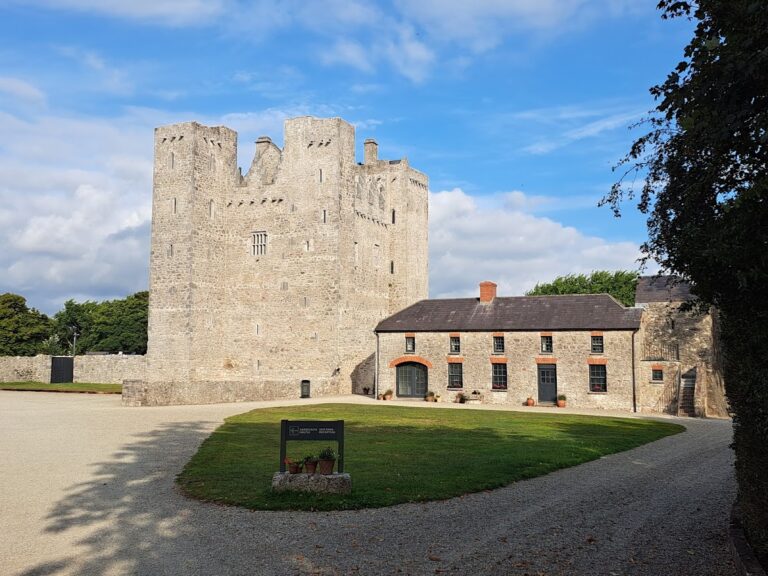
Belvelly Castle is a lowland castle beside the village of Belvelly. It stands opposite and overlooks the only road bridge connecting Fota Island with Great Island, the island on which Cobh is situated. Built of rubble stone, the castle is organized as a tower house, a fortified stone residence arranged vertically in a tall, compact building rather than across a broad fortified complex.
Restored Fabric and Associated Works
The restoration reconstructed the tower house’s battlements and slate roof while adapting the building for residential use. The associated works included a separate garage, a boiler room, a new boundary wall, a new vehicle entrance, and a proprietary sewage-treatment system. Additional artworks were placed on the roof of the tower house after the restoration.