Castell de Plegamans: A Gothic Fortified Residence in Spain



Site at a Glance
- Rating
- 4.5
- Popularity
- Low
- Country
- Spain
- Primary era
- Medieval
- External website
- Open
- Eras represented
- Medieval
- Civilizations
- Crown of Aragon
- Site type
- Military
- Remains
- Castle
On this page8 sections
History
Castell de Plegamans is a medieval castle in Spain, east of Palau-solità i Plegamans, whose present form was shaped as a Gothic residence in the fourteenth and fifteenth centuries. Built around an earlier tower, it became the centre of the Quadra de Plegamans, a medieval territorial district governed from a castle or fortified settlement.
Early settlement and the castle district
The place-name Plegamans appears for the first time on 22 June 965, in a donation of land to the monastery of Sant Cugat del Vallès by Deudat, Adulf, Oriola, and Martí, who were described as successors of Cilici. Other references from the tenth century indicate that the area was already inhabited. A document from 990 describes a settled territory with houses, farmyards, cultivated fields, vineyards, orchards, streams, springs, meadows, roads, woods, and scrubland. Its boundaries extended between Coscollola, the road to Caldes, Palaudàries, the ridge above Rodal, Gallecs, and the route across the plain towards Caldes.
The first settlement probably consisted of scattered farmhouses in the surrounding hills and valleys, together with a possible early church and a tower that later became the nucleus of the castle. The deepest remains may belong to an earlier phase, although their date still requires archaeological investigation. After the frontier was established at the Llobregat during the Christian reconquest, the region was repopulated and a network of castles and towers was created for defence and surveillance. The elevated site at Plegamans was probably reused for this purpose.
Lords, jurisdiction, and rebuilding
The land initially belonged to the count. During the reign of James I of Aragon, direct ownership passed to the monastery of Sant Cugat del Vallès, which held the land and exercised religious and institutional authority in the surrounding area. Successive lords or castellans governed the castle and its inhabitants while holding property around it. The first securely identified lord was Guadall Gilabert de Plegamans in 1122.
Members of the Plegamans family took part in the conquest of Mallorca, the 1147 expedition against Almería, and the administration of Terrassa. Ramon de Plegamans, the family’s most prominent member, served as the king’s lieutenant and joined James I in the conquest of Mallorca. In 1371, Pere de Citrà purchased jurisdiction over Plegamans, Gallecs, and Palau-Solità. King Alfonso the Magnanimous incorporated this jurisdiction into the Crown in 1427, after which the Plegamans family no longer appears as possessor of the castle.
In 1441, jurisdiction over the Quadra de Plegamans was granted to Antoni de Vilatorta, a prominent merchant and councillor of Barcelona. Alfonso V authorized him to rebuild the castle and raised its status by making it a Castell Termenat, meaning a castle with recognized jurisdiction over a defined territorial district. In 1472, during the reign of King John II, Vilatorta lost the jurisdiction after being accused of rebellion. It passed to Francesc Burguès, but a royal pardon restored it to Vilatorta a few months later.
Later ownership and preservation
At the end of the sixteenth century, the castle and its territory passed to the Clariana family, then to the Gualbes, and through successive marriages to the marquises of Sentmenat. The Sentmenat family held the Quadra from the eighteenth century and divested itself of its Plegamans possessions in the 1930s. Joan Casajoana, a local resident, acquired the castle in 1931.
The building was later abandoned for many years, during which one of its Gothic windows was stolen. Restoration took place in 1995. Castell de Plegamans is protected as a Cultural Asset of National Interest and as a Spanish cultural-interest monument, with the designation recorded from 1988 under reference RI-51-0005582. It is also included in the Catalan architectural heritage inventory as item 1300. The restored building now houses the headquarters and archive of the Folch i Torres Foundation.
Remains
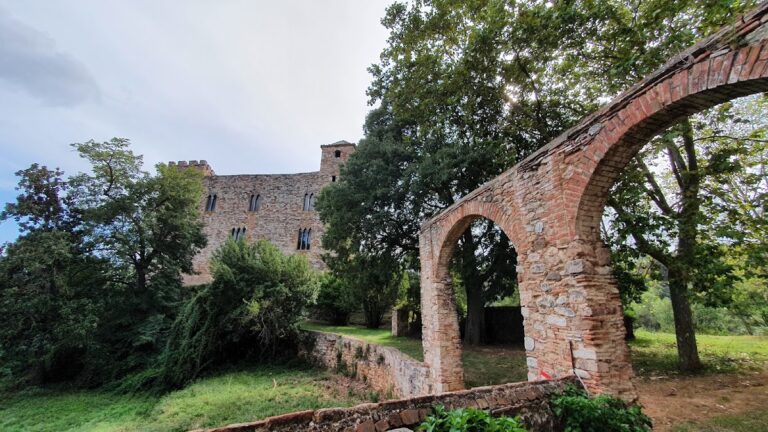
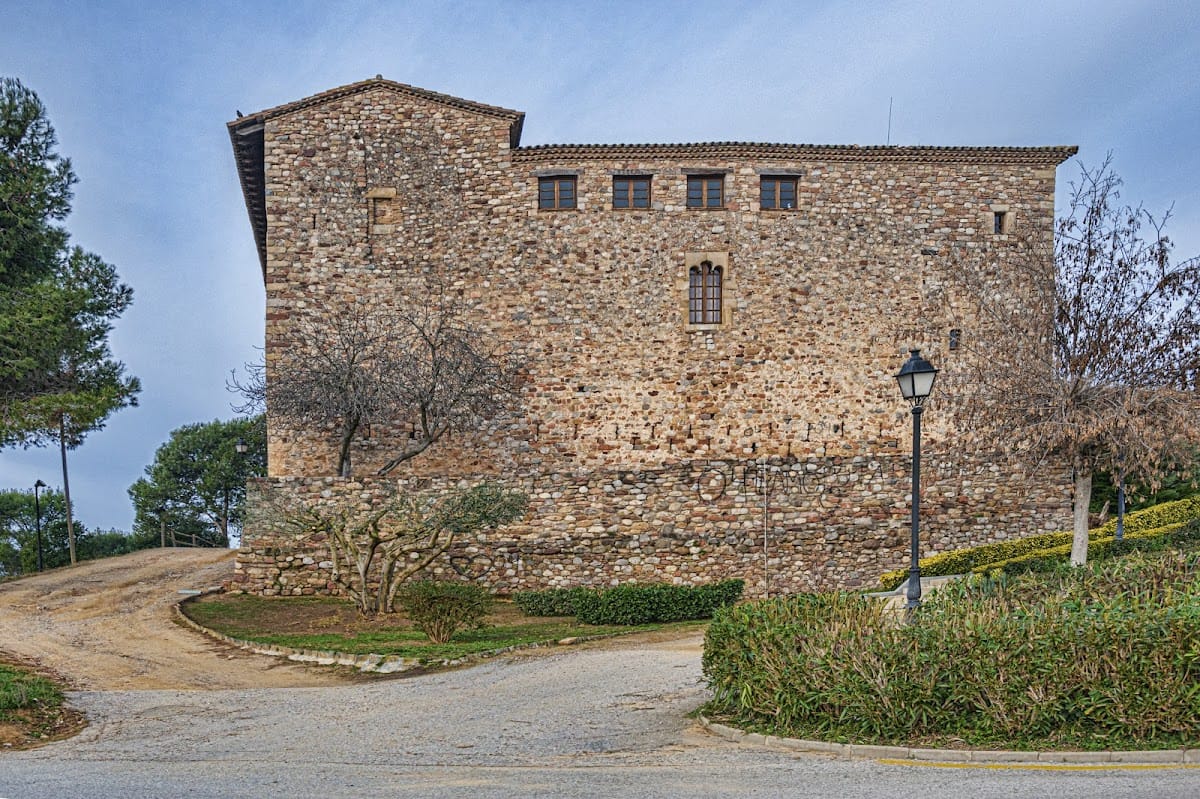
Castell de Plegamans stands on La Serra, the highest nearby hill east of Palau-solità i Plegamans. Its opposing buildings form a roughly square complex around a central courtyard, giving it the character of a large fortified residence. The building combines Romanesque and Gothic elements and contains a ground floor, first floor, attic, and courtyard.
Early tower and courtyard complex
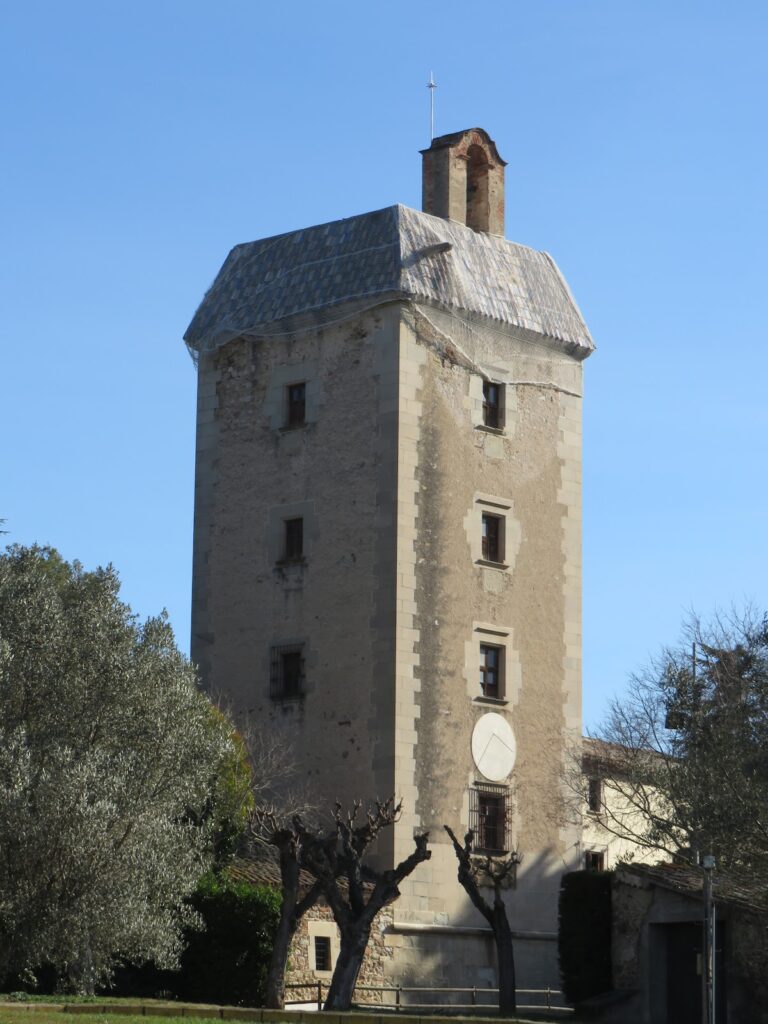
The oldest surviving component is a rectangular tower at the northeastern corner, probably built in the late tenth or early eleventh century. River stones bonded with lime form its walls, while the upper part was remodelled during the fourteenth and fifteenth centuries. An early enclosing wall created a courtyard beside the tower. Probably during the twelfth century, a large hall with two semicircular arches was added outside the southern side of the wall. Further dependencies were later attached, creating the present quadrangular arrangement.
An old bread oven survives at the base of the tower. Local tradition claims that a tunnel links the castle with the farmhouse of Can Cortès, although the existence of the tunnel has not been established.
Gothic residence
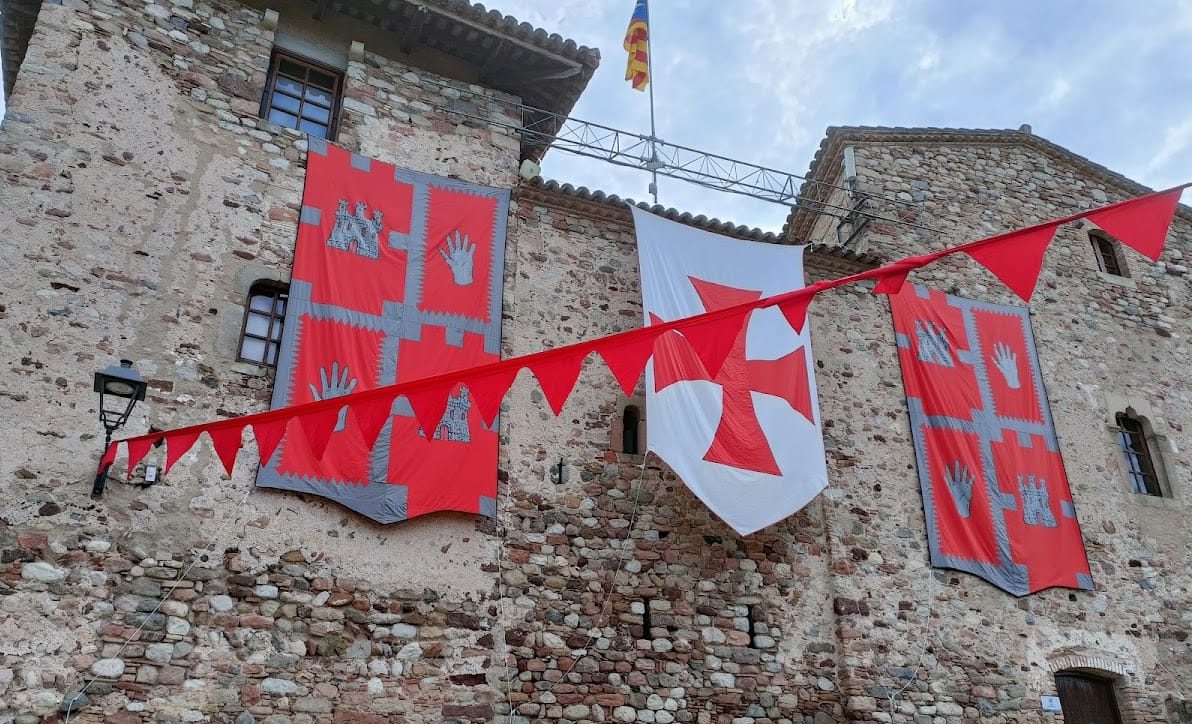
Rebuilding during the fourteenth and fifteenth centuries gave the complex its present character as a substantial Gothic residence. The southern façade contains lobed, mullioned Gothic windows, with some impost lines decorated by rosettes. The ceilings retain wooden coffered work, while the roof has been reconstructed with tiled coverings and exposed wooden trusses. Most of the roof has two slopes, whereas the western wing has a single-slope roof at first-floor level.
Entrance and defensive features
The northern entrance passes through a Gothic portal with a semicircular arch formed by wedge-shaped stones. Three arrow slits flank each side of the portal, and a machicolation is placed on its vertical axis. The eastern façade has thirteen arrow slits arranged alternately across two levels. These defensive features remain integrated into a residence whose architectural form developed through successive medieval additions and rebuilding. Following restoration, the castle is in good condition.
Nearby sites