San Andrés Castle: A Coastal Defensive Tower in Tenerife


Site at a Glance
- Rating
- 4.2
- Popularity
- Low
- Country
- Spain
- Primary era
- Early Modern
- Eras represented
- Early Modern
- Civilizations
- Spanish
- Site type
- Military
- Remains
- Castle
On this page11 sections
History
San Andrés Castle is a former Spanish military fortification in San Andrés, Spain, within the municipality of Santa Cruz de Tenerife. Its first tower was built around 1706, and its present circular form dates from a reconstruction after 1769. It belonged to Tenerife’s network of minor coastal defenses, protecting the shore, sheltering ships seeking refuge from pirates, and preventing enemy vessels from gaining the windward position needed to attack the forts of Paso Alto and San Miguel.
Plans and early construction
A defensive tower for the valley then known as the Salazar Valley or San Andrés Valley was proposed in 1697 by the captain general, the senior military and governmental authority in a Spanish territory, Count of Eril. The Count of the Salazar Valley offered to maintain the tower at his own expense, but a lack of funds and the demands of other wars delayed the project.
Historians attribute the first construction, around 1706, to Captain General Agustín de Robles y Lorenzana, who commissioned the engineer Miguel Tiburcio Rossel to investigate and build the tower. Its initial appearance is unknown. Floodwaters had already ruined it before 1740, and a later rebuilding was followed by another destruction caused by the waters of the ravine, a steep-sided seasonal watercourse, around 1769.
The circular reconstruction and military role
After the 1769 destruction, engineer Alfonso Ochando rebuilt the fortification in the circular form that survives as a ruin. The new castle helped end the valley’s earlier reputation as a “pirate port.” Over time, it served not only as a defensive tower but also as an armory, a prison, and an occasional short-term jail for local people accused of disturbances or minor offenses.
Following the reorganization of the militias, a half-company of militia artillerymen was established for the San Andrés Valley on 20 November 1774. The unit gathered at the tower on Sunday afternoons for artillery exercises. Its garrison and equipment varied with military needs and changes in command, while the castle helped resist pirate ships and attempted landings, especially those involving English, French, and Dutch vessels.
The attack of 1797
San Andrés Castle took part in Horatio Nelson’s failed attack on Santa Cruz de Tenerife in 1797. Nelson was a British admiral who commanded the assault. After the capitulation had been signed, currents carried unanchored British ships towards San Andrés. The castle’s commander, José Feo de Armas, did not know that the surrender had taken place and ordered the fortification to open fire.
The firing damaged the rigging of Nelson’s flagship, Theseus, and also struck Emerald. The British ships returned fire, while Rayo bombarded the San Andrés Valley. The castle’s response nearly caused Rayo to capsize, and Nelson’s guns failed to reach the fortification.
Communication with the main command at Castillo de San Cristóbal was limited to short, predefined bell signals because no direct coastal route linked the two defenses. During the 1797 incident, the castle had two guns, although one could not be used. The other burst after about 20 shots, killing one artilleryman and injuring several more.
Disarmament and protection
The castle remained active and comparatively well preserved until an order for its disarmament was issued in 1878. Later flooding caused serious damage, and a torrential flood in the 1890s left the structure in the ruined condition visible today. A royal order of 2 January 1924 declared it militarily and defensively obsolete, and the castle passed to the municipal authorities on 15 January 1926.
Spain’s general historic-heritage decree of 22 April 1949 protected the castle, which later became an Asset of Cultural Interest under Law 16/1985. This is a protected category within Spain’s heritage-law system. Its protection perimeter was defined in 1999, and it was placed on the Red List of Heritage in 2015 because of the risk of disappearance, destruction, or substantial alteration. The municipality of Santa Cruz de Tenerife owns the property.
In the mid-1980s, work to channel the Cercado Ravine was accompanied by redevelopment around the castle, including a stone wall and wooden fence. A commemorative monument marking the 215th anniversary of the 1797 campaign was inaugurated beside the fortification on 24 July 2012.
Remains
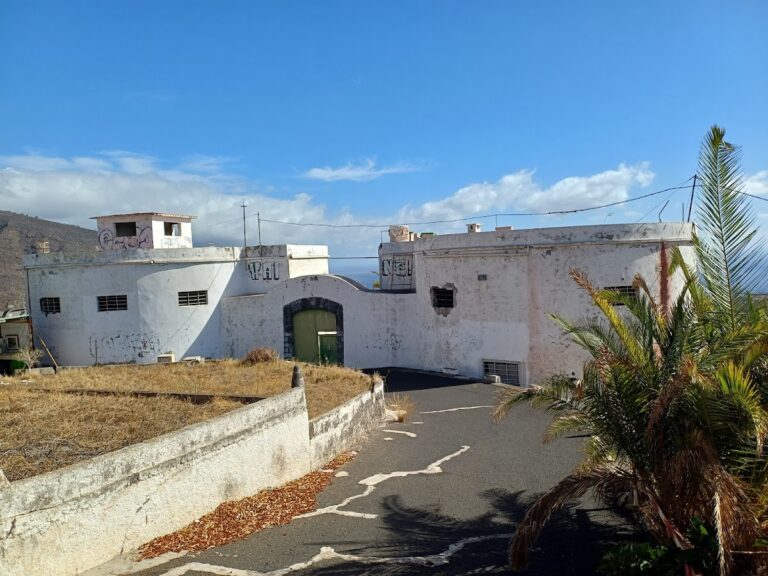
San Andrés Castle survives as a circular defensive tower between the confluence of the Cercado and Las Huertas ravines and the seashore, beside the urban center of San Andrés. Its position leaves it directly exposed to flooding during torrential rain. The main structure uses regularly cut ashlar stone blocks, while later features around it include a stone enclosure wall, a wooden fence, and the adjacent monument erected in 2012.
Circular tower
Masonry and entrance
The tower’s structural ashlar masonry is made from green diorite, a volcanic rock quarried nearby in the San Andrés Valley. A different reddish volcanic stone forms the upper perimeter band, the bell gable, and the ashlar blocks of the barrel vault, a continuous semicircular vaulted ceiling. The original tower was surrounded by a moat and reached by a wooden drawbridge made from tea wood, the dense heartwood of the Canary Island pine, and fastened with bronze nails. A bell gable marked the entrance and held a signal bell.
Lower level and water supply
The lower level contained vaulted spaces and could hold a small powder store. Two further vaulted rooms in the southern part of the tower accommodated the commander and as many as 50 members of the garrison. Rainwater was gathered in a cistern with a capacity of 11.7 cubic meters, providing an internal water supply for the fortification.
Upper level and artillery
The upper story was open to the sky and had a stone-paved floor. The defensive equipment included four culverins, long-barreled early modern cannons, and three other cannons; five cannons were installed in 1788. Artillery rammers, ladles, a worm, cannonballs, gunpowder, cartridges, and a bell formed part of the equipment associated with the tower.
Later surroundings
The circular rebuilding attributed to Alfonso Ochando belonged to a group of similarly constructed towers. It has been compared with the fortifications of Gando and San Pedro on Gran Canaria, El Cotillo and Caleta de Fuste on Fuerteventura, and Torre del Águila on Lanzarote. The later stone wall and wooden fence enclose the surrounding area, while the nearby commemorative monument carries a plaque describing the castle’s history and physical characteristics.