Aymavilles Castle: From Medieval Stronghold to Aristocratic Residence


Site at a Glance
- Rating
- 4.5
- Popularity
- Medium
- Country
- Italy
- Primary era
- Medieval
- External website
- Open
- Eras represented
- Medieval, Early Modern, Modern
- Civilizations
- Duchy of Savoy, Holy Roman Empire, Kingdom of Sardinia
- Site type
- Domestic
- Remains
- Castle
On this page17 sections
History
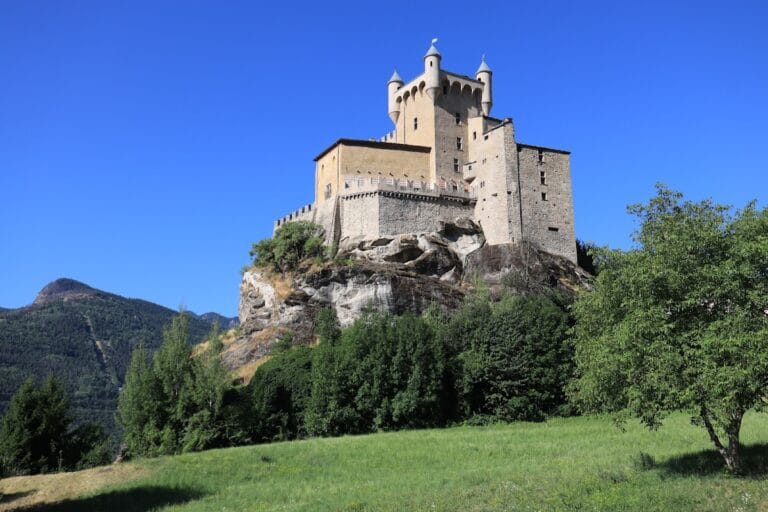
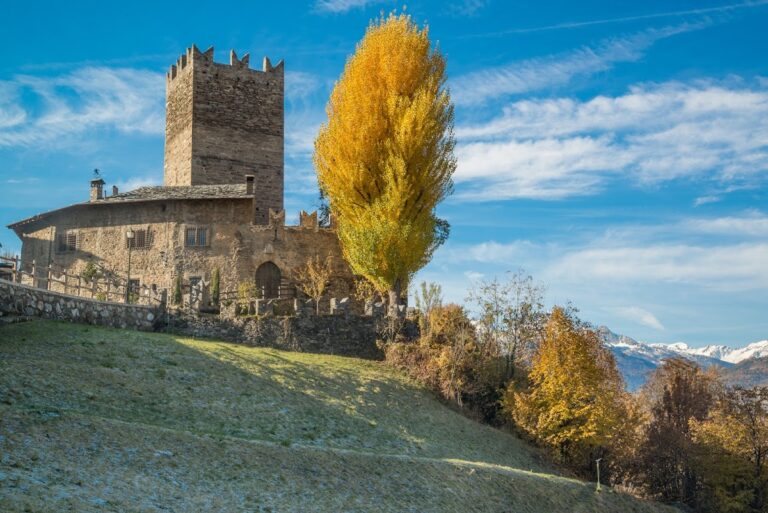
Aymavilles Castle is a medieval castle in Italy, first associated with 1287 and later given a predominantly Rococo character. It stands on a strategic glacial-debris hill above the central Aosta Valley, near the confluence of the Dora Baltea and Grand Eyvia. From this position, it controlled the valley route, including the Roman road between Mediolanum, modern Milan, and Lugdunum, modern Lyon, as well as the approach to Val di Cogne, where bardiglio marble was extracted.
Medieval foundation and the Challant-Aymavilles line
The earliest evidence connected with the castle dates to 1287. The first complex differed greatly from the building seen today. It was a fortified residence enclosed by a wall that could shelter and protect the local population in times of danger. Its position gave the stronghold both defensive value and control over movement through the valley.
In 1354, the counts of Savoy entrusted the castle to a branch of the Challant family. The family was a major noble lineage of the Aosta Valley, and this branch became known as Challant-Aymavilles. During this period, the keep, or principal fortified tower, gained an additional storey and was extended westward. Aymon II de Challant also ordered a second enceinte, meaning an enclosing defensive wall, together with a moat and drawbridge. These works expanded the castle’s defenses and strengthened its role within the local landscape.
Fifteenth-century expansion
At the beginning of the fifteenth century, Amedeo de Challant commissioned four corner towers and further reinforced the complex. Two towers carried Guelph motifs and two carried Ghibelline motifs. These represented opposing political alignments in medieval Italy, broadly connected with papal and imperial interests, and gave the towers a political meaning alongside their decorative function.
The towers, galleries, loggias, and defensive features formed the architectural ensemble that continued through later rebuilding. In 1413, after Amedeo de Challant married Louise de Miolans, the castle was reshaped as a prestigious residence. Amedeo’s son Jacques de Challant is also associated with the construction of the towers and with the fifteenth-century roof structure.
Transformation into an aristocratic residence
Between 1715 and 1728, Baron Joseph-Félix de Challant ordered the castle’s major conversion from a mainly military complex into a more comfortable and representative aristocratic residence. The external fortifications were largely demolished, while a park, a monumental entrance staircase, a fountain, and Baroque loggias were added. The resulting configuration remained broadly intact and gave the castle its predominantly Rococo character.
The Challant connection ended in 1857 with the death of Vittorio Cacherano della Rocca-Challant. He had inherited the castle in 1837 and modernized its interiors around 1840, including the halls and decorative schemes on the walls and doors. His collection of paintings, coins, books, and other precious objects was later lost. On 18 October 1804, Maurice-Philippe de Challant-Châtillon had died at the castle at the age of seven. He was described as the last male descendant of the Challant family.
Private ownership and the museum
After Challant ownership ended, the castle passed through several private owners. Count Clemente Asinai Verasis di Castiglione acquired it in 1870. By the late nineteenth century, it belonged to the Bombrini family, including Senator Giovanni Bombrini and the Genoese industrialist Raffaele Bombrini. The family used the building as a private residence for celebrations, weddings, and gatherings, particularly during the summer. Photographs preserved in the family archive record everyday life at the castle.
In 1970, the Italian state acquired Aymavilles Castle and later transferred it to the administration of the Autonomous Region of Valle d’Aosta. Regional planning for its conservation and conversion into a museum began in 2004. Restoration and museum works started in May 2013 and ended in December 2021, following approximately seventeen years of planning, restoration, and organization. The work examined the building’s archaeological, architectural, and decorative phases, including its elevations, interior decoration, weathered external walls, tower battlements, timber structures, and decorated plaster.
The castle officially reopened as a museum on 14 May 2022. Its permanent route presents the history of the families associated with the building, nineteenth-century collections, part of the Académie Saint-Anselme collection, and the architectural development of the castle. The Académie Saint-Anselme, founded in 1855 by lay and religious intellectuals, promotes learning and the preservation of Valle d’Aosta’s cultural heritage. Aymavilles Castle and the disused Pompiod mines, which cover 1.6 hectares, are recognized as a Site of Community Importance under code SIC IT1205034.
Remains
Hilltop plan and defensive structure
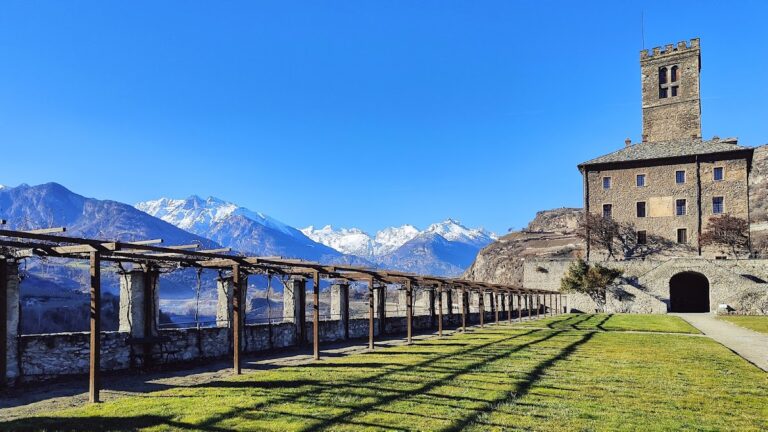
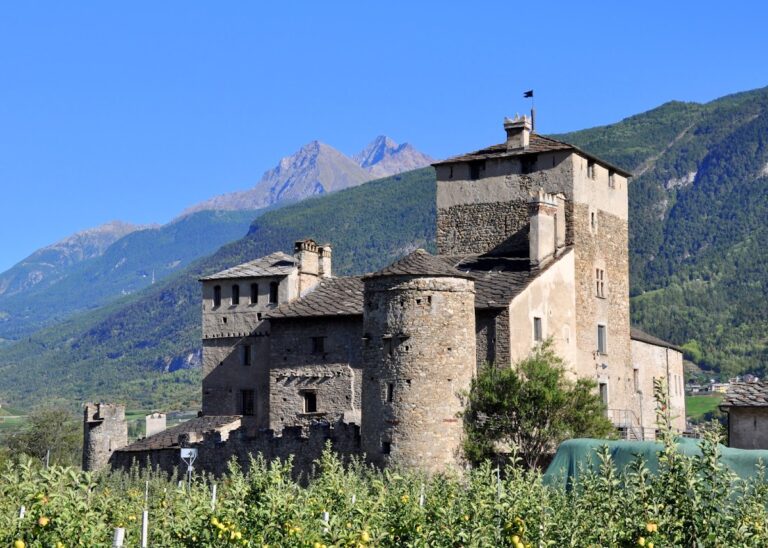
The castle is a quadrangular building on a morainic hill, a mound of glacial debris deposited by a glacier, that slopes toward the Dora Baltea and Grand Eyvia. Vineyards surround much of the site, which occupies a position above the valley. Stone, tuff, and local bardiglio marble form the principal construction materials. The medieval complex developed from a fortified residence with an enclosing wall into a larger defensive arrangement with a second enceinte, moat, drawbridge, and enlarged keep.
Corner towers and connecting galleries
Four slightly unequal cylindrical towers stand at the corners of the quadrangular building. Their battlements are raised protective elements along the tops of walls and towers, while projecting corbels provide supports beneath the upper structures. Galleries and loggias connect the towers, and further defensive structures were placed along the enclosing wall. The two towers bearing Guelph motifs and the two bearing Ghibelline motifs preserve the political symbolism associated with the fifteenth-century expansion.
Eighteenth-century architectural ensemble
The eighteenth-century remodeling is visible in the monumental entrance staircase, which has a double flight, and in the circular Baroque fountain. The park descends in terraces toward Aymavilles across rocky ground and follows the lines of the surrounding hilly, vineyard-covered landscape. An avenue shaded by horse chestnuts, poplars, lime trees, and other trees leads to the garden in front of the castle, where the fountain stands. The park forms part of the architectural ensemble and is used for cultural events and concerts.
Loggias and the Gallery
Baroque loggias occupy the spaces between the towers. The western loggia was enclosed by three large windows framed with pilasters made from local marble, creating a room known as the Gallery. Oval window openings, stucco decoration, and other late-Baroque details belong to the same transformation. Together, these elements express the change from a principally defensive complex to a residence designed for aristocratic representation.
Nineteenth-century interiors and museum displays
The restored interiors are presented in the appearance associated with the nineteenth century. Representative rooms contain painted and decorative schemes on walls, doors, and fireplace screens. Their subjects and styles combine Neo-Gothic motifs, chinoiserie, mythological scenes, naturalistic subjects, and Neo-Egyptian imagery. Vittorio Cacherano della Rocca-Challant promoted this decorative program in the early 1940s.
Ground and first floors
The museum route occupies four levels. The ground floor presents the Challant and Bombrini families through the main reception hall and the rooms known as the Challant Room and Bombrini Room. A lateral veranda overlooks the gardens and the surrounding Alpine landscape. The first floor is organized around a hall that mirrors the ground-floor salon. Its rooms contain nineteenth-century collections and material from the Académie Saint-Anselme, including natural-history and foreign objects, medieval material from Aosta and stone objects, coins and medals, and religious treasures and furnishings.
Madame Josephine’s rooms and upper levels
The second floor contains rooms associated with Madame Josephine, a nineteenth-century lady-in-waiting to Countess Teresa de Challant. Personal objects illustrate life in the castle, while additional rooms display weapons, furniture and household objects, and a small treasury.
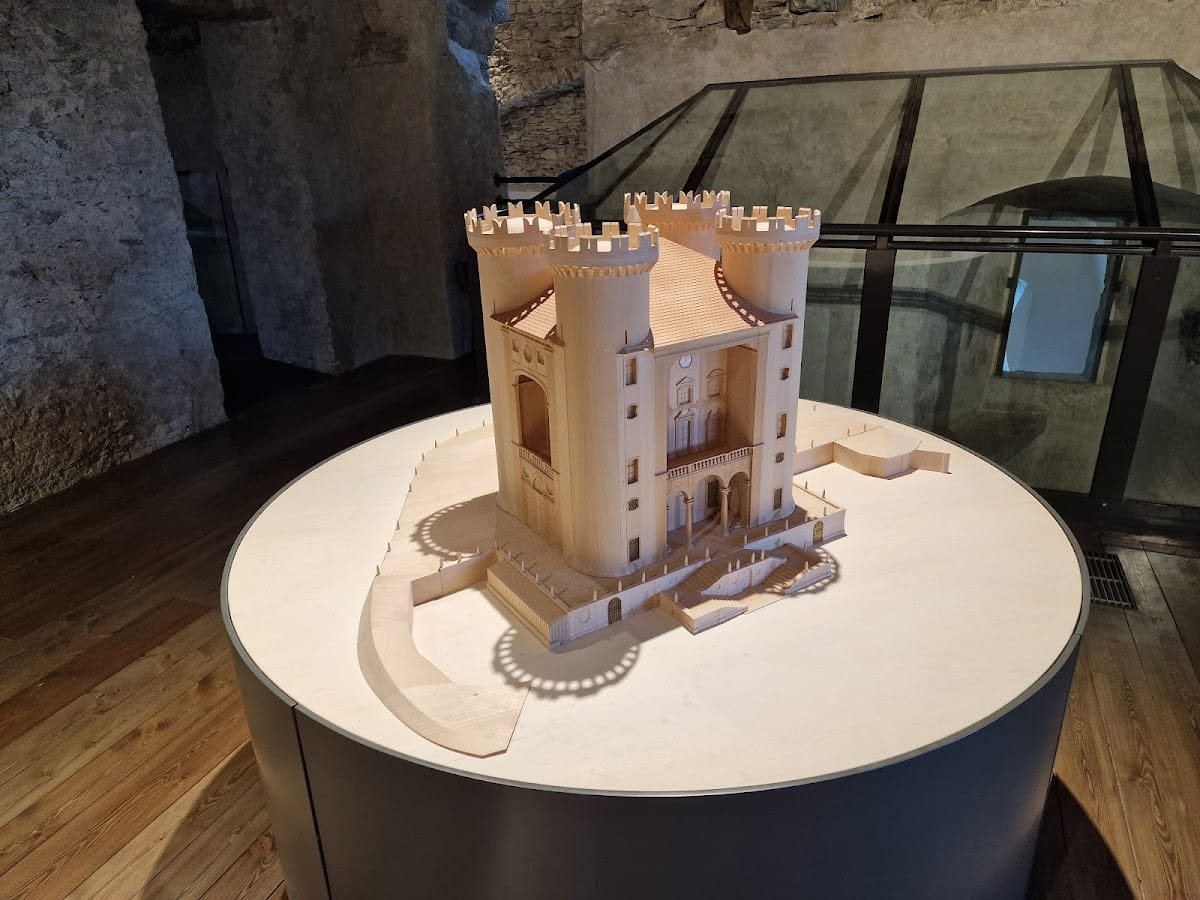
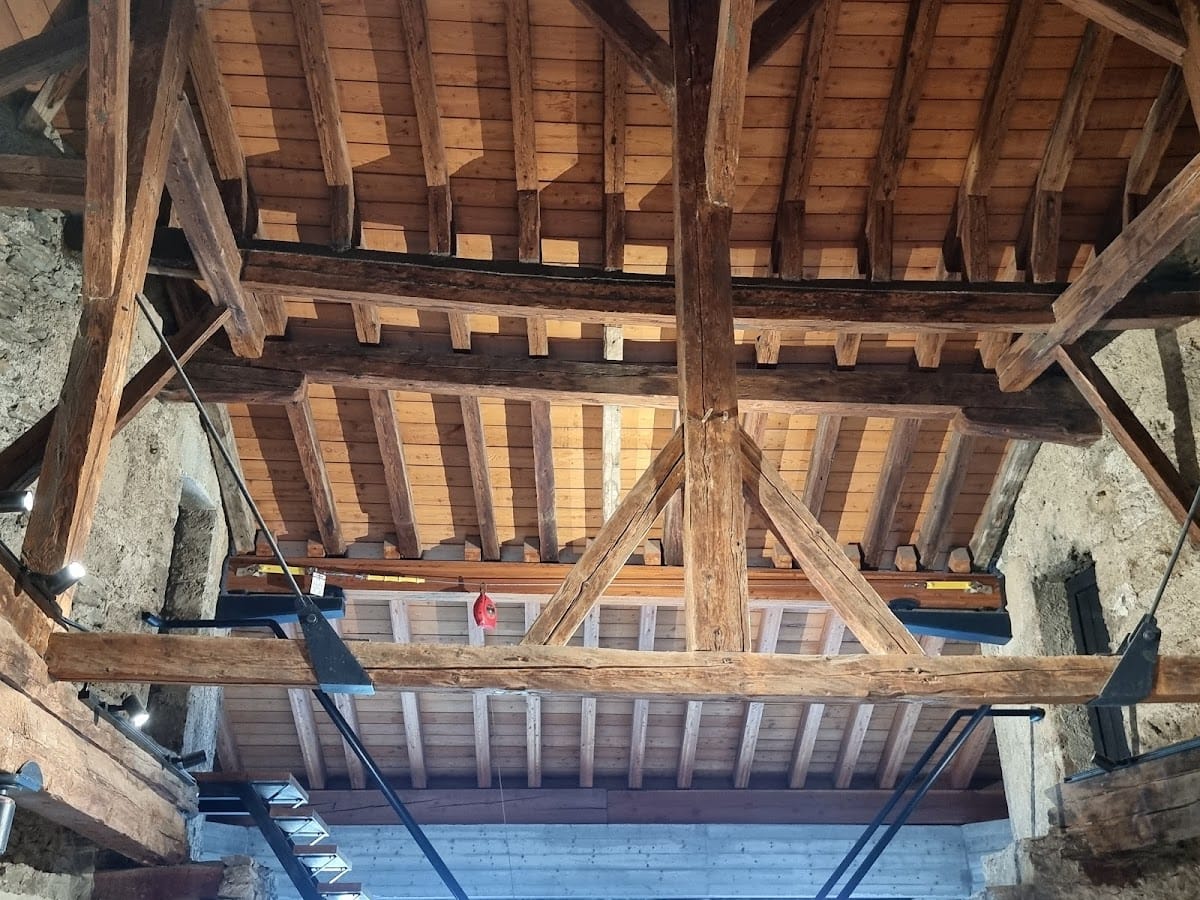
On the third floor, a room divided into two spaces uses three models and wall panels to explain the principal phases of the castle’s architectural evolution. Video projections provide further interpretation. Original timber roof trusses remain visible above, supporting the fifteenth-century ceiling and the roof of the structure. The attic level also incorporates the original timber roof system, dating from the middle of the fifteenth century, while multimedia installations present the successive transformations of the building.
Outbuildings and painted panels
A small one-storey building beside the castle has a traditional stone roof and originally served as stables. It has been restored. A second rural building in the historic ensemble is called the grandze, a Valle d’Aosta patois term meaning “farm.” Since 2020, it has been used for temporary exhibitions and cultural events.
Medieval painted panels
Several medieval painted panels were found in the attics during the nineteenth century. They show René de Challant, his wife Mencia, their daughters, and the Annunciation. The panels were probably parts of a polyptych, a multi-panel painted artwork often made for religious use. They were found in severely damaged condition and had been restored by 2005.
Académie Saint-Anselme sculpture
The Académie Saint-Anselme collection displayed in the castle includes a high relief of Saint Catherine of Alexandria made from alabaster plaster by Stefano Mossettaz, a fifteenth-century sculptor and architect active in Aosta.
Conservation of the fabric
Conservation work cleaned the exterior walls and tower battlements, which had been heavily affected by weathering, as well as the interior timber structures. Decorated plaster was consolidated and then examined through stratigraphic analysis, a study of successive material layers, to establish the sequence and development of the decorative phases.