Šumburk: A Gothic Castle Ruin in Czechia


Site at a Glance
- Rating
- 4.7
- Popularity
- Low
- Country
- Czechia
- Primary era
- Medieval
- Eras represented
- Medieval
- Civilizations
- Holy Roman Empire, Kingdom of Bohemia
- Site type
- Military
- Remains
- Castle
On this page12 sections
History
Šumburk is a Gothic castle ruin in Czechia, located about 3 kilometres west of Klášterec nad Ohří on the summit of Šumburk hill. The castle was probably established by Vilém of Šumburk after the Perštejn estate was divided on 26 October 1431, and construction was probably complete around 1435, when Vilém described himself as living at “New Šumburk.” The castle was first recorded under that name in 1435.
Names and foundation
Šumburk was also known as Šumná and Schönburg. The forms Schönburg and Neuschönburg, meaning “New Schönburg,” are historically associated with the castle. Since 1950, the site has generally been called Šumná. One historical hypothesis proposes that an older Schönburg stood elsewhere, possibly south of the hill, while the present ruin was the later Neuschönburg. The earlier site is thought to have disappeared, but its location and history remain uncertain.
Changing ownership in the fifteenth and sixteenth centuries
In 1449, after disputes with neighbouring nobles and conflicts over property, Vilém of Šumburk sold Klášterec nad Ohří and Šumburk to Vilém of Illburk. Illburk held the estate only briefly, after which it passed among members of the Kaufunk and Fictum families.
Members of the Fictum family repaired the deteriorating castle and enlarged the estate by acquiring Petlery and part of Miřetice, while selling several other properties. Felix of Fictum became the sole owner in 1486, but the castle was later held jointly by several Fictum brothers. In 1512, King Vladislav II, also known as Vladislaus II Jagiellon, granted the estate hereditary allodial status at the request of Opl of Fictum. This status meant that the estate was held as inheritable property rather than as a conditional feudal fief.
Opl of Fictum operated a counterfeiting workshop at Šumburk. When the workshop was exposed, he fled the country, and the king confiscated his share even though it had been transferred to Opl’s brothers. Members of the Šumburk family, descendants of the founder, reacquired two shares of the estate in 1543.
Fire, abandonment, and later history
The castle was damaged by fire during the sixteenth century and was not properly repaired afterward. By the latter part of that century, its owners no longer lived there, and the buildings fell into increasing neglect. The castle was not rebuilt and had become a ruin during the seventeenth century.
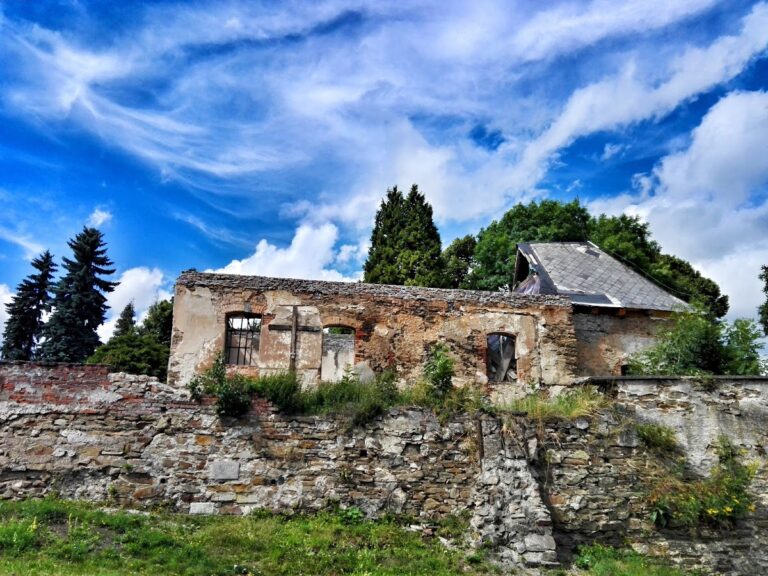
In 1623, the ruin was transferred to Christoph Simon, Baron von Thun, who owned the Klášterec estate. Šumburk and its associated farmstead subsequently belonged to the Thun and Hohenstein family until 1945. A farm court below the castle was renovated around the end of the sixteenth century and later rebuilt in the Baroque style. A settlement called Šumná, also appearing in several forms related to the name Schönburg, gradually developed around the farm court and survived until after 1945. The Baroque farmstead deteriorated into a ruin after 1946. Šumburk has been protected as a cultural monument of the Czech Republic since 1963.
Remains
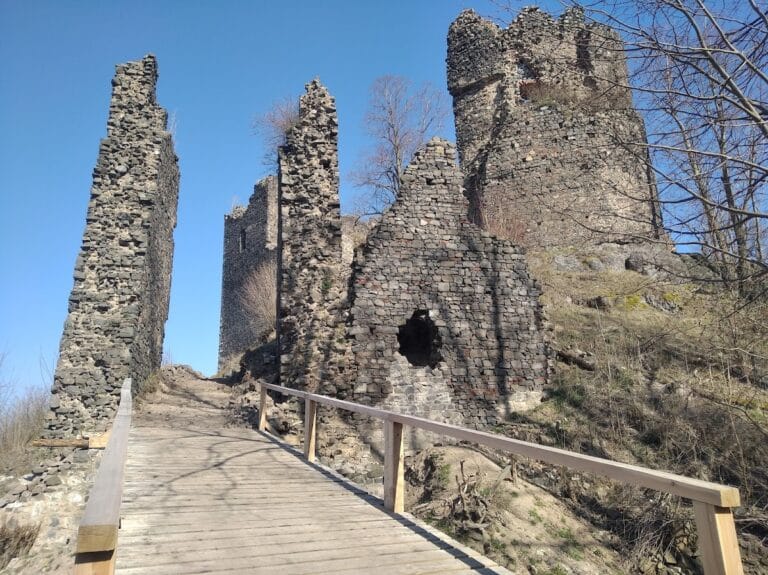
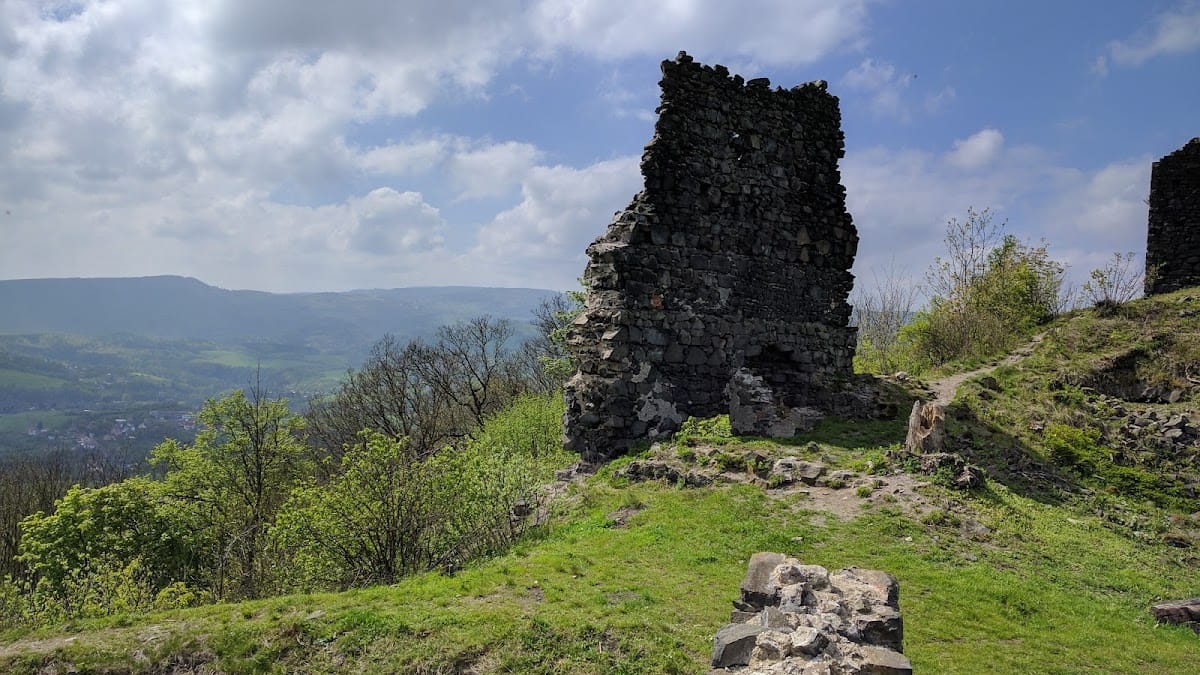
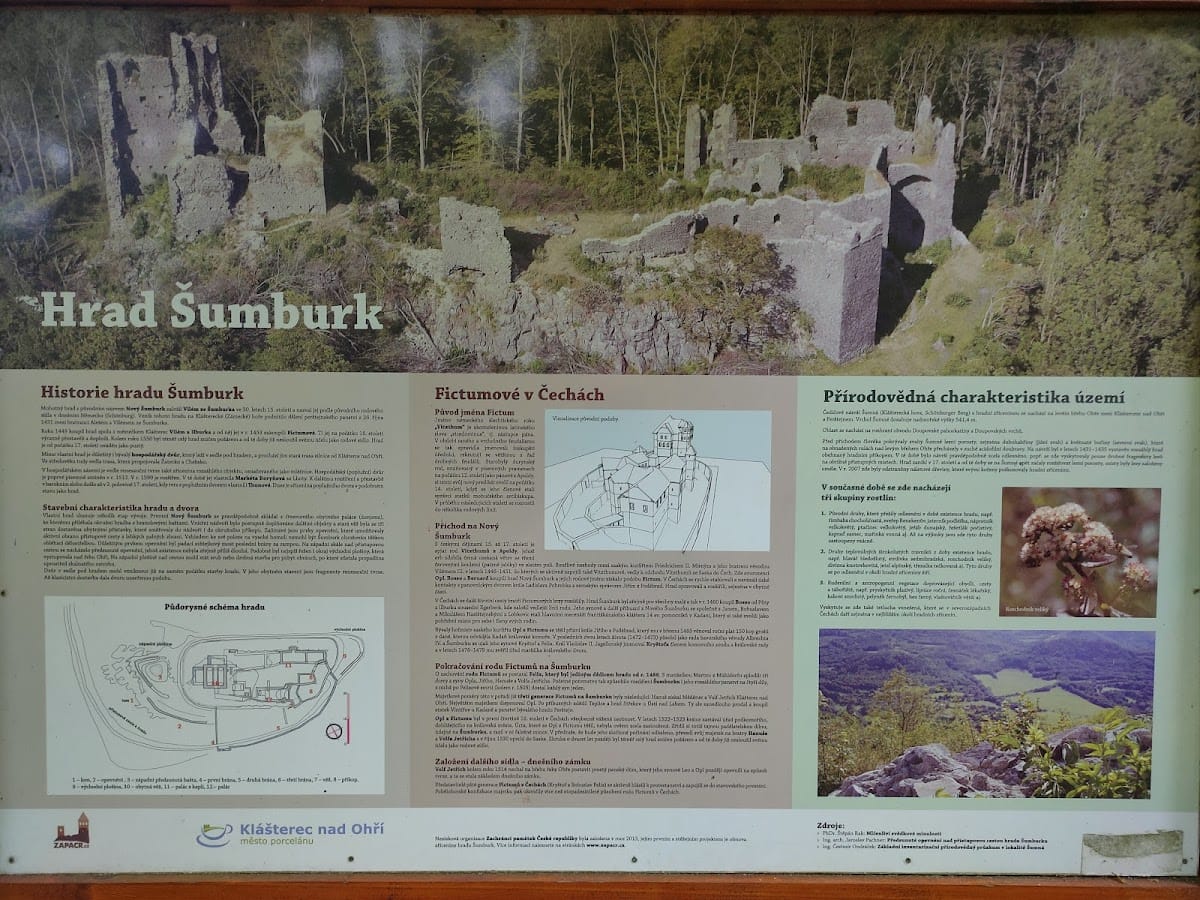
Šumburk occupies the summit of an isolated conical hill at approximately 540 metres above sea level. The castle core was arranged around a large residential tower and protected by a rock-cut ditch, walls, gates, and projecting defensive works. The elevated position was selected during the early development of firearms because the site was difficult for artillery to reach.
Defensive works and approach
Ditch and southern approach
A rock-cut ditch surrounded the castle core, with part of its front side lined in masonry. The approach rises along the southern slope and was later strengthened by a wall and divided by two screen gates. The final part crossed an artificial ramp and then a bridge over the ditch.
Gates and foregate
The first gate stood on three pillars joined by arches. Only one of these arches survives. Beyond the bridge, a third gate was formed by a pointed arch with a recess for a drawbridge. Openings for the drawbridge pivots were later blocked with masonry. The foregate had a fan-shaped plan and was protected by a bastion, a projecting fortification that strengthened the wall and provided defensive positions. Numerous loopholes, narrow openings for firearms, survive in the bastion.
Western advanced bastion
Below the residential tower, on the western edge of the castle, are the remains of a V-shaped wall built from stone laid without mortar. It has been interpreted as an advanced bastion that may have been linked to the main fortifications by a wall or by a palisade, a defensive barrier made from upright stakes or posts, set on a stone foundation.
Residential and service buildings
Residential tower
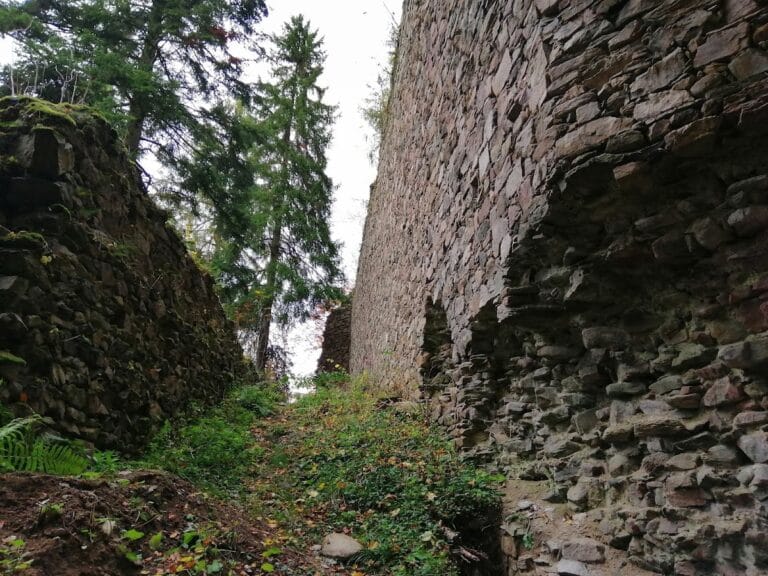
The dominant structure of the inner castle is a residential tower measuring about 12.5 by 12.7 metres. Its walls are approximately 1.7 metres thick, and the surviving masonry reaches part of the fourth storey. Later residential annexes were attached to three sides of the tower, with a series of corbels supporting privies.
The ground floor contained two rooms connected by a small semicircular portal and covered by barrel vaults. A barrel vault is a continuous, semicircular ceiling shaped like an extended half-cylinder. The rooms were probably entered through an opening in the vault. A portal about 3 metres above ground level led to the first floor, which was divided into three elongated rooms, also covered by barrel vaults. Each of the two upper floors contained one room, and the second-storey floor was covered with tiles.
Eastern palace
When the tower no longer met contemporary residential requirements, a new three-room palace was built on the eastern side of the courtyard. It stood opposite a large service and agricultural building. The palace wall facing the courtyard is about 80 centimetres thick and runs parallel to the fortification wall at a distance of 5.4 metres.
Channels for warm-air heating survive within the palace wall. The heating furnace has not been located, although it may have stood in a room near the gate, where the floor level is markedly lower. Larger sections of the palace, the outer walls, and the residential tower remain standing, while the castle as a whole survives as a ruin. The associated Baroque farm court below the castle is also ruined.
Nearby sites