Belfort Castle Ruin: A Medieval Castle in Switzerland
Site at a Glance
- Rating
- 4.8
- Popularity
- Low
- Country
- Switzerland
- Primary era
- Medieval
- External website
- Open
- Eras represented
- Medieval, Modern
- Civilizations
- Holy Roman Empire
- Site type
- Military
- Remains
- Castle
On this page13 sections
History
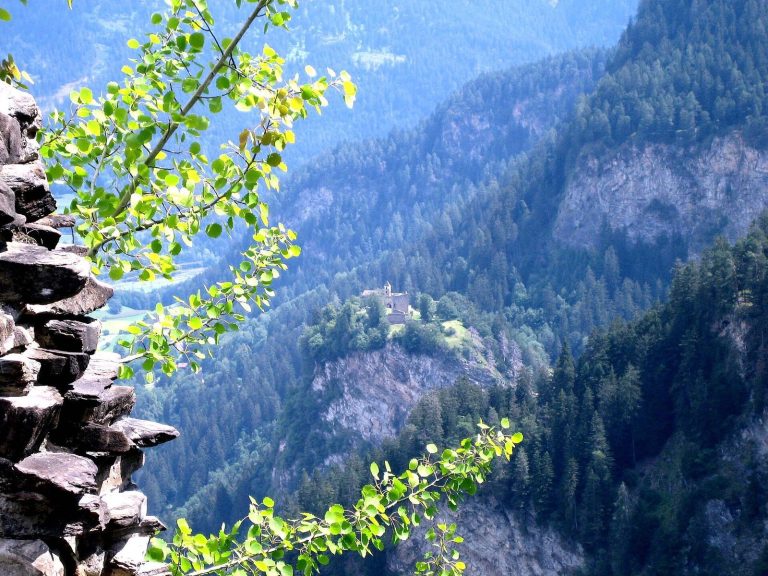
Belfort Castle Ruin is a medieval rock castle in Switzerland, built by the Lords of Vaz around the beginning of the thirteenth century on a ridge above Surava. Located in what is now Albula/Alvra in the Canton of Graubünden, the castle became the principal residence of this powerful noble family and expressed its claims to authority and princely status.
Foundation and expansion
The earliest castle on the site probably dates to around 1200. Belfort was first mentioned in 1222 as the property and residence of the Lords of Vaz, while dating of surviving wooden building elements places some construction between 1228 and 1231. The principal building campaign is also dated broadly to 1229-1233.
During the thirteenth century, the Lords of Vaz abandoned their earlier family seat at Nivagl near Zorten and moved their main residence to Belfort. They retained their established family name after the move. Around 1240, the complex was enlarged. The upper castle gained further residential buildings, the keep received another story, and a lower castle was built, apparently chiefly for protection rather than habitation.
Conflict and political change
In the late thirteenth century, Walter Vatz von Vaz allied with the Habsburgs, a major European ruling dynasty, against the Bishop of Chur, the senior ecclesiastical ruler of the Chur bishopric, and other local nobles. In 1287, the bishop’s representative Walter Caramamma was killed at Belfort. In 1332, another episcopal representative, Ulrich von Marmels, was executed there, probably after his capture in a battle near Filisur.
Donat von Vaz, the last male member of the Vaz line, died in 1337. Through his daughter Kunigunde, Belfort passed to the Counts of Toggenburg, a regional noble house, probably under Count Friedrich V von Toggenburg. A bailiff, an official who administered a lord’s property and collected its revenues, probably occupied the castle during this period. The surviving history of Belfort under Toggenburg rule is otherwise limited.
After the death of the last Toggenburg count, Friedrich VII, in 1436, the Belfort lands declared themselves free and joined the League of the Ten Jurisdictions, a late-medieval political alliance in the Alpine region. In the disputes that followed, Belfort initially passed to Wilhelm von Montfort-Tettnang and Heinrich von Sax-Misox. On 5 February 1438, they issued a charter to the people of Davos concerning occupation of the castle and its relationship with the Davos community.
Austrian claims and local resistance
From 1441, members of the Beeli family of Davos served as bailiffs at Belfort. They collected revenues and later exercised judicial and territorial authority on behalf of the castle’s lords. In 1475, the garrison consisted of a bailiff and two mercenaries. Niklaus Beeli was provisionally granted the castle’s lordship rights by Austria in 1486.
Ownership continued to shift during the fifteenth century. In 1466, Count Hugo of Werdenberg sold Belfort and associated castles, including Strassberg, to Sigmund of Austria. Local inhabitants refused to accept Sigmund’s authority, and in 1471 he pledged his interest in Belfort to Ulrich von Matsch. Austria bought the castle back from the Matsch family in 1477, provoking further protest and rebellion.
A fire in the western wall-walk around 1468 led to the enlargement of the palas, the principal residential building of a medieval castle, by two stories. In 1490, the castle walls were raised in an effort to strengthen the fortification.
Destruction and conservation
Belfort was destroyed during the Swabian War, the 1499 conflict between the Swiss Confederation and Habsburg-led forces. Graubünden forces stormed and burned the castle on 14 March to eliminate it as an Austrian stronghold. Bailiff Nikolaus Beeli had petitioned for Belfort to be spared, but his request failed. Charred window beams still preserve physical evidence of the fire.
Repairs and structural securing in 1935-1936 slowed the deterioration of the walls but substantially damaged the archaeological evidence, making later research into the buildings and settlement more difficult. A comprehensive restoration and rescue campaign from 2002 to 2007 stabilized the ruin, while metal stairs were installed to provide access to parts of the complex. Belfort is included in the Swiss inventory of cultural property of national and regional importance and is recognized as a Swiss heritage site of national significance. The Canton of Graubünden owns the site.
Remains
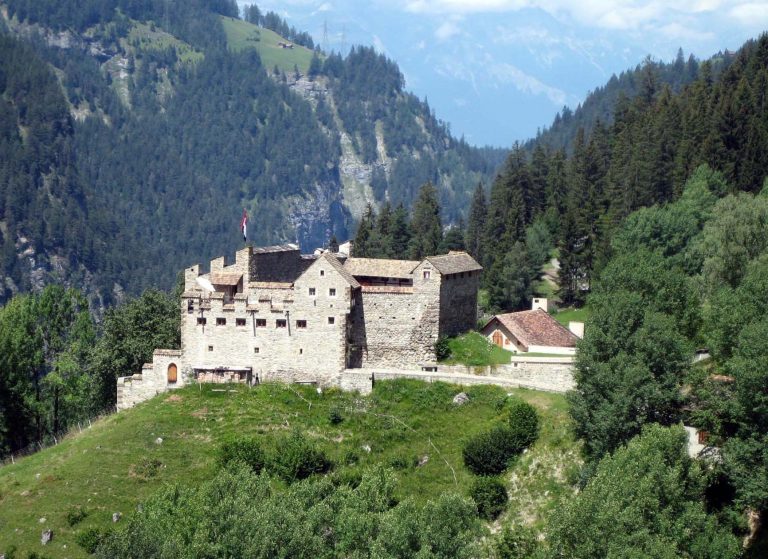
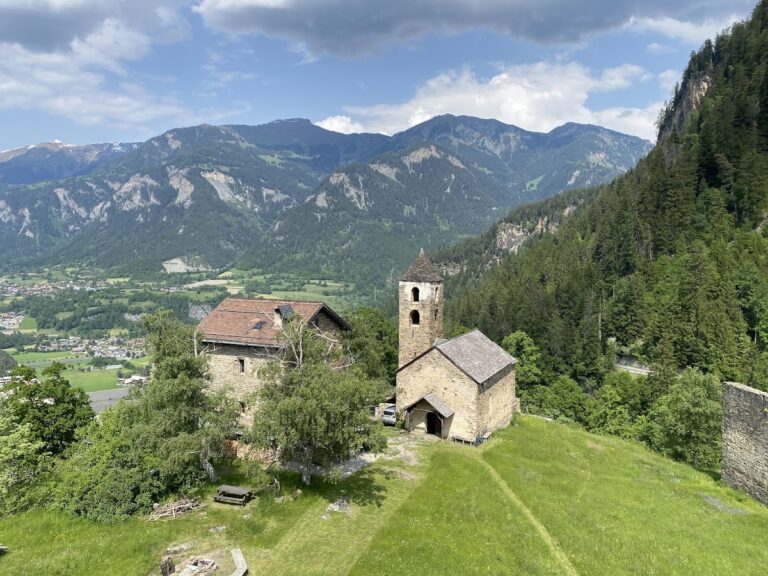
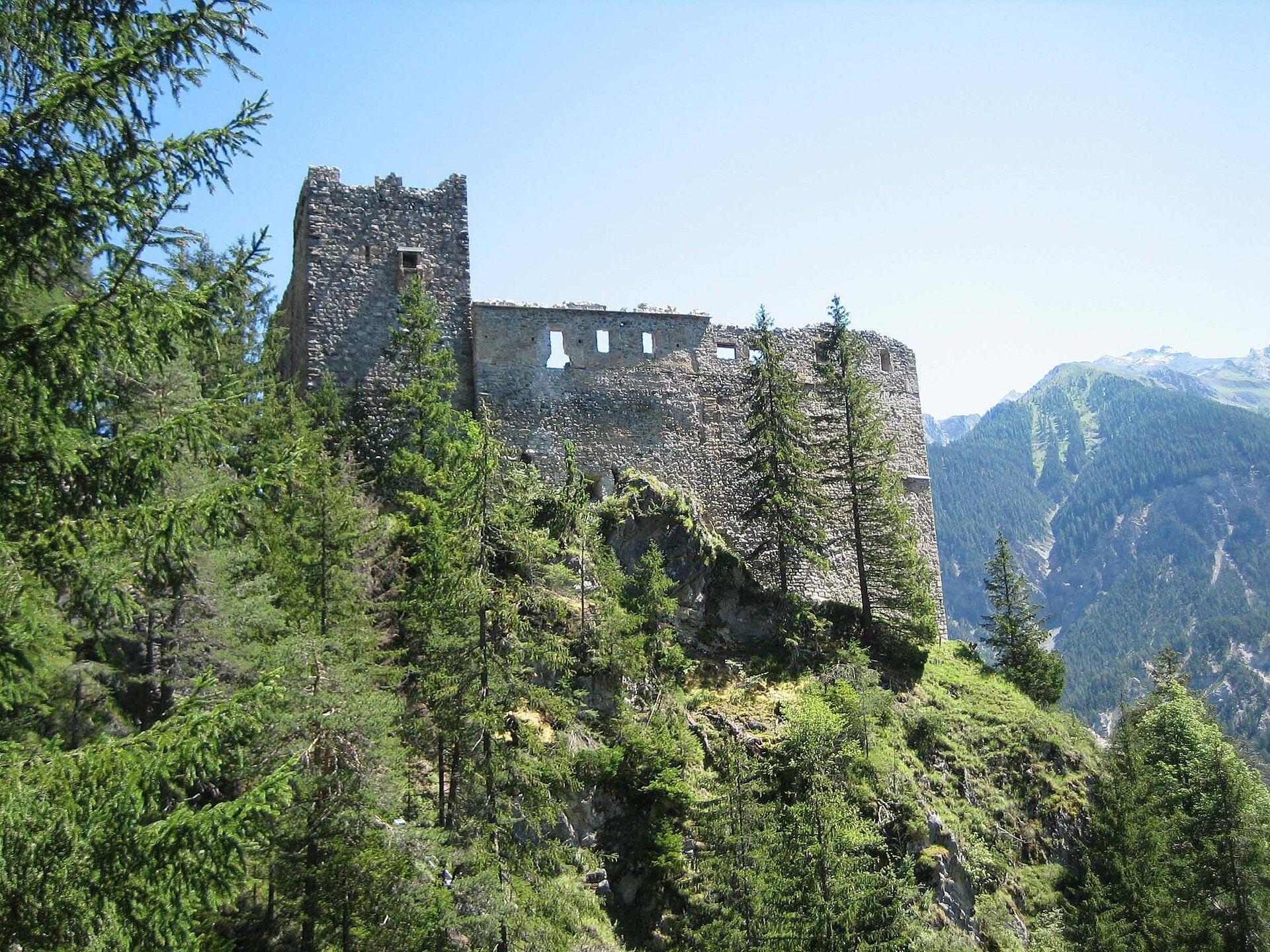
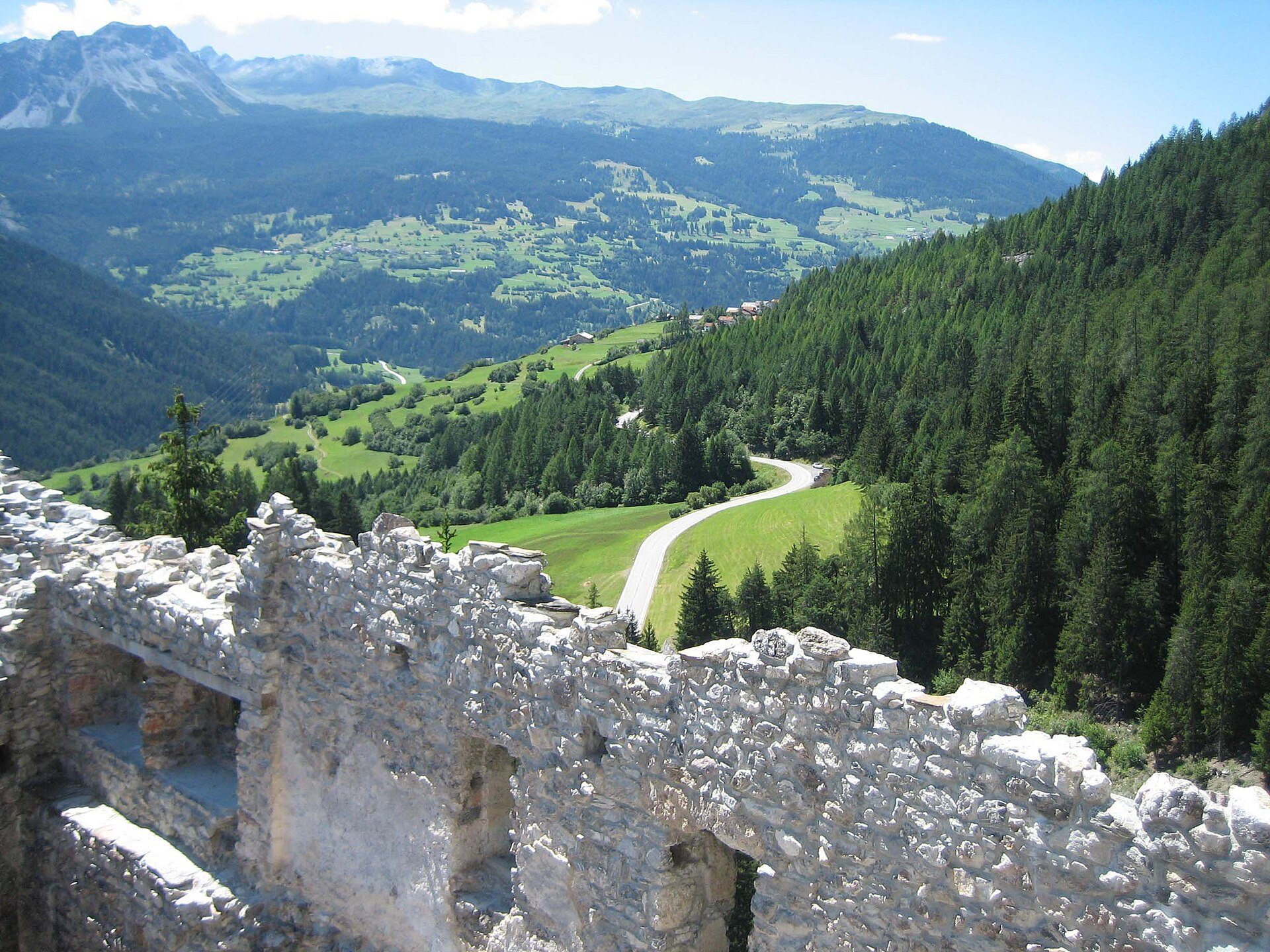
Belfort occupies a steep, rocky ridge at approximately 1,150 metres above sea level. The surviving complex is clearly divided into an upper castle and a lower castle. The upper section forms a rough pentagon around a central courtyard, while the lower fortification extends southward along the narrowing ridge. The buildings and walls follow the natural rock, with rock-cut stairs and ledges forming important parts of the access system.
Upper castle
Keep
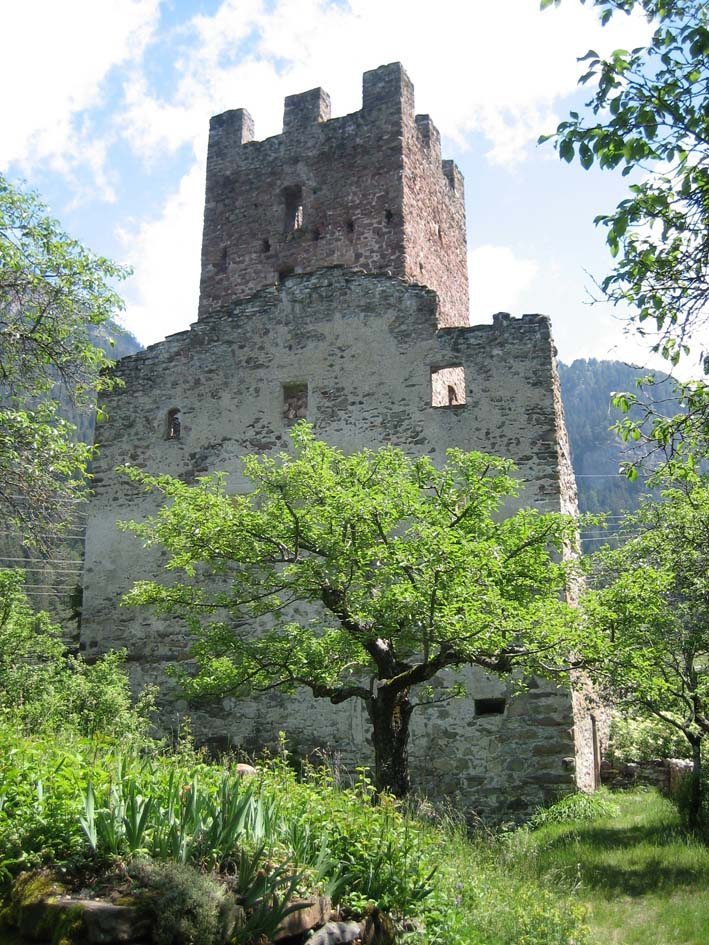
The oldest probable part of the upper castle is the massive square keep in its northwestern section. Its walls reach up to 2.3 metres in thickness, and the tower originally stood about 20 metres high. Several windows, a privy bay, and at least two upper floors suitable for habitation show that it served both defensive and residential purposes. An elevated entrance on the southern side opened at the level of the third floor, while external stairs from the courtyard led to the keep rooms.
The keep originally ended in a crenellated parapet. When the tower was raised, the crenellations were blocked, and the building was probably given a single-pitched roof descending toward the south. A horizontal roof of wood and glass now protects the surviving structure.
Gates and entrances
The original upper castle had a northern gate and gatehouse. The northern entrance was later closed, and a new entrance was formed on the eastern side. This approach ran along a narrow rock ledge and led directly into the courtyard, changing the way the upper castle was entered.
Residential wings
A five-story residential wing was later attached to the northern side of the keep. A visible masonry joint shows that it was built separately, while sockets for floor beams reveal the former divisions between its levels. A doorway on the northern ground floor was later blocked.
A smaller residential building stood along the western wall, and another ancillary building was built against the surrounding wall within the courtyard. These additions formed part of the upper castle’s changing residential arrangement as Belfort developed beyond its original tower.
Southern building complex
The southern part of the upper castle consists of a massive building complex that was altered several times. Its ground floor was divided by a passage once covered by a vault made from tuff blocks. The passage led through a gate, now vanished, toward the lower castle.
Plastered interior walls, windows, a privy bay, and fireplaces indicate residential rooms in the southern building. Its highest level contained a continuous hall measuring about 20 metres long and 8 metres wide. Round-arched entrances raised above the ground were reached from the courtyard. The surviving south wing probably dates from the late fourteenth or early fifteenth century.
Courtyard cistern
A round cistern was cut into the rock at the centre of the upper-castle courtyard. It extends approximately 5 metres below the surface and formed part of the castle’s water infrastructure.
Lower castle
The lower castle adjoins the southern wing of the upper castle and stretches south along the ridge. Its enclosing walls followed the eastern and western edges of the rock, with a larger wall crossing the southern end. A steep stairway carved into the rock connected the two fortifications.
The lower castle’s enclosing wall did not join the circuit of the upper castle. Instead, it disappeared into the rock, while evidence of additional construction survives at the southwestern corner. The area is now filled with rubble from the collapsed southern facade of the upper castle. It apparently became less important after the southern wing was built and was later abandoned.
Surviving remains include portions of the outer walls, the keep, the five-story residential wing, the gatehouse, the courtyard cistern, and the rock-cut access features. The northern upper-castle ruins were repaired and reinforced in 1935-1936, and the entire site was cleaned and repaired in 2002.