Blansek Castle: A Medieval Stronghold in the Czech Republic


Visitor Information
Google Rating: 4.5
Popularity: Low
Google Maps: View on Google Maps
Country: Czechia
Civilization: Medieval European
Remains: Military

History
Blansek castle is located in the municipality of Vavřinec-Sloup v Moravském Krasu in the Czech Republic. It was constructed in the latter half of the 13th century by the Bishop Bruno of Olomouc, a figure associated with the ecclesiastical leadership of the region.
From its founding, the castle became the administrative center of a fiefdom that included over thirty manors. By the late 14th century, the castle was granted as a fief by the local bishop, a common practice in medieval Europe to delegate authority and control. In 1396, Bishop Mikuláš of Riesenburk bestowed the castle upon Erhart of Kunštát and Skal, initiating a sequence of noble ownership.
The early 15th century saw a series of transfers: Aleš of Kunštát and Lysice held the property beginning in 1400; by 1417, Vilém Zajíc of Valdek assumed control, maintaining it until 1420. Following this, the Studnice family became the lords of Blansek until 1435. During the Hussite Wars, a religious conflict that deeply affected Bohemia and Moravia, Blansek served as a defensive stronghold for Bishop Jan Železný, who opposed the Hussite forces. The castle reportedly endured sieges in 1424 and again in 1431, although historical evidence suggests it was neither captured nor severely damaged during these confrontations.
Later in the 15th century, Bishop Pavel of Miličín managed to retain the castle in his family’s possession despite earlier promises to hand it over to Vok V of Holštejn. This period also featured Blansek as a venue for political gatherings, as demonstrated by a documented meeting of episcopal vassals held there in 1440.
By the year 1461, records note Blansek as deserted and ruined by fire, indicating the end of its role as a residential or administrative site. Despite this destruction, local traditions recount a brief use of the castle’s remaining structures as a defensive position against Swedish forces during the Thirty Years’ War in the 17th century. Since 1964, the castle ruins have been formally protected as part of the cultural heritage of the region.
Remains
The surviving site of Blansek castle consists of a compact core area approximately 70 meters long and 25 meters wide. This core included the main palace, reflecting its origin in the 13th century under Bishop Bruno. Before 1349, the castle’s defensive capabilities were expanded with the construction of a large outer bailey—a fortified courtyard—set apart from the inner castle by a double moat, a water-filled ditch that provided an additional layer of security.
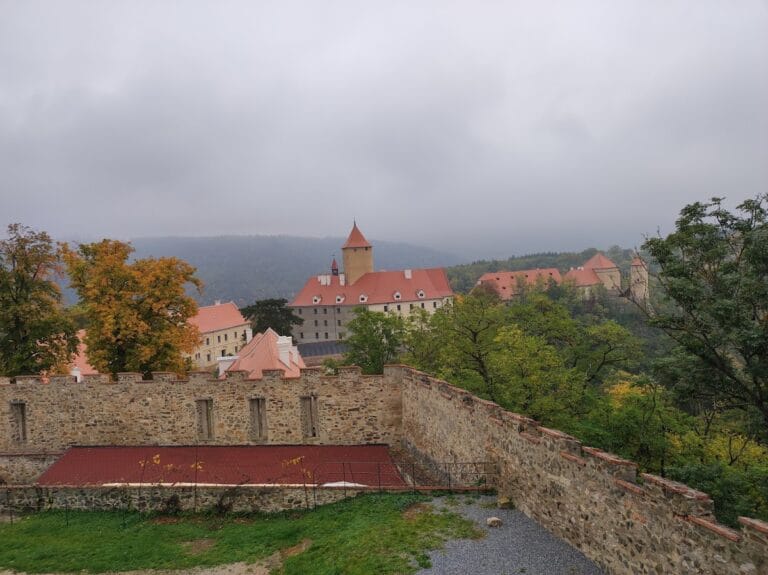
Today, the remains include fragments of the palace itself along with portions of the defensive walls that once encircled the castle’s heart. Visible ruins of the outer bailey further illustrate the defensive layout intended to protect both the living quarters and the wider estate. The walls were constructed primarily of masonry, a common medieval technique using stone and mortar to form durable fortifications.
In the 1930s, some sections of unstable masonry were deliberately dismantled to prevent dangerous collapses onto the nearby roadway leading to the Punkevní Caves. These caves lie directly beneath the hill on which the castle stands, emphasizing the close relationship between the site’s elevated position above the Punkva River valley and its surrounding landscape. The castle ruins face north toward this deep natural gorge known as the Macocha Abyss, situated about half a kilometer away.
Despite some preservation efforts, the ruins remain fragile, with portions of the wall crowns—the uppermost parts of the castle walls—loose and at risk of falling into the valley below. These conditions reflect both the site’s considerable age and the challenges of maintaining medieval structures exposed to natural decay over many centuries.
Nearby sites