Týnec nad Sázavou Castle: A Medieval Guard Castle in Czechia
Site at a Glance
- Rating
- 4.5
- Popularity
- Low
- Country
- Czechia
- Primary era
- Medieval
- External website
- Open
- Eras represented
- Medieval
- Civilizations
- Holy Roman Empire, Kingdom of Bohemia
- Site type
- Military
- Remains
- Castle
On this page10 sections
History
Týnec nad Sázavou Castle is a medieval guard castle in Czechia whose history reaches at least to the eleventh century and whose surviving core combines Romanesque and Gothic architecture. It stands on the left bank of the Sázava River, on a hill protected by a deep ravine and the Janovický Stream. Its original purpose was to guard merchants travelling through the surrounding area.
Early fortification and medieval owners
Archaeological finds made around the turn of the 1870s and 1880s indicate that a castle existed here as early as the eleventh century. The first fortification was built of wood and was later replaced by a stone castle that included a Romanesque rotunda. Romanesque architecture, a medieval style known for massive masonry, rounded arches, and compact forms, shaped the earliest surviving part of the complex.
The identities of the first owners are unknown, although one may have been a ruler of Bohemia. The earliest documented owner was Oldřich of Týnec, recorded in 1318. His successors, the Medeks of Valdek, retained the castle until the fifteenth century. Members of this family included Zdeněk of Valdek, Zdeněk Medek, and Protiva of Valdek.
Changing ownership and decline
After the Medeks, Týnec passed through several hands. Litvín of Kinštejn acquired the castle in 1498. The Hodějovský family of Hodějov followed and united the Týnec and Konopiště estates. After their property was confiscated, Albrecht of Valdštejn acquired the castle. He was a Bohemian nobleman and military commander of the early seventeenth century. Pavel Michna of Vacínov, another Bohemian nobleman and landowner, later purchased the local estate.
From the beginning of the seventeenth century, the castle no longer suited the needs of its lords and began to deteriorate. The Counts of Vrtby, a Bohemian noble family, acquired it together with Konopiště at the beginning of the eighteenth century, but the decline continued.
Restoration and modern use
In the middle of the eighteenth century, Marie Anna O’Kelly took over the castle’s administration and restored it to a habitable condition. After 1918, the usable parts of the complex served as apartments. The castle was briefly owned by František Xaver Jiřík, director of the Museum of Decorative Arts in Prague, before it was eventually purchased by the Czechoslovak Hussite Church. This Christian denomination combines elements of the Hussite tradition with modern Czech religious practice.
Since 1965, Týnec nad Sázavou Castle has been protected as a cultural monument of the Czech Republic. The grounds also contain the Týnec Rotunda natural monument, a legally protected natural feature designated because bats nest there. The castle now accommodates the town museum, religious services of the Czechoslovak Hussite Church, exhibitions, and cultural events. A permanent exhibition focuses on Týnec stoneware, produced by a small local factory that was among the earliest factories of its kind in Bohemia.
Remains
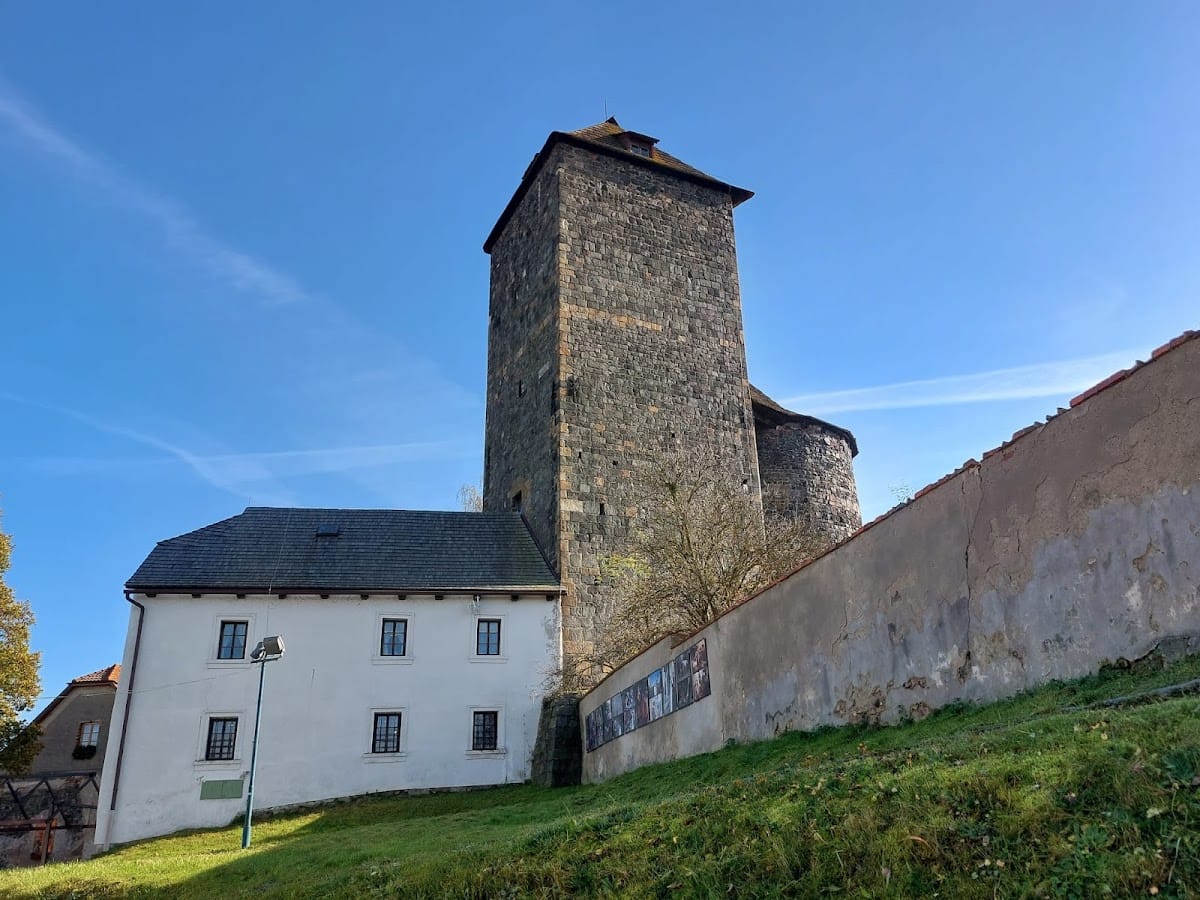
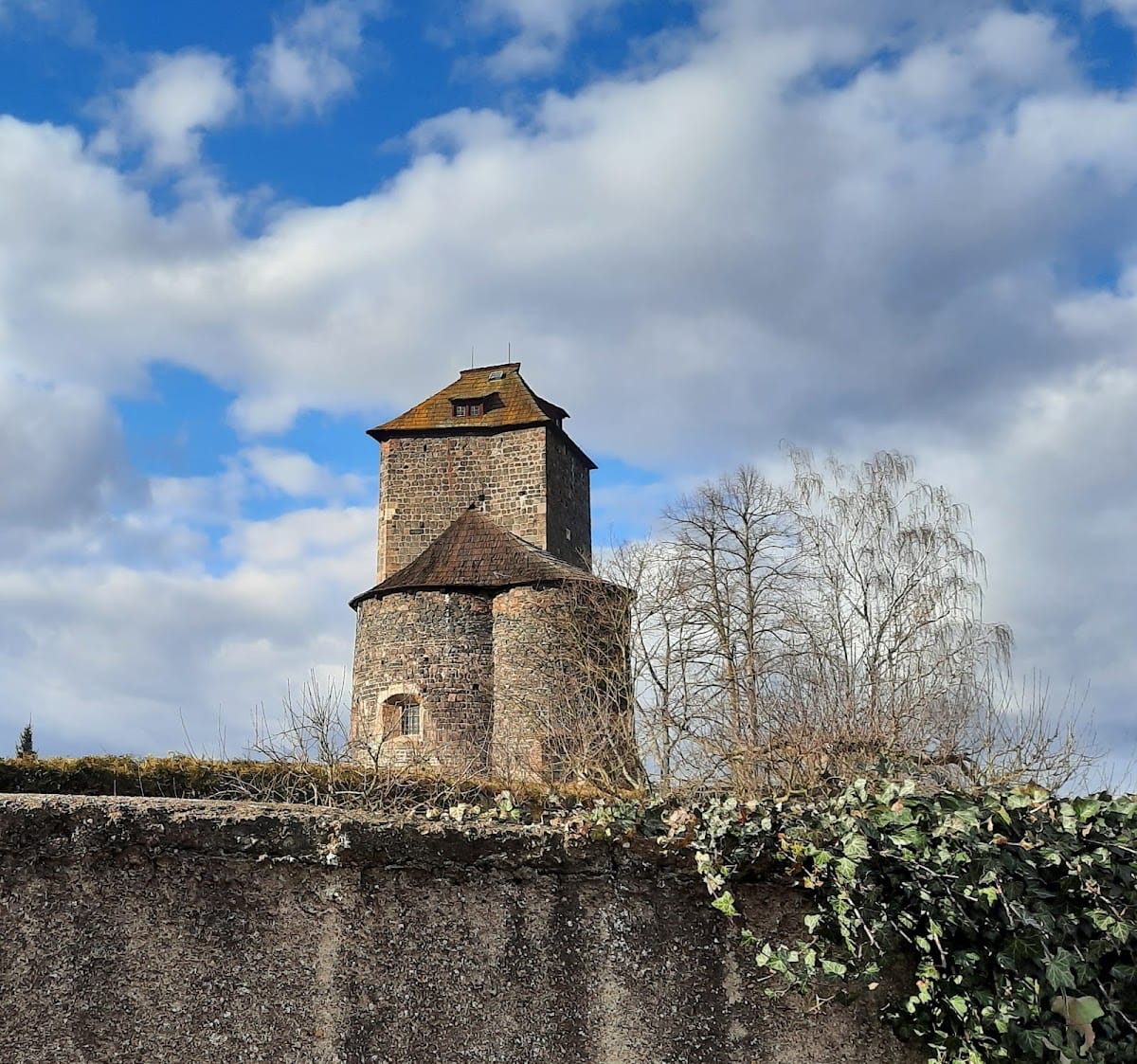
The surviving castle core consists of the Romanesque rotunda, a rectangular tower, and the rebuilt spaces of a former palace. Together they preserve a mixture of Romanesque and Gothic elements. The protected complex extends beyond these central buildings to include their immediate surroundings, the northern and southern parts of A. Hodějovský Courtyard, both access roads, the gate, and grounds south, southeast, west, and southwest of the tower.
Castle core
Saint Wenceslas Rotunda
The Rotunda of Saint Wenceslas is the oldest surviving monument in Týnec nad Sázavou. Built as part of the early stone castle, it was later converted into the castle chapel. Religious services continue to be held inside the rotunda, whose Romanesque form remains a defining part of the castle core.
Rectangular tower
The rectangular tower rises beside the rotunda and contains a viewing platform on its highest floor, with views over Týnec and its surroundings. Its exhibition spaces host regular displays. The tower also provides a summer refuge for the greater mouse-eared bat, linking the building to the protected natural value of the castle grounds.
Former palace
The former palace survives in rebuilt form and houses the town museum. Its present appearance reflects the later reconstruction of the palace spaces within the older castle complex.
Protected surrounding buildings
The protected area includes the house north of the tower that contains the town museum and the house south of the tower, which contains medical offices. It also covers buildings southwest and west of the tower, houses at A. Hodějovský Courtyard numbers 47, 49, 51, 59, 63, and 174, and the building at number 174, which contains the Pod Věží wine bar. The Mono wood-modelling workshop and the rectory on Benešovská Street are also part of the complex.
Associated courtyards, roads, grounds, and the site of a former southeastern wing complete the protected castle area. These elements preserve the wider spatial framework around the rotunda, tower, and rebuilt palace rather than limiting the monument to the central medieval buildings.