Kožlí: A Gothic Castle Ruin in Czechia
Site at a Glance
- Rating
- 4.5
- Popularity
- Low
- Country
- Czechia
- Primary era
- Medieval
- External website
- Open
- Eras represented
- Medieval
- Civilizations
- Holy Roman Empire, Kingdom of Bohemia
- Site type
- Military
- Remains
- Castle
On this page10 sections
History
Kožlí is a Gothic castle ruin in Czechia, built before 1318 by Kunrát of Chvojno. Its name first appears in 1318 in the designation used by Ctibor of Kožlí. In medieval usage, a designation such as “of Kožlí” indicated a noble person’s association with a place or estate rather than necessarily a hereditary surname.
Early Lords and Late Medieval Use
In 1363, the brothers Konrád and Heřman used Kožlí as their territorial designation after previously being associated with nearby Chvojen. The lords of Kožlí held the patronage right over the Church of Saint James at Chvojen, a legal privilege involving influence over the appointment of clergy and the church’s administration. The castle remained in the hands of poorer lower nobility into the late fourteenth century, and in 1399 it was recorded as a base for raiders.
Petr of Pětichvost, an ally of King Wenceslaus IV, owned Kožlí in 1404. The castle later became closely associated with the Libún family of Dubá. Beneš III Libún of Dubá first adopted Kožlí as his territorial designation in 1414. He held important political offices, took part in the victorious Battle of Lipany, and participated in the capture of Ostromeč Castle.
Transformation and Abandonment
Beneš III’s son, Beneš IV Libún of Dubá, lived at Kožlí with his wife, Buzka of Makov. During their period, the castle ceased to serve as a residence. In the early 1490s, ownership passed to the Šternberk family, who also owned neighboring Konopiště Castle. Kožlí was listed in 1495 as the Kožlé fortress within the Konopiště estate.
The castle declined during the sixteenth century and was later abandoned. By the end of that century, written records described it as deserted. In 1835, during a summer journey through the Sázava region, the Czech Romantic poet Karel Hynek Mácha visited the ruin. He may have drawn it, but no surviving evidence confirms that possibility; the site appears as Kožly in the inventory Castles Seen. Kožlí has been protected as a cultural monument of the Czech Republic since 1965.
Remains
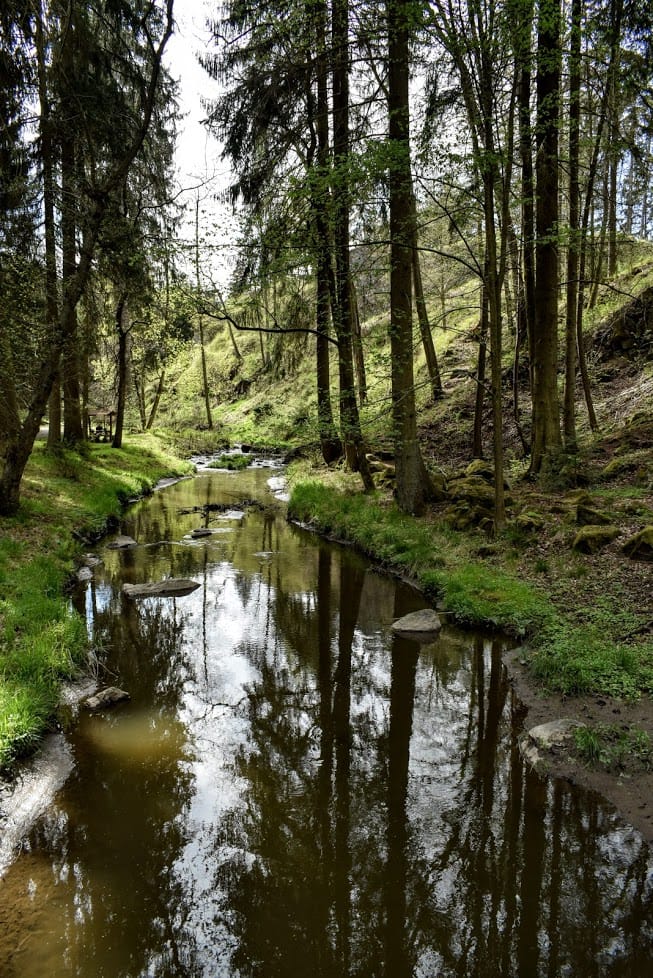
Kožlí occupies a promontory above the confluence of the Tisemský and Janovický streams, at the foot of Chlum Hill. The complex extended across the northeastern part of the Tisem cadastral area, near the meeting point with the cadastral areas of Benešov u Prahy and Přibyšice. It consisted of an outer bailey, an enclosed area outside the principal stronghold, and an inner castle divided by a deep ditch cut into the rock.
Outer Defenses and Entrance
Bailey and Ditch
The outer bailey and inner castle were separated by the rock-cut ditch. Communication between the two sections probably occurred across a drawbridge. The bridge was positioned at a small entrance-gate tower standing in front of the defensive-wall line.
Parkan Wall
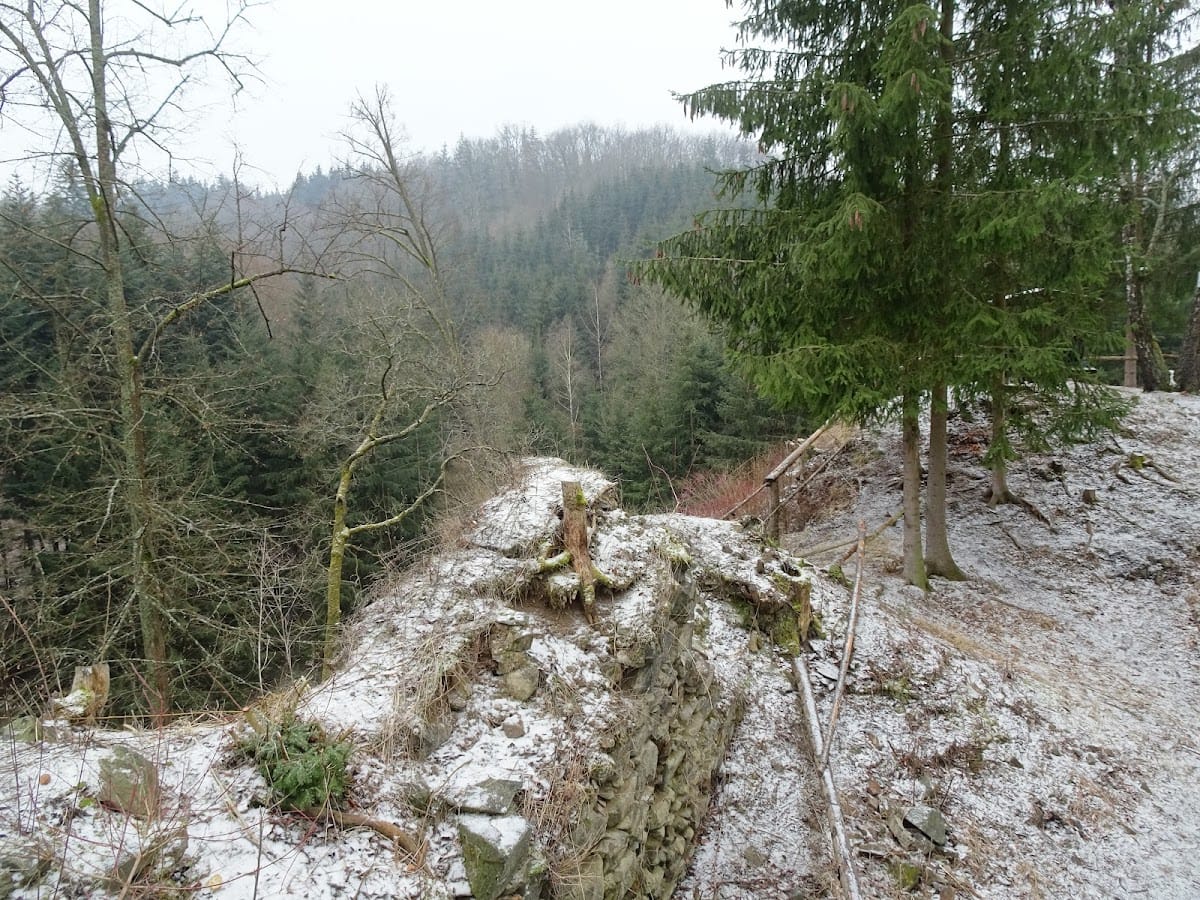
A parkan wall, an additional enclosing wall outside the principal fortification, surrounded the entire complex. The southeastern stretch is the best-preserved part of this outer enclosure, while much of the remaining castle survives as traces in the terrain.
Inner Castle
Two-Palace Layout
The inner castle had a rectangular, two-palace arrangement that may represent the earliest example of this form in Bohemia. An entrance gate led to the first palace, followed by a courtyard and a second palace that closed the complex on the southeastern side.
Inner Defensive Wall
The two palaces were linked along both sides by the inner defensive wall. Part of this wall survives in the southeastern section, alongside the better-preserved stretch of the parkan wall. The site has also been cleared of encroaching woody vegetation.