Castello di Petroia: A Medieval Castle near Gubbio, Italy
Site at a Glance
- Rating
- 4.7
- Popularity
- Low
- Country
- Italy
- Primary era
- Medieval
- External website
- Open
- Eras represented
- Medieval
- Civilizations
- Unclassified
- Site type
- Military
- Remains
- Castle
On this page7 sections
History
Castello di Petroia is a medieval castle in Italy, near Gubbio in Umbria. Its construction probably began in the ninth or tenth century as part of Gubbio’s defensive system, and a deed of gift confirms its existence by 1073. The fortress later became part of the network protecting Gubbio’s southern approaches and remained connected with the political history of the surrounding territory.
Early Medieval Estate and Defensive System
In 1171, a notarial deed referred to the Curtis Petroij, an estate on which other fortresses depended. On 7 May 1257, Ugolino, Count of Coccorano, took control of Petroia together with neighboring fortifications. During the same period, several feudal dependents of Gubbio transferred their allegiance to Perugia, reflecting the political competition affecting the area.
In 1384, Antonio da Montefeltro took control of Gubbio, ending the city’s status as a free commune. Gubbio and its surrounding territory, including Petroia, then came under the Duchy of Urbino, an Italian territorial state ruled first by the Montefeltro and later by the della Rovere dynasties. Petroia formed part of Gubbio’s southern defensive system, alongside Magrano, Castel d’Alfiolo, Caresto, Colpalombo, Biscina, and Giomici, guarding against attacks from Perugia and Assisi.
Montefeltro Ownership and Federico’s Birth
Petroia and its surrounding lands changed hands through a series of documented transfers. Galasso da Montefeltro acquired them in 1396, and Matteo degli Accomandugi di Urbino purchased the property in 1414. On 7 June 1422, Matteo’s niece Elisabetta degli Accomandugi, daughter of Guidopaolo, gave birth at Petroia to Federico da Montefeltro. Elisabetta was a lady-in-waiting to Rengarda, the wife of Count Guidantonio da Montefeltro, with whom she had the child.
Federico later became Duke of Urbino, a fifteenth-century Italian military leader, patron, and ruler. He retained a lifelong connection with Petroia and frequently used it as a base for falconry. During his stays in Gubbio, which became the second capital of his state, he also stayed at Petroia with his brother, Count Ottaviano Ubaldini della Carda, and his sons Antonio and Guidobaldo da Montefeltro.
In 1458, the freehold estate passed by inheritance from Elisabetta degli Accomandugi to the Ugolino dei Bardi family, together with its feudal rights. In 1487, Guidobaldo da Montefeltro transferred Petroia and its lands to Alessandro Reggeri di Canossa. The property remained with the Canossa family for four generations, passing from Alessandro to Bonifacio, then to Orazio, and finally to Camilla.
From the Canossa Family to Modern Ownership
Camilla di Canossa, who had no children, left the property in 1617 to the Monte di Pietà of Reggio Emilia, a charitable lending institution. The institution sold Petroia to the Ugolini family of Gubbio on 8 May 1629 for 6,200 scudi.
From 1631, following the extinction of the della Rovere dynasty, the Duchy of Urbino and Petroia became part of the Papal States. Napoleon Bonaparte’s occupation of Gubbio in 1797 abolished Petroia’s separate territorial status and incorporated it with Gubbio into the Department of the Metauro. After Napoleon’s fall, the territory returned to Pope Pius VII. Petroia remained an attached municipality of Gubbio until 1837, when that administrative designation disappeared.
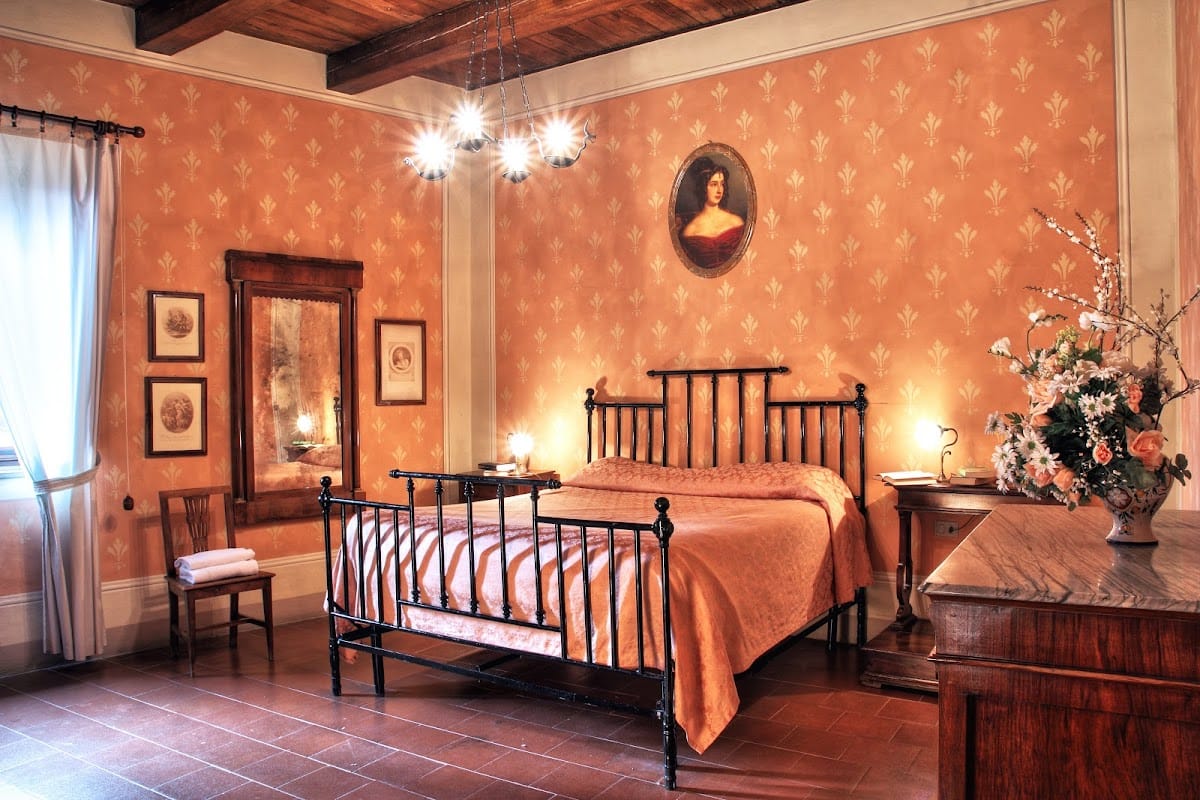
From 1823, the castle and its lands belonged to the Benvenduti family of Gubbio. David Sagrini acquired the castle and an adjoining estate of more than 1,000 hectares in 1909. His descendants remain associated with the property. Restoration and modernization began around 1988, affecting the three buildings that form the fortress. The restored complex now functions as a hotel.
Remains
Fortress Layout and Setting
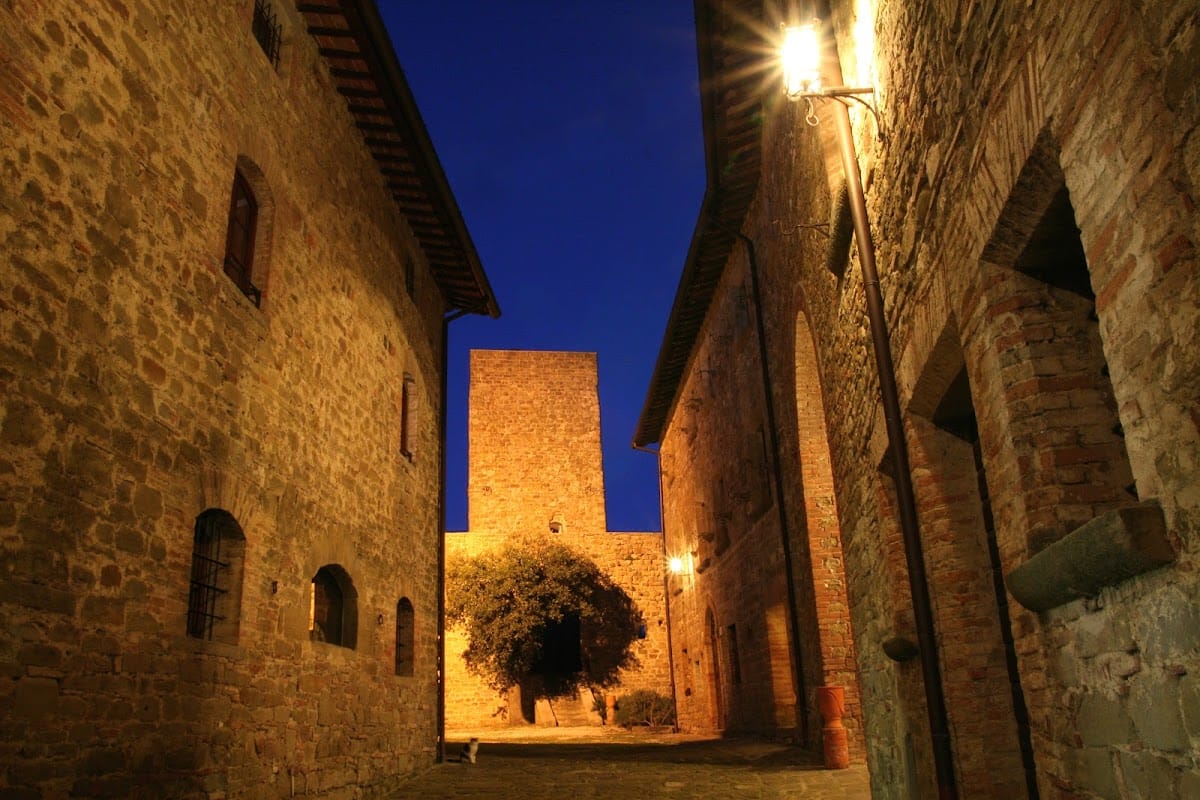
Castello di Petroia occupies a hill near Gubbio, overlooking the Chiascio plain and a broad section of the Umbrian-Marchean Apennines, including the Catria massif and Mount Cucco. The surviving fortress is arranged around a central keep, the principal fortified tower and stronghold of a castle, together with a powerful adjacent watchtower used for surveillance and warning. An attached fortified village completes the complex.
Buildings and Materials
The fortress comprises the tower, the larger castle building, and the smaller castle building. Sandstone, gray pietra serena sandstone traditionally used in central Italian architecture, and brick are the principal construction materials. These three structures underwent restoration and modernization beginning around 1988, and the restored complex incorporates a hotel facility.