Castello di Montebello: A Medieval-to-Renaissance Fortress in Italy


Site at a Glance
- Rating
- 4.5
- Popularity
- Medium
- Country
- Italy
- Primary era
- Medieval
- External website
- Open
- Eras represented
- Medieval, Early Modern
- Civilizations
- Unclassified
- Site type
- Military
- Remains
- Castle
On this page7 sections
History
Castello di Montebello is a medieval-to-Renaissance hilltop fortress in Italy, overlooking the village of Montebello di Torriana. Built within the territory of the former Malatesta lordship of Rimini, the castle was first associated with the Malatesta family and later became the center of the county held by the Guidi di Bagno family.
Malatesta Origins and Expansion
The castle first appears in a notarized deed drawn up at Verucchio on 24 September 1186. In that document, Ugolinuccio di Maltalone sold the stronghold to Giovanni Malatesta, a relative of Malatesta “Mastin vecchio.” Construction and development extended from 1186 into the fourteenth century.
For about three centuries, the Malatestas enlarged the original fortification into a much more extensive fortress. They completed the enclosing walls, added towers, and installed elevated defensive passages along the fortifications, together with an armory. These works established the defensive framework that still defines the castle’s medieval character.
The Guidi di Bagno County
After Sigismondo Pandolfo Malatesta and his son Roberto surrendered following Roberto’s sack of Montebello, Giovanni Francesco Guidi di Bagno received the title of count in the second half of the fifteenth century. Pope Pius II, the fifteenth-century pope, granted the title in a bull promulgated on 1 June 1464, rewarding Guidi di Bagno for his contribution to Sigismondo’s defeat. The Guidi di Bagno then made Montebello the center of their county.
The family retained the territory until 1797, when Napoleon Bonaparte’s administration abolished the feudal system in territories under its control. The Guidi di Bagno had held marquisal rank since 1549 and remain the owners of the castle. They continued to maintain it as a residence, and after the building suffered damage during the Second World War, the family began major restoration work in 1989. Castello di Montebello is designated Italian national heritage.
The Azzurrina Tradition
The castle is also associated with the Azzurrina legend, a local tradition concerning the disappearance of Guendalina Malatesta, a five-year-old child with albinism. She is said to have disappeared at the castle on 21 June 1375, the date of the summer solstice. Tradition describes her as the daughter of the feudal lord Ugolinuccio and Costanza, although her parentage is presented as a supposition. The place linked to the story is identified as the Azzurrina Corridor.
Remains
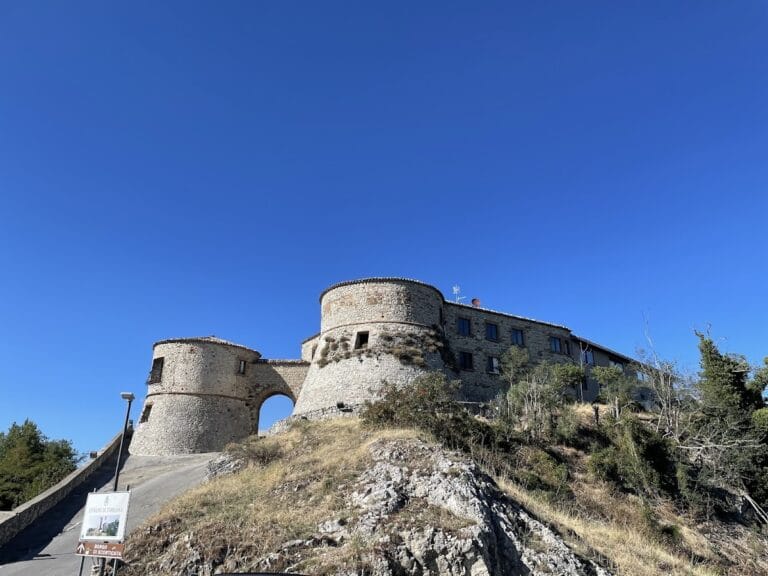
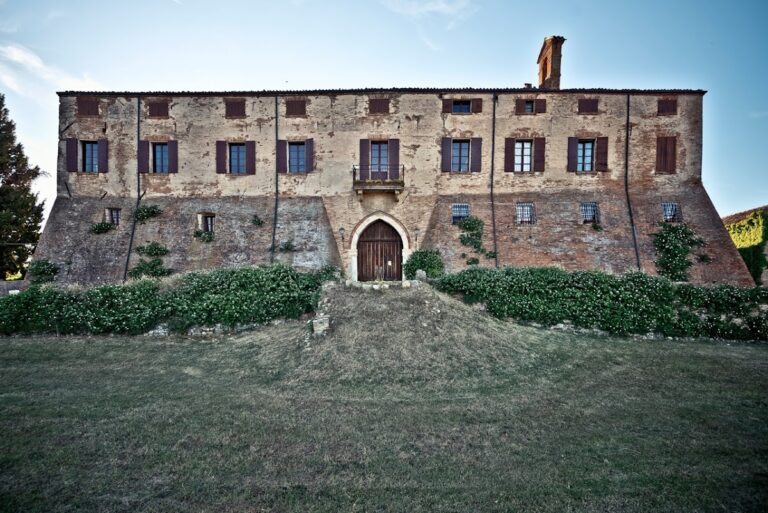
Castello di Montebello occupies a hilltop overlooking Montebello di Torriana, at an elevation described as approximately 436 metres in one account and 405 metres in another. The complex combines medieval and Renaissance elements and was built principally with rubble stone and brick masonry. Its surviving arrangement includes the fortified enclosure, towers, defensive passages, internal residential rooms, and structures associated with the castle’s changing military and domestic functions.
Medieval Fortifications
The medieval defenses include a massive keep, the castle’s principal fortified tower, together with enclosing walls, towers, and elevated wall walks. The complex also retains feudal prisons, secret passages, defensive traps, and a massive safe. French invaders unsuccessfully attempted to remove the safe at the end of the eighteenth century. Outside the main complex stands the rectangular armory, substantially modified in the eighteenth century and identified as a former parish church.
Gate and Renaissance Interiors
The main gate gives access to the fortress. A stone-carved coat of arms on the wall dates from the sixteenth century and combines the arms of the Guidi di Bagno and the Colonna di Zagarolo. It commemorates a marriage between the two noble families.
The Renaissance section commissioned by the Guidi di Bagno contains jewelry, mirrors, ancestral portraits, a large painted genealogical tree, and chests and marriage trunks. The Festival Hall retains its original furnishings, while the family chapel contains a painting of the family saint, Carlo Guidi. A portrait displayed in the castle was painted by Novella Parigini, a Tuscan painter.