Castle of Mogadouro: A Templar Frontier Fortress in Portugal
Site at a Glance
- Rating
- 4.3
- Popularity
- Medium
- Country
- Portugal
- Primary era
- Medieval
- External website
- Open
- Eras represented
- Medieval, Early Modern
- Civilizations
- Crusader, Knights Templar, Portuguese
- Site type
- Military
- Remains
- Castle
On this page14 sections
History
Castle of Mogadouro is a Portuguese frontier fortress in Mogadouro, Portugal, built under the Templars between 1160 and 1165. It formed part of the northeastern defensive line during the Christian Reconquista, the long expansion of Christian kingdoms into territories ruled by Muslim powers on the Iberian Peninsula.
Earlier occupation and the frontier
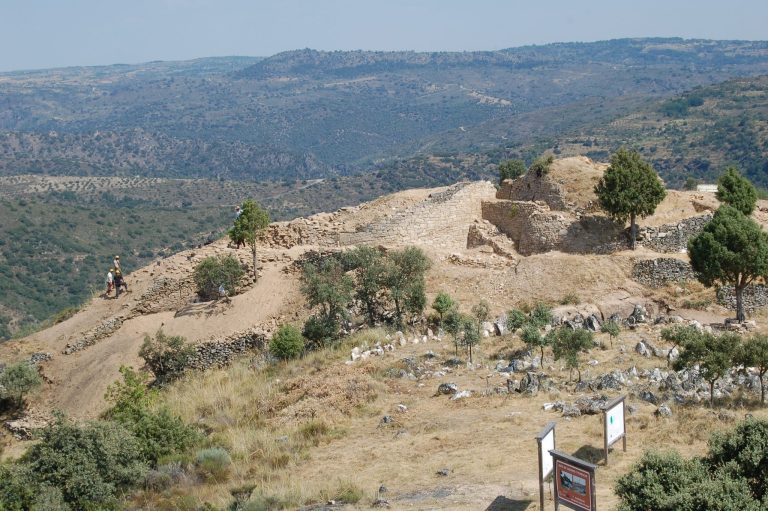
The castle occupies a hill associated with a prehistoric hillfort that was probably later incorporated into Roman culture. The surrounding region also preserves evidence of Visigothic occupation and Muslim settlement from the eighth century. Some scholars have connected the place-name Mogadouro with the Muslim period.
A secondary north-south route called the Moorish Road crossed the region toward Astorga, in present-day Spain. During the Reconquista, the area around Miranda do Douro saw repeated battles, and Mogadouro helped defend the northeastern approaches alongside Penas Róias, Algoso, Miranda do Douro, Outeiro de Miranda, and Vimioso.
Templar foundation and municipal development
In 1145, Afonso Henriques, Portugal’s first king, entrusted the Templars with defending the approaches south and east of the Mondego River. The military religious order received Mogadouro and other territories in Trás-os-Montes for this purpose. The castle was built between 1160 and 1165 beside a small residential settlement.
In 1186, Fernão Mendes, a nobleman from Bragança, donated Mogadouro to the Templars. Sancho I exchanged the region, together with Penas Róias, for Idanha in 1197. The territory returned to the Templars in the early thirteenth century, while the Portuguese Crown continued to support its churches. São Mamede de Mogadouro served first as a Templar commandery, an administrative and economic unit of the order, and was later elevated to a priory headed by a prior.
Afonso III granted Mogadouro and Penas Róias a municipal charter, or foral, on 27 December 1272. This charter established local rights, obligations, administration, and privileges, while also encouraging settlement and regional defense. It was confirmed and expanded at Santarém on 18 December 1273. During the thirteenth century, the castle grew and its walls were strengthened. Denis I issued another municipal charter in 1297, when additional fortification works were added to the settlement.
From Templar rule to Távora lordship
After the Templars were suppressed, their possessions at Mogadouro passed to the Order of Christ in 1311. The Order of Christ inherited many Portuguese Templar properties and continued their religious and frontier functions.
During the Portuguese dynastic crisis of 1383, a succession conflict that brought Portugal into conflict with Castile, Mogadouro aligned with Castile. By 1433, the settlement had been donated to Álvaro Pires de Távora. His father had previously served as the castle’s alcaide, the governor or commander of a fortified settlement. The Távora family later became the castle’s lords and chief governors.
John II passed through the region in autumn 1483 while traveling from Lamego toward Vila Real and Bragança. Repairs to the castle may belong to this period and have also been associated with Cristóvão de Baião, a knight of the royal household. Between 1509 and 1510, Duarte de Armas depicted Mogadouro in the Book of Fortresses, showing a complex that was still relatively well preserved.
Early modern transformation and decline
A 1507 inventory described the former priory lodging as converted into Álvaro Pires de Távora’s stable. The building stood between Távora residences, the northern wall, and the castle courtyard. Manuel I issued a new municipal charter in 1512. The Távoras continued to play an important part in defending Trás-os-Montes until the end of the seventeenth century, including during the Portuguese Restoration War, the conflict that restored an independent Portuguese dynasty after the period of Iberian union. A clock tower was built in the seventeenth century.
Eighteenth-century engravings and sketches called the complex a palace called a castle. After the downfall of the Távora family and the loss of the castle’s defensive function in the second half of the eighteenth century, the complex was progressively abandoned and fell into ruin.
Conservation and protection
Public conservation began in 1950 under the Directorate-General for Buildings and National Monuments, with work focused on the walls and keep. Later interventions included leveling the ground, rebuilding part of the tower wall, surveying the site, consolidating walls and foundations, cleaning, and landscaping. Further restoration and improvement continued in later decades.
Vandalism in the 1990s destroyed the handrail and entranceway of the tower and damaged archaeological material stored or exhibited at the site. The property came under the administration of the Portuguese Institute for Architectural Heritage on 1 June 1992. The clock tower was damaged during the severe winter of 1993. The castle had already been classified as a National Monument by a decree published on 2 January 1945. It remains associated with the former commandery of the Order of Christ and is owned by the Portuguese Republic.
Remains
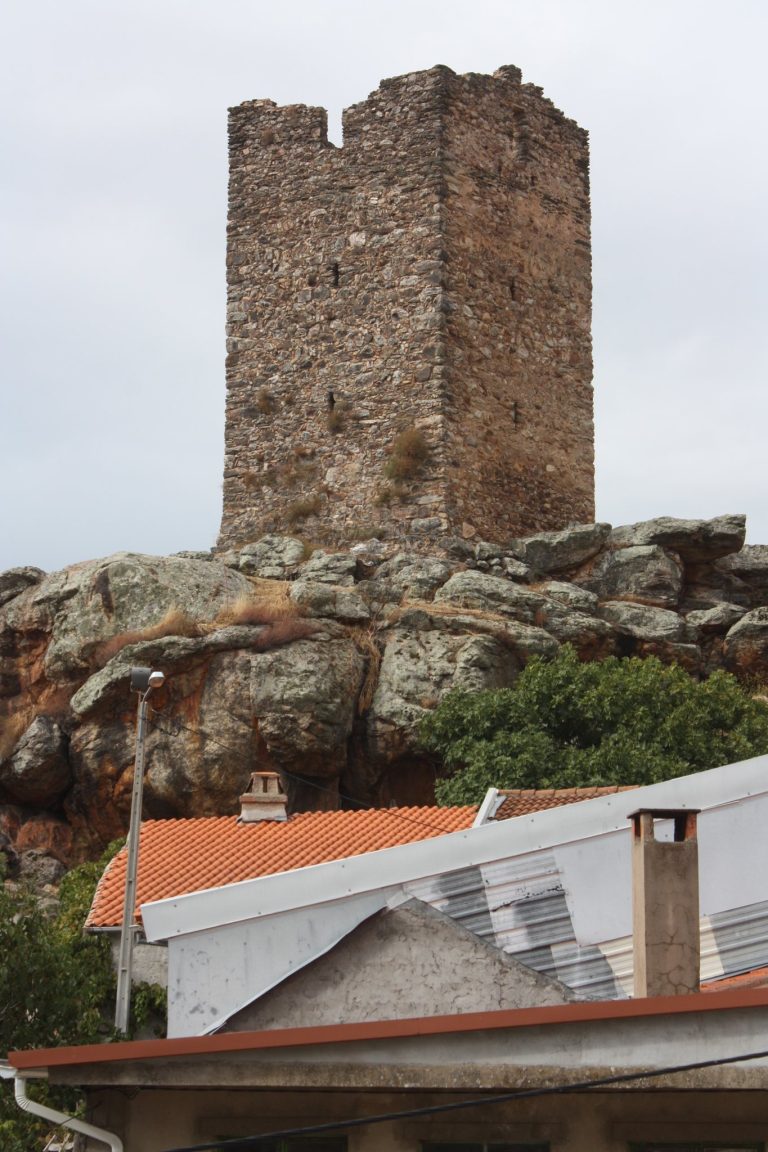
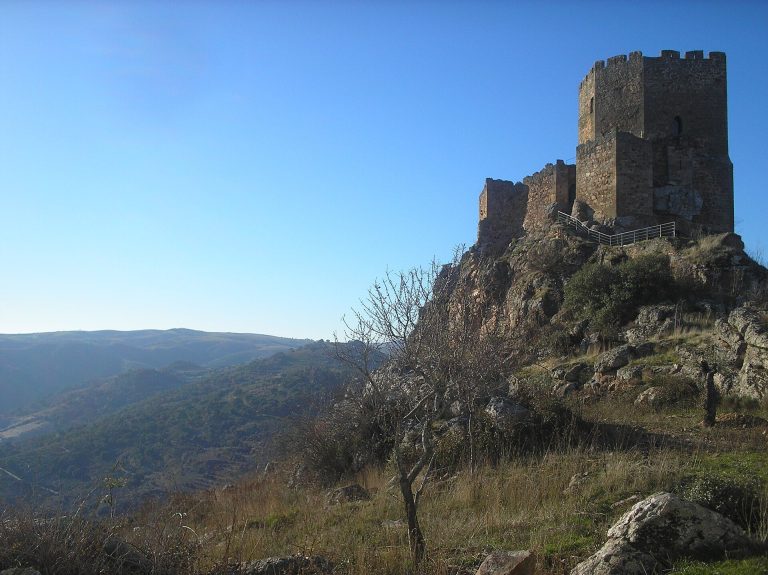
The surviving complex occupies a rocky hilltop on the northern side of the Serra de Mogadouro, with cliffs along the north and views toward the mountain range to the south. Its defenses form an irregular polygon. The principal remains are built from irregular masonry, including schist bonded with clay, while the listed materials also include rammed earth, stone, and reinforced concrete.
Keep and defensive works
Keep
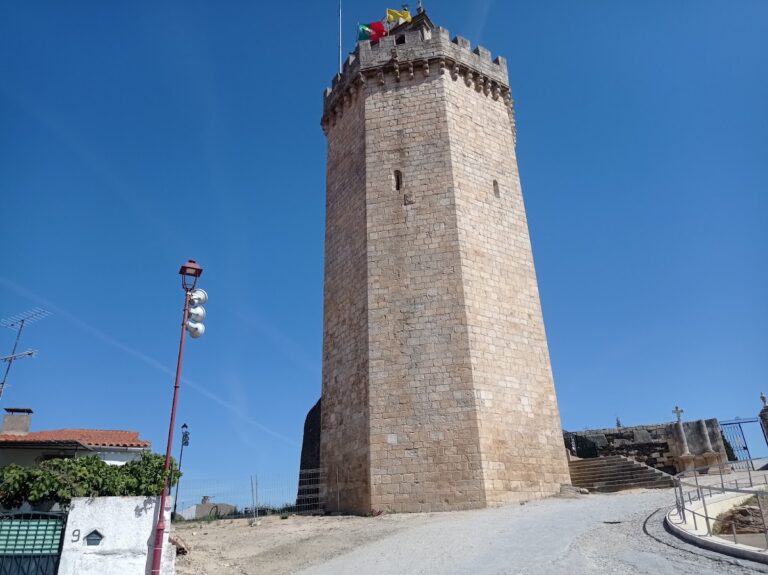
The quadrangular keep stands over the rocky summit. Two arched entrances open on its northeast and southeast sides, each reached by its own flight of stairs and landing. On the northwest elevation, a rectangular window with a grille is set above an arrow slit, a narrow opening for missile weapons. The southwest elevation contains two arrow slits on each of two levels.
A rectangular cistern runs along the western side of the keep. Two surviving wall sections define the wider defensive layout. One connects the keep to a small trapezoidal or cubelo tower, while another wall line links the former residence with the smaller tower. A corner wall also survives.
Barbican
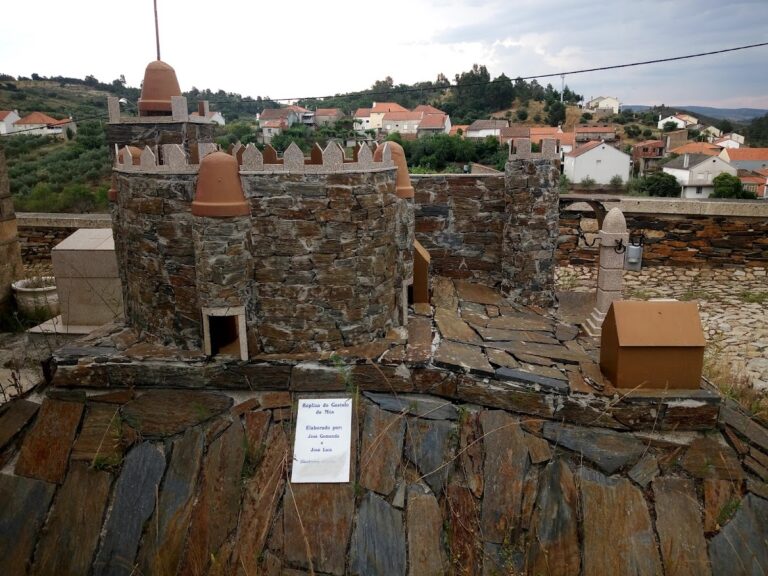
Parts of the former barbican, an outer defensive enclosure protecting a fortress entrance or section, remain southeast of the keep. Duarte de Armas represented it as an irregular elliptical enclosure topped with merlons and crenellations, the raised and notched elements of a battlement. One barrier had collapsed and lacked crenellations, while a small rectangular tower attached to the corner was still being built.
The early sixteenth-century fortress included a military courtyard, two ruined buildings, and eleven rectangular or trapezoidal chambers. Some chambers retained roofs and cylindrical chimneys. Right-angled stairs provided access, with a passage and a circular well beneath them.
Residential and settlement remains
Paço dos Távoras
The former Paço dos Távoras, the Távora family residence, was attached to the keep. It comprised three rectangular spaces of different heights. The shortest had a full arch and four rectangular windows. The tallest rose two storeys and included arched windows, a wooden balcony, and merlons. The third space had full-arched windows on the first floor, rectangular windows above, and merlons.
Settlement outside the fortress
Outside the walls, a rabbit shed was attached to the barbican on the east. The settlement extended from this area and included a pillory. A church with a steeple stood beside the barbican, while a cross and five houses with cultivated land lay farther away. Remains of the settlement’s enclosing wall circuit are visible below the castle.
Clock tower
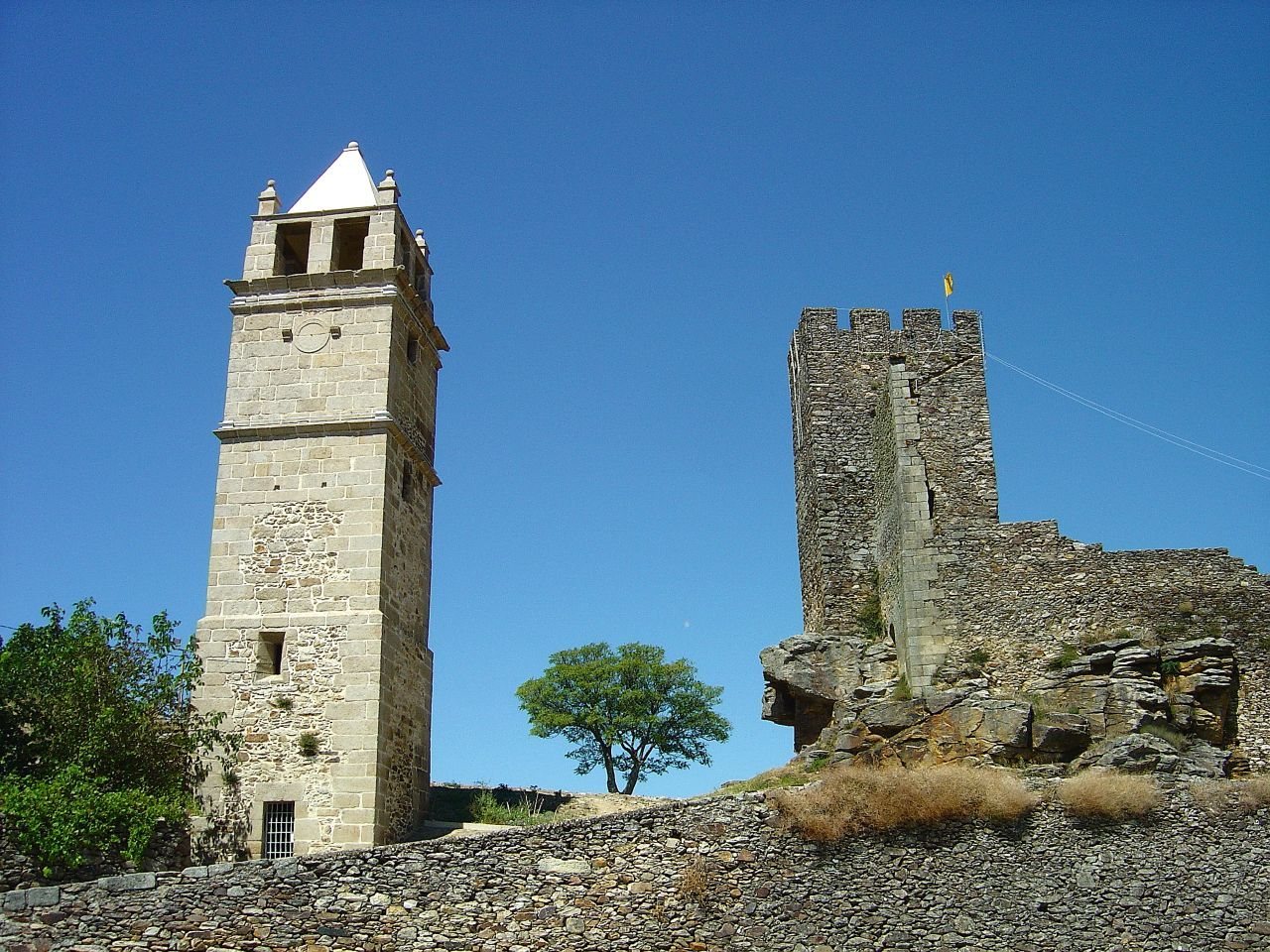
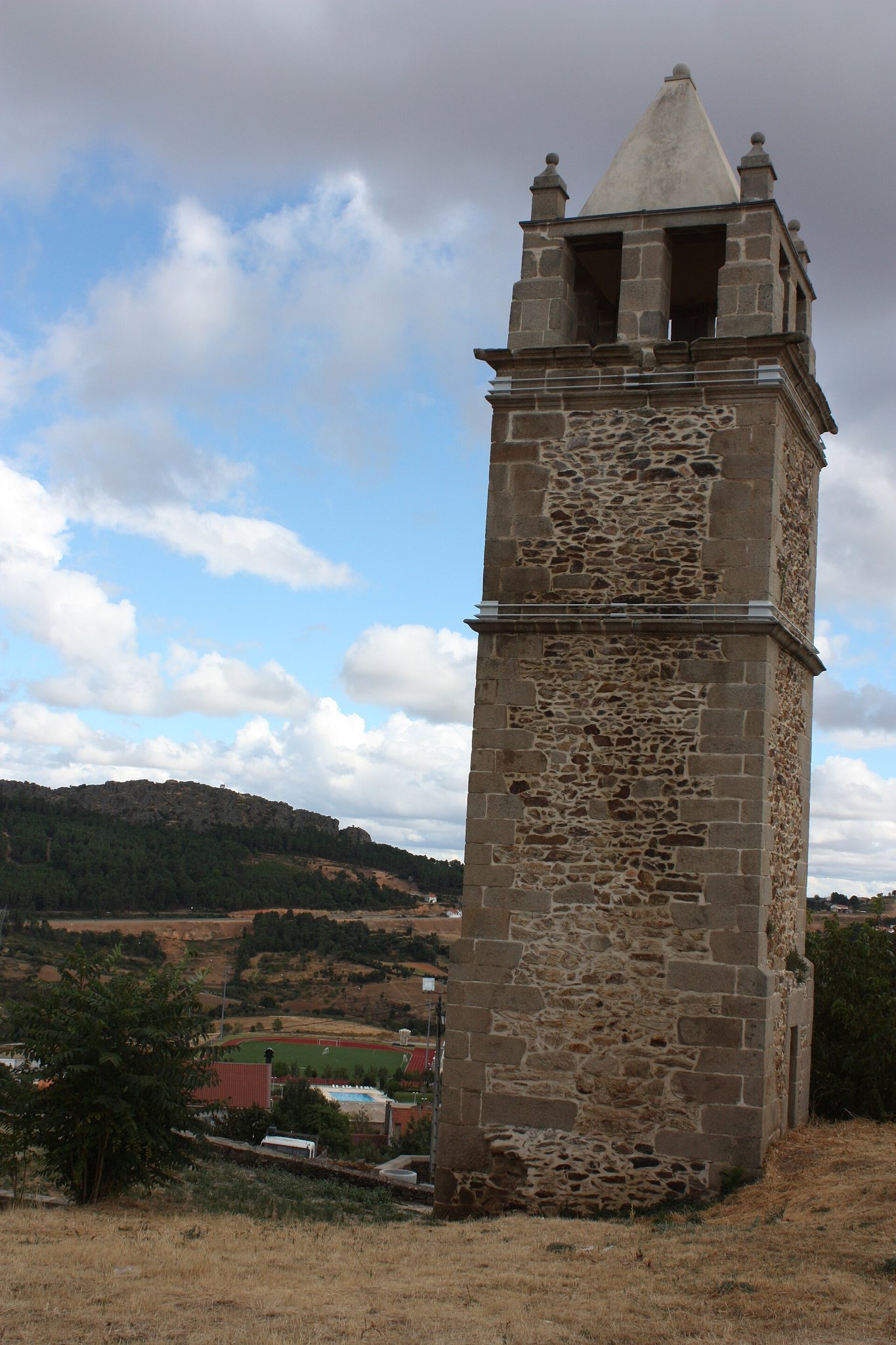
The Torre do Relógio, or clock tower, stands near the keep as a later square structure. Its corners are made of dressed stone, while irregular masonry fills the central wall surfaces. A sundial is carved into the south elevation. The tower contains three internal storeys, an upper level intended for bells, a pyramidal roof, and four granite pinnacles at the corners.