Burg Großfurra: A Medieval Water Castle in Germany

Site at a Glance
- Rating
- 4.7
- Popularity
- Low
- Country
- Germany
- Primary era
- Medieval
- External website
- Open
- Eras represented
- Medieval
- Civilizations
- Holy Roman Empire, Landgraviate of Thuringia
- Site type
- Military
- Remains
- Castle
On this page7 sections
History
Burg Großfurra, also known as Burg Furra, Wuor, or locally Schloss, is a medieval water castle in Germany, in the Großfurra district of Sondershausen. Built by the Thuringian landgraves in the eleventh century, it developed within a region where Fulda Abbey, a major medieval Benedictine monastery and territorial institution, already had a presence by the ninth century. The castle controlled the Wipper Valley west of Sondershausen.
The Furra lords and the divided castle
The castle was first mentioned in 1198 as the property of the noble family of Furra. In 1249, the Lords of Furra became followers of the margraves of Meissen, territorial rulers in the medieval German lands. By 1276, they were recorded as vassals of Hohnstein, a medieval noble county and ruling house in central Germany.
When the Furra family died out in 1332, the castle passed as a fief to several noble families. Its holdings were divided into separate sections, including the eastern wing, the bailiwick, an administrative or judicial district governed by a bailiff, and the western noble fief.
Five centuries under the Wurmb family
From 1425, the Wurmb family gradually acquired the separate sections from their various noble owners. They brought the castle and its estates under their direction and remained connected with their history for more than 500 years.
The German Peasants’ War, an uprising against social and political conditions in the German lands, reached Großfurra in 1525 and 1526. Insurgent peasants expelled the Wurmb family from the castle, but the family recovered possession after the revolt was suppressed. The former defensive castle was then increasingly reshaped into a coercive fortress directed against the peasantry. It underwent several later alterations and survived epidemics and numerous wars with little damage until 1945.
War, dispossession, and restoration
In April 1945, American artillery fire against Großfurra struck the castle’s keep, the principal fortified tower of a medieval castle. After Soviet occupation began in July, the Wurmb family was dispossessed without compensation and expelled. The castle was looted and nationalized, then used as a school, kindergarten, and housing for refugees. Its library was lost, while the estate buildings and land were also confiscated.
After 1945, the approximately 500-metre castle wall was demolished and its stones were reused in the foundations of new buildings. The Wurmb family burial chapel survived the upheavals after being converted into a Catholic church. Following German reunification in 1990, the increasingly dilapidated castle stood empty because major repairs were too costly. Helmut Pohl later purchased the buildings and had them extensively repaired and restored between 1996 and 2004 in accordance with historic-preservation requirements. They subsequently became his residence and business headquarters. Burg Großfurra is designated as a heritage monument in Thuringia.
Remains
Castle complex
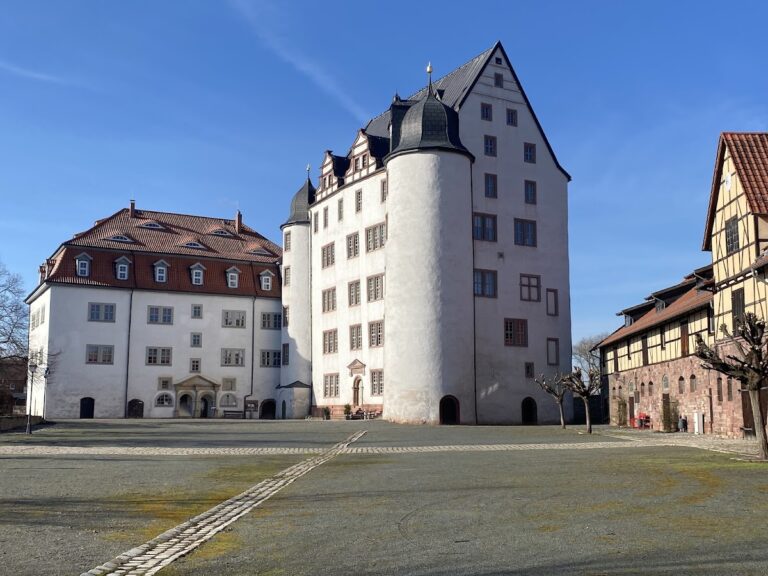
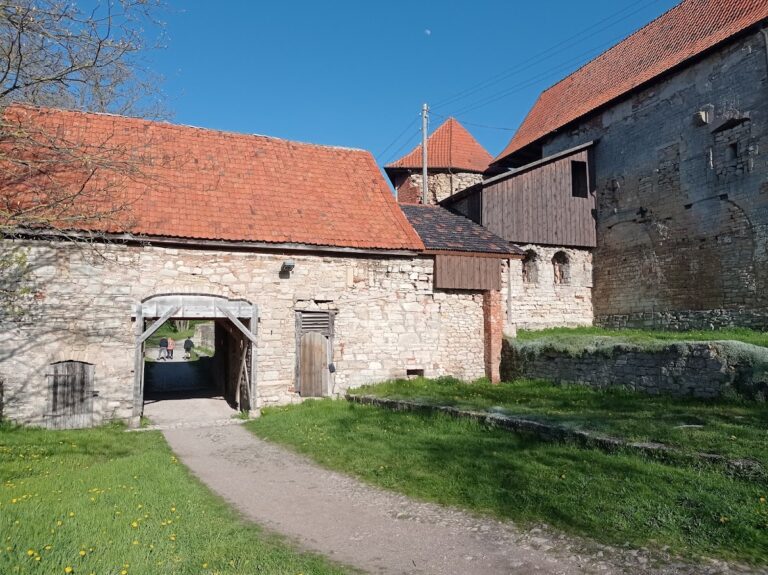
The original complex was a water castle enclosed by earthworks. Its substantial central building incorporated two wings, one rising to two storeys and the other to three. The taller wing has a half-timbered upper structure, a construction method in which a visible wooden frame is filled with masonry or another infill material.
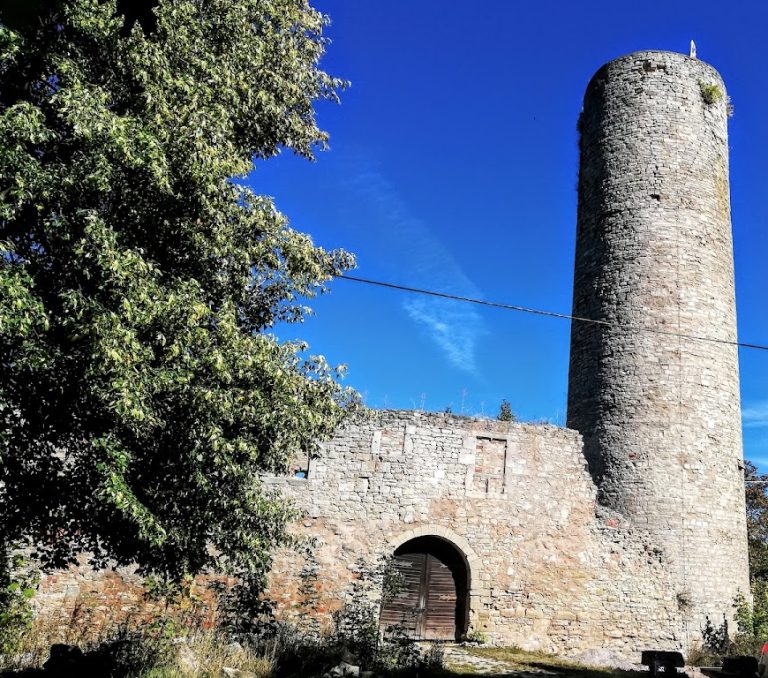
A round keep is integrated into the building complex. It rises approximately 20 metres, measures 10 metres in diameter, and is covered by a domed roof. The former castle wall, which extended for about 500 metres, was demolished after 1945. Stones from it survive as reused foundation material in postwar buildings.
Park and burial chapel
The castle park began as a pleasure garden laid out in the seventeenth century. It was redesigned as a landscape garden in the mid-nineteenth century. Parts of the park were built over after 1945, and many mature trees were felled.
The burial chapel associated with the Wurmb family contains a crypt and coffins. Its conversion into a Catholic church enabled the chapel to survive the postwar changes to the castle complex.
Nearby sites