Castle of Algoso: A Medieval Frontier Fortress in Portugal


Site at a Glance
- Rating
- 4.7
- Popularity
- Low
- Country
- Portugal
- Primary era
- Medieval
- External website
- Open
- Eras represented
- Medieval, Early Modern
- Civilizations
- Crusader, Knights Hospitaller, Portuguese
- Site type
- Military
- Remains
- Castle
On this page14 sections
History
Castle of Algoso is a medieval fortress in Portugal, located at Algoso on the eastern frontier between the County of Portugal and the Kingdom of León. Its earliest medieval construction probably dates from the twelfth century, during the Christian Reconquista, the prolonged Christian conquest and consolidation of territories in the Iberian Peninsula formerly ruled by Muslim powers. The castle was later remodelled as a Gothic fortress and became an important centre of royal authority in the lands of Miranda and Penas Róias.
Earlier occupation and the frontier fortress
Archaeological evidence points to several phases of activity on the rocky site before the Middle Ages. These include Chalcolithic occupation, Bronze Age moulds, protohistoric activity, and settlement during the Roman period. Roman ceramics indicate a non-military settlement, showing that the site’s earlier use was not necessarily continuous as a fortress.
During the Reconquista, Algoso stood at the eastern end of a contested frontier. It formed part of a defensive network that included the castles of Bragança, Outeiro, Penas Róias, Mogadouro, and Miranda do Douro, together with smaller fortifications such as Vimioso. The first medieval fortress was probably erected in the twelfth century, possibly late in the reign of Afonso Henriques, the first king of Portugal, when his son Sancho was already exercising royal power.
The 1258 inquiries identify Mendo Bofino as the builder. He received the lordship of Vimioso in return, while his son Afonso Mendes inherited the family majorat, an inheritable lordship intended to remain within a family. Rodrigo Mendes took the lordship of Algoso and adopted the family name Rodrigues de Algoso. The fortress became associated with local noble families whose loyalties extended both to Portugal and to León, and it housed the royal representative responsible for collecting royal dues.
Royal authority and conflict with León
During the transition from Afonso Henriques to Sancho I, the castle’s alcaide, the military governor responsible for a castle, offered Algoso to the new king. Sancho I intended it to become the centre of a broad territory that included Miranda do Douro and Penas Róias. In 1212 and 1213, Leonese forces invaded the territory during a conflict arising from the Portuguese king’s opposition to the treatment of his sisters. Peace between León and Portugal was brokered in 1219.
After a prolonged period of conflict with León, Sancho II transferred the castle and its lands to the Knights Hospitaller in 1224. This medieval religious and military order maintained commanderies, administered landed estates, and defended frontier territories. The donation placed Algoso, with its terms and belongings, under the authority of Prior Rui Pais and his successors. From the sixteenth century, the Hospitallers were also known as the Order of Malta.
Hospitaller administration and remodelling
Algoso remained involved in disputes over frontier lands and commandery rights. An agreement between the Knights Templar and the Hospitallers in 1230 addressed territories that included Algoso, Vila Chã, Atenor, Penas Róias, and Paradela. In 1239, a settlement involving the Templar commander Pedro Costem concerned Algoso and the commanderies of Mogadouro and Penas Róias. King Dinis reached another settlement in 1291 concerning the commandery of Algoso and neighbouring lands. Its commander received annual revenues of approximately 7,000 to 8,000 cruzados, including shares of produce from several abbeys.
Under Hospitaller control, the castle was extensively remodelled into a Gothic fortress adapted for active defensive warfare. It also became associated with a church dedicated to Our Lady of the Assumption, which local inhabitants commonly called Our Lady of the Castle. King Dinis ordered repairs and improvements at the end of the thirteenth century. By 1341, a royal sentence described the castle and its territory as belonging to the Hospitaller prior in the Portuguese kingdom since time immemorial.
Charters, decline, and later military history
Afonso V granted Algoso a charter in 1480, and Manuel I confirmed it on 1 June 1510. Duarte de Armas depicted the settlement and castle in the Book of Fortresses, produced around 1509 and 1510. By 1530, only the alcaide was reported to live inside the castle, while the charter encouraged inhabitants to move to the settlement’s later location.
During the Portuguese succession crisis of 1580, a struggle over the Portuguese throne, the castle’s alcaide, Diogo Fernandes de Almeida, supported António, Prior of Crato, a claimant to the throne. In 1588, Philip I, the Habsburg king who became ruler of Portugal during the ensuing dynastic union, appointed Diogo’s son, the Hospitaller friar Gonçalo de Azevedo, as commander and alcaide. Gonçalo held both offices until 1610. Philip I also granted privileges to the municipality of Algoso on 1 January 1592, challenging the castle’s traditional authority and the allegiance of its nobility.
The castle had lost much of its importance by the seventeenth century and was abandoned and ruinous by 1684. An inventory from that year described the commandery’s furniture and state of conservation. Between 1689 and 1690, the municipality of Vimioso attempted to consolidate and restore the structure. The last recorded military occupation occurred in 1710 during the War of the Spanish Succession, a European conflict over the inheritance of the Spanish monarchy.
After Spanish forces sacked Miranda do Douro in 1762 during the Seven Years’ War, they raided villages and buildings in Vimioso. Algoso resisted occupation while defended by a small contingent under an ensign. The municipality of Algoso was incorporated into Vimioso in 1855.
Conservation and archaeological investigation
In 1944, the municipality requested intervention by the Directorate-General for Buildings and National Monuments. Conservation work from 1974 to 1977 consolidated the masonry, repaired walls and battlements, strengthened the access stairs, cleared vegetation, and addressed the risk of landslides.
Responsibility for the property passed to the Portuguese Institute for Architectural Heritage in 1992. From 1999, refurbishment and maintenance included archaeological and structural work, improvements around the castle, resurfacing of the approach road, installation of stair rails, cleaning of the cistern, and consolidation of the tower and ceilings. Excavations within the fortress began in 2001. An agreement between Vimioso municipality and the institute in 2002 led to an interpretive centre, built in 2006, while IGESPAR and the municipality undertook further intervention in 2004.
Castle of Algoso has been classified as a Portuguese property of public interest since 1955. It is owned by the Portuguese Republic, and management was assigned to DRCNorte, the regional cultural-heritage authority for northern Portugal, in 2009.
Remains
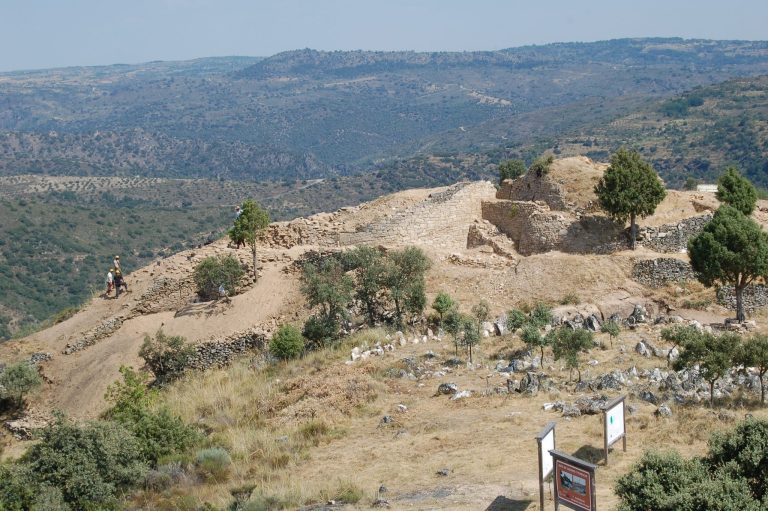
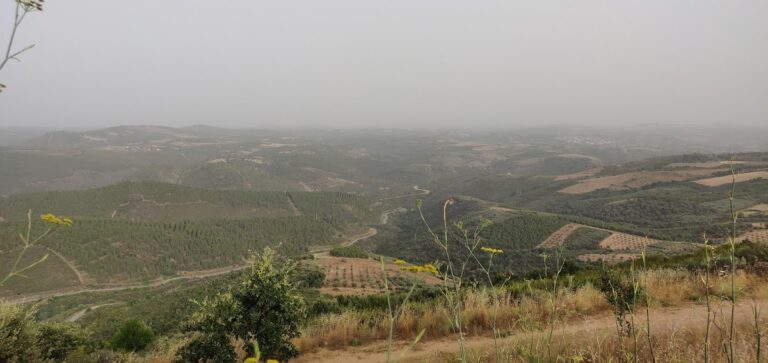
The fortress occupies an isolated rocky prominence called Cabeço da Penenciada, approximately 690 metres above sea level. It overlooks the right bank of the Angueira River and the confluence of the Angueira and Maçãs rivers. Its small, roughly rectangular plan follows the rocky terrain, with granite and quartz schist walls set directly on the outcrop and interrupted by cliff faces about 12 metres high. The elevated position provides views across the Mirandese plateau and toward the Serra da Sanábria, Serra de Bornes, and Serra da Nogueira.
Fortifications and entrances
Northern entrance
The northern entrance is reached by stairs cut into the rock. A round-arched opening leads into the fortress, protected by a small circular tower, or cubelo, whose merlons have been lost. The tower formerly carried a projecting machicolation, an opening used to defend the base of a wall or entrance. A barbican, a fortified outer defence protecting an entrance, and additional small towers strengthened the approach.
Main keep
The keep is an irregular heptagonal tower with substantial stone cornerwork and three storeys. Its Gothic entrance is placed on the second level and retains the remains of machicolations. The first two floors served as residential spaces, divided by an internal wall into two separate rooms or dependencies. The upper floor was arranged for defence and retains merlons, the raised sections of a battlement, and arrowslits, narrow openings for missile weapons. Vaulted ceilings survive within the tower.
Walls and additional towers
The surviving defences include the main wall lines, several small circular towers, and a restricted inner area that functioned as a military square. The walls were formerly topped with battlements. At least one additional southern tower was later demolished, but its form is preserved in Duarte de Armas’s drawings from the early sixteenth century. A tower on the eastern wall was subsequently adapted for artillery pieces during a final seventeenth-century modification of the defences.
Interior structures and water supply
Stables and kitchen
Small-building remains in front of the keep have been identified as the original stables and kitchen. The interior of the fortress is cramped and contains large stones of varied dimensions, reflecting the restricted rocky foundation on which the buildings and defensive works were arranged.
Cistern
An irregular cistern occupies part of the fortified interior. Its vaulted structure measures approximately 30 by 30 metres and is 3 metres high, with a capacity of about 90,000 litres. The reservoir stored water for use during a siege, when supplies from outside the fortress could be cut off.
Castle of Algoso survives as a ruin, with portions of its walls, keep, cistern, entrance works, and associated structural remains conserved or consolidated through interventions in the twentieth and twenty-first centuries.