Castle of Alter do Chão: A Medieval Fortress in Portugal

Site at a Glance
- Rating
- 4.4
- Popularity
- Medium
- Country
- Portugal
- Primary era
- Medieval
- Eras represented
- Medieval, Early Modern
- Civilizations
- Portuguese, Umayyad
- Site type
- Military
- Remains
- Castle
On this page12 sections
History
Castle of Alter do Chão is a medieval Portuguese fortress in Alter do Chão, Portugal, whose present form derives from a 14th-century reconstruction in the early Gothic style. It stands on a site occupied since the pre-Roman period and developed during the Roman conquest of the Iberian Peninsula along one of the three roads connecting Olissipo, now Lisbon, with Augusta Emerita, now Mérida. The settlement became known as Abeltério and later acquired defenses that were repeatedly damaged, rebuilt, and adapted.
Roman and Islamic foundations
During the Roman conquest, Abeltério grew beside an important route between Lisbon and Mérida. The settlement was later destroyed by the legions of Emperor Hadrian, an event that may have prompted the construction of a Roman fortification. The Vandals subsequently damaged its defenses. During the Muslim occupation, the fortification was rebuilt, probably under Abd al-Rahman III, an Umayyad ruler of al-Andalus. Five rows of ashlar masonry, carefully cut stone blocks, are associated with the caliphal period of medieval Islamic rule.
Christian repopulation and royal rebuilding
Portuguese forces occupied the region from the second decade of the 13th century during the Christian reconquest, the medieval process by which Christian kingdoms reoccupied territories ruled by Muslim powers in the Iberian Peninsula. King Afonso II ordered the repopulation of Alter do Chão in 1216. By 1232, the castle appeared in the settlement charter issued for the town by Vicente Hispano, bishop of Guarda. A charter was a formal grant defining a settlement’s rights, obligations, privileges, and administrative status.
King Afonso III granted Alter do Chão a new charter in 1249 and ordered the castle to be rebuilt. King Denis issued another charter on 26 August 1292 and revised it the following year. Among its privileges was the declaration that the town should have no lord other than the sovereign. The castle’s current appearance is chiefly associated with the reconstruction ordered by King Peter I on 22 September 1357, a date preserved in the marble inscription above the main gate. Peter I also revised the town charter in 1359.
The House of Braganza and later military use
King Ferdinand I granted the domains of Alter do Chão to Nuno Álvares Pereira, who later transferred them to Gonçalo Eanes de Abreu. In 1428, King John I confirmed the town and castle to Pereira. After Pereira’s death, his daughter inherited the domains and transferred them through her marriage to the Duke of Braganza. They consequently entered the possessions of the House of Braganza, a major Portuguese aristocratic dynasty that later became a royal house. A campaign of works at the castle followed in 1432.
During the reign of King John II, Ferdinand II, Duke of Braganza, used the castle as a prison. This use was later cited in accusations of rebellion and conspiracy against him, leading to his condemnation and execution in 1483. King Manuel I granted Alter do Chão another charter on 1 June 1512. The lintelled doorway of the former governor’s residence dates from this period.
During the Portuguese Restoration War, the conflict in which Portugal defended its independence from the Spanish monarchy, a barbette, or raised firing platform behind a parapet, was added to the northeastern wall and the battlements were reconstructed. An urban enclosure was in use during this period. Spanish troops commanded by John of Austria conquered and occupied the town and castle in 1662.
Ownership, protection, and conservation
José Barreto Castelino Cota Falcão acquired the castle between 1830 and 1840 and sold it in 1892 to José Barahona Caldeira de Castel-Branco Cordovil. The Casa Agrícola de Francisco Manuel Pina & Irmãs acquired it in 1942, after which ownership passed to the Foundation of the House of Braganza, which remains the owner.
The castle became a National Monument by decree on 23 June 1910. A commemorative tribute marking the third centenary of the Portuguese Restoration was added in 1940. Consolidation and restoration undertaken from the 1950s by the Directorate-General for Buildings and National Monuments, with funding from the Foundation of the House of Braganza, contributed to the castle’s present good state of conservation. The castle also cooperated with the neighboring Castle of Alter Pedroso in the defense of the region.
Remains
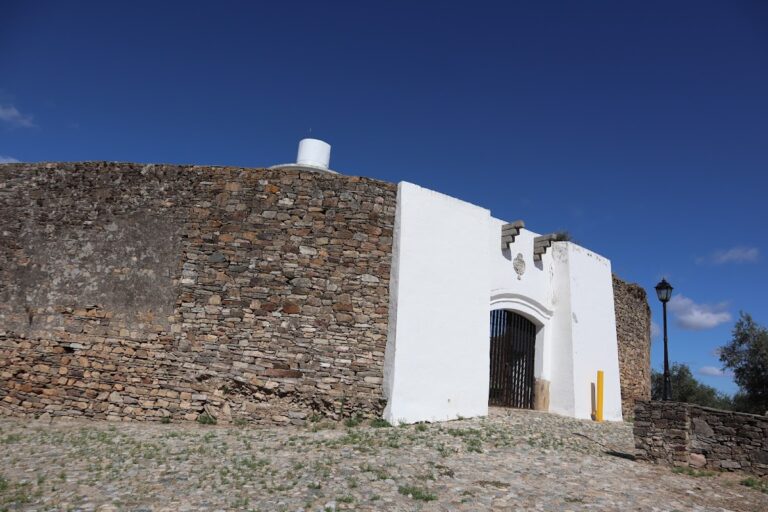
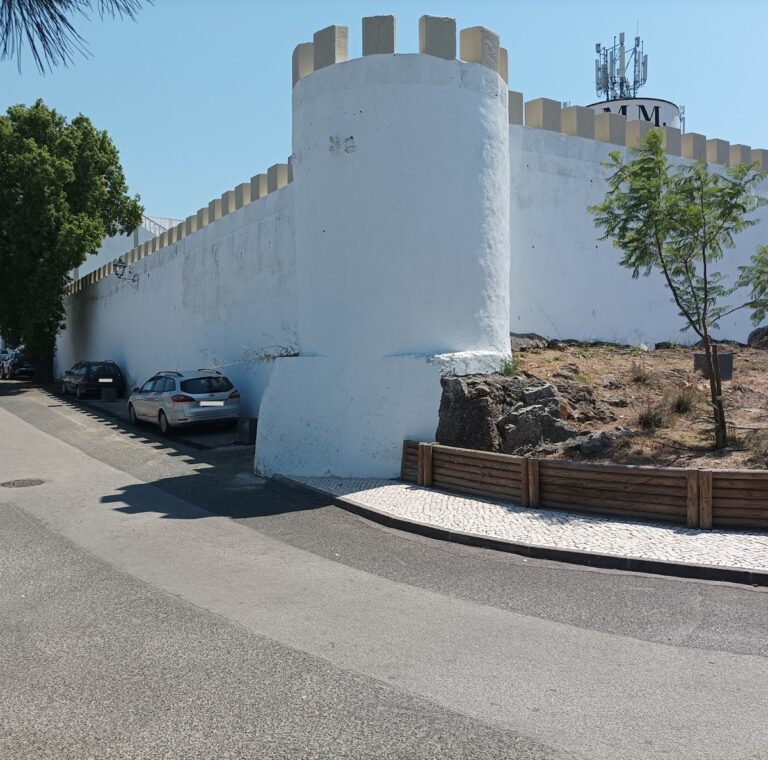
The castle stands at an elevation of 270 meters and has a quadrangular plan. Its enclosure is built of schist and granite and is reinforced by six towers. Two are quadrangular, two are cylindrical corner towers, one is a quadrangular tower at the center of the northeastern wall, and another square tower rises above the gate at the center of the southwestern wall. The eastern corner tower is crowned by a conical pinnacle.
Walls, towers, and entrance
Defensive walls and towers
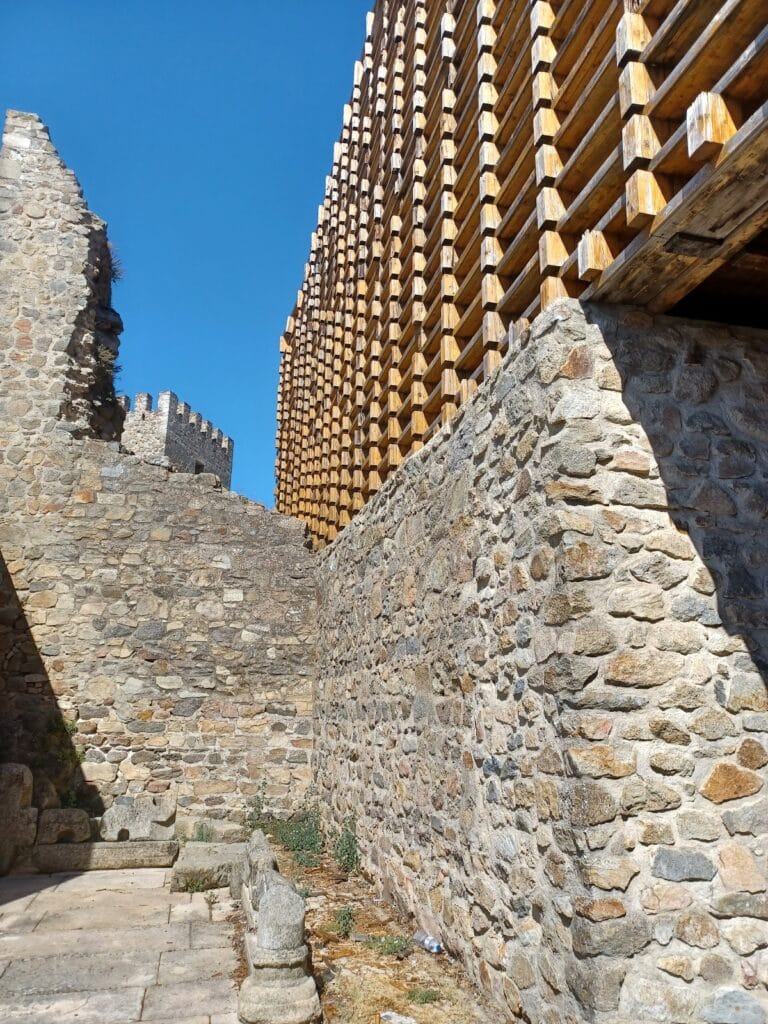
A wall-walk, a passage along the top of a defensive wall, follows the enclosure and is protected by battlements. Along the eastern section, it rests on corbels. Some towers are crowned by quadrangular merlons, the raised sections between openings in a battlement, arranged with alternating arrow slits. These merlons were reconstructed during works in the 1940s. The northeastern wall also retains the barbette added during the Portuguese Restoration War.
Main gate
The main entrance has a pointed arch and opens onto the parade ground. Above it are a coat of arms and a marble inscription stating that King Peter ordered the castle’s construction on 22 September 1357. The gate is incorporated into the square tower that rises at the center of the southwestern wall, linking the principal entrance with the defensive circuit.
Inner buildings
Keep
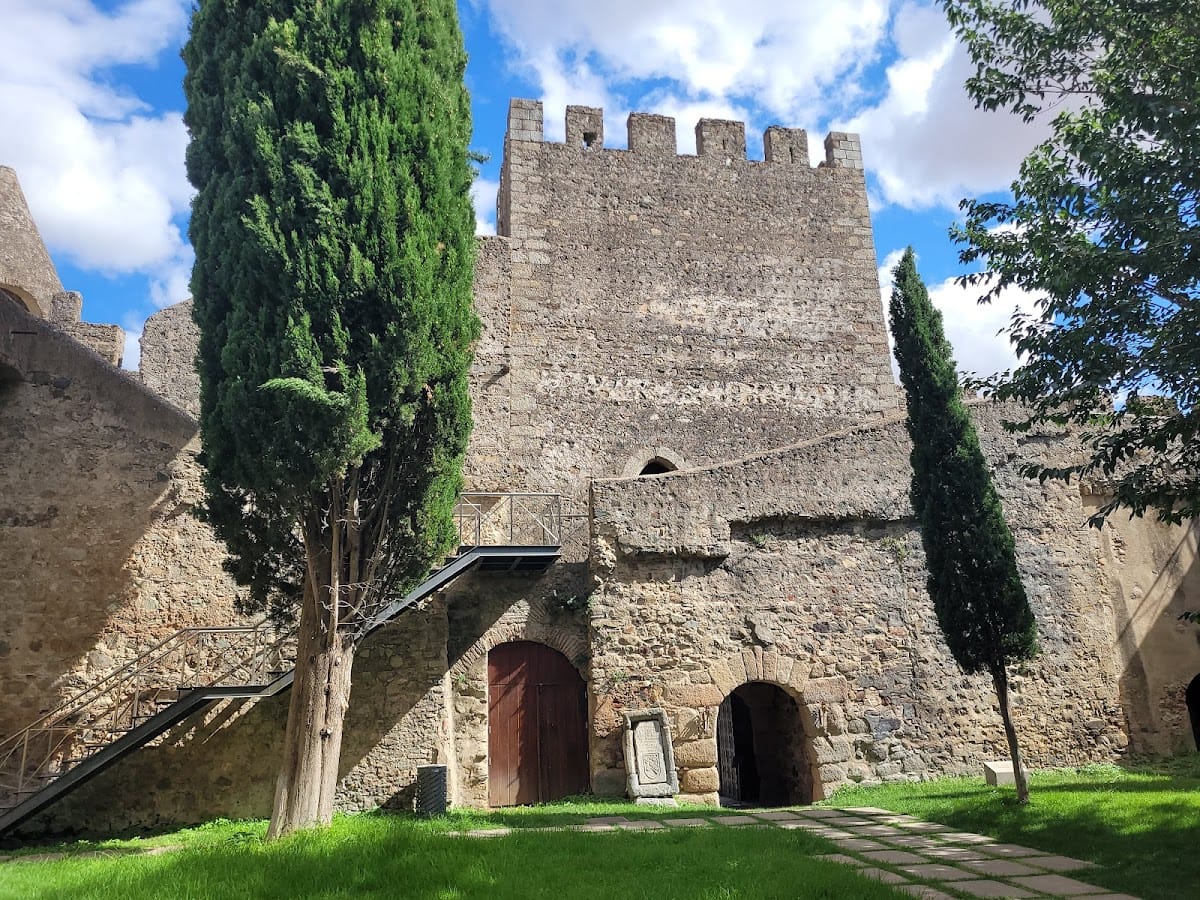
Beyond the gate, the parade ground contains the well and cistern. Set back from this open area is the quadrangular keep, the castle’s principal fortified tower. It rises to 44 meters and ends in a parapet crowned by truncated pyramidal battlements. Two internal stories survive within the tower. Their barrel-vaulted ceilings are strengthened by pointed stone arches, while barred windows light the rooms. The doors have pointed-arch lintels.
Former governor’s residence
The keep stands beside the facade of the former governor’s residence and other dependencies. Several doors, windows, and an access stairway remain in the walls, revealing the residential and administrative functions once accommodated within the castle. The residence doorway has granite jambs and a second epigraphic inscription. It states that Fernão Rodrigues, an overseeing official to Dom Fernando, commissioned the work. The inscription identifies Dom Fernando as the king’s grandson and Count of Arraiolos and dates the work to 1372.
A narrow landscaped strip surrounds the castle. Together with the surviving enclosure, towers, wall-walk, parade ground, keep, well, cistern, and residential structures, it defines the physical organization of the fortified site.