Castle of Alegrete: A Medieval Frontier Fortress in Portugal


Site at a Glance
- Rating
- 4.6
- Popularity
- Low
- Country
- Portugal
- Primary era
- Medieval
- Eras represented
- Medieval
- Civilizations
- Portuguese
- Site type
- Military
- Remains
- Castle
On this page12 sections
History
The Castle of Alegrete is a medieval fortress in Portugal, developed under Portuguese rule mainly during the thirteenth and fourteenth centuries in the Gothic military tradition. Standing within the frontier region of Alto Alentejo, it formed part of the defensive system that guarded Portugal’s eastern border and later became involved in conflicts with Castile.
Early occupation and Portuguese incorporation
The earliest human occupation of the summit remains uncertain. Tradition and archaeological interpretation associate the site with the Lusitanians, followed by occupation or control by Roman, Vandal, Alan, and Muslim forces. Tradition attributes the Christian reconquest of Alegrete to Afonso Henriques, the first king of Portugal, in 1160.
The first documentary evidence dates from the thirteenth century. Under the Treaty of Badajoz, an agreement between Portugal and Castile that settled territorial control along part of the Iberian frontier, King Afonso III of Portugal and King Alfonso X of Castile incorporated Alegrete and its castle permanently into Portuguese territory on 16 February 1267. Afonso III repaired and reinforced the fortifications, and work continued during the reign of King Denis. The settlement received a charter in 1319, an act traditionally associated with the rebuilding of its defences.
Most of the castle’s construction belongs to the period after the Treaty of Badajoz and continued through the fourteenth century. Its frontier position gave it a military role during later conflicts with Castile.
Wars with Castile and the sixteenth century
During the Portuguese crisis of 1383–1385, a succession struggle that led to the establishment of the Avis dynasty, Alegrete and its castle supported the Master of Avis, the claimant who became King John I. The Portuguese constable Nuno Álvares Pereira, the leading military commander of that faction, camped at Alegrete with his forces on 8 April 1384. He later defeated Castilian troops at the Battle of Atoleiros.
Castilian forces captured Alegrete in 1475 during the reign of King Afonso V. Portuguese control was subsequently restored, and King Manuel I granted the settlement a new charter on 14 February 1516.
Gunpowder warfare and frontier defence
The growing use of gunpowder artillery gradually reduced the military value of the medieval castle. Its strategic importance returned during the succession crisis of 1580 because Alegrete stood on the Spanish frontier. The walls were rapidly repaired and adapted under the influence of the Marquess of Marialva, a Portuguese nobleman and military leader. These alterations created a bastioned fortress, with projecting artillery positions incorporated into the defences.
During the Portuguese Restoration War, the conflict that restored Portugal’s independence from the Spanish Habsburg monarchy, King John IV rewarded the military commander Matias de Albuquerque by making him Count of Alegrete. The castle was placed on the first line of defence. In 1662, its garrison comprised two infantry companies commanded by La Coste. A legend relates that the governor attempted to deter forces besieging the town under John of Austria by sending two bottles of local wine and declaring that the garrison would resist until the final drop had been consumed.
Repairs and rehabilitation of the fortifications took place under the direction of the Marquess of Marialva on 12 July 1664. A field fortification with bastions was also built during this period, probably with temporary brushwood bundles known as fascines. The Marquessate of Alegrete was established on 19 August 1687, with Manuel Teles da Silva as its first holder.
In 1704, Alegrete and its fortifications resisted a siege by the forces of Philip V of Spain. During the War of the Oranges in 1801, a conflict between Portugal and Spain, the settlement accommodated a considerable number of troops and withstood Spanish bombardment, although its defences were already in marked decline. Fighting between the forces of the Count of Vila Flor and royalist troops took place nearby during the Portuguese Liberal Wars in 1826, but the declining castle played no significant part in those combats.
Abandonment and conservation
Responsibility for the castle passed with the Alcaidaria-Mor of Alegrete, the senior castle wardenship responsible for administration and defence, to the Counts of Vila Flor and the lords of Zibreira. Cristóvão Manoel de Vilhena, Lord of Pancas and Zibreira, became its last lord in 1860. After his death in 1877, the wardenship and castle reverted to the National Treasury.
The municipality and magistrate courts of Alegrete were abolished on 26 June 1855. The castle then entered a period of abandonment and neglect. It was classified as a National Monument in 1946. Consolidation and restoration began in 1965 under the Directorate-General for Buildings and National Monuments. Further work in 1977 consolidated the castle tower and removed masonry that blocked its openings and crenellations. In 1984, the walls were consolidated and the castle entrance was closed. Despite these interventions, the monument remained in a precarious state of conservation.
Remains
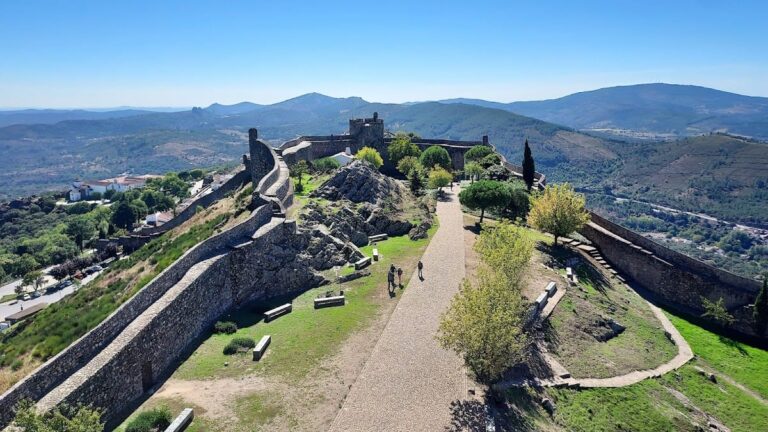
The fortifications occupy the summit of a mountain approximately 502.9 metres above sea level. The castle stands south of the primitive settlement, while the northern flank supported the Arrabalde, an outlying settlement beyond the main fortified core. Agricultural land and olive groves occupy the other flanks. To the west, the landscape is crossed by the Ribeira de São Pedro, also called the Ribeira do Ninho d’Açor.
Castle enclosure and defensive structures
Walls and gateway
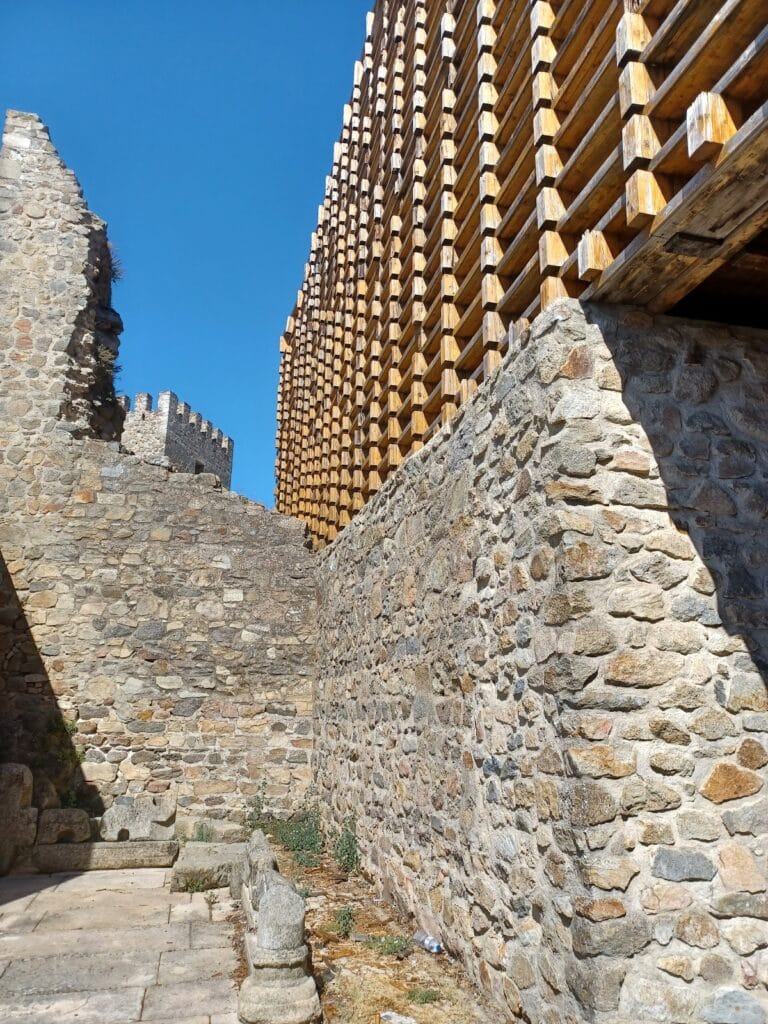
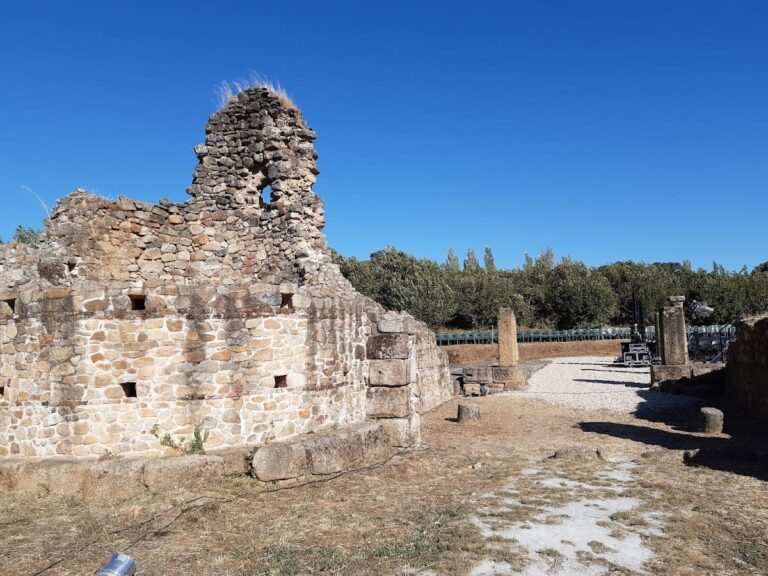
The castle has an irregular rectangular plan and represents Gothic military architecture. Its principal gateway was on the southern side and was crowned by a small tower equipped with machicolations, projecting openings through which defenders could drop objects or discharge weapons onto attackers below. A stone staircase set into the ground reaches the wall-walk, the passage running along the top or inner side of a defensive wall. Much of the interior consists of exposed rock and uneven ground, while surviving wall sections stand in a generally ruined condition.
Vila Gate
The Vila Gate forms part of the preserved urban fortifications and is associated with the northern side of the castle enclosure. This Gothic entrance is flanked by two cubels, small defensive towers used in the castle and town walls.
Traitors’ Gate and presumed keep
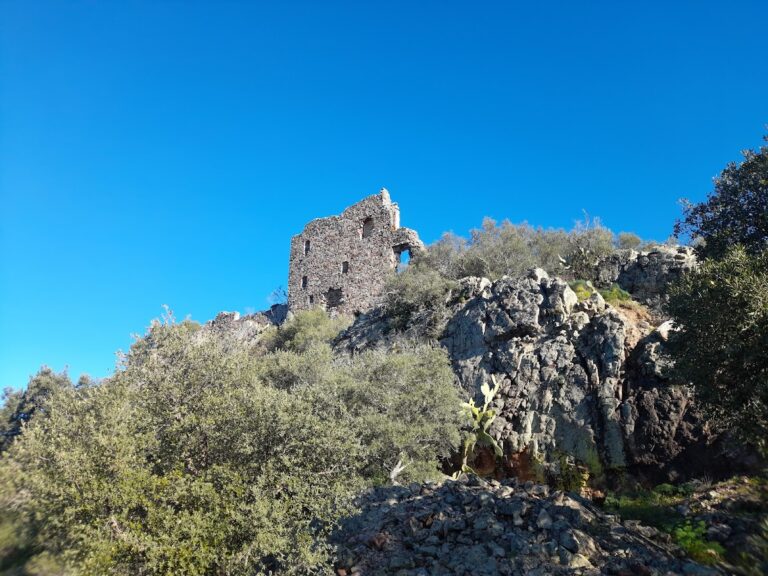
The eastern defences included the Traitors’ Gate, also known as the Sun Gate. Nearby ruins may represent the keep, the principal fortified tower of a castle. The presumed keep had a rectangular plan and two storeys, stood beside the eastern walls, and was associated with a cistern that supplied water to the community inside the walls and to the military garrison.
The cistern connects with a pavement and a southern doorway. A second pavement above it is reached by stairs extending from the courtyard, and the tower appears to have been divided into two sections by the water tank.
Western and southern towers
West of the presumed keep stands a small tower and terrace opening onto a courtyard. In the south-southwest are the remains of a rectangular cubel or watchtower, reached by a staircase attached to the southern wall.
Urban enclosure
A separate urban enclosure surrounded the settlement and connected it with the castle. From the castle, the walls extend toward the southwest around the area of the Santana Gate. Another section runs westward from a cubel before turning northward. The urban walls then turn east-southeast at the Rua do Forno Gate, connect with the Vila Gate between two corbels, continue toward an eastern cubel, and turn southward before reconnecting with the castle and terminating in the southwest.
The castle and town walls are generally in poor or ruined condition. The seventeenth-century bastioned field fortification forms part of the later defensive history of the site, whose surviving fabric also preserves the relationship between the medieval castle and the settlement it protected.