Glamis Castle: A Historic Scottish Tower House and Family Seat
Site at a Glance
- Rating
- 4.7
- Popularity
- Medium
- Country
- United Kingdom
- Primary era
- Early Modern
- External website
- Open
- Eras represented
- Medieval, Early Modern
- Civilizations
- British, Kingdom of Scotland
- Site type
- Domestic
- Remains
- Castle
On this page16 sections
History
Glamis Castle is a historic castle in the United Kingdom, beside the village of Glamis in Angus. A castle stood here by 1372, and major rebuilding in the seventeenth century gave the building much of its present form. The site developed from a medieval tower-house complex and has remained connected with the Lyon, later Bowes-Lyon, family for more than six centuries.
Early Glamis and the Lyon family
Prehistoric activity surrounded Glamis, and the intricately carved Pictish Eassie Stone was found in a streambed at nearby Eassie. A royal hunting lodge stood at Glamis in 1034. Tradition associated with the site holds that Malcolm II, the Scottish king who died that year, was killed or mortally wounded in the area and taken to the lodge. The circumstances of his death are uncertain.
Robert II, a fourteenth-century king of Scotland, granted Glamis to Sir John Lyon, Thane of Glamis, in 1372. A thane was a Scottish noble or landholding official, and the title connected Lyon with the territory around the castle. Sir John was married to Robert II’s daughter, and Glamis remained with the Lyon family from this period. The family later became known as Bowes-Lyon.
Sir Patrick Lyon received the title Lord Glamis in 1445. His descendants later became the Earls of Strathmore and Kinghorne, a Scottish aristocratic title held by the Lyon and Bowes-Lyon family, as well as chiefs of Clan Lyon.
Janet Douglas and the sixteenth century
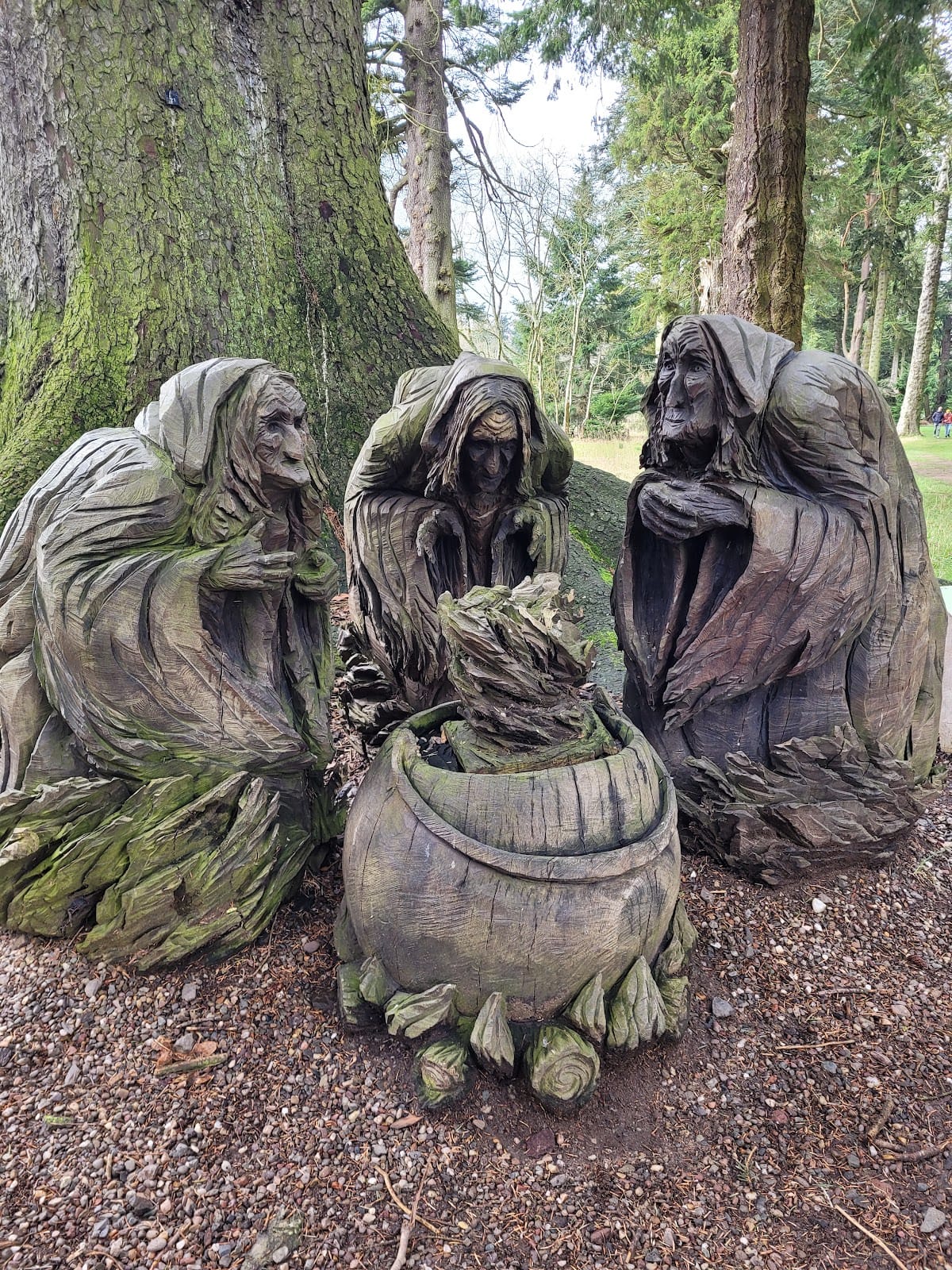
Janet Douglas, the wife of John Lyon, 6th Lord Glamis, was accused of treason, poisoning her husband, and witchcraft during James V’s conflict with the Douglas family. James V ruled Scotland from 1513 to 1542, and his struggle with the Douglas family shaped the prosecution. Janet was burned at the stake in Edinburgh on 17 July 1537, after which the king seized Glamis. He stayed at the castle in November 1538.
Glamis was returned to John Lyon, 7th Lord Glamis, in 1543. The castle’s later history continued under the Lyon family, whose titles and connection with the estate developed into the Strathmore and Kinghorne earldom.
Seventeenth- and eighteenth-century transformation
In 1606, Patrick Lyon, 9th Lord Glamis, became Earl of Kinghorne and began major works at the castle. The rebuilding is commemorated by an inscription naming Patrick and Dame Anna Murray. The redesign has traditionally been linked with Inigo Jones, although William Schaw, the King’s Master Mason, is considered a more likely designer because the work reflects a traditional Scottish style.
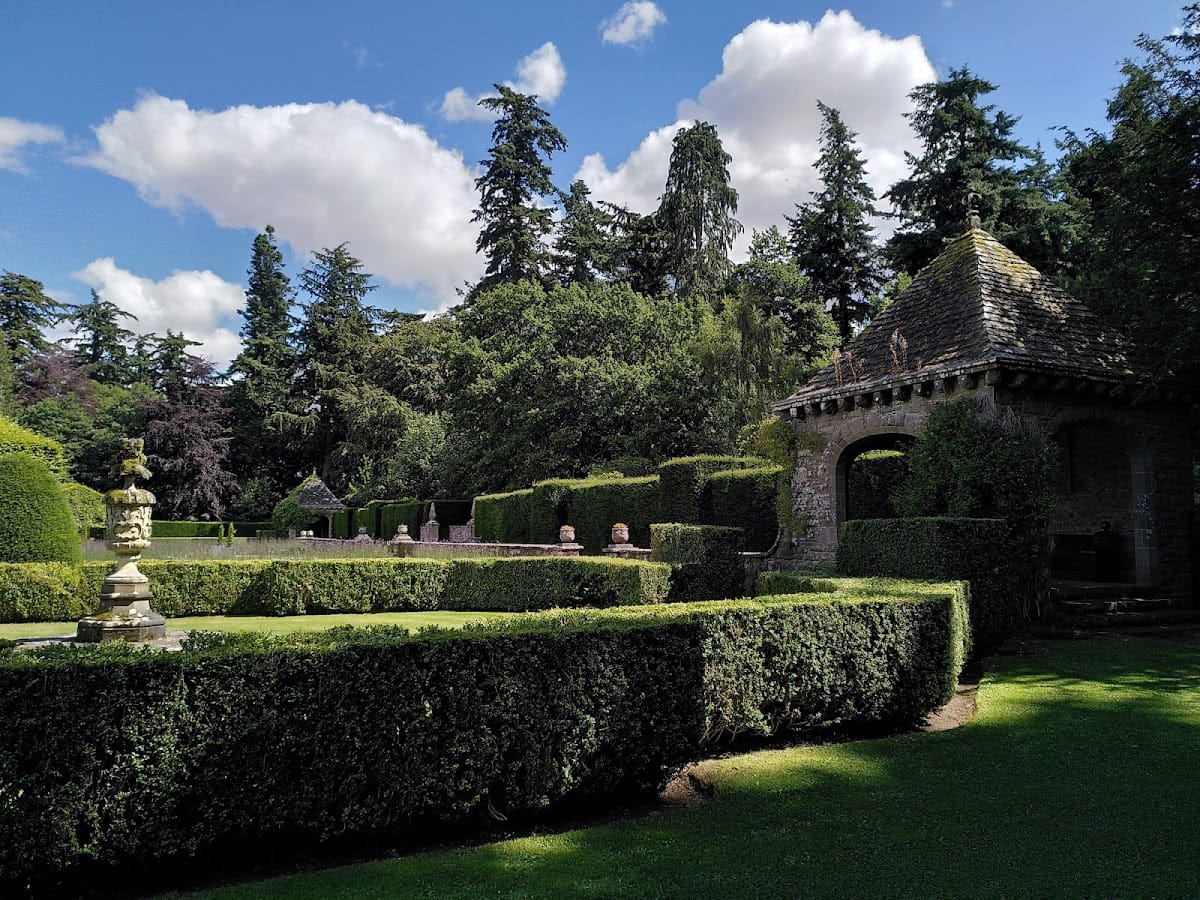
During the Commonwealth of England, Scotland, and Ireland, the republican government that ruled the three kingdoms before the restoration of the monarchy, soldiers were garrisoned at Glamis. When Patrick Lyon, 3rd Earl of Strathmore and Kinghorne, returned in 1670, he found the castle uninhabitable. Restoration continued until 1689, and a major Baroque garden was created during this period. Baroque was a highly ornamental European style associated especially with the seventeenth and early eighteenth centuries.
John Lyon, 9th Earl of Strathmore and Kinghorne, succeeded in 1753. After marrying the heiress Mary Eleanor Bowes in 1767, he began improving the grounds during the 1770s in the picturesque style, which sought landscape compositions that appeared visually striking or romantic.
Later history and royal associations
The south-west wing was rebuilt after a fire in the early nineteenth century. During the First World War, Glamis was used as a military hospital. Lady Elizabeth Bowes-Lyon helped organize the rescue of the castle’s contents during a serious fire on 16 September 1916.
Elizabeth Bowes-Lyon was born in 1900 and spent much of her childhood at Glamis. She became queen consort of the United Kingdom in 1936 and was later widely known as the Queen Mother. Her younger daughter, Princess Margaret, was born at the castle on 21 August 1930.
Glamis has also acquired literary and legendary associations. In Shakespeare’s Macbeth, written around 1603 to 1606, the title character is associated with Glamis Castle. The historical King Macbeth, who died in 1057, had no connection with the castle.
The drawing room contains a prominent portrait of Charles Lyon, 6th Earl of Strathmore and Kinghorne. Its association with his death reflects an important episode in Scots law. On 9 May 1728, Charles was killed at Forfar by James Carnegie of Finhaven when he intervened in a physical altercation involving John Lyon of Brigton. Finhaven’s acquittal established the right of Scottish juries to judge the whole case, including intent, and became an important legal precedent.
Traditions and present status
The best-known Glamis legend concerns the Monster of Glamis, supposedly a severely deformed child born into the family and confined in the castle throughout his life, with his rooms later bricked up. Other versions describe a vampire child born in every generation. The story may have been influenced by a tradition about the Ogilvie family, who were allegedly walled into a room while seeking protection from the Lindsay family and died there of starvation. Another local tradition places a monster in nearby Loch Calder.
The Earl Beardie card-playing legend concerns a fifteenth-century figure identified variously as Alexander Lyon, 2nd Lord Glamis, or Alexander Lindsay, 4th Earl of Crawford. In the story, he plays cards on the Sabbath with a stranger identified as the Devil and is condemned to continue until Doomsday. Later traditions claim that cries and the sound of dice can still be heard.
Castle guides associate the so-called Grey Lady with Janet Douglas and say that one chapel seat is reserved for her ghost. The chapel continues to be used for family functions, and tradition holds that the seat should not be occupied. These claims belong to the castle’s traditions rather than its established historical record.
Glamis Castle has been a Category A listed building since 1971. This Scottish designation is given to structures considered to have national architectural or historic importance. The grounds entered the Inventory of Gardens and Designed Landscapes in Scotland in 1987, a national record of important designed landscapes and gardens. Since 1987, an illustration of the castle has appeared on the reverse of ten-pound notes issued by the Royal Bank of Scotland. The castle is the home of Simon Bowes-Lyon, 19th Earl of Strathmore and Kinghorne, who inherited the earldom in 2016.
Remains
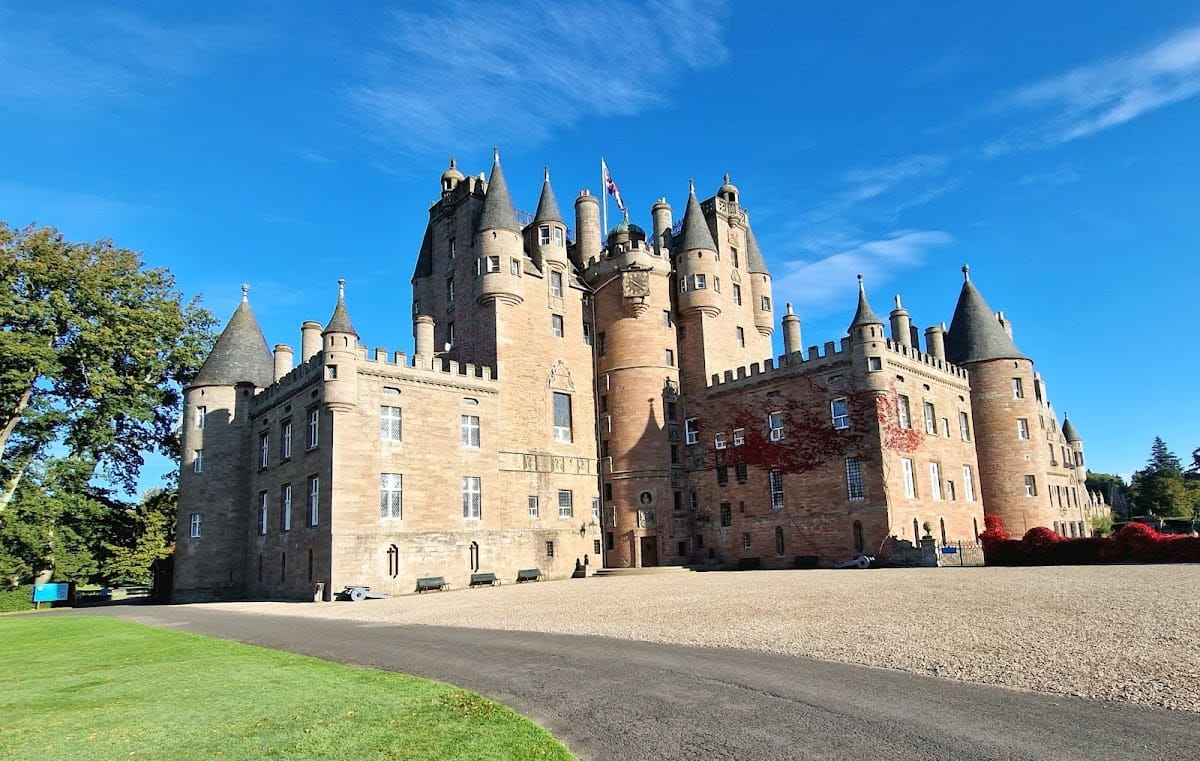
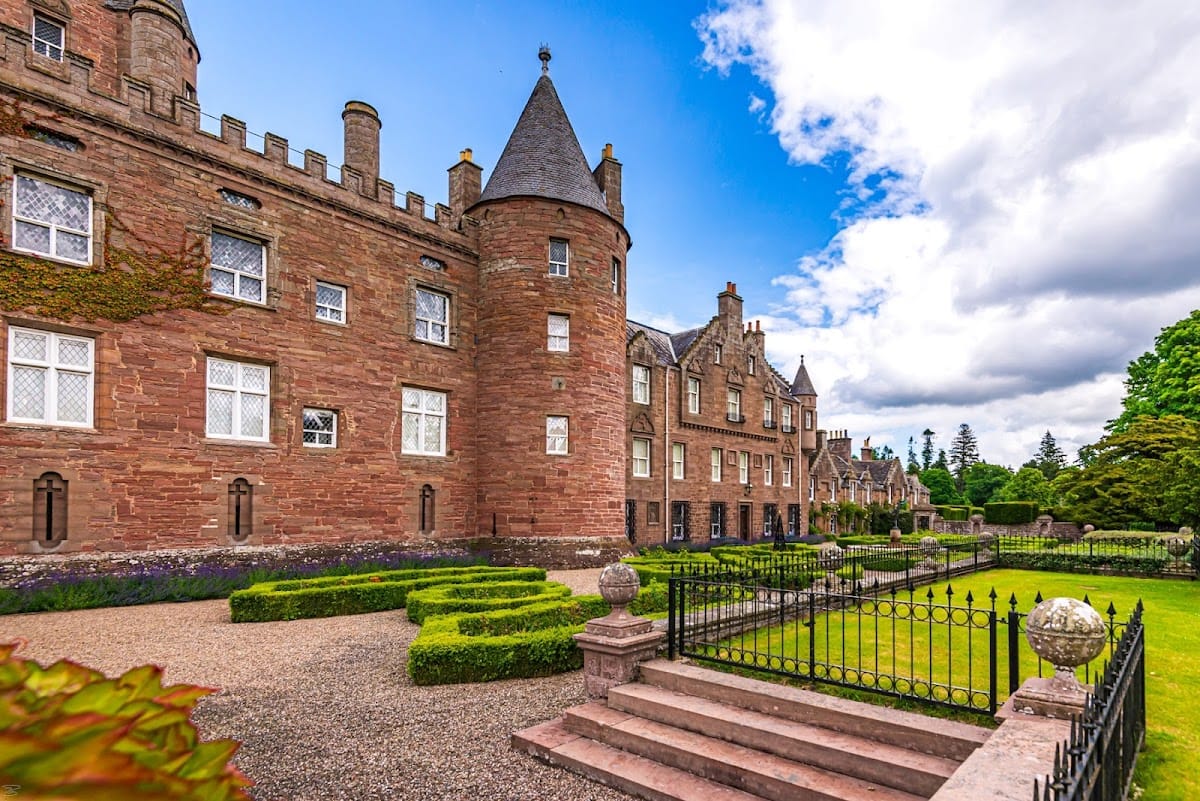
Glamis Castle stands in the fertile valley of Strathmore, between the Sidlaw Hills to the south and the Grampian Mountains to the north, about 20 kilometres inland from the North Sea. The surviving building developed from a medieval tower-house complex, with a central structure rebuilt as an L-plan tower house in the early fifteenth century. An L-plan tower house is a fortified residence formed by joining a main tower to a projecting wing. The present castle dates largely from the seventeenth century and incorporates later additions and alterations.
Castle structure and interiors
Central tower house
The central building preserves the form of a fortified residence expanded over several periods. Seventeenth- and eighteenth-century rebuilding and restoration account for much of its present appearance. The central tower bears the inscription “Built by Patrick, Lord Glamis, and Dame Anna Murray,” linking the surviving fabric with the works begun by Patrick Lyon in 1606.
Front towers
The towers at the front of the castle are each about 7 metres in diameter and approximately 4 metres high. Their walls are about 1 metre thick, and they have modern parapets. These substantial circular forms contribute to the defensive character inherited from the medieval tower-house complex.
Chapel and decorated rooms
The castle contains a small chapel with seating for 46 people. One seat is traditionally reserved for the Grey Lady. The interiors include eighteenth- and nineteenth-century rooms, while the plasterwork on the ceilings is noted for its detail and preservation. The Dining Room is among the interiors associated with these later periods.
Billiard Room fireplace
A large fireplace from Gibside, the Bowes-Lyon estate near Gateshead, was removed in the 1920s and installed in the Billiard Room. It bears the coat of arms of the Blakiston family. Elizabeth Blakiston, heiress of Gibside, had married Sir William Bowes, connecting the fireplace with the family’s wider estates.
Approach and estate landscape
Approach avenue and statues
Four statues were placed along the approach avenue in the seventeenth century. They represent Charles I in boots, James VI wearing a stole, Charles II in Roman dress, and James VII as shown in his Whitehall portrait. Arnold Quellin sculpted the first two statues. The avenue itself extends for one mile and is lined with daffodils.
Gardens, streams, and arboretum
The estate covers more than 57 square kilometres, or about 14,000 acres, and includes parks, gardens, cultivated land, woodland, and cattle pasture. A major Baroque garden was created during the late seventeenth-century restoration, followed by landscape improvements in the picturesque style during the eighteenth century. Two streams cross the estate, including the Glamis Burn. An arboretum overlooks the burn and contains trees from around the world, including rare specimens several hundred years old.
Archives
The clock tower houses archives relating to Glamis Castle and the Bowes and Lyon families. The holdings include a papal bull, a formal document issued by the pope, and the memoirs of Mary Eleanor Bowes. The castle archives are closely connected with those of the University of Dundee, whose search room is used by researchers consulting the material.