Fingask Castle: A Scottish Country House and Threipland Estate



Site at a Glance
- Rating
- 4.6
- Popularity
- Low
- Country
- United Kingdom
- Primary era
- Early Modern
- External website
- Open
- Eras represented
- Medieval, Early Modern, Modern
- Civilizations
- British, Kingdom of Scotland
- Site type
- Domestic
- Remains
- Castle
On this page10 sections
History
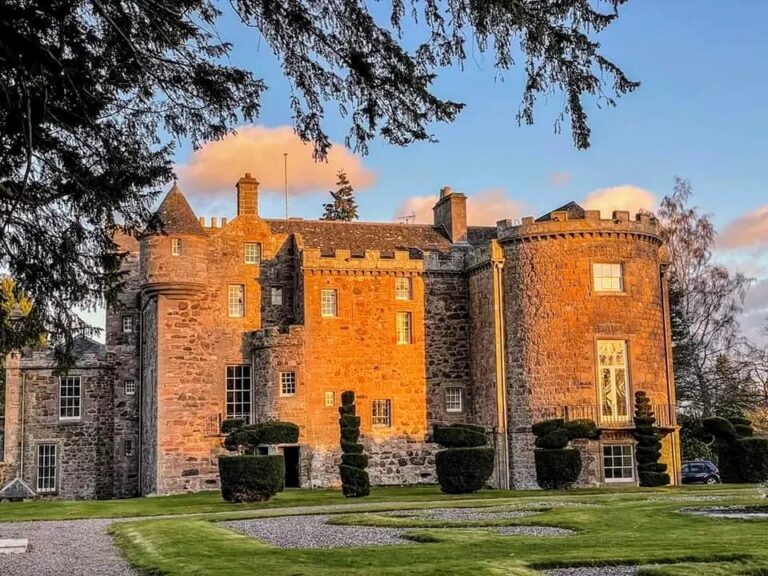
Fingask Castle is a country house in the United Kingdom, above the village of Rait near Errol in Scotland. The present house is dated to 1592 and was built around a twelfth-century structure. Its lands were associated with Scone Abbey from the early twelfth century, and the estate later became closely connected with the Bruce and Threipland families, Jacobite politics, and the development of a designed landscape.
Medieval associations and Bruce ownership
Fingask’s lands appear in the foundation charter of Scone Abbey issued by King Alexander I, whose reign lasted from 1107 to 1124. The charter is traditionally dated to 1114 or 1115. Fingask was described as a holy and numinous stopping place between the abbeys of Falkirk and Scone, giving the site a religious association before the surviving house was built.
The Bruce family held the lands of Rait, including Fingask, from the fifteenth century. The family descended from the senior line of the Bruces of Clackmannan. Sir David Bruce married Janet, daughter of Sir William Stirling of Keir, and their son Robert Bruce held a charter for Rait in 1484, confirmed in 1488. In February 1506 or 1507, David Bruce surrendered his claim to Clackmannan to his uncle.
During Patrick Bruce’s tenure as laird, a stone dated 1594 was inserted into the house. The last Bruce laird, Laurence Bruce, was compelled to sell the estate for the benefit of his creditors in 1671.
The Threiplands and the Jacobite risings
Patrick Threipland bought Fingask in 1672, when the estate was made a feudal barony, meaning a territorial estate held with feudal obligations and jurisdiction. He renovated the house and laid out the gardens. In 1674 he added the neighbouring Braes of the Carse tower house and the Kinnaird estate. He was knighted for suppressing conventiclers, religious dissenters who worshipped outside the established Church of Scotland, and became a baronet of Nova Scotia in 1687. He died as a prisoner in Stirling Castle in 1689 after supporting the ousted King James VII.
David Threipland, the 2nd Baronet, joined the Jacobite rising of 1715, an attempt to restore the Stuart dynasty to the British throne, and fought with the Earl of Mar at Sheriffmuir. After the rising failed, an Act of Parliament attainted him. An attainder was a legal penalty for treason that could remove titles and property, and Fingask and its estate were consequently forfeited to the Crown.
The York Buildings Company purchased the forfeited estate for £9,606 6s 4.5d and retained it until 1783. During this period Fingask was leased to Dame Katherine Threipland, the 2nd Baronet’s daughter, who was known as “the lass of Gowrie.” The family’s Jacobite allegiance continued during the rising of 1745, when government troops badly damaged Fingask Castle. David Threipland, son of the 2nd Baronet, was killed at the Battle of Prestonpans.
Repurchase, restoration, and family succession
David Threipland’s half-brother, Dr Stuart Threipland, repurchased Fingask at a sale of forfeited land in 1783 for £12,207. His sister Euphame Threipland is said to have managed the estate during his absence. Stuart Threipland served as president of the Royal Medical Society, an Edinburgh-based learned medical society, from 1766.
The attainder of 1715 was repealed by Act of Parliament in 1826. Sir Patrick Budge Murray Threipland, an advocate and Stuart Threipland’s eldest son, was restored to the baronetcy. He later served as Deputy Lieutenant for Perthshire and Caithness, a position representing the Crown in a Scottish county.
Sir Patrick-Murray Threipland, the 5th Baronet, lived at Fingask with his three elder sisters before and after their mother died in 1855. When his sister Jessie died in 1871, the household was described as losing its former life. Sir Patrick died in 1882, after which the Threipland baronetcy became dormant.
Fingask then passed to William Scott Kerr, the second son of Sir Patrick’s first cousin. Kerr changed his name to William Murray Threipland. He commanded the newly raised Welsh Guards from 1915 and became colonel of the regiment in 1937.
Twentieth-century changes and continuing use
The estate left the Threipland family in 1917, when it was bought by the whisky merchant Sir John Henderson Stewart. It then covered about 2,587 acres, including approximately 1,070 acres of arable land, 1,400 acres of hill land, and 116 acres of woodland. The combined annual rental from Fingask, Kinnaird, and Inchmichael was £4,000.
Sir John Henderson Stewart became heavily indebted after alcohol prohibition in the United States and died by suicide at Fingask on 6 February 1924. H. B. Gilroy of Ballumbie bought the estate in 1925 and saved the house from ruin, but completely remodelled it. Additions made to the south and west sides between 1828 and 1840 were later demolished, and the remodelling removed all the spiral staircases.
Fingask returned to the Threipland family in 1969, when Mark Stepney Murray Threipland, grandson of William Murray Threipland, bought the reduced estate, then measuring about 75 acres. Mark, his wife Molly, and their son Gavin lived there for 25 years and planted hundreds of trees. Andrew Murray Threipland acquired Fingask in 1996.
Fingask Castle is a protected Category B listed building, and its estate is included in the Inventory of Gardens and Designed Landscapes in Scotland. The associated font, cross, sundial, garden well, and statuary also have Category B status, while the gardens, walled garden, and bridge over the Craig Burn have Category C status. The estate continues to function as a cultural venue through the annual Fingask Follies, a professional musical revue developed by Andrew Threipland and his wife Helen.
Remains
Fingask Castle stands about 61 metres above Rait, approximately 5 kilometres north-east of Errol, on the fringes of the Sidlaw Hills. The house overlooks the Carse of Gowrie and the Firth of Tay, with Fife beyond them. Its present form combines the 1592 house, built around a twelfth-century structure, with later changes to the building and a planned park and garden extending around it.
The house and designed landscape
The house was enlarged on its south and west sides between 1828 and 1840. These nineteenth-century frontal additions were subsequently demolished during later remodelling, which also removed the spiral staircases. The surviving building therefore reflects several stages of alteration, including the sixteenth-century house and the major changes carried out after 1925.
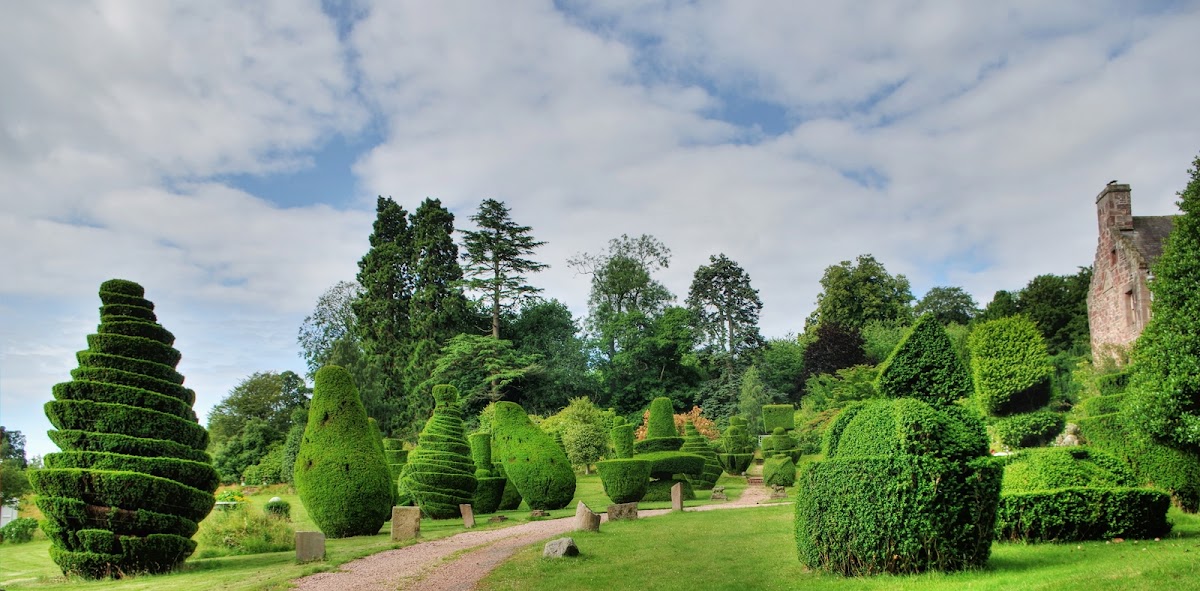
Sir Patrick Threipland, 4th Baronet, laid out the park, while his son planted the topiary gardens and installed their statuary. Topiary, the shaping of living trees and shrubs into ornamental forms, remains a defining feature of the gardens. The grounds also contain the Pavilion, a picturesque building used for entertainments, colloquia, and wedding celebrations.
Garden sculpture and literary subjects
Much of the garden sculpture was made by David Anderson of Perth. His statues depict characters and scenes from Scots literature, including Alexander Wilson’s “Watty and Meg,” Robert Burns’s “Willie Brew’d a Peck o’ Maut,” “And Rab and Allan cam’ tae Pree,” Sir Walter Scott’s The Last Minstrel or Ossian, and Burns’s “Tam o’ Shanter and Kate.”
Other statuary includes a naked black figure of the Doryphoros, the classical Greek “Spear Bearer” associated with the sculptor Polykleitos, and a full-length statue of William Pitt the Younger. Smaller works were made by Charles Spence, known as the Bard of Gowrie and Poet of the Carse. Spence worked for the Threiplands both as a footman and as a mason.
Religious and civic features
The Well of St Peter lies beside the Linn-ma-Gray in a sheltered glen off the drive. A stone above the well bears verses inviting a weary pilgrim to drink, pray, and bless the spring, while describing it as protected from sun, frost, and thaw. The grounds also contain a medieval font, a basin used for Christian baptism, together with a cross, sundial, garden well, walled garden, and other garden structures.
A bridge crosses the Craig Burn within the designed landscape. The Perth mercat cross, a civic market cross associated with a Scottish burgh’s authority and marketplace, was moved to the Fingask grounds around 1660 after it was considered an obstruction to traffic in Perth’s city centre.
Modern artistic features
A subscription mural by Ivan Govorkov and Lena Gubanova measures 4,572 by 2,540 millimetres. It is extended each spring and contains nearly 60 objects, including 35 portraits of patrons, performers, and other people associated with Fingask.