Zítkov Castle: A Medieval Bohemian Fortress Near Choceň


Visitor Information
Google Rating: 4.5
Popularity: Very Low
Country: Czechia
Civilization: Unclassified
Site type: Military
Remains: Castle

History
Zítkov was a castle established in the later part of the 14th century near the town of Choceň in what is now the Czech Republic. It was built by the medieval Bohemian civilization during an era of regional fortification development.
The castle’s early history is connected to a cluster of fortifications around Choceň, alongside castles at Hlavačov, Darebnice, Koutníkov, and Hrádníky. At some point in its use, Zítkov was involved in a siege, likely tied to a dispute over estate ownership following the death of Zikmund Pykna of Lichtenburk. After his passing, the royal authority took control of the estate and King Václav IV granted it to Půta of Častolovice. This transfer sparked a contest from Boček of Poděbrady, leading to military confrontations that involved Zítkov.
The castle’s destruction appears connected to this conflict and events around 1433, when forces loyal to Půta of Častolovice burned the nearby town of Choceň. During this campaign, Zítkov, then held by Boček of Poděbrady’s side, was attacked and likely dismantled. By the early 15th century, Zítkov was abandoned and replaced by a fortified manor within Choceň itself, referenced in records from 1410 to 1417. Notably, the name “Zítkov” is a modern label rather than an original designation.
Findings from archaeological research reveal that artifacts on the site date back to centuries before the castle’s known construction, some reaching as far as the 12th century. This hints at an earlier fortification or settlement in the same place before the 14th-century castle was built. Among the uncovered items are military-related objects and fragments of a silver chalice along with gilded copper horse spurs, which may reflect spoils from wartime or ritual depositions made after the castle’s abandonment. The horse spurs, gilded and symbolic of knighthood, and the damaged chalice fragments suggest practices connected to either warfare or symbolic gestures toward the castle’s downfall.
Remains
Zítkov castle exhibits a clear two-part arrangement, consisting of a southern outer bailey and a northern inner core where the principal buildings stood. The entire complex was positioned on a narrow elevated ridge on the western side of the Tichá Orlice valley, taking advantage of natural steep slopes and ravines for defense.
Access to the outer bailey was secured by two earth-filled ditches. The southern ditch still survives in part today and leads to a constricted entrance marked by a second ditch. Above this gateway area, a raised mound likely supported a tower that guarded the main access point. The outer bailey was largely open inside, with no evidence of permanent structures, but featured a defensive earthwork along its northwest boundary.
Separating the outer bailey from the inner castle core was another deep ditch, which wrapped around the western and northern sides. A broad rampart adjoined this ditch, expanding into an area resembling a barbican—a fortified outwork designed to protect the entrance—on the castle’s western flank. To the northeast of the core, a small terraced section may represent remnants of another elevated defensive position known as an upper barbican.
The inner core contained two vaulted palaces, whose outlines are still visible as raised ground forms. Archaeologists found brick fragments and burnt material from clay plaster (daub) here, indicating that the originally timber-framed upper floors were supported by masonry vaults below. Bricks were used extensively due to the absence of suitable local stone, as the surrounding geology mainly consists of gravel and sand.
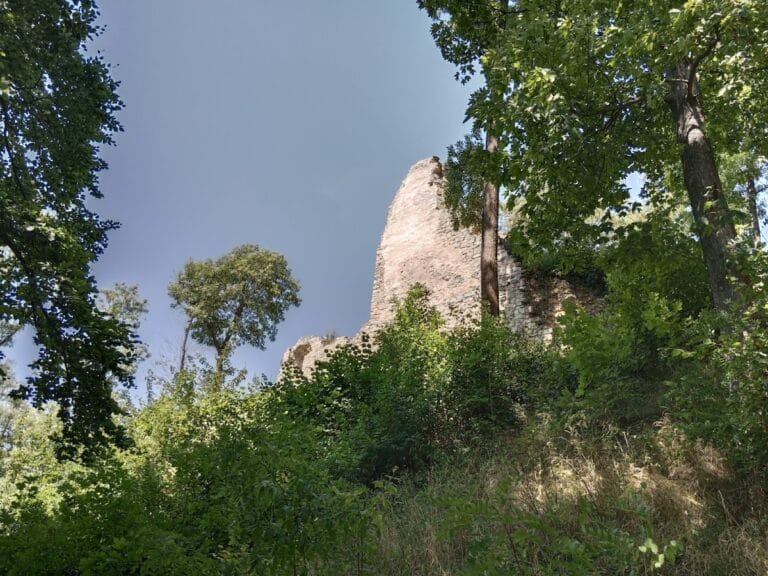
Today, most of what remains visible of Zítkov consists of earthworks such as ditches and ramparts, along with scattered masonry debris from its buildings. Excavations have recovered numerous iron arrowheads and other metal objects, illustrating the castle’s military character. Among these finds are a silver chalice broken into pieces and gilded copper horse spurs, which appear to have been deliberately deposited or dismantled after the castle was no longer occupied. This material evidence ties the site directly to the violent events that ended its use and hints at the habits and symbols important to those who once lived or fought there.
Nearby sites