Rychmburk: A Medieval Castle in Czechia


Site at a Glance
- Rating
- 4.6
- Popularity
- Low
- Country
- Czechia
- Primary era
- Early Modern
- External website
- Open
- Eras represented
- Medieval, Early Modern
- Civilizations
- Holy Roman Empire, Kingdom of Bohemia
- Site type
- Military
- Remains
- Castle
On this page12 sections
History
Rychmburk is a medieval castle in Czechia at Předhradí, built by Tas of Mrdice in the first quarter of the fourteenth century, probably around 1325. It stands on a steep spur above the confluence of the Krounka and Lešanský streams. The castle was established after King John of Luxembourg transferred the area to Tas, and it was initially known as Reichenberg or “Tas’s Castle.” Its medieval defensive foundations were later reshaped into Renaissance and Baroque residences.
Fourteenth-century foundation and early lords
Rychmburk’s early connection with the Mrdice family is inferred from the shared ownership of Heřman of Mrdice and later property relationships involving his sons Heřman and Ctibor of Rychmburk. Before 1349, the castle passed to Beneš of Vartenberk. Before 1361, it was acquired by William of Pardubice, the brother of Archbishop Arnošt of Pardubice.
Around 1387, William’s younger son Smil Flaška of Pardubice became the castle’s lord. Smil was known as a Czech poet and writer. After his death in 1403, Rychmburk passed to his son Arnošt, whose possession was interrupted by the religious and political conflicts of the fifteenth century.
Rychmburk during the Hussite Wars
At the beginning of the Hussite Wars, fifteenth-century religious and political conflicts in Bohemia associated with the followers of Jan Hus, Rychmburk became a refuge for Catholic nobles and townspeople. In 1425, the Hussites took the castle after its garrison surrendered in exchange for safe departure. The surrender followed the burning of the abbot of the nearby Podlažice monastery at Lažany near Skuteč.
The Hussites placed Rychmburk under the administration of Jiřík, the son of the Hussite captain Jakub Kroměšín. In 1433, the Hussite commander Jan Pardus of Horka and Vratkov took possession of the castle. In 1436, the estate was returned to Arnošt Flaška of Pardubice for loyal service to the emperor. Arnošt died without children in 1439, and the estate reverted to the king.
Rychmburk then passed to Jan Pardus in 1454. In 1465, Jan’s underage son Vilém Pardus inherited it under the guardianship of Zdeněk Kostka of Postupice. After Vilém’s death in 1490, Anežka of Chlum and Košumberk administered the estate.
Renaissance transformation and the Berka family
Jindřich Šťastný of Valdštejn acquired the estate in 1500. His son Vilém of Valdštejn inherited it in 1537 and carried out extensive repairs. During the first third of the sixteenth century, especially between 1530 and 1540, the medieval stronghold was remodelled as a Renaissance residence. Renaissance architecture introduced more regular proportions and decorative stone framing alongside the older defensive structure.
In 1547, Ferdinand I confiscated Rychmburk from Vilém of Valdštejn because of his participation in the Estates’ revolt, an uprising by Bohemian estates against the rule of the Habsburg monarch. The property later returned to the Waldstein family. Kryštof Jandert of Vrchlabí held the castle in pledge for one year from 1550, followed by Marie Jansovská of Soutice. In 1555, Zdeněk Berka of Dubá and Lipá took possession and purchased the entire Rychmburk estate in 1558.
After Zdeněk Berka’s death in 1572, the estate passed to Václav the Elder Berka of Dubá and Lipá, and in 1600 to his son Lev Burian Berka. Lev Burian expanded the estate by acquiring Rosice, Úhřetice, Řestoky, Dašice, and Slatiňany. He was raised to the rank of count in 1623 and created a hereditary fideicommissum from Rychmburk, Dašice, and other properties. A fideicommissum was an estate legally tied to family succession, normally restricting its division or unrestricted sale.
Lev Burian died in 1625, leaving the estate to his underage son Matyáš Ferdinand. His mother, Eusebie Hypolita Františka Berková, administered it until 1636. Matyáš Ferdinand died without heirs in 1644, and Bohuslav Ferdinand Berka held the estate from 1650. After Bohuslav’s death in 1659, the male line of this Berka branch ended. His daughter Františka Božena Rosálie Berková inherited the property and appointed František of Jansdorf as administrator.
Later Berka, Kinský, and Thurn-Taxis ownership
From 1670, the estate passed to the Jablonský branch of the Berkas. Count František Antonín Berka held it as a family fideicommissum and became hereditary Supreme Marshal of the kingdom in 1701. He died without children in 1706, ending the Berka family of Dubá and Lipá in Bohemia. Františka Rosálie Berková inherited the estate in the same year. After her death in 1714, it passed to her half-brother Václav Albrecht of Bruntál and Vrbno.
Václav Norbert Oktavián Kinský purchased the Rychmburk estate in 1718 and left it to his son Štěpán Vilém, Prince Kinský, when he died in 1719. After Štěpán Vilém’s death in 1749, the estate passed to František Josef Kinský and then to his underage daughter Marie Augusta Kinská, who died in 1753. Filip Kinský subsequently took over the estate, altered the castle extensively, and established farmyards and sheepfolds that contributed to the formation of new settlements on the estate.
Between about 1793 and 1798, Filip Kinský remodelled Rychmburk in the Baroque style for residential and economic purposes. Baroque alterations generally emphasized later residential and representational uses. In 1823, he sold the Rychmburk estate together with Chroustovice to Prince Karl Alexander of Thurn and Taxis. The Thurn-Taxis family acquired Košumberk in 1826, creating a combined estate that included two towns, two townships, and 70 villages in 1848.
Estate administration and modern use
The Thurn-Taxis family was based in Regensburg, while the manorial administration operated from Rychmburk and Chroustovice. Forestry provided the principal income of the Rychmburk, Chroustovice, and Košumberk estates. In 1919, the Ministry of Agriculture imposed state administration on the Rychmburk estate, and land-allotment proceedings began in March 1924 as part of the land reform. The estate then covered about 1,458 hectares and included breweries and distilleries at Rychmburk and Uhersko.
The Thurn-Taxis family retained the properties until 1945, when the estate and castle were confiscated and nationalized. Rychmburk became a home for elderly people, while the estate’s forests passed to the state forests. From 2007 to 2021, the building served as a social institution for adults with mental illnesses. Today, the castle is owned by the Pardubice Region, administered by the Regional Museum in Chrudim, and protected as a cultural monument of the Czech Republic.
Remains
Fortified site and perimeter
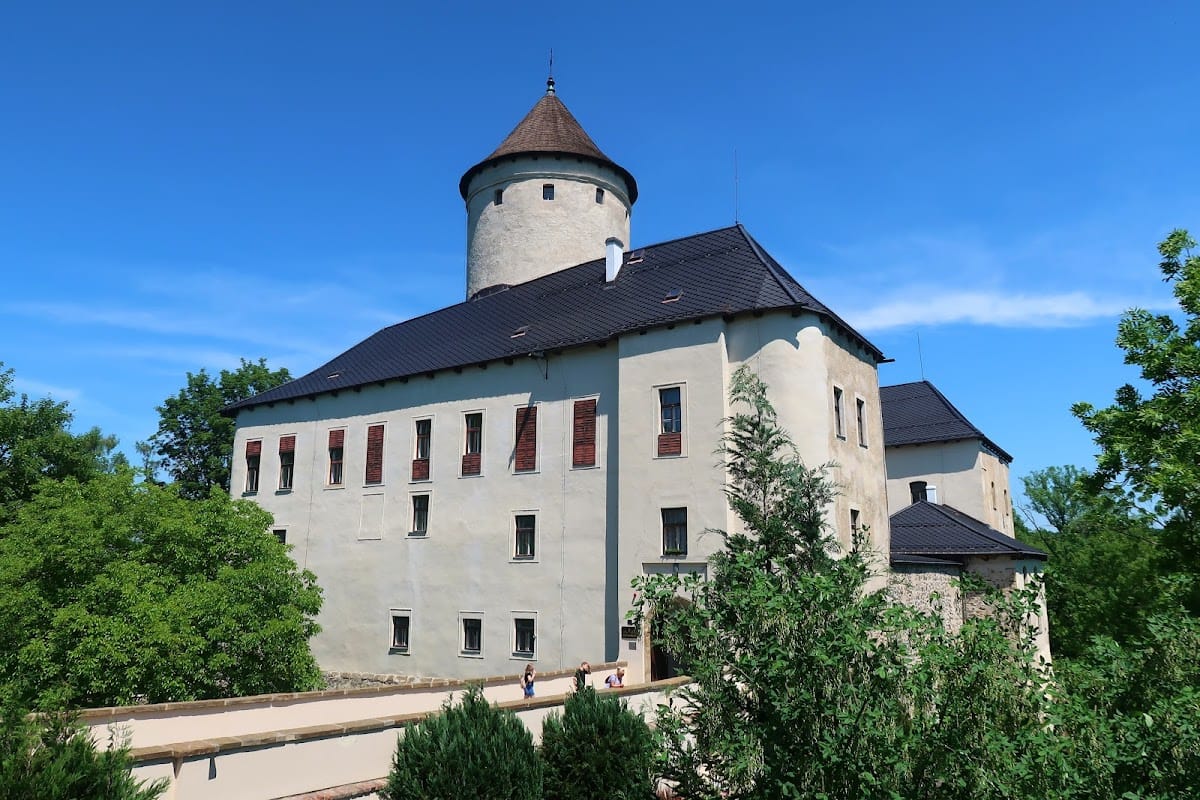
Rychmburk occupies the northeastern end of a steep spur above the meeting point of the Krounka and Lešanský streams. Steep valley slopes bound the site, while an artificial moat separates it from Předhradí. The original castle, established at the beginning of the fourteenth century, formed a relatively regular elongated rectangle enclosed by a solid perimeter wall. A large moat protected the approach from the southwest, where a stone bridge now crosses the defensive feature.
Towers and entrance
The southern entrance side was protected by a powerful round tower, while the residential section occupied the more secure opposite side of the plan. The tower survives at about 30 metres high beneath a conical roof. Its fabric includes partial Gothic embrasures, which are defensive or observation openings, and corbels, projecting stone supports that once carried parts of the structure above. Remains of sgraffito decoration also survive. Sgraffito is made by scratching through one surface coating to reveal a contrasting layer below.
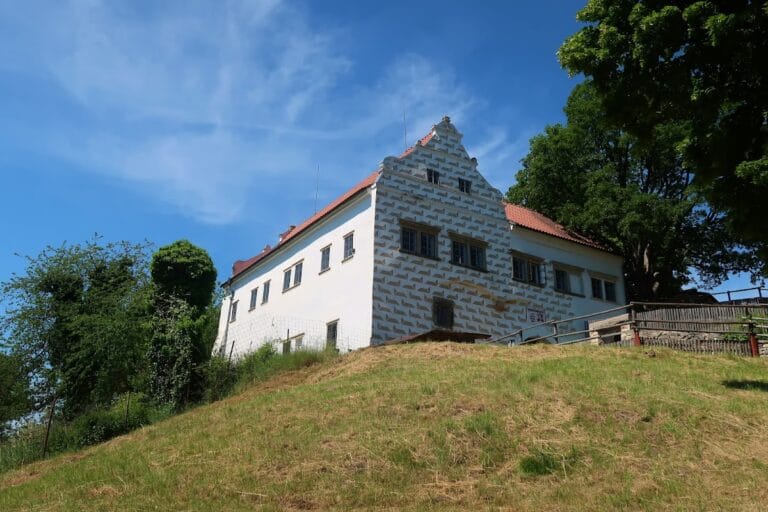
The present castle is a two-storey rectangular building on the spur above the valley. Its entrance gate, positioned at the southern corner, has Renaissance stone framing. The fourteenth-century round tower stands at the western corner of the rectangular courtyard, while a smaller quadrangular tower occupies the northern corner. These towers preserve the principal defensive elements of the medieval plan within the later residential complex.
Residential wings and interior spaces
The northern wing contains a Renaissance gallery on its upper storey and three rectangular portals with stone surrounds. The courtyard gives access to a vaulted basement room supported by a central pillar. Gothic vaulted cellars, together with Gothic and Renaissance vaults on the first and second floors, preserve elements from the castle’s earliest building phases and its sixteenth-century transformation.
Chapel and preserved exhibitions
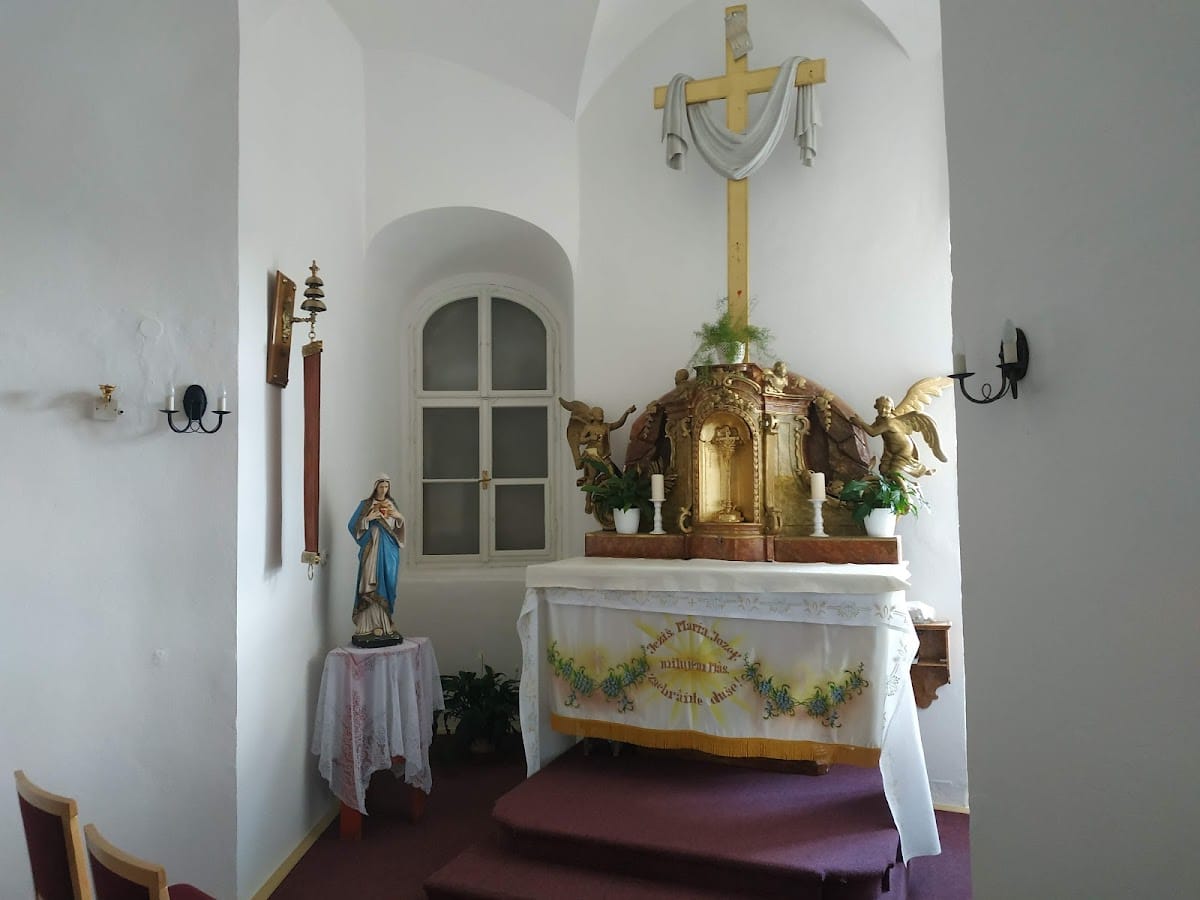
The second floor of the round tower contains the Chapel of the Holy Cross, dating from the second half of the seventeenth century. Its unusual vault and two panel paintings belong to the later history of the tower and reflect the castle’s continued adaptation after its principal medieval defensive phase.
The cellars contain a permanent exhibition devoted to Rychmburk Castle and the municipality of Předhradí. Small exhibitions occupy the accessible round tower, using the surviving medieval structure to present aspects of the castle and its history.
Outer bailey
A fortified outer bailey, an enclosure adjoining the main residential and defensive core, was constructed during the late Gothic period around 1500 in connection with the settlement of Předhradí. Its unusually large layout survives as one of the best-preserved examples of this type in Czechia.
Nearby sites