Potštejn: A Gothic Castle Ruin in Czechia

Site at a Glance
- Rating
- 4.6
- Popularity
- Medium
- Country
- Czechia
- Primary era
- Medieval
- External website
- Open
- Eras represented
- Medieval, Early Modern
- Civilizations
- Holy Roman Empire, Kingdom of Bohemia
- Site type
- Military
- Remains
- Castle
On this page23 sections
History
Potštejn is a large medieval castle ruin in Czechia, built by the Drslavic family in the late thirteenth century on a wooded, conical hill southeast of the town of Potštejn in eastern Bohemia. Its Gothic construction was connected with the colonization of the middle Divoká Orlice basin. The castle later became a royal possession, a Hussite-era stronghold, and the residential and administrative center of the Pernstein domain in eastern Bohemia.
Before the medieval castle
A prehistoric hillfort occupied the summit before Potštejn was built. Pottery indicates settlement during the Lusatian and Silesian-Platěnice cultural periods. The construction of the medieval castle altered the summit and damaged the earlier remains, incorporating the hill into a new fortified complex.
The Gothic castle was probably founded by Půta of the Drslavic family in connection with the settlement of the surrounding region. Some chronologies place its construction between 1270 and 1287, while other descriptions place it more generally at the end of the thirteenth century. The name Potštejn derives from Půta’s name and the meaning “Půta’s stone,” reflected in the medieval forms Puttenstein and Potštejn.
The Drslavic and royal castle
In 1312, Potštejn was held by Procek of Potštejn and his son Mikuláš, who were involved in a dispute with the Prague patrician Proš family. Mikuláš later became one of the leading opponents of the Luxembourgs in Bohemia and acquired a reputation as a robber knight.
In 1339, Margrave Charles besieged the castle. After nine weeks he captured it, seized it, and ordered its demolition. Mikuláš of Potštejn was killed during the siege. In 1341, King John of Luxembourg returned most of the family’s possessions to Mikuláš’s sons but retained Potštejn. The Půtic family consequently moved its residence to nearby Velešov.
Charles, who became King of Bohemia and Holy Roman Emperor, bought Potštejn from Mikuláš’s descendants in 1356. He began rebuilding it as the center of a royal domain. Before 1371 he pledged the castle to Prince Bolko of Opole, who was documented there five years later. Wenceslas IV, the succeeding Luxembourg king of Bohemia, pledged Potštejn in 1396 to Jindřich Lacembok of Chlum and in 1398 to Margrave Prokop of Moravia.
In 1399, forces belonging to the League of Lords, an alliance opposing Wenceslas IV, unsuccessfully besieged Potštejn. Wenceslas transferred the castle to his wife, Queen Sophia, in 1410, while also pledging it to Hynek Krušina of Lichtenburg.
Hussite-era conflicts
After Queen Sophia died in 1425, Potštejn passed to King Sigismund, another Luxembourg ruler of Bohemia. In 1429, Sigismund pledged it to Půta the Younger of Častolovice, a leading opponent of the Hussite movement in eastern Bohemia. The Hussites were a religious and political reform movement that began in Bohemia during the fifteenth century.
The eastern Bohemian Orphans, a Hussite military faction, soon besieged Potštejn. The castle held out for six months before being captured. After Půta’s death, his mother, Princess Anna of Oświęcim, received the castle and transferred the pledge rights to Hynek Krušina of Lichtenburg.
Hynek’s son Vilém transferred all his rights in Potštejn to George of Poděbrady in 1454. George, a fifteenth-century Bohemian king, also controlled the neighboring Litice domain. Potštejn’s importance declined as George resided at Litice, although he allowed the Hussite captain Bedřich of Strážnice to use the castle as his final refuge. Bedřich died at Potštejn in 1459.
The Pernstein stronghold
After George of Poděbrady died, his eastern Bohemian estates passed to his son Boček and soon afterward to his brother Henry of Münsterberg. Heavy debts led Henry to sell the Litice domain in 1495 and transfer the pledge rights to Potštejn to William of Pernstein. In 1497, King Vladislaus Jagiellon converted the pledge into hereditary tenure.
Potštejn then became an important Pernstein stronghold in eastern Bohemia for more than half a century. The Pernsteins were a powerful noble family whose estates included extensive holdings in the region. During the first quarter of the sixteenth century, William of Pernstein extensively rebuilt the castle, turning it into the residential and administrative center of the Pernstein domain in the eastern Hradec region. The rebuilding also greatly strengthened its artillery defenses.
Under William’s successor, Vojtěch of Pernstein, the castle and its associated manor housed 43 members of the lordly and farm staff. An administrative regulation lists their names and half-yearly wages. It places the burgrave Jan Okrouhlický first, with a salary of 40 kop of groschen.
Financial decline and later ownership
After Vojtěch died in 1534, his brother Jan, known as “the Rich,” inherited the estates. He could not prevent the financial collapse of the Pernstein domain. His son Jaroslav took over the administration of Potštejn in 1548 and was forced to sell much of the family property.
The combined Potštejn-Litice domain passed to Ernest, Count Palatine of the Rhine, in 1556 and was resold in divided form two years later. Václav Hrzán of Harasov and Jenštejn acquired the newly defined Potštejn domain. Under his son Adam Šťastný, who assumed control in 1576 after a period of guardianship, parts of the upper castle were restored in Renaissance style, adding to the owner’s debt.
After Adam died in 1598, Adam the Elder Hrzán of Harasov administered Potštejn for Adam’s daughter Anna Kateřina. When she assumed control in 1603, the castle’s importance declined. The lord’s principal residence became the Dvoreček estate in Kostelec nad Orlicí, and only part of the administrative staff continued to live at Potštejn.
Debt forced Anna Kateřina to sell the domain in 1629 to the imperial general Kašpar of Gramb. He bequeathed part of it, including Kostelec nad Orlicí and neighboring villages, to the Jesuit College of Saint Clement in Prague. His daughter Františka Magdalena, who was married to Václav Záruba of Hustířany, took control of the reduced Potštejn estate.
The castle remained with the Záruba family for more than a century and gradually deteriorated. Bohuslav Balbín, a seventeenth-century Bohemian historian and writer, still described it as habitable in 1681.
The Harbuval Chamaré family and the treasure legend
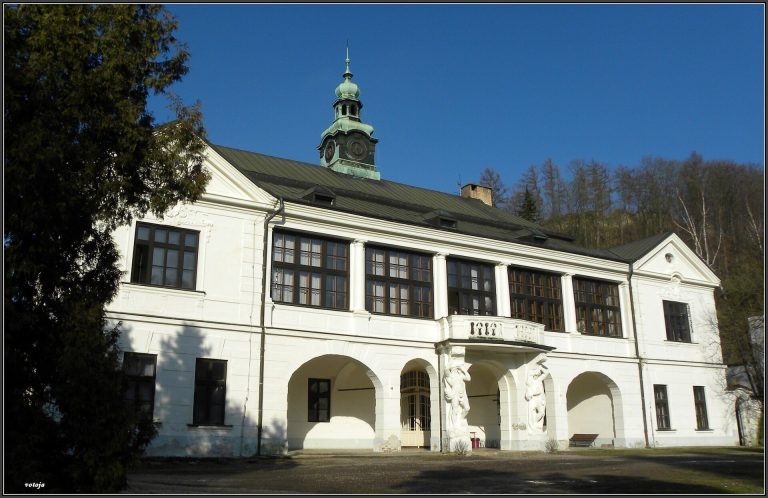
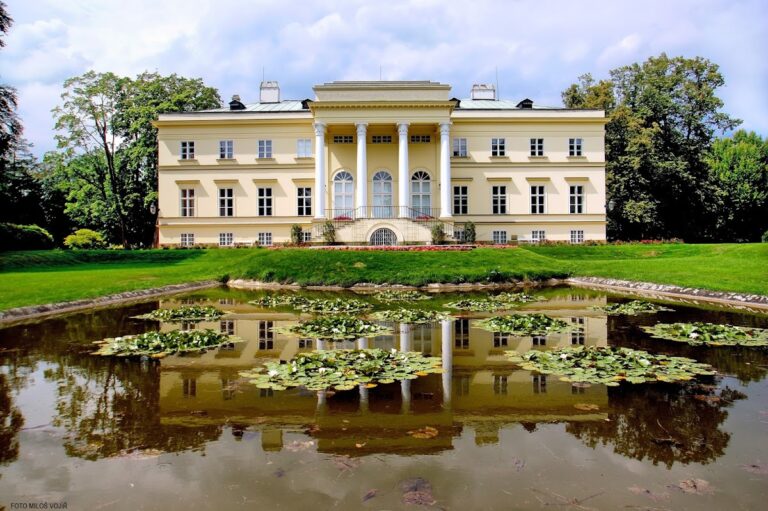
In 1746, the daughter of the last male Záruba heir sold Potštejn Castle, the town, and part of the surrounding villages to Jan Ludvík Harbuval Chamaré, a Silesian emigrant. His family built a new château in the town and altered the castle’s appearance by adding religious structures.
The Harbuvals also damaged several castle buildings while searching for a legendary underground treasure. The story became especially associated with Count Jan Antonín Harbuval Chamaré, the son of Jan Ludvík. He spent decades looking for the supposed treasure after interpreting a late Gothic inscription as a coded instruction for excavation.
The legend was popularized by Alois Jirásek, a Czech historical novelist, in his historical novella Poklad, or “The Treasure,” which was serialized from January 1881. The search produced many tens of meters of tunnels beneath the upper castle and destroyed parts of the masonry. Chamaré also treated marked stones from collapsed passages as clues, although they were probably masons’ marks.
The inscription is now understood as a protective saying carved during the second half of the fifteenth century, probably on the lintel of a door jamb. It was moved to its present position during the early sixteenth-century Pernstein rebuilding and attracted attention more than 150 years later. The most valuable archaeological discovery associated with the search has been a group of stove tiles. Medieval pottery and pieces of metal were more common finds.
Conservation and public ownership
During the late nineteenth century, Potštejn became a popular excursion destination for summer visitors and other travelers. More substantial stabilization began in the late 1930s, after the castle complex was acquired by the Czechoslovak Tourist Club. The work was forcibly halted during the occupation.
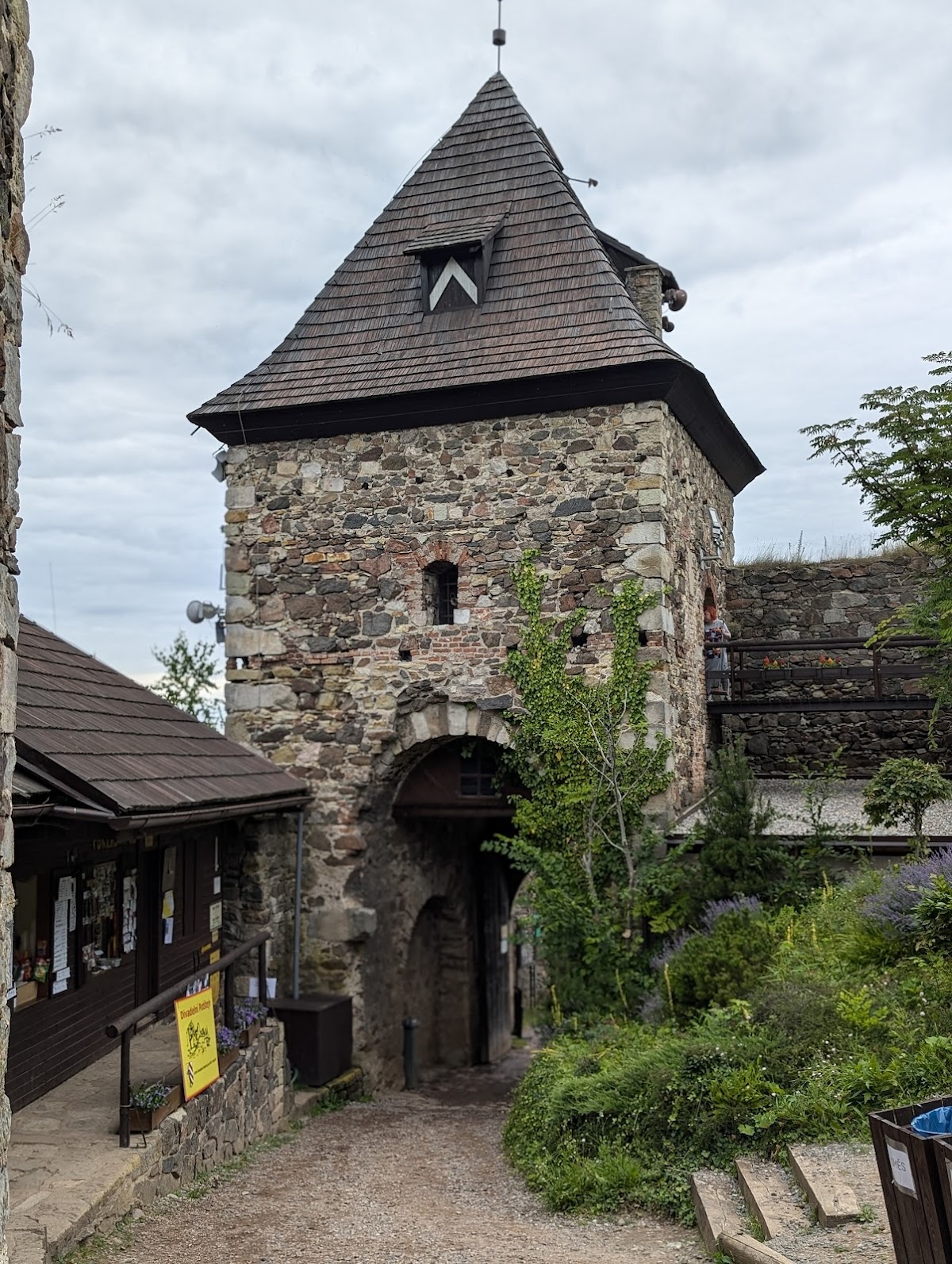
In 1945, the Dobřenští estate of Dobřenice was confiscated. The castle then passed to the Czech Sokol Community and later to the state forests. A costly structural-stabilization plan was prepared in the 1970s, but only a roof over the fourth gate was completed, in 1976. During the 1980s, the Brontosaurus movement cleared invasive shrubs and carried out minor conservation work. The front section of the fifth gate was also stabilized as a stage-like façade.
After 1989, Potštejn became municipal property. The municipality opened the castle to the public in 1994 and began long-term conservation of the surviving masonry and improvement of the complex. The spaces at the fourth gate were adapted for the castle administrator, and the upper-castle chapel was newly roofed. A mainly local volunteer group of older residents, known as Dědkostav, continues to care for the castle. Potštejn is protected as a cultural monument.
Remains
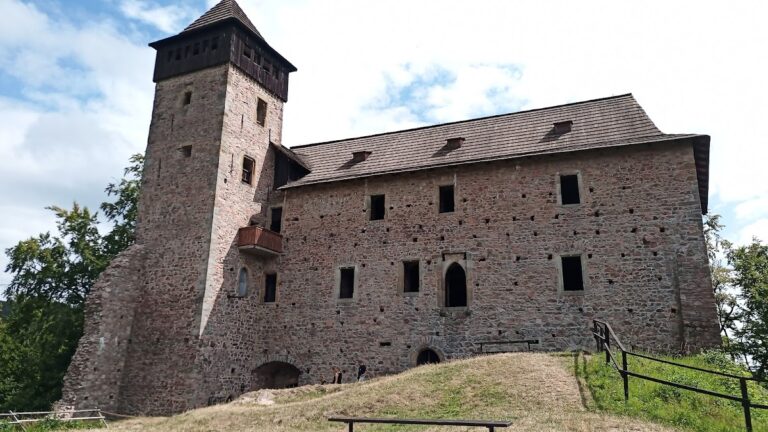
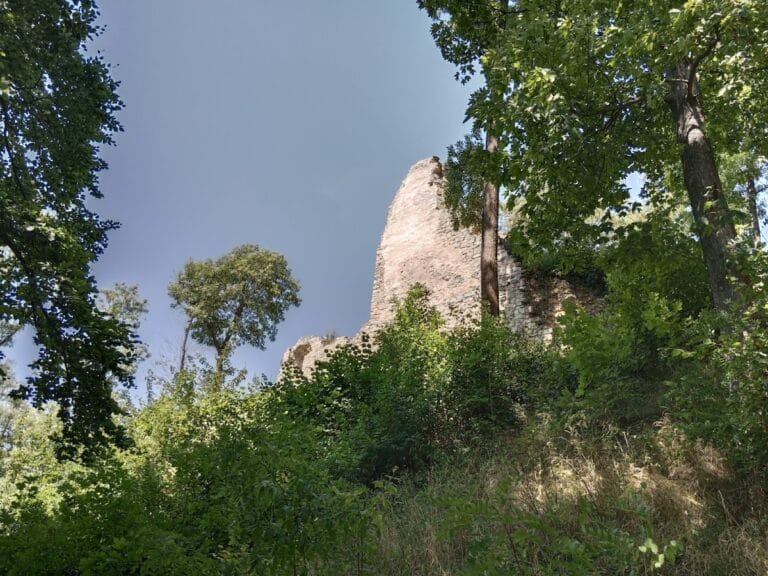
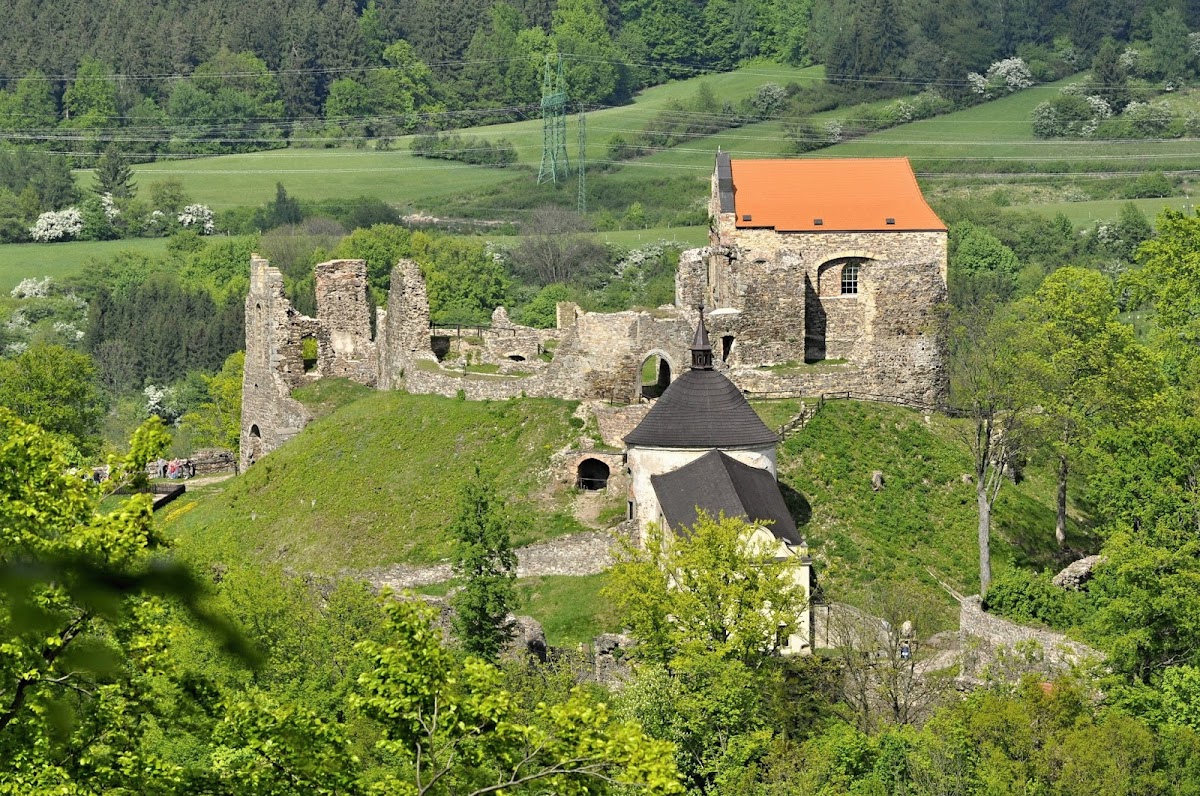
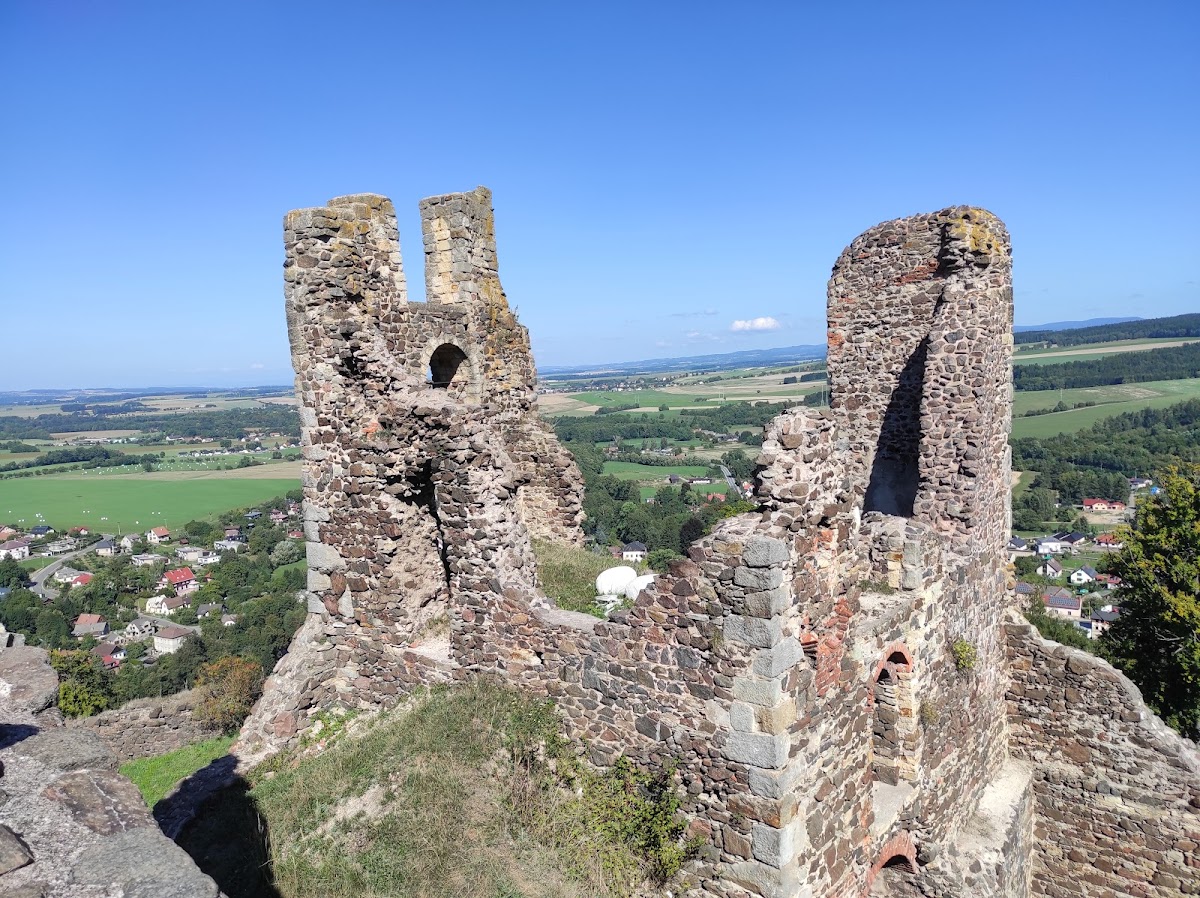
Potštejn is an extensive sandstone ruin with Gothic, Renaissance, and Baroque phases. The castle occupies the summit and slopes of a conical wooded hill. Its surviving layout includes the upper castle, successive defensive circuits, bastions, gates, palace and residential remains, and religious buildings added after the medieval castle had declined. The physical form reflects both the compact early fortress and the much larger artillery complex created under the Pernsteins.
Upper castle and medieval core
Early defensive core
The earliest Drslavic castle probably occupied only the hilltop area corresponding approximately to the present upper castle. It was probably organized as a bergfried-type fortress, meaning a medieval castle centered on a principal defensive tower. Rebuilding under Charles IV enlarged the complex and included work directed by the burgrave Půta the Elder of Častolovice. The rebuilding probably ended before 1360, when a castle chapel is first recorded.
Palace and inscription
The upper castle contains parts of the palace and residential chambers, together with numerous carved stone architectural elements incorporated during the Pernstein rebuilding. A late Gothic inscription is set high in the eastern corner of the palace. The stone probably began as a door-jamb lintel and carries a protective formula referring to the sign of Tau, the doorposts, God, and the intimidation of enemies. Its later position helped give rise to the treasure interpretation.
Well tower and construction
The well was protected by a cylindrical tower connected to the corridor wall by a masonry neck. Rebuilding of the upper castle created almost continuous construction around its perimeter. The complex was built primarily of sandstone, and the surviving masonry preserves the results of medieval defensive work, Renaissance alterations, later religious construction, and localized damage from the treasure search.
Pernstein fortifications
Middle defensive circuit
William of Pernstein’s rebuilding added an access corridor and two new circuits of fortification around the upper castle. The middle circuit was intended to carry the principal defensive burden. It included three semicircular bastions, a large southern bastion, an entrance gate, and another irregular bastion.
The middle circuit’s wall averaged about 1.4 meters in thickness and rose approximately six meters above the ground to a wall-walk with a parapet, probably including crenellation. The bastions contained loopholes suitable for heavier firearms, showing how the castle’s defenses were adapted to changing artillery technology during the early sixteenth century.
Second gate and earthen bastion
The present second gate was approached across a transverse ditch lined with masonry on both sides and crossed by a drawbridge. The adjoining part of the access corridor was vaulted. The entire bastion was covered with earth, forming a bolwerk, or large earthen artillery bastion. Its crest could carry heavy guns and defend the sector where the terrain offered attackers the easiest approach.
Renaissance alterations
Fifth gate and northeastern wing
Adam Šťastný Hrzán’s Renaissance alterations were smaller than the Pernstein rebuilding. Associated with the Italian builder Burian Gozzi, they concentrated on the fifth gate and the adjoining northeastern wing. The fifth gate was raised by a fourth story, while the gate and wing probably took over the residential function previously housed in the more confined oldest part of the castle.
Baroque religious buildings
Chapel of Saint John of Nepomuk
Between 1750 and 1752, Anna Barbora of Sanning, the wife of Jan Ludvík Harbuval Chamaré, commissioned the Chapel of Saint John of Nepomuk in the eastern part of the upper castle. The building projected into the courtyard beyond the original footprint of the castle palace. It burned in 1762, was repaired soon afterward, and became a ruin during the nineteenth century.
Stations of the Cross
In 1754, Anna Barbora established a Stations of the Cross between the town and the castle. This Christian devotional sequence represents episodes from Christ’s Passion. It began at the Church of Saint Lawrence and partly followed the original access road. Its central station, the Calvary, stood in the northern part of the bolwerk beside the second gate.
Chapel of the Holy Stairs
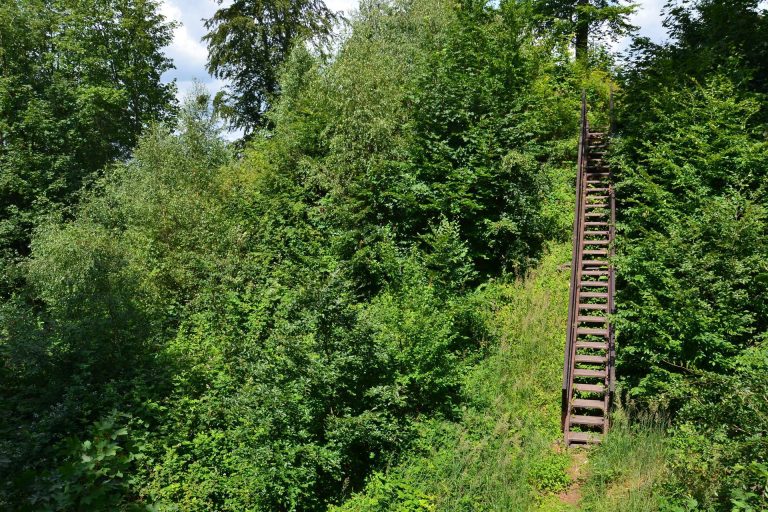
Between 1762 and 1766, Jan Antonín Harbuval Chamaré built the Chapel of the Holy Stairs on the slope between the lower courtyard and the upper castle’s zwinger. A zwinger is the outer defensive space between concentric fortifications. The chapel is the best-preserved structure in the castle complex. It was repaired in 1831 and rededicated to Saint John of Nepomuk after the chapel in the upper castle had become severely dilapidated.
Archaeological evidence and surrounding features
Archaeological work at Potštejn has recovered a group of stove tiles, medieval pottery, and pieces of metal. The network of treasure-search tunnels beneath the upper castle caused localized destruction of historic masonry. A plan of the excavated tunnels survives in Chamaré’s German-language memoirs.
At the foot of the castle is Bendlovka, a place marked by a bench and a commemorative plaque for the composer and conductor Karel Bendl.