Wildeneck Castle: A Medieval Fortress in Austria

Visitor Information
Google Rating: 3.3
Popularity: Very Low
Google Maps: View on Google Maps
Country: Austria
Civilization: Unclassified
Remains: Military

History
Wildeneck Castle ruins lie within the municipality of Zell am Moos in modern-day Austria. The castle was originally built around the year 1140 by Rapoto I of Ortenburg, a noble figure associated with medieval Bavaria. Its early establishment marks it as part of the feudal landscape shaped by the Ortenburg family during the High Middle Ages.
Throughout the medieval period, the castle experienced several changes in ownership that reflected the shifting political dynamics of the region. Notably, in 1286, Wildeneck was sold to Dukes Stephan and Otto of Lower Bavaria but was reacquired by Count Heinrich III of Ortenburg in 1321. Around 1370, the castle took on an official administrative function when the Wildeneck bailiwick was created. This bailiwick operated as a distinct judicial district under the treasury office based in Burghausen, with appointed caretakers who served both as overseers and judges.
During the following centuries, control over the castle and its lands repeatedly shifted between the Bavarian dukes, the Archbishopric of Salzburg, and the Mondsee monastery. This fluctuation is documented in transactions occurring in 1390, 1462, 1494, 1506, and 1565. These changes reflect ongoing jurisdictional negotiations common in medieval and early modern European territories. By the late 16th or early 17th century, either by 1572 or 1611, the castle was abandoned following the transfer of the judicial seat to Mondsee, signaling its decline in administrative importance.
The region’s legal and fiscal landscape was frequently marked by conflict, involving competing claims to judicial authority and tax rights. These disputes persisted until the late 18th century, reaching resolution after the Peace of Teschen in 1779, which incorporated the Innviertel region into Austria. The history of Wildeneck is further marked by social unrest, particularly peasant revolts between 1611 and 1662, which were forcefully suppressed by ruling authorities.
Remains
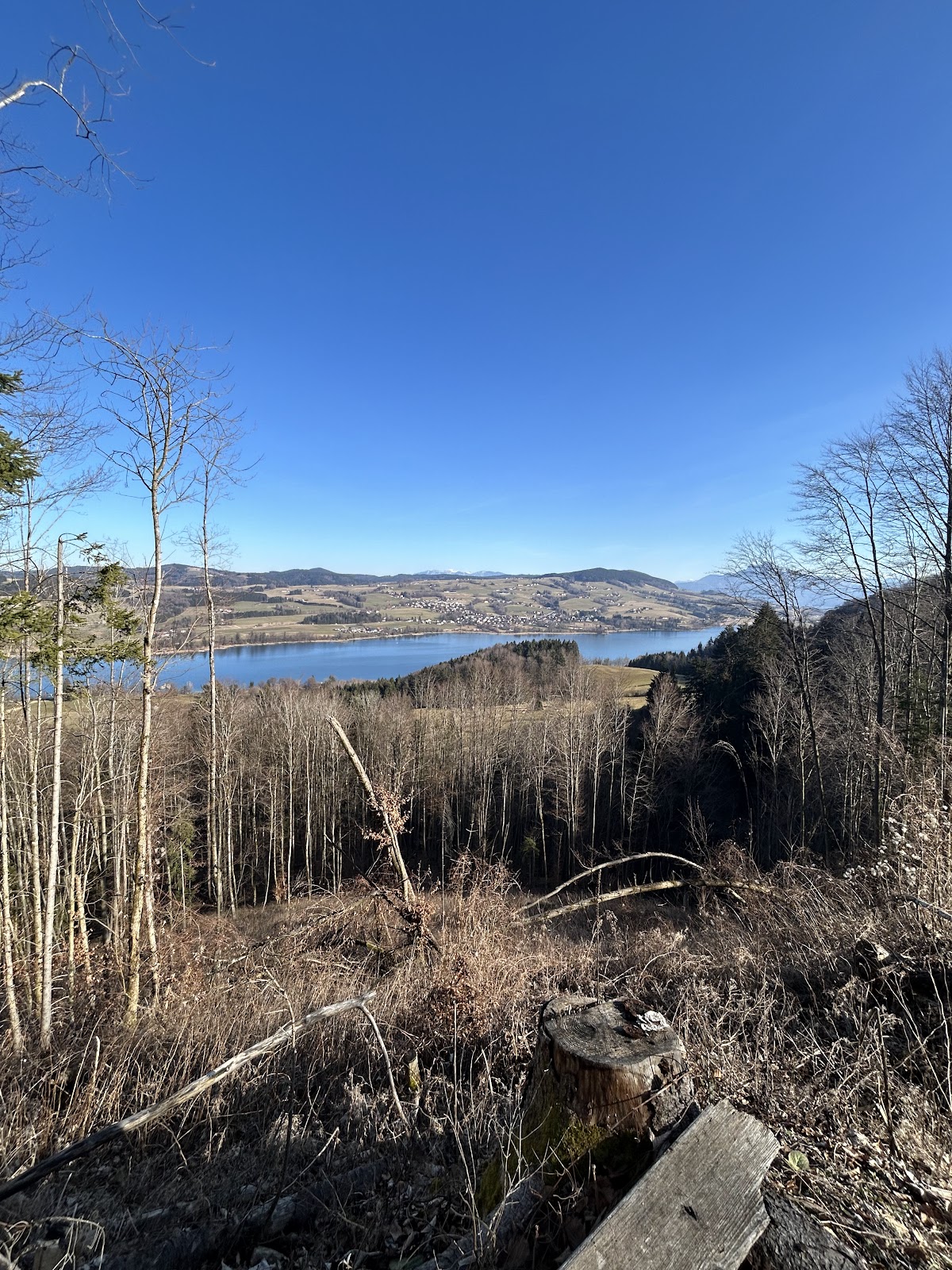
The ruins of Wildeneck Castle are situated on a steep rocky outcrop overlooking the western shore of the Irrsee lake, positioned on the eastern slope of the Kolomansberg hillside. The site’s layout demonstrates a defensive purpose typical of medieval fortifications. The remains include a partially preserved tower enclosed within a surrounding defensive wall.
The enclosing wall sections, now largely covered by vegetation, once formed a protective barrier around the castle’s inner structures. On the approach side, a deep neck ditch—a narrow trench cut into the terrain—provides evidence of a fortified entrance designed to hinder attackers. Archaeological indicators suggest there was likely a drawbridge spanning this ditch, though no physical remnants of such a bridge survive today.
Within the castle grounds, depressions can be seen that correspond to vaulted rooms or chambers which have collapsed over time. These architectural forms were common in medieval stone construction, often used to create strong ceilings or passageways below ground level. The overall condition of the ruins reveals fragments of walls and structural elements standing in place, offering a glimpse into the site’s original defensive arrangement.
Access to the site involves a steep climb from the lakeshore, consistent with the castle’s strategic position atop elevated ground. The layout and preserved features attest to a well-planned medieval fortress adapted to its natural environment and administrative role. No specific decorative elements or inscriptions have been documented in the surviving ruins, but the remains continue to reflect the castle’s historical significance through their form and location.
Nearby sites