Spello’s Villa of Mosaics: A Roman Residential Complex in Italy



Visitor Information
Google Rating: 4.6
Popularity: Medium
Google Maps: View on Google Maps
Official Website: villadeimosaicidispello.it
Country: Italy
Civilization: Roman
Remains: Domestic

History
The Villa dei Mosaici di Spello is situated near the ancient walls of Spello, in the Sant’Anna district of modern Italy. It was constructed during the Roman period, within the territory historically known as Hispellum. The villa’s origins trace back to the Augustan era, indicating its establishment under the early Roman Empire.
The first phase of the villa’s construction dates from the late 1st century B.C. to the early 1st century A.D., corresponding to the reign of Emperor Augustus (27 B.C.–14 A.D.). This initial stage is evidenced by the presence of cement flooring remains, suggesting the villa’s early development as a residential complex. During this period, the villa likely served as a countryside estate for a wealthy Roman, although no direct records identify the owner.
A second significant phase of construction and use occurred between the 2nd and early 3rd centuries A.D., during the high Imperial period. This phase saw extensive architectural and decorative enhancements, including the addition of elaborate mosaic floors. The villa’s function appears to have remained residential, possibly linked to agricultural production, particularly viticulture, as implied by the iconography found in the mosaics. No inscriptions or documents have been discovered to clarify the identity of the proprietor or any administrative role the villa might have held.
No historical records mention military occupations, religious dedications, or administrative functions directly associated with the villa. Likewise, there are no documented legends, myths, or symbolic associations tied to the site beyond the thematic content of the mosaics, which reflect agricultural and seasonal motifs. The villa’s discovery has contributed to a deeper understanding of Roman life in Hispellum, complementing the known historical narrative of the area.
Remains
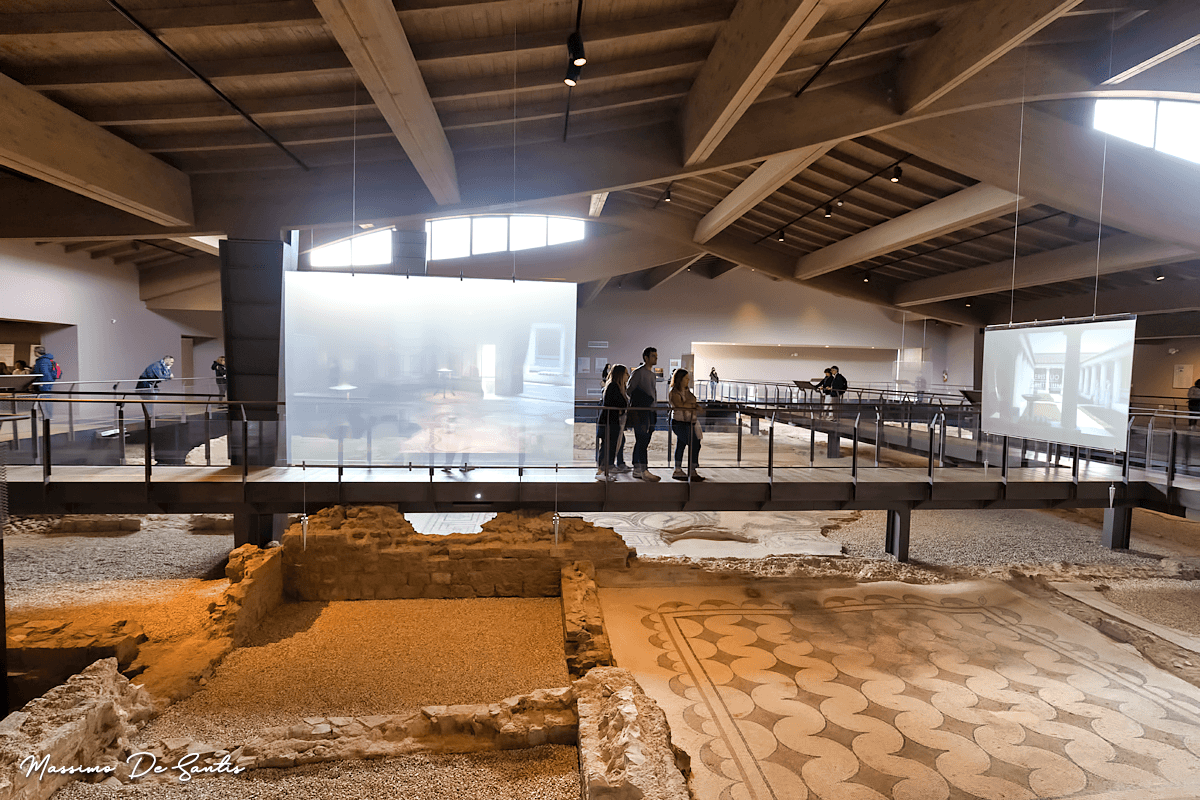
The archaeological site of the Villa dei Mosaici di Spello encompasses approximately 500 square meters and includes around twenty rooms, primarily concentrated in the central sector of the complex. The construction reflects typical Roman residential architecture, with a layout organized around a peristyle courtyard, although no colonnade remains have been found. The peristyle floor is covered with monochrome geometric tiles.
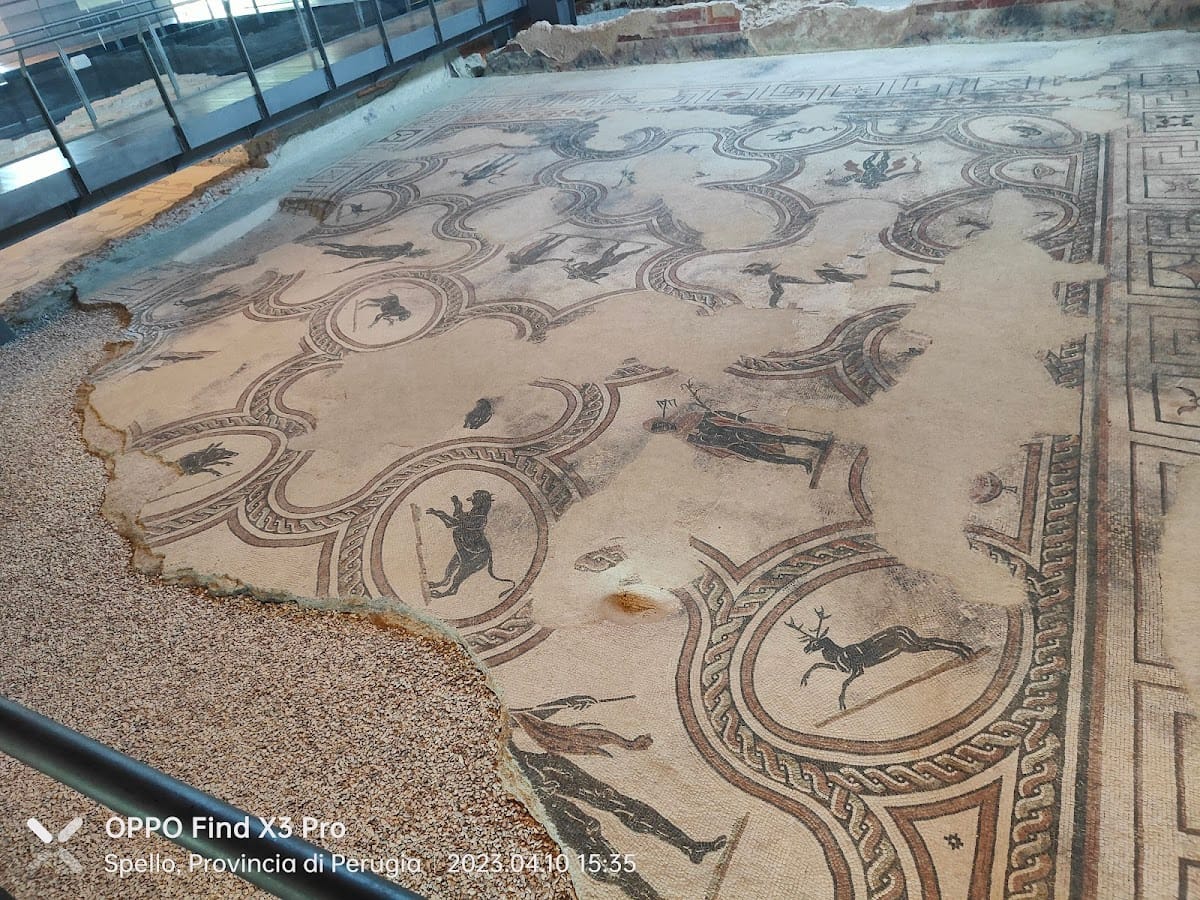
About half of the uncovered rooms feature polychrome mosaic floors distinguished by high artistic quality. These mosaics display a variety of motifs, including geometric designs, depictions of wild and domestic animals, mythical creatures, and human figures with plant attributes symbolizing the four seasons. Such imagery suggests thematic connections to agriculture and wine production.
Among the notable rooms is the Triclinium, or main dining hall, which contains a “cushion-style” mosaic illustrating a Bacchic scene of wine pouring. The Bird Room features octagonal mosaic panels depicting various bird species. The Amphora Room is decorated with a rare cross pattern formed by stylized amphorae, while the Radiant Sun Room centers on a sun motif above marsh vegetation. The Geometric Mosaic Room likely served as a bedroom, and the Shield Room is adorned with continuous “pelta” motifs, crescent-shaped shield designs.
The earliest phase of the villa includes a Heated Room equipped with suspensurae, brick pillars that supported a hypocaust system for underfloor heating. The walls throughout the villa retain traces of multicolored plaster decorated with floral and mythological marine themes.
The villa has undergone extensive excavation and restoration since its accidental discovery in 2005. The mosaics and structural elements have been conserved in situ, allowing for detailed study of the site’s artistic and architectural features. No inscriptions or documentary evidence have been found on site to provide further historical context.
Nearby sites