Assisi Cathedral: Cathedral Church of San Rufino in Italy


Site at a Glance
- Rating
- 4.7
- Popularity
- Medium
- Country
- Italy
- Primary era
- Medieval
- External website
- Open
- Eras represented
- Classical, Medieval, Early Modern, Modern
- Civilizations
- Papal States, Roman
- Site type
- Religious
- Remains
- Church
On this page19 sections
History
Assisi Cathedral, also known as the Cathedral of San Rufino, is the principal Catholic church of Assisi, Italy, and the cathedral church of the Diocese of Assisi-Nocera Umbra-Gualdo Tadino. Since 1986 it has also been a co-cathedral, a cathedral sharing that status with another cathedral in the same diocese. Its present church developed through medieval reconstruction and a late Renaissance remodeling, while its site preserves evidence of Roman and earlier Christian activity.
Roman and early Christian foundations
The cathedral stands on a terrace from the Roman period that may have formed part of the forum of Asisium, the Roman city of Assisi. This identification remains uncertain. Medieval historians connected the terrace with a temple dedicated to Bona Mater, a Roman goddess associated with female religious rites.
Saint Peter Damian, an eleventh-century Benedictine cardinal and church reformer, wrote that a basilica containing the remains of Saint Rufinus stood here from 412. Rufinus, the cathedral’s patron saint, was a third-century Christian bishop and martyr traditionally associated with Assisi. The present church is generally regarded as the third building raised on the site to house his relics.
The foundation of the present cathedral probably dates from the eighth century. In the eleventh century, Bishop Ugone sought to move Rufinus’s relics to Santa Maria Maggiore, then the cathedral of Assisi. The townspeople opposed the transfer and prevailed. Ugone enlarged the church and gave it cathedral status in 1036. In the feudal town, San Rufino stood at the center of the “citadel of the canons,” the community and precinct associated with the cathedral clergy.
Medieval reconstruction
A further rebuilding began in 1140 according to designs associated with Giovanni da Gubbio and continued for several decades. The municipality used the forecourt for meetings and pressed for the building’s completion in 1210. The unfinished church became associated with the misfortune that people believed was worsening factional conflict within the city.
Pope Gregory IX consecrated the high altar in 1228, during his visit to Assisi for the canonization of Saint Francis. Pope Innocent IV consecrated the completed cathedral in 1253. The Romanesque building that emerged from this medieval campaign provided the structure later altered in the sixteenth century.
Franciscan associations
The cathedral has a close place in the history of the Franciscan movement. Saint Francis of Assisi, who founded that movement, was baptized here in 1182. Saint Clare, founder of the Poor Clares, the women’s branch of the Franciscan tradition, was baptized here in 1193, as were many of their early followers. Saint Gabriel of Our Lady of Sorrows, a nineteenth-century Passionist saint, was baptized at the font in 1838. Frederick II of Swabia, the medieval Holy Roman Emperor, may also have received baptism here in 1197, although this association is uncertain.
In 1209, Clare heard Francis preach in the cathedral. His message deeply moved her, and she recognized her religious vocation. A tradition recorded by Tommaso da Celano also tells of Francis praying in the church while appearing at the same time at the Porziuncola as a rider on a chariot of fire.
Later transformation and preservation
In 1571, the cathedral’s originally Romanesque interior was radically remodeled in the late Renaissance style following a design by Galeazzo Alessi, a sixteenth-century Italian architect. The building consequently brings together Romanesque, Baroque, and neoclassical elements.
Restoration following the 1997 earthquake exposed foundations belonging to the earlier basilica and revealed Roman and medieval remains beneath the present church. The cathedral complex forms part of the UNESCO World Heritage property “Assisi, the Basilica of San Francesco and Other Franciscan Sites,” inscribed in 2000 under criteria (i), (ii), (iii), (iv), and (vi). A diocesan museum beside the cathedral preserves artworks and liturgical objects associated with it, while the adjacent Chapter Archive preserves illuminated manuscripts and documents dating from 963 onward.
Remains
The cathedral occupies Piazza San Rufino. Its surviving fabric combines a Romanesque exterior of Monte Subasio stone with a basilical interior, later chapels, Renaissance and Baroque decoration, and archaeological remains beneath and within the church. The plan has a central nave, two aisles separated by massive pillars, a transept, an apse, a crossing dome, and a presbytery, the area around the main altar.
Facade and bell tower
Romanesque facade
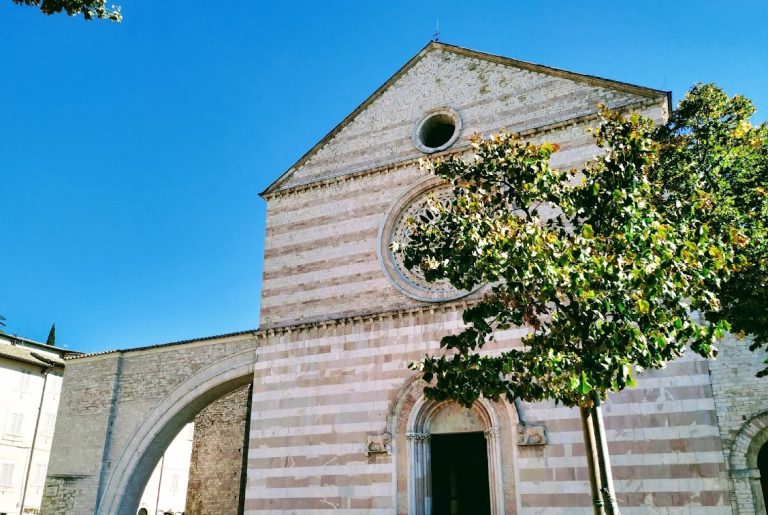
The three-part facade is a major example of Umbrian Romanesque architecture and can be compared with contemporary Romanesque buildings in Spoleto. Its lower section dates from the twelfth century and contains three decorated stone portals. Lions and griffins flank the entrances. The central portal has several carved arches with vine branches, spirals, allegorical figures, geometric patterns, intertwined swans, and monstrous animals. Lions appear at the base of its central arch.
In the lunette, the semicircular field above the doorway, Christ sits enthroned within a clipeus, a round frame enclosing a figure. The sun, moon, the nursing Virgin Mary, and Saint Rufinus accompany him. The right portal shows two peacocks drinking from a fountain, an image associated with Christian souls drinking divine grace. Two lions surround a vase on the left portal.
A horizontal band of animal figures and corbels with human and animal-like heads runs above the portals. A gallery projects above it and carries four animals. The middle section contains three rose windows, large circular windows with radiating tracery. The central rose window is the largest and most elaborate. Three telamones, carved human or partly human supports, carry its frame, while the four spandrels around it contain the symbols of the Evangelists. The upper facade ends in a triangular gable with an empty arch probably intended for a painting, frieze, or mosaic.
Medieval bell tower
The Romanesque bell tower stands to the left of the facade. Its lower and middle portions date from the eleventh century and are largely associated with Bishop Ugone’s building campaign. The upper level belongs to the thirteenth century. Paired openings mark the bell chamber, and the tower contains a large one-handed liturgical clock displaying the twenty-four hours of Italian time. Its foundations rest on a Roman cistern.
Nave and interior decoration
Traces of the earlier church survive above the vaults, including remains of a former dome. Restoration removed the lateral altars and exposed part of a Roman-period wall along the left side. Ten smaller altar tables now alternate with statues of prophets made by Agostino Silva in 1672.
Near the central portal, two marble statues face the counterfacade. Giovanni Dupré’s Saint Francis was erected in the piazza in 1882 and moved inside in 1888 for better preservation. Saint Clare, by Amalia Dupré, was placed there in 1888.
Baptismal font
The baptismal font occupies the first bay of the right aisle. It consists of an ancient basin fashioned from a granite column and enclosed by an iron grille. Its wooden superstructure was decorated in 1882 with allegorical figures of the four Evangelists represented as a lion, eagle, angel, and bull. A shell symbolizing earthly pilgrimage, together with angels and flaming vases, completes the decoration.
Right-aisle chapels
The Chapel of Saint Joseph occupies the second bay of the right aisle. Its altar includes a banner by Berto di Giovanni. Fluted columns, a broken-arch pediment, putti, allegorical stucco figures, floral garlands, herms, sculptural pillars shaped as human figures, a broken triangular pediment, a central coat of arms, and a painting of Saint Joseph form the chapel’s decoration.
The third bay gives access to the Chapel of the Blessed Sacrament. A small adjoining door opens onto a Romanesque portal on the right, contemporary with the portals of the facade. The Chapel of Our Lady of Sorrows occupies the fourth bay and contains a polychrome statue of Our Lady of Sorrows from 1672 against a gilded radiating background.
The Chapel of Saint Francis fills the fifth bay. Its architecture includes columns, an architrave, a window framed by herms, a triangular pediment with angels and a central coat of arms, and an aedicule, a small architectural shrine or framed niche, containing a painting of Saint Francis. Agostino Silva created the surrounding stucco figures of the cardinal virtues.
The sixth bay contains Dono Doni’s Christ in Glory with Saints, dated 1550, and a statue of Saint Rufinus of Assisi. The statue was carved in Carrara marble by the French sculptor Paul Lemoyne in 1823.
Left-aisle chapels
The first bay of the left aisle contains remains of a Roman settlement uncovered during restoration, together with the cistern that forms the foundation of the medieval bell tower. The Chapel of Santa Maria della Consolation occupies the second bay. Fluted columns, an architrave, putti holding palms, a marble disk supported by putti, and an aedicule frame a painting of the Virgin and Child with Saints, made about 1745 by an unknown artist.
Giacomo Giorgetti designed the Chapel of Saint Emidius in the third bay. Paired columns, relief decoration, a convex arrangement, a broken triangular pediment, a smaller aedicule, and stucco prophets by Agostino Silva frame Francesco Appiani’s 1752 canvas of the Trinity, the Virgin Mary, and Saints interceding for Assisi. A representation of King David appears on the right.
The Chapel of the Immaculate Conception occupies the fourth bay. Its decoration includes columns, an architrave, large angels with outspread wings, stucco herms, a broken-arch pediment, a niche with a statue of the Immaculate Conception, a shell, angels, a scroll, and a double superimposed pediment. Agostino Silva produced the stucco work.
The Chapel of the Holy Crucifix fills the fifth bay. Paired columns in a convex arrangement support an architrave, while angels bearing symbols of the Passion decorate the projecting elements. A high relief of an angel with a shroud, a broken-arch pediment, a shell, volutes, and putti frame a polychrome Crucifix from 1561 set against a gilded radiance. The stucco figures are by Agostino Silva.
The sixth bay contains the Chapel of Saint Cajetan of Thiene. Pilasters and superimposed columns support spiral scrolls and a broken triangular pediment. A small aedicule represents the Trinity, while the central aedicule contains Francesco Refini’s painting of the Virgin Mary with Saint Cajetan of Thiene. Agostino Silva made the stucco statues.
Transept, apse, and altar
The right transept contains the Chapel of Saint Vitalis. Its altar has paired columns, an architrave, flaming vases, and a panel topped by an apical cross. Dono Doni’s Descent from the Cross, made in 1563, occupies the chapel.
The left transept contains the Chapel of Saint Rufinus of Arce. Its altar also has paired columns, an architrave, flaming vases, and a niche topped by an apical cross. The aedicule contains Dono Doni’s painting of the Crucifixion.
The apse contains sixteenth-century wooden choir stalls carved by Piergiacomo da Sanseverino and dated 1520. The choir has twenty-two stalls. A large Martinelli organ occupies the center. The elevated altar against the apse has a triangular pediment and incorporates part of the organ pipes, while the episcopal chair in the presbytery stands beneath a large Crucifix.
A sarcophagus beneath the altar facing the congregation holds the remains of Saint Rufinus. The relics were formerly kept in a carved Roman sarcophagus that remains visible in the crypt. The nineteenth-century main altar stands beneath the octagonal Renaissance crossing dome.
Crypt and adjoining chapels
Crypt
The crypt is divided into three aisles and preserves fragmentary eleventh-century frescoes bearing the symbols of the Evangelists. It also contains a third-century Roman sarcophagus once associated with the body of Saint Rufinus. Its front bears a relief depicting the myth of Diana and Endymion. The medieval Pozzo della Mensa well and ruins of a tenth-century Carolingian cloister are also preserved below the church.
Chapel of Our Lady of Tears
The Chapel of Our Lady of Tears, beside the cathedral, contains a wooden copy of a fifteenth-century Pietà originally made in polychrome terracotta by an unknown German sculptor. The original was traditionally believed to have wept in 1494. It was stolen in 1982, leaving the copy in its place.
Chapel of the Blessed Sacrament
Created in 1511 and completed in its later form by Giacomo Giorgetti in 1663, the Chapel of the Blessed Sacrament has a Baroque interior devoted to the Eucharist. Giovanni Andrea Carlone executed most of its paintings between 1663 and 1672, including The Sacrifice of Elijah, Hagar in the Desert, David in Prayer, Elijah and the Angel, The Nativity, The Supper at Emmaus, The Resurrection, Tobias and the Angel, David Receiving the Garments from Ahimelech, and The Sacrifice of Isaac.
Giacomo Giorgetti painted the apse and vault frescoes, including the Allegory of Faith. Giovanni Antonio Grecolini added the lateral episodes in the eighteenth century. The counterfacade lunette contains The Last Supper by Fra Emanuele da Como. A gilded and carved wooden choir organ in the chapel dates from 1602.
Organs, sacristy, and collections
The cathedral has three pipe organs. The main organ was built between 1848 and 1851 by the Martinelli brothers of Umbertide. It retains its original characteristics and has thirty-three stops on two manuals and pedal. Its pipes are enclosed in a faux-marble-painted wooden case with a window console. A choir organ made by the Chichi firm in 1971 for Santa Maria Maggiore was later transferred to the cathedral. It has eight stops, one manual, pedal, and mechanical action. The organ in the Chapel of the Blessed Sacrament dates from 1645 and is probably by Tommaso Campana. Its Baroque wooden case has carved and gilded reliefs, and the instrument has ten stops on one manual and pedal.
The sacristy is entered from the right side of the apse. Its works include The Immaculate Conception and Saint Philip Neri, Dying Saint Francis Blessing the City of Assisi by Cesare Sermei, and paintings by Sermei, Girolamo Marinelli, Giacomo Giorgetti, Martin Knoeller, and Baldassarre Orsini.
The diocesan museum, opened in 1941, holds artworks and liturgical objects associated with the cathedral. Among its works are the front panel of a third-century Roman sarcophagus with winged victory figures and a libation scene; late-thirteenth-century frescoes of the Madonna and Child by the Master of Saint Clare; and frescoes of the Passion and Crucifixion by Puccio Capanna from 1334, originally made for the Oratory of San Rufinuccio.
The collection also includes a 1378 processional banner of the Confraternity of Saints Francis and Leonard, a gilded fifteenth-century reliquary containing wood from the True Cross, Niccolò Alunno’s 1462 polyptych of the Story of Saint Rufinus, and an aedicule of the Confraternity of the Most Holy Sacrament from about 1475 with frescoes by Matteo da Gualdo. Other works include Dono Doni’s two-panel predella of 1563 depicting Saint Gregory the Great and Saint Lawrence, a 1627 processional banner by Orazio Riminaldi, a 1673 banner by Giovanni Andrea Carlone, and works by Pace di Bartolo, Giovanni di Pieriacopo da Sanseverino, Lorenzo Doni, Raffaello Coda, and Girolamo Marinelli.
The museum further preserves Cesare Sermei’s 1640 canvas Dying Saint Francis Blesses the City of Assisi, along with liturgical documents and objects from the seventeenth century to the present. It also holds the Frederick Mason Perkins Collection, comprising thirty-two works by artists including Giovanni Boccati, Jacopo della Quercia, Filippo Lippi, Francesco di Giorgio Martini, and Giovanni Santi.