Venus’ Gate: An Augustan Roman Gate in Spello, Italy


Site at a Glance
- Rating
- 4.6
- Popularity
- Low
- Country
- Italy
- Primary era
- Classical
- Eras represented
- Classical, Medieval
- Civilizations
- Papal States, Roman
- Site type
- Military
- Remains
- Gate
On this page9 sections
History
Venus’ Gate is an Augustan Roman gate in Spello, Italy, built during the reign of Augustus, the first Roman emperor, between 27 BC and AD 14. It formed one of the town’s six urban gates and has remained an important point within Spello’s historic fabric.
Roman origins and sacred associations
The gate’s central structure belongs to the Augustan period. It later acquired the name Venus’ Gate in the seventeenth century because it stood near a temple dedicated to Venus, the Roman goddess of beauty. Substantial remains of that temple have been found in the park of Villa Fidelia.
The gate’s orientation helped shape its historical interpretation. It faced toward the amphitheater and the sanctuary at Villa Fidelia, while processions passed through it toward Assisi and Perugia. In the medieval period, processions led by Spello’s consuls also used the gate when travelling to the annual festival at the nearby church of San Claudio. Historical descriptions and nineteenth-century guidebooks consequently treated the monument as having a sacred character.
Study, restoration, and later understanding
Sebastiano Serlio, a Bolognese architect, first analyzed and illustrated Venus’ Gate in 1540. During the seventeenth century, local scholars connected the gate with the temple outside Spello’s fourteenth-century walls. Several important restorations have taken place over the centuries, including recent work, and the monument is currently described as being in excellent condition.
Remains
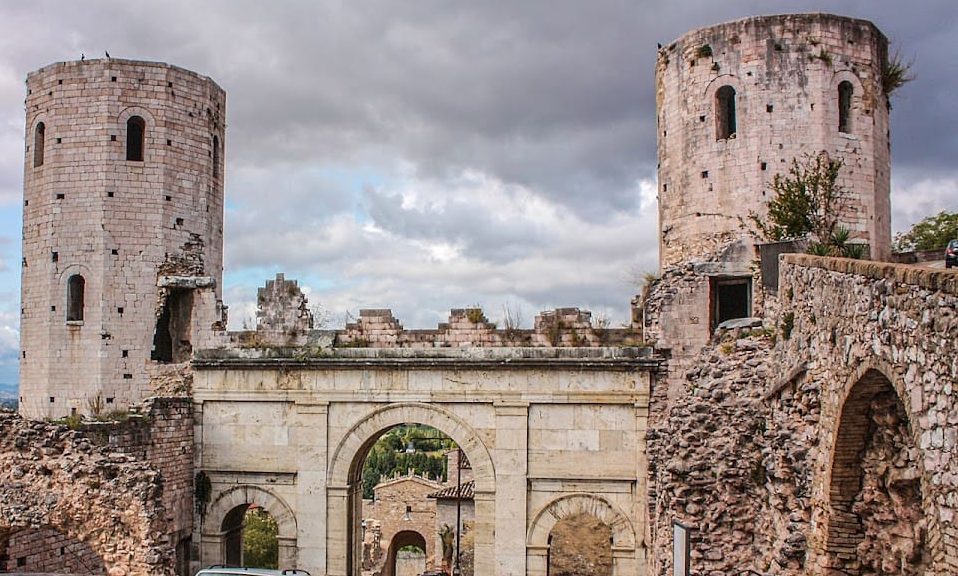
Venus’ Gate is constructed from white travertine and combines a central Roman entrance with later medieval defenses. Its three arched passageways are framed by Doric-order pilasters, a classical form distinguished by sturdy supports and simple capitals. The gate stands within Spello’s historic urban fabric, overlooking ancient lanes and small town palaces.
The Roman gate and defensive layout
Three Augustan passageways
The central Roman structure contains three arched openings dating to the Augustan period. The original arrangement included a double curtain wall, meaning a defensive wall linking fortified structures, together with an internal courtyard. The right-hand passage led to an underground route toward the Urbica Gate, while the left-hand passage connected with the patrol walk, a defensive passage used by guards, leading toward the highest point of the town.
Fortified section
A fortified section with two entrances formed part of the gate’s defensive arrangement. Together with the curtain walls and internal courtyard, it organized movement through the entrance and linked the gate to Spello’s wider system of fortifications.
The Towers of Propertius
Medieval Romanesque towers
Two massive twelve-sided towers flank the Roman gate. They are medieval Romanesque structures, built in a style characterized by heavy masonry, rounded arches, and robust forms. Each tower rests on a tall square support. Known as the Towers of Propertius, they take their name from Sextus Aurelius Propertius, a Latin elegiac poet of the first century BC. Spello and Assisi traditionally disputed his birthplace, although Assisi is considered more probable.
Venus’ Gate and its towers have often been compared with the Palatine Gate in Turin, another monument associated with the same period. The comparison belongs to the monument’s later architectural interpretation, while the surviving gate itself shows the combination of an Augustan Roman entrance and medieval Romanesque additions.