Turaida Castle: A Medieval Fortress in Latvia


Visitor Information
Google Rating: 4.6
Popularity: Medium
Google Maps: View on Google Maps
Official Website: www.turaida-muzejs.lv
Country: Latvia
Civilization: Medieval European
Remains: Military

History
Turaida Castle, located in the municipality of Sigulda, Latvia, was constructed by the Livonian branch of the Catholic Church during the early 13th century. Its origins trace back to the upheavals of the Livonian Crusades, a series of military campaigns aimed at Christianizing the Baltic region.
The castle was established in 1213 or 1214 by command of Albert, the Archbishop of Riga, on the site formerly occupied by a wooden stronghold belonging to the Livonian chieftain Kaupo. This wooden fortress had been destroyed amid the conflicts of the Crusades. Originally called Fredeland, which means “Land of Peace,” the stone castle was intended to assert Christian dominance in the area and serve as an administrative center and residence for the Archbishopric of Riga.
During the 13th through 16th centuries, Turaida Castle was frequently embroiled in regional disputes, notably between the Archbishopric and the Livonian Order, a military religious order active in the Baltics. The castle changed hands multiple times, reflecting its strategic importance. It was also the site of significant battles including the Battle of Turaida in 1211, which predated the castle’s stone construction, and the Battle of Treiden in 1298. Throughout these centuries, the fortress served military, administrative, and episcopal functions.
In the 17th century, the castle’s military role diminished due to advancements in warfare and shifting political landscapes. It sustained damages during various conflicts and suffered a decisive blow when a fire, triggered by an accidental ignition of its straw roof in 1776, led to its abandonment. After the fire, the site fell into ruin; stones were taken for other local buildings, and parts of the structure became buried over time.
Archaeological work commenced in the 1950s during Soviet administration, uncovering extensive remains. Restoration projects, conducted from 1953 through the 1980s, aimed to preserve and reconstruct significant elements of the castle. Today, these efforts have secured Turaida Castle’s place as a preserved cultural monument, hosting exhibitions about its storied past and the region’s medieval history.
Remains
Turaida Castle is situated on a commanding high ridge, surrounded on three sides by steep slopes ranging from 30 to 50 meters in height. The Gauja River loops around the ridge to the south, while access from the north is protected by a man-made moat. This natural and artificial defensive arrangement shaped the castle’s irregular, elongated layout, approximately 210 meters long and up to 50 meters wide. Unlike many Teutonic Order castles that have more rectangular plans, Turaida’s design resembles the Wartburg castle, adapted closely to the terrain.
The oldest parts of the castle, dating from the early 13th century, include brick curtain walls forming an irregular polygon surrounding a central courtyard with a well. These walls feature crenellations—stepped battlements—and arrow slits for archers. The main gate is located on the northern side, guarded by an imposing round bergfried, or main tower. This tower rises about 38 to 39 meters high, with thick walls between 2.9 and 3.7 meters. It has seven internal floors connected by spiral staircases built within the walls. Notably, the entrance to the tower is situated nearly 9.5 meters above ground level, a defensive feature designed to impede attackers. Originally, the bergfried was topped with a conical stone roof and battlements; today it features a tiled hipped roof reconstructed during restoration and serves as a vantage point.
Adjacent to the southern curtain wall, a three-story rectangular wing measuring roughly 6.5 by 9 meters was added in the late 13th century. This section includes a ground-floor chamber with a late Romanesque cross vault, a style of stone ceiling vaulting, indicating combined residential and defensive use. This southern wing underwent reconstruction in the late 20th century as part of preservation efforts.
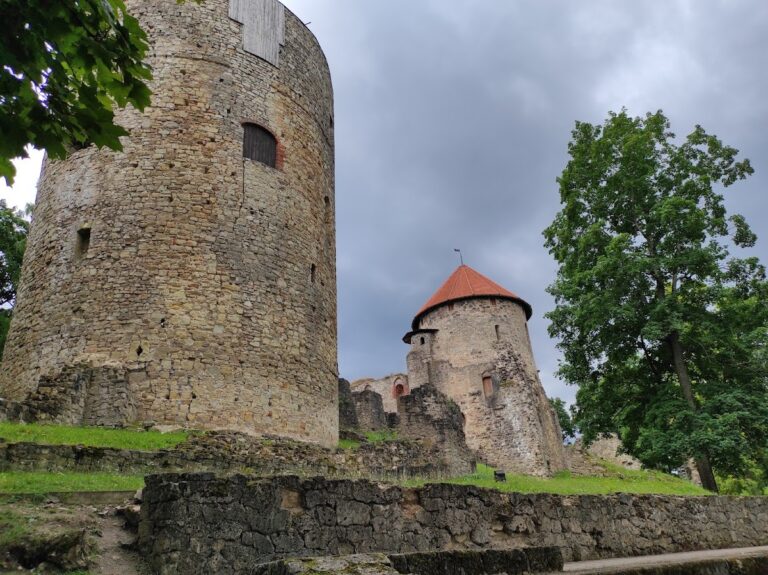
The castle expanded in the 14th and 15th centuries with the construction of a northern outer bailey, or vorburg, a fortified courtyard serving as an additional defensive and service area. This outer bailey was protected by two round towers, one of which measures 12 meters across with walls up to 4.5 meters thick. A gate with a drawbridge bridged the moat, allowing controlled access. Within this section, features such as stables and a smithy were located, and the space likely functioned as a zwinger, a killing ground where attackers trapped between two walls could be targeted.
On the western side, a semi-circular tower measuring approximately 11.3 by 12.4 meters was erected in the 15th century, reaching about 25 meters tall and containing five floors plus a cellar. This tower had walls between 2.1 and 2.9 meters thick. Historically, its cellar served as a prison. Restoration between 1970 and 1974 successfully conserved this tower.
In the early 16th century, a large round cannon tower was built northwest of the main gate to bolster defenses on the northern and western approaches. This structure measured 14 meters in diameter with walls 4.2 meters thick and was adapted to accommodate artillery emerging in late medieval warfare. This tower was destroyed in the 17th century, but archaeological excavations in the 1980s uncovered and preserved its foundations.
The castle’s construction primarily employed red brick, a relatively uncommon material for bishop’s castles in the Livonian region, set upon foundations of mortared fieldstones. Archaeological excavations have revealed features such as medieval heating ovens (hypocaust systems), a brewery, and a bathhouse supplied by a well, underscoring the castle’s complex functions. Numerous artifacts were recovered, including coins made of copper, silver, and even a gold ducat, as well as arrowheads, pottery fragments, and horseshoe nails, all evidencing the site’s long-term occupation.
Today, the main tower, parts of the western curtain wall, the semi-circular western tower, the southern gate tower, and sections of the northern outer bailey have been preserved or restored. The former economic buildings within the outer bailey have been adapted to house museum exhibitions, allowing the site’s layered history to be interpreted. Narrow and low interior passages with stone staircases provide access to the main tower’s viewing platform, where passage widths measure about half a meter and heights just over 1.5 meters, reflecting medieval defensive design. Through careful restoration, Turaida Castle’s surviving architecture offers a tangible connection to its medieval origins and the turbulent history of Livonia.
Nearby sites