Temple of Divus Claudius, Rome: A Monument to an Imperial Deity




Visitor Information
Google Rating: 4.5
Popularity: Very Low
Google Maps: View on Google Maps
Country: Italy
Civilization: Roman
Remains: Religious

History
The Temple of Divus Claudius is located in Rome, Italy, on the Caelian Hill. It was built by the ancient Romans to honor Emperor Claudius, who was deified after his death. The temple’s construction began in 54 AD, shortly after Claudius died, under the direction of his wife Agrippina the Younger. At the time, it was the largest temple dedicated to a deified Roman emperor.
In 59 AD, Nero, Claudius’ successor and Agrippina’s son, partially destroyed the temple. This act symbolized Nero’s rejection of Claudius’ deification. Nero incorporated the temple site into his grand palace complex, the Domus Aurea, and added a monumental nymphaeum, a decorative fountain structure, on the eastern side. This nymphaeum was supplied by an extension of the Aqua Claudia aqueduct.
Following Nero’s death in 68 AD and the subsequent fall of the Domus Aurea, Emperor Vespasian resumed work on the temple. He restored its function as a place of imperial worship and dedicated it anew. Vespasian integrated the temple into a larger urban complex that included the Meta Sudans fountain, the Forum of Peace, and the Flavian Amphitheatre. This restoration reaffirmed continuity with the Julio-Claudian dynasty and the imperial cult.
The temple remained a site for sacrifices and imperial cult ceremonies, with offerings to Claudius recorded both before Nero’s repudiation and later during his reign. Vespasian’s restoration marked a return to traditional religious practices associated with the imperial family. Over time, the temple’s importance declined, and from the Middle Ages onward, its remains were extensively quarried for building materials. The last known documentary mention of the temple dates to a papal bull issued in 1217.
In the 5th century, the site was repurposed for Christian worship with the construction of the basilica of Santi Giovanni e Paolo. Medieval convent buildings were also established nearby, reusing parts of the temple’s masonry. This reuse reflects the long history of adaptation and transformation at the site.
Remains
The Temple of Divus Claudius stood on a large rectangular platform measuring about 180 by 200 meters. This platform was elevated roughly 50 meters above the surrounding area on the Caelian Hill and supported by retaining walls up to 15 meters high. The platform’s western façade featured two levels of arcades with rustic stonework and Doric pilasters, built from travertine. The lower arcade had rectangular openings framed in brick, while the upper arcade contained travertine arches, resembling other Roman structures like the Theatre of Marcellus.
The temple itself faced west toward the Palatine Hill and had a six-columned porch in the Corinthian order, with columns estimated to be nearly 18 meters tall. The pronaos, or entrance hall, was three columns deep, leading to a cella, or inner chamber, without columns. Access was provided by a grand stairway on the southern side of the platform.
Beneath the platform’s retaining walls were tabernae, or shops, with rooms originally about 3.5 meters wide and 6.75 meters deep. Under Vespasian, these rooms were expanded to greater depths, reaching up to 9.5 meters on the north side. The northern area also contained vaulted rooms with water conduits and fountains, including a sculpted ship’s prow with a boar’s head, now housed in the Capitoline Museums. Vespasian reduced water use here, returning supply to civilian use.
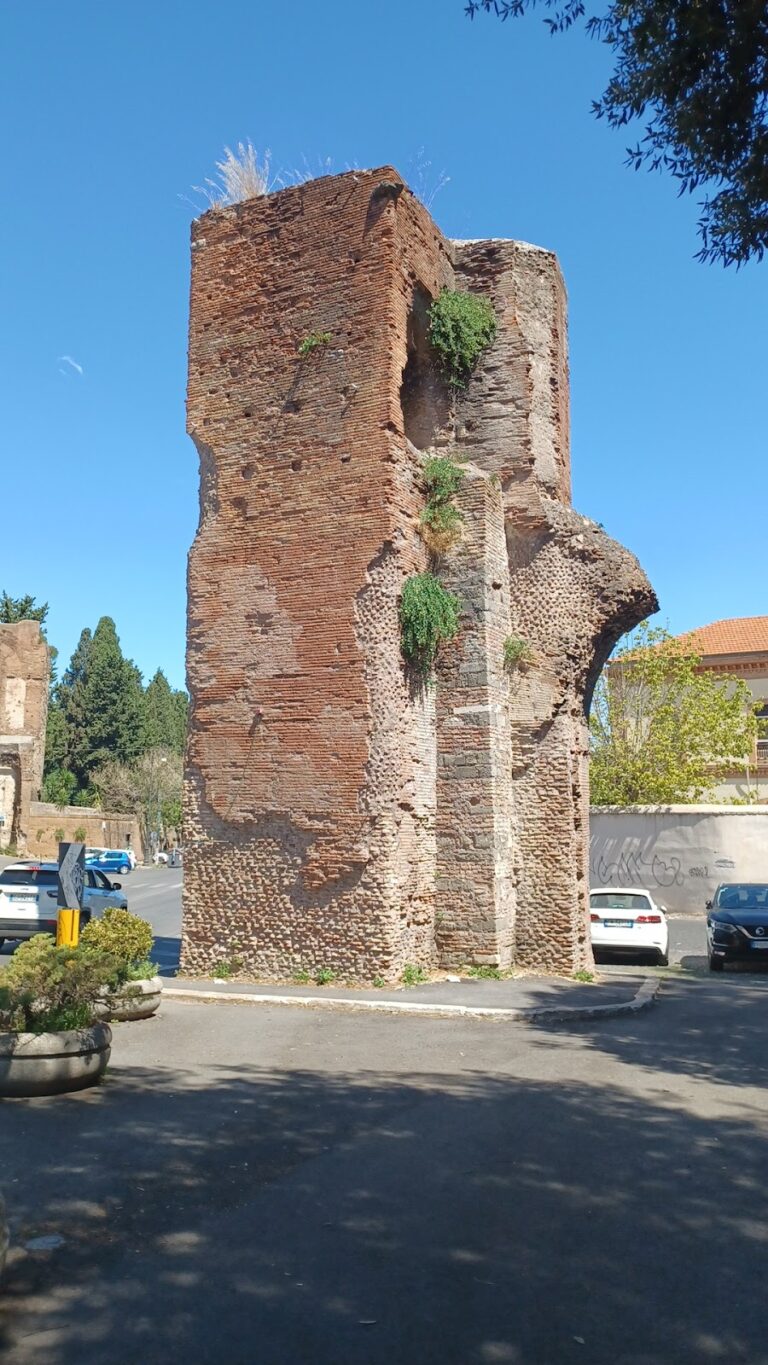
On the eastern side, Nero transformed the area into a monumental nymphaeum approximately 167 meters long and over 21 meters high. This structure featured alternating rectangular and semicircular niches and apses, with a colonnaded or arcaded portico in front. Cascading fountains were supplied by an extension of the Aqua Claudia aqueduct, creating an elaborate water display.
The southern retaining walls were less ornate but included a large apsidal room with a statue base. This space may have served cult or collegial functions related to the imperial family or the Augustales, a religious group devoted to the emperor.
Surrounding the temple on the platform was a large garden, depicted on the ancient Forma Urbis map by parallel lines interpreted as rows of hedges or trees. Marble channels found on site suggest the garden was irrigated. Evidence also points to a large covered walkway, the Porticus Claudia, encircling the temple and garden. Although no direct remains survive, this portico may have been about 9.5 meters wide with columns around 8 meters tall.
Beneath the platform, subterranean passages and cisterns have been mapped. A large cistern drained water from the hill through conduits beneath the terrace pavement, indicating sophisticated water management.
Statues carved from rare Egyptian greywacke were found on site, identified as representations of Agrippina the Younger as priestess and Britannicus, Claudius’ son. These likely formed part of a family statuary group adorning the temple.
Several architectural fragments, including Corinthian capitals and a marble architrave, were reused in later buildings. Notably, some capitals were incorporated into the bell tower of Santi Giovanni e Paolo and the church of Santa Maria degli Angeli e dei Martiri. Today, the temple survives only in fragmentary form due to extensive quarrying and reuse over the centuries.
Nearby sites