Roman Forum, Rome: The Civic and Religious Center of Ancient Rome


Site at a Glance
- Rating
- 4.7
- Popularity
- Very High
- Country
- Italy
- Primary era
- Classical
- External website
- Open
- Eras represented
- Iron Age, Classical, Medieval
- Civilizations
- Byzantine, Roman
- Site type
- Civic
- Remains
- Forum
On this page11 sections
History
The Roman Forum is an ancient Roman public complex in Rome, Italy, whose development began in the eighth century BC as the valley between the Palatine, Capitoline, and Velian hills changed from a burial ground into a civic and religious center. It became the principal setting for Rome’s political, judicial, religious, and commercial life, and its surviving remains trace the city’s development from the Roman Kingdom through the Republic and Empire and into the medieval period.
From cemetery to public center
Human activity in the valley extends back to the Final Bronze Age, around 1200 to 975 BC. During the early Iron Age, part of the area was used as a cemetery, with cremated remains placed in earthenware urns alongside grave goods. Burials probably ended in the late ninth century BC, after which the Esquiline Necropolis became the principal burial ground. The archaic cemetery had been abandoned by the early sixth century BC.
During the eighth century BC, the valley began to acquire a public and religious character. Votive offerings from the Comitium, Rome’s formal public assembly area, and the Vulcanal indicate early cult activity. Paving and the construction of sanctuaries accompanied this transformation. Roman tradition connected the Forum’s origins with an alliance between Romulus, the legendary first king of Rome, and Titus Tatius, the Sabine leader associated with the Capitoline settlement. According to the tradition, the agreement followed the Battle of the Lacus Curtius and was formed at the Vulcanal after the Sabine women intervened.
The early Forum lay outside the walls of the original Sabine fortress, which was entered through the Porta Saturni. It first functioned as an open-air market beside the Comitium. As speeches, civil trials, religious ceremonies, and other public affairs increased, political and judicial activities displaced much of its commercial role. Specialized markets developed elsewhere, including the cattle market known as the Forum Boarium and the herb and vegetable market called the Forum Holitorium.
The low-lying valley was drained during the seventh century BC by the Cloaca Maxima, Rome’s major ancient drainage and sewer system. Tradition attributed its beginning to Tarquinius Priscus and its completion to Lucius Tarquinius Superbus, rulers of the Roman Kingdom. Tarquinius Priscus was also traditionally credited with the first paving of the area around 600 BC. Archaeological layers show that the ground was repeatedly raised to improve drainage and provide foundations for new paving.
The early religious and political complex
Roman tradition associated Numa Pompilius, the second king of Rome, with the establishment of the cult of Vesta, the construction of her temple and residence, and the Regia. The Regia later served as the seat of the pontifex maximus, Rome’s highest priestly official, and preserved the city’s annals. Tullus Hostilius, the third king, was traditionally linked with enclosing the Comitium and converting an earlier Etruscan structure into the Curia Hostilia, the Senate meeting house. Archaeologically, the Forum’s earliest major development is associated with the Tarquinian kings, who ruled Rome from approximately 616 to 509 BC.
By the late seventh century BC, the Forum had distinct political, commercial, and religious areas. The Comitium was the main political and judicial space. Commercial activity occupied the central and southern parts of the valley, while the Regia, Temple of Vesta, House of the Vestals, and Domus Publica formed a religious complex. Development intensified between approximately 625 and 600 BC, and elaborate terracotta decoration was being used on surrounding buildings during the sixth century BC.
During the Roman Republic, the Comitium continued to serve political and judicial functions, although the Senate expanded the adjacent public area by buying and demolishing private houses. The earliest securely dated Forum temples are the Temple of Saturn, built in 497 BC, and the Temple of Castor and Pollux, built in 484 BC. The Temple of Concord was added in the fourth century BC, probably in connection with Marcus Furius Camillus.
The Rostra, an elevated platform for political speeches, became the principal place for public speaking. Its name came from bronze ship prows taken from defeated Volscian vessels and attached to the platform. A tradition associated Caius Licinius, consul in 361 BC, with the practice of turning from the political elite toward the people in the Forum. Gaius Gracchus was said to have repeated the gesture about two centuries later. This practice was linked with the political ideal known as locus popularis, addressing the Roman people rather than speaking exclusively toward the elite.
In 318 BC, the censor Gaius Maenius added balconies to buildings near the Forum so that spectators could watch games held in temporary wooden arenas. These balconies later became known as maeniana. Tribune benches were first placed near the Senate house and were moved in the late Republic to the area in front of the Basilica Porcia.
Republican monumentalization
Basilica architecture entered the Forum under Marcus Porcius Cato in 184 BC, beginning a major process of monumentalization. The Basilica Fulvia opened on the north side in 179 BC. It was rebuilt and renamed several times as the Basilica Fulvia et Aemilia, the Basilica Paulli, and finally the Basilica Aemilia. Nine years later, the Basilica Sempronia opened on the south side and was eventually replaced by the Basilica Julia.
Assemblies, aristocratic funerals, and games formerly associated with the Comitium increasingly moved into the larger Forum. The comitia tributa, an important focus of popular politics, moved there in 145 BC. In 133 BC, the tribune Tiberius Gracchus was killed in the Forum by a group of senators.
During Sulla’s dictatorship in the 80s BC, the Forum underwent extensive rebuilding. The plaza was raised by nearly one meter and received permanent marble paving. This paving level remained broadly intact until the sack of Rome by Robert Guiscard and his Norman forces in 1084. Afterward, neglect allowed debris to accumulate across the area.
The Tabularium, a major records building, was constructed in 78 BC at the Capitoline end of the Forum on the orders of the consuls Marcus Aemilius Lepidus and Quintus Lutatius Catulus. In 63 BC, Cicero denounced the associates of Catiline in the Temple of Concord. After their condemnation, they were taken to the nearby Tullianum, or Mamertine Prison, and executed.
Caesar and Augustus
Julius Caesar’s building program altered the balance of the Forum before his assassination in 44 BC. He rebuilt the Curia and transformed the Basilica Sempronia into the Basilica Julia, directing judicial and senatorial activity toward the larger Forum. The Comitium consequently lost much of its earlier independent importance.
After Caesar’s death, Mark Antony delivered Caesar’s funeral oration from the partly completed New Rostra. Caesar’s body was publicly cremated opposite the platform, and Augustus later built the Temple of Caesar around the cremation site. Nearly two years later, Mark Antony displayed Cicero’s severed head and right hand on the Rostra.
Augustus, the first Roman emperor and successor to Caesar’s political program, completed the principal Augustan reorganization of the Forum. He built the Temple of Caesar and the Arch of Augustus in 29 BC and gave the central area its final quadrilateral form. Economic and judicial activities later moved to larger imperial complexes, especially Trajan’s Forum and the Basilica Ulpia.
Imperial renewal and decline
The Forum remained a setting for imperial conflict and commemoration. In AD 69, during the Year of the Four Emperors, a civil conflict over the succession to the imperial throne, the emperor Galba was killed near the Lacus Curtius by cavalry supporting his rival Otho.
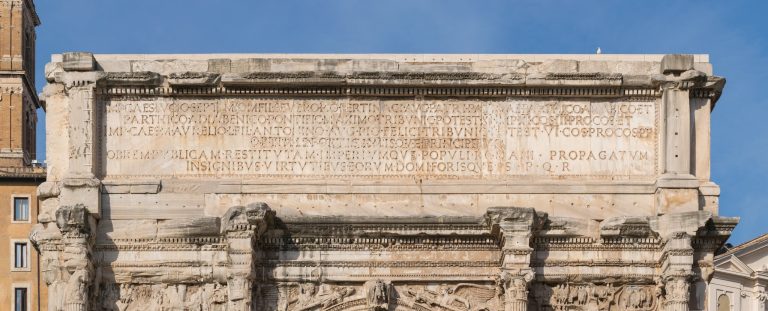
The Arch of Septimius Severus was dedicated in AD 203 to commemorate Septimius Severus and his sons’ victories over Pescennius Niger and the Parthians. Under Diocletian, who ruled from AD 284 to 305 and introduced a system of rule by four emperors, the Forum was reorganized. The Temple of Saturn, Temple of Vesta, Curia Julia, and Rostra were rebuilt or renewed.
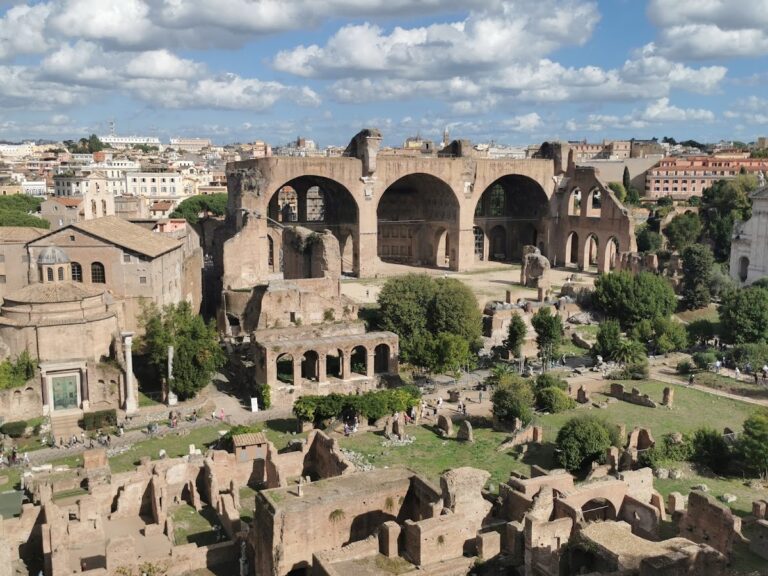
The Basilica of Maxentius was completed during the reign of Constantine the Great in AD 312. It was the last major expansion of the Forum and temporarily restored the site’s political importance. As imperial power shifted toward the Palatine and civic functions declined, the area became increasingly occupied by honorific monuments. The Column of Phocas, erected in AD 608 for the Eastern Roman emperor Phocas, is traditionally regarded as the Forum’s last ancient monumental addition.
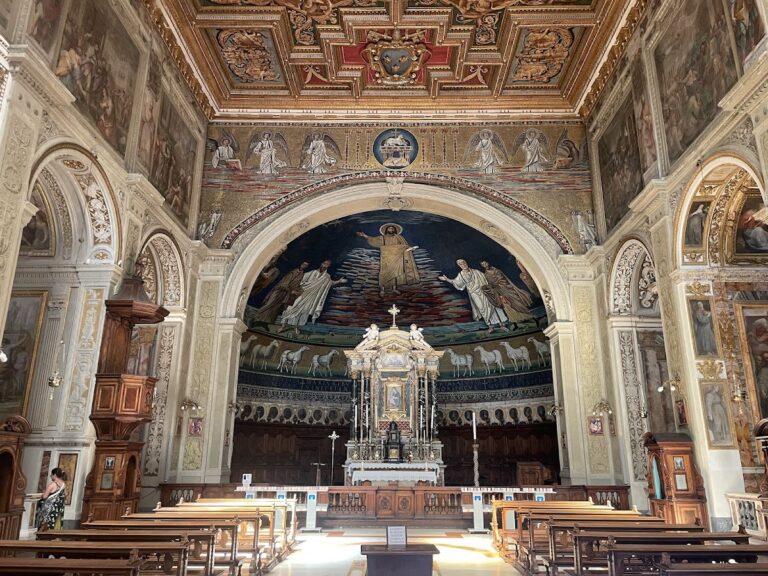
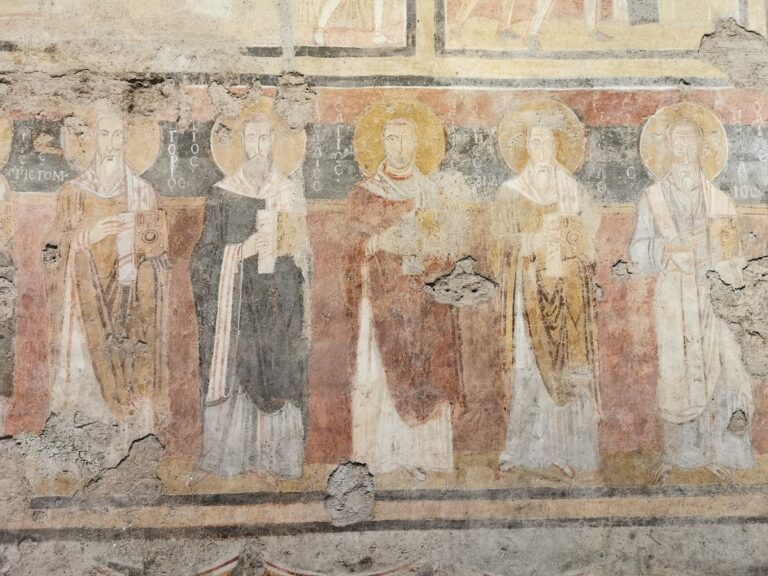
Some ancient buildings were converted into Christian churches during the sixth century. After the visit of Emperor Constans II in AD 663, the removal of lead roofs exposed structures to weather and accelerated their deterioration. By the eighth century, Christian churches stood among abandoned or ruined temples. The last recorded assembly in the Forum took place in 768 before the church of Saint Hadrian.
Burial, rediscovery, and excavation
From the eighth century onward, the Forum was largely neglected. Debris buried its monuments, and the area became known as the Campo Vaccino, or cattle field. Ancient masonry was dismantled and reused in medieval towers and castles. By the thirteenth century, dumping had raised the ground level further.
Interest in Rome’s ancient remains increased after Pope Urban V returned from Avignon in 1367. In 1425, Pope Martin V issued a bull supporting civic rebuilding, increasing demand for stone and marble from the Forum. The maestri di strade, medieval Roman officials responsible for roads and, for a period, the protection of ancient ruins, shared authority over the remains with Rome’s Conservators, its senior civic magistrates. In 1452, Pope Nicholas V transferred the power to issue excavation licenses from the maestri to the Vatican. The overlapping authority of the Vatican and the Conservators was recognized in 1462 by Pope Pius II.
Renaissance extraction caused extensive damage. A 1426 license permitted the destruction of the foundations of a structure called the Templum Canapare for conversion into lime. Rodolfo Lanciani later identified it as the Basilica Julia, although that identification remains uncertain. Between 1431 and 1462, a large travertine wall near the Senate house and Forum of Caesar was demolished. Other licensed demolitions affected the Temple of Venus and Roma in 1450, the Templum Sacrae Urbis in 1461 and 1462, and the House of the Vestals in 1499.
In 1536, Charles V celebrated a triumph in Rome after the conquest of Tunis. To prepare a procession modeled on an ancient Roman victory procession, papal authorities demolished approximately 200 houses and several churches, excavated a new route for the Via Sacra beneath the arches of Titus and Septimius Severus, and exposed foundations of prominent ancient monuments. In 1540, Pope Paul III placed the Forum under the control of the Deputies of the Fabric of the new Saint Peter’s Basilica. Stone and marble continued to be extracted, while remains of several monuments were dismantled or burned for lime. The Conservators protested the destruction, including by appealing to Pope Gregory XIII.
Carlo Fea began clearing debris from the Arch of Septimius Severus in 1803. Official excavations began in 1898 under the Italian government and the Minister of Public Instruction, Dr. Baccelli. Giacomo Boni directed the work until his death in 1925, seeking to return architectural fragments to their original positions, expose the lowest safe level of the Forum, and identify partly excavated structures such as the Senate house and Basilica Aemilia. Work paused briefly during the First World War.
Heavy rain damaged the modern concrete covering over the Lapis Niger in 2008. Excavations continued from 2009 and raised questions about the traditional chronology of Rome’s foundation. A tuff wall near the Lapis Niger, used to channel water from nearby aquifers, was dated by associated pottery and food remains to the eighth or ninth century BC. In 2020, Italian archaeologists found a sarcophagus and circular altar dating to the sixth century BC. Their possible identification as a memorial tomb dedicated to Romulus remains disputed. The Roman Forum is recognized as Italian national heritage.
Remains
The Forum is a rectangular complex oriented from northwest to southeast, extending from the foot of the Capitoline Hill toward the Velian Hill. During the Imperial period, its principal open area measured approximately 130 by 50 meters. The Basilica Aemilia and Basilica Julia defined its long northern and southern sides, while the Forum Adjectum extended southeast toward the Arch of Titus. The Via Sacra, Rome’s principal sacred processional road, crossed the complex from the Capitoline area toward the Arch of Titus.
The site occupies a former low-lying marsh or lake into which water drained from the surrounding hills. Flooding from the Tiber and erosion from the hills repeatedly raised the ground. The final visible travertine paving belongs to the reign of Augustus, while excavations have revealed successive paving layers. The deepest excavated level lies approximately 3.60 meters above sea level. A pebble-paved surface was laid over earlier deposits and structures, including carbonized wood, and the Cloaca Maxima carried water toward the Tiber.
Political and civic spaces
The Comitium began as an open area and later acquired a circular form. It served as the Roman legislative assembly area and was associated with the Curia and Rostra. Its earliest known phase dates to approximately 650 to 630 BC and consisted of a deep triangular depression, first surfaced with beaten earth and later with gravel. Repeated rebuilding and the transfer of political functions to the larger Forum greatly altered its earlier form.
The Rostra was the principal speaker’s platform. Its original orientation was north toward the Senate house. Later platforms were reconstructed at both ends of the Forum, and a fifth-century extension known as the Vandalic Rostra was built of rough brick and decorated with ship prows. Near the Rostra stood the Milliarium Aureum, or Golden Milestone, a bronze column erected under Augustus that listed the names and distances of provincial capitals.
The Curia Julia was the Senate meeting hall and successor to the Curia Hostilia. Its basic present form derives from Diocletian’s reconstruction after a fire. Conversion into a church during the seventh century helped preserve the building. Its modern appearance also reflects restoration under Benito Mussolini. The bronze doors now in place are replicas, while the originals are preserved at the main portal of the Basilica of Saint John Lateran.
The Basilica Aemilia occupied the northern side of the main square and was rebuilt under several names. The Basilica Julia stood on the southern side after replacing the Basilica Sempronia. At the Capitoline end, the Tabularium served as a records hall and formed part of the architectural boundary between the Forum and the Capitoline Hill.
Temples and religious buildings
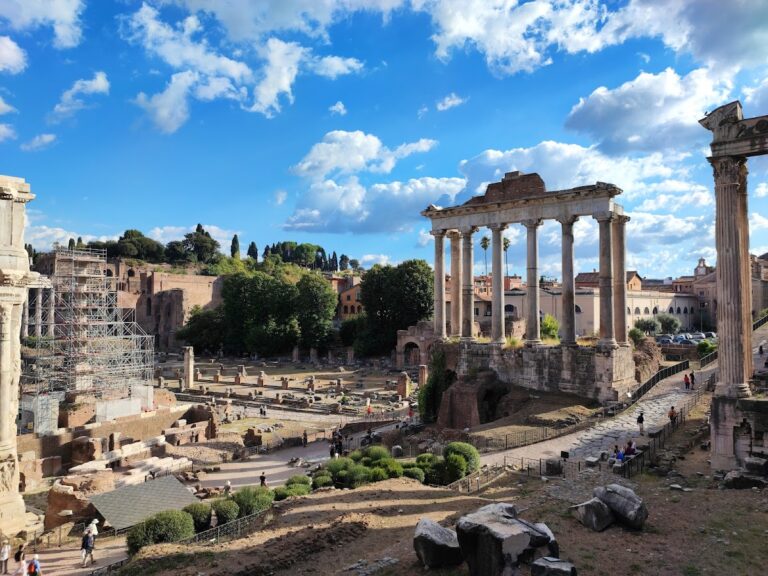
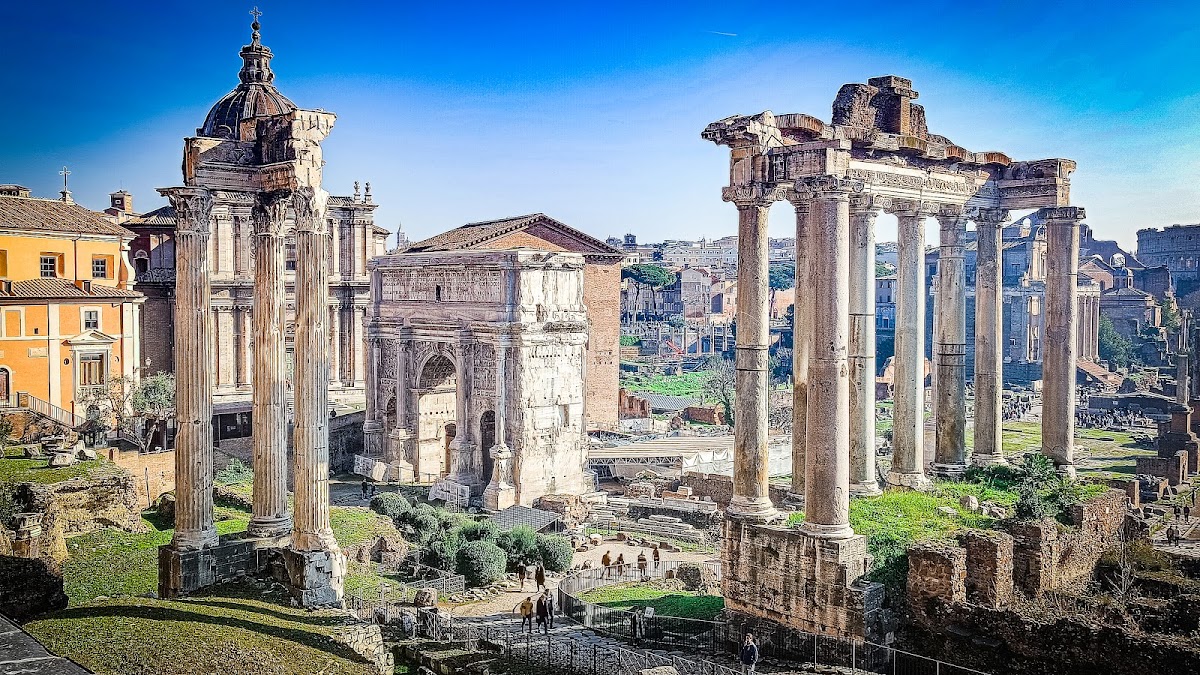
The Temple of Saturn stood on the western side below the Capitoline Hill. Its original construction date is uncertain, and it was believed to have been burned by the Gauls in the early fourth century BC before being rebuilt by Munatius Plancus in 42 BC. Eight columns survive. The temple served as a sanctuary and housed the state treasury, public and private vaults, speaking areas, and spaces for feasts.
The Temple of Concord stood at the western end beneath the Capitoline steps. Dedicated to Concordia, the Roman personification of harmony, it probably originated in the fourth century BC and was redesigned around the beginning of the Imperial period under Tiberius. Its principal surviving remains are the podium, while the hall was sometimes used for Senate meetings.
The Temple of Castor and Pollux, or Temple of the Dioscuri, stood on a high podium at the southern end of the Forum. Most of the surviving building belongs to an Augustan reconstruction and redesign. Nearby, the Fountain of Juturna was dedicated to the nymph Juturna. Its water was regarded as healing, and the location was considered one of the Forum’s sacred places.
The Temple of Vesta stood north of the fountain and formed the central sanctuary of the Forum. Its sacred room contained a statue of Athena. Access was restricted to the Vestal Virgins, priestesses responsible for maintaining Vesta’s sacred fire, and the pontifex maximus; men were not permitted to enter at night. The adjacent House of the Vestals, or Atrium Vestae, was a richly furnished two-story residence.
North of the House of the Vestals, the Regia served first as the seat of the king of sacred matters and later as the office of the pontifex maximus. It hosted meetings of the pontiffs and preserved Rome’s annals. The Domus Publica, the official residence of the pontifex maximus, formed part of the same religious complex. Excavations have revealed early phases of the Regia, House of the Vestals, and Domus Publica dating to the seventh century BC.
The Vulcanal, south of the Arch of Septimius Severus, was an archaic altar or sanctuary of Vulcan, the deity associated with fire and metalworking. Nearby, the Umbilicus Urbis was regarded as the symbolic center of Rome and the Roman world, and as a point where the upper and lower worlds met. Sacrifices were performed there. South of the Basilica Aemilia, only the foundation of the Sanctuary of Venus Cloacina survives.
The Lapis Niger, or Black Stone, is a square area surfaced with black marble between the Curia Julia and the Arch of Septimius Severus. Excavations beneath it revealed an ancient sanctuary associated with Vulcan. A modern concrete covering protected the marble surface and was damaged by heavy rain in 2008.
Imperial monuments and later structures
The Temple of Caesar stands between the former cremation site of Julius Caesar and the Regia. Augustus built it at the site of Caesar’s cremation and dedicated it to the deified ruler on 18 August 29 BC. An uncertain monument south of the temple is conventionally identified as the Arch of Augustus.
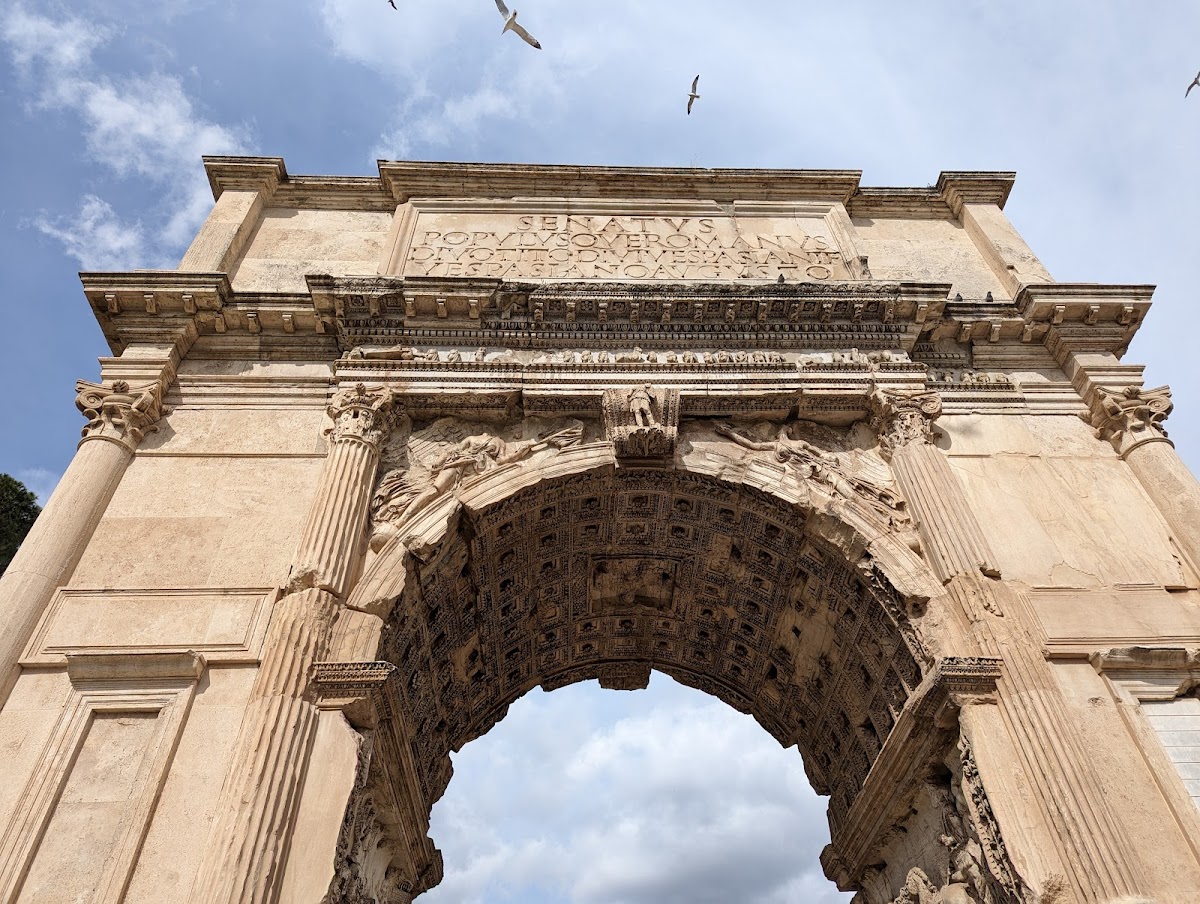
The Arch of Septimius Severus is a white-marble triumphal arch at the northwest end of the Forum, near the foot of the Capitoline Hill and the former Comitium. It closed the central area and formed one of the Forum’s two triumphal arches with the Arch of Augustus. The Arch of Titus, built in marble late in the first century AD, commemorated Titus’s victory in Judaea and the conquest of Jerusalem. It stands at the highest point of the route toward the Colosseum and was incorporated into the medieval Frangipani fortress.
The Portico of the Harmonious Gods stood above the Temple of Saturn and was probably last reconstructed in AD 367. Its lower level, built under Titus beside the Temple of Vespasian, contained seven rooms interpreted as shop fronts. After the Temple of Vespasian blocked public access to the Tabularium, Domitian added an upper level of eight rooms, including a staircase to the records building. These rooms are generally interpreted as scribal offices. Hadrian later added a colonnade of thirteen pillars, probably carrying bronze statues of the twelve Dii Consentes, the traditional group of major Roman deities.
The Temple of Vespasian and Titus was dedicated to the deified Flavian emperors Vespasian, Titus, and Domitian and was completed under Domitian. Three Corinthian columns survive. The adjacent Domitianic ramp connected the Forum with the Palatine and may have served as a monumental entrance to the imperial palaces; it may also have housed the Praetorian Guard.
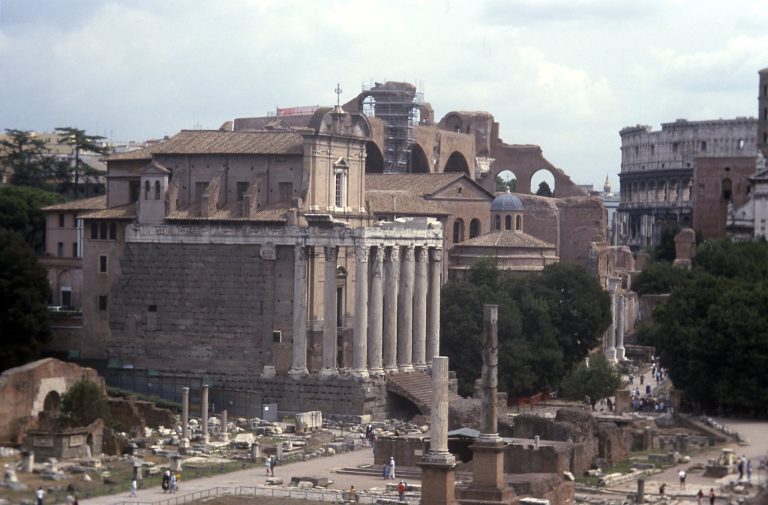
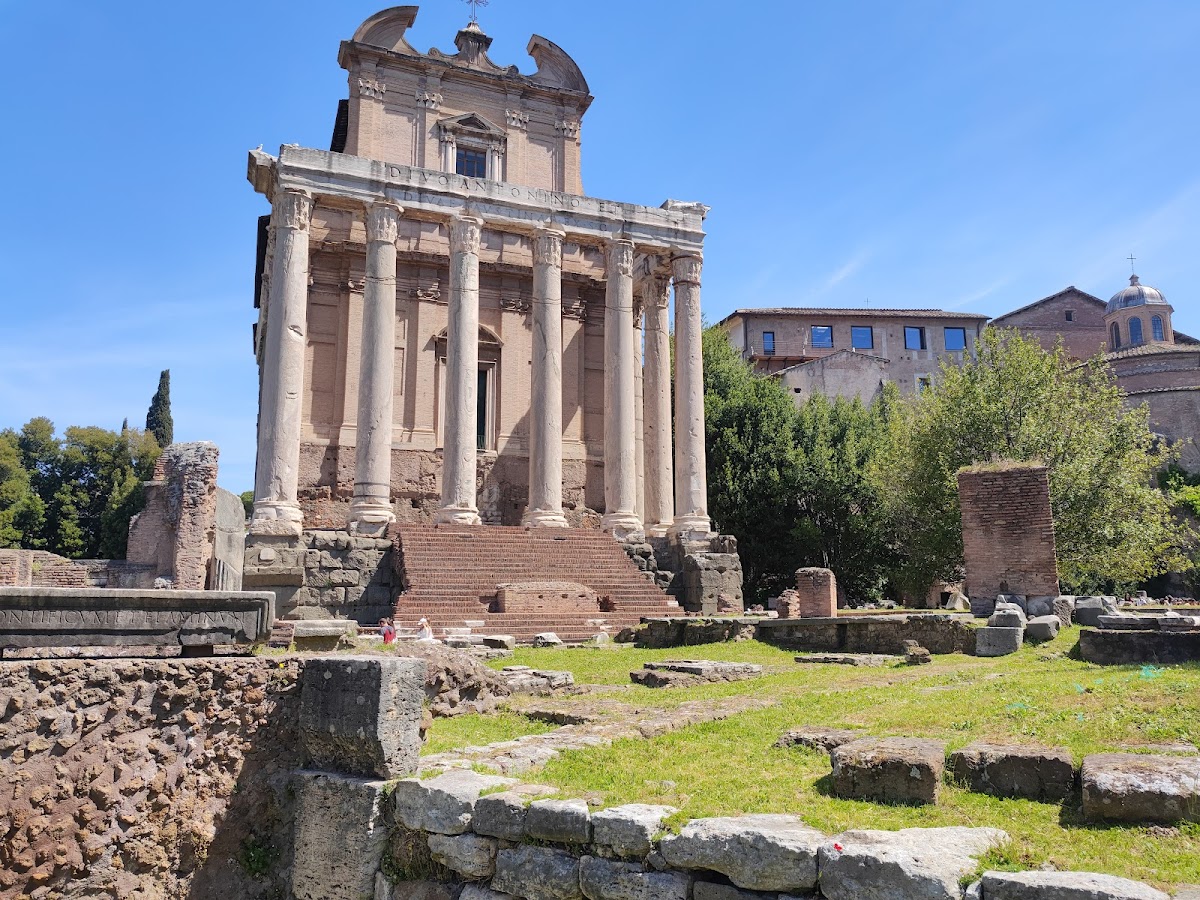
The Temple of Antoninus and Faustina stands on the northern side of the Forum and is among the best-preserved ancient Roman temples. Antoninus Pius built it for his deified wife Faustina. Its conversion into a church in the seventh or eighth century helped preserve the structure. Nearby excavations exposed an archaic cemetery containing approximately forty ninth-century BC burials and preserved tombs dating to around 500 BC.
The building known as the Temple of Romulus lies between the Temple of Antoninus and Faustina and the Basilica of Maxentius. Its identification and original dedication are uncertain. It may have been dedicated to Jupiter Stator, with the Penates also worshipped there. Its conversion into a church in the sixth century contributed to its preservation.
The Temple of Venus and Roma stood on the slope toward the Colosseum. Its western cell faced the Forum and was dedicated to Roma Aeterna, the personification of the eternal city, while the cell facing the Colosseum was dedicated to Venus Felix, a form of Venus associated with good fortune. The western cell now contains the Forum’s antiquarium.
The Basilica of Maxentius, completed in AD 312, is a monumental basilica with large vaulted spaces. It stands east of the Temple of Antoninus and Faustina and the so-called Temple of Romulus, and formed the last major addition to the Forum complex. The Tullianum, or Mamertine Prison, stood near the Forum as the Roman state prison. It held prisoners including Jugurtha and Vercingetorix and was associated in Christian tradition with the imprisonment of Peter and Paul.
The Column of Phocas was erected before the Rostra on 1 August AD 608. Dedicated to the Eastern Roman emperor Phocas, it may originally have carried a gilded statue of him. Around it, the site preserves ruined and buried structures, architectural fragments, altered buildings, reused masonry, debris deposits, and excavation areas. Medieval and later layers progressively covered ancient paving, foundations, and monuments before modern clearance exposed portions of the Forum’s earlier fabric.