Střekov Castle: A Medieval Fortress in Ústí nad Labem, Czech Republic


Visitor Information
Google Rating: 4.7
Popularity: Medium
Official Website: www.lobkowicz.cz
Country: Czechia
Civilization: Medieval European
Site type: Military
Remains: Castle

History
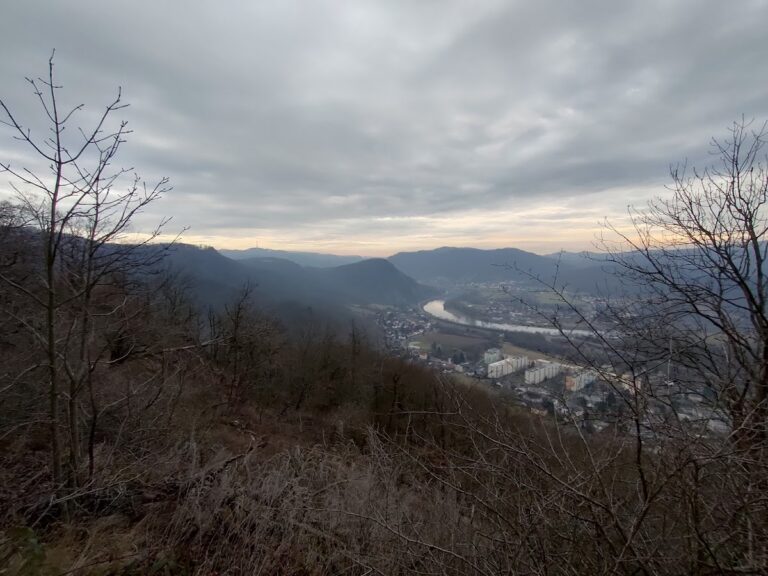
Střekov Castle is located in the municipality of Ústí nad Labem-Střekov in the Czech Republic. It was built by medieval Bohemians to oversee and protect the vital waterway of the Elbe River.
The castle’s construction began between 1316 and 1319, commissioned by King John of Bohemia, also known as Jan Lucemburský. Its primary purpose was to secure control over river traffic and to serve as a point for collecting customs duties. The king entrusted the initial building phase to Pešík of Veitmile, who held the castle briefly as a fief. Soon after, in 1319, ownership passed to the influential Vartenberk family. Střekov replaced an older fortress nearby, Ústí nad Labem castle, as the main administrative and military stronghold in the area. The Vartenberks maintained control through the early 15th century, after which the castle changed hands several times, including possession by the margraves of Meissen and noble families such as the Kladenští and the Glac.
In the early 1500s, the Glac family undertook significant renovations, transforming parts of the fortress into a more comfortable residence with late Gothic architectural features. Starting in 1563, the Lobkowicz family acquired the castle and retained ownership until 1945, and then again from 1992 onwards after restitution laws, though they never lived there permanently. Throughout its history, Střekov Castle played a role as a strategic military site. During the Thirty Years’ War in the 17th century, Imperial, Saxon, and Swedish armies occupied it at various times, often resulting in damage. Later, during the Seven Years’ War, the fortress saw action again, notably in a 1757 siege involving Croatian and Prussian troops.
By the late 1600s and through the 1700s, the castle fell into ruin as many of its buildings collapsed. However, in the 19th century’s Romantic era, it attracted artists and writers including Goethe, Richard Wagner, and Czech poet Karel Hynek Mácha. To accommodate visitors drawn by the castle’s picturesque ruins and dramatic setting, a restaurant was established on the grounds in 1830. The state nationalized the property after World War II, placing it under preservation protection beginning in 1953. Following political changes, the Lobkowicz family regained ownership in 1992, preserving it as a cultural monument.
Remains
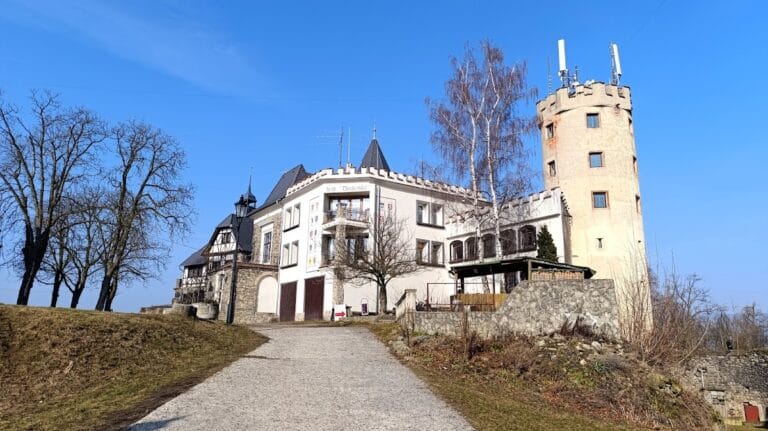
Střekov Castle sits dramatically on a steep, weathered trachyte rock outcrop about 258 meters above sea level, towering roughly 100 meters above the adjacent Elbe River. The site is naturally defended by near-vertical cliffs and fractures in the rock, which form an extensive system of cellars below the castle structures. The original design from the early 14th century consisted of a core divided into two parts, with a forecourt entered through a tower gate. Within the forecourt stood a rectangular two-room palace featuring rounded corners on its western side. Opposite the palace, visitors find a large round bergfried, the main defensive tower, accompanied by a smaller round tower or turret in the southeast corner.
The castle’s palace and towers were connected by curtain walls reinforced by semicircular bastions that faced inward toward the courtyard. These bastions were an early example in Bohemia of French-influenced castle defenses designed to strengthen wall sections. Access to the inner parts of the castle included a bridge with a gate below the bergfried that was protected by a drawbridge. Behind this gate lay the rear core of the castle, dominated by a large building with thick walls that may have served a tower-like protective function for the front sections.
In the early 16th century, during the castle’s transformation into a residence, a new outer bailey was added around the original core. The forecourt’s rectangular palace was converted into a residential hall with a large main room. The smaller southeastern tower was dismantled and replaced with a tower-like palace building. Additional constructions were inserted along the curtain walls, among them a castle chapel created by converting the eastern bastion’s interior. The castle’s construction predominantly used locally quarried stone, with clear-cut masonry lines. Gothic architectural details included pointed arch windows and ornamented late Gothic crossbars, demonstrating stylistic changes over time.
The bergfried is a cylindrical tower capped by a conical roof covered with wooden shingles. Originally, access to this tower was through a pointed-arch doorway located above ground level on the first floor, enhancing its defensibility. The upper palace structures exhibit a slightly rhomboid outline characteristic of late Gothic style, with a pavilion roof also shingled with wood. This palace is partially embedded into the rocky slope, with its eastern side perched directly on the rock’s edge and the western side built into the hillside. The lower palace closes off the southern side of the upper castle and stands two stories high. Oriented perpendicular to the rock formation, it retains Gothic-style windows. The western section remains preserved up to parapet height, forming a panoramic terrace, while the eastern portion survives up to the cornice but no longer has a roof. A now-lost oriel window once extended from the eastern side.
Beyond the main structures, the castle complex included auxiliary buildings such as administrative offices and agricultural spaces, a forge for metalworking, and a courtyard. The lower castle gate sits amid retaining walls and is separated from the upper core by a natural moat cut into the terrain, bridged by an arched structure. Such a natural moat serving as a dividing feature was unusual for castles built in the 14th century.
Restoration and preservation work began in the late 19th century and continued with efforts in 1911–1912. Since 1963, Střekov has been protected as a cultural monument, with its stone ruins and foundational features remaining visible on the rocky promontory above the Elbe. The site retains its historical atmosphere and continues to offer insights into medieval military architecture and noble residential design.
Nearby sites