Sobroso Castle: A Historic Fortress in Villasobroso, Spain



Visitor Information
Google Rating: 4.4
Popularity: Medium
Google Maps: View on Google Maps
Official Website: www.castelodesobroso.com
Country: Spain
Civilization: Unclassified
Remains: Military

History
Sobroso Castle stands in Villasobroso, a locality within the municipality of Mondariz in Spain, and was originally constructed by Christian forces during the period of the Reconquista between the 9th and 11th centuries. The site itself had been occupied previously in pre-Roman times as a castro, or fortified settlement, reflecting a long history of strategic importance tied to its commanding position over the surrounding landscape.
The earliest documented event linked to the castle dates back to 983 when King Bermudo II of León sought refuge within its walls during the Battle of Portela Arenaria. Over the following centuries, Sobroso played a key role in regional power struggles and dynastic conflicts. Queen Urraca I used the fortress as a refuge during a siege in 1117, escaping a blockade imposed by forces loyal to her son Alfonso VII and her sister Teresa of León through a secret passage. Alfonso VII later ascended to the throne with his coronation taking place at the castle, underscoring its political significance at that time.
In the late 11th and 12th centuries, Sobroso became closely linked to the church when Queen Urraca, together with Raimundo de Borgoña, granted the castle to the bishopric of Tuy in 1095. Documentation from 1170 records Villasobroso under the name “Villa San Martini de Portela Subcastelo de Suveroso” following a donation from King Fernando II of León to the bishop of Tuy, showing the continued importance of both the locality and the fortress in ecclesiastical and royal affairs. The castle was also owned by the Sobroso family, relatives of King Alfonso IX, tying it firmly to prominent noble lineages.
During the mid-15th century, Sobroso Castle became embroiled in the Irmandiña Revolts (1467-1469), a widespread uprising against feudal nobility across Galicia. The fortress suffered extensive damage but was reconstructed thereafter by the nobleman Pedro Madruga (Pedro Álvarez de Soutomaior). However, his captivity between 1477 and 1478 led to the loss of the castle, after which the Catholic Monarchs issued orders to demolish Sobroso twice, in 1481 and 1486, though these directives were never carried out. Subsequent ownership passed through noble families such as the Sarmiento and Soutomaior houses, maintaining the castle’s aristocratic links.
By the 17th century, Sobroso Castle had lost its strategic relevance and gradually fell into ruin over the next two hundred years. In 1625, King Philip IV granted the title of Marquisate of Sobroso to García Sarmiento de Luna y Sotomayor, further associating the location with Spanish nobility and the broader colonial administration. In the 20th century, the castle’s ruins were purchased by Alejo Carrera Muñoz, a local journalist and the first mayor-pedáneo (a local magistrate) of Villasobroso. Beginning in 1923, Carrera Muñoz directed private restoration efforts supported by local residents until his death in 1967. Later, in 1981, the municipality of Puenteareas acquired Sobroso Castle and resumed restoration activities from 1995 onward.
Recognized for its cultural value, Sobroso Castle was declared a National Monument in 1949 and later designated a Bien de Interés Cultural (a heritage listing) by the regional government in 2013. It now houses exhibitions related to the traditional crafts and ethnography of the region.
Remains
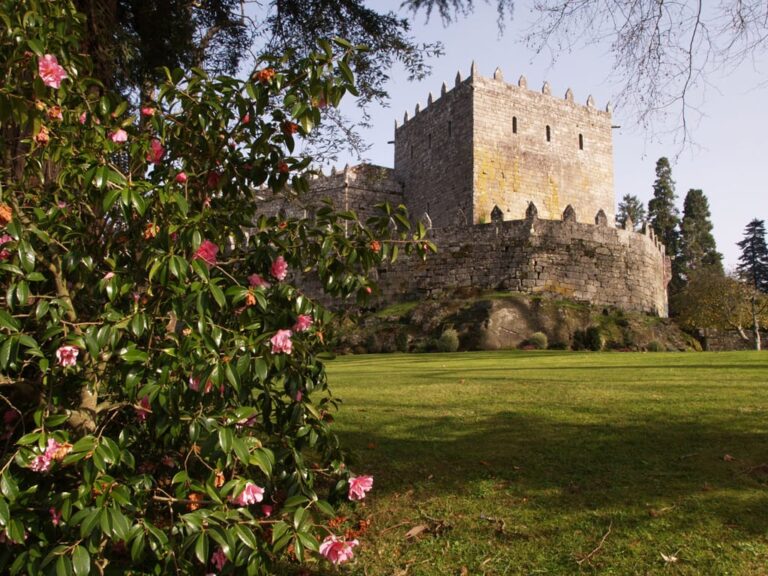
Sobroso Castle is situated atop the hill of Landín, occupying around 360 square meters with a layout shaped as an irregular polygon that capitalizes on the natural contours of the landscape, providing extensive views over the surrounding valley and more than fifty Galician villages reaching toward the Portuguese border. The fortress displays a combination of medieval and 15th-century construction techniques, primarily consisting of carefully cut stone blocks known as perpiaños.
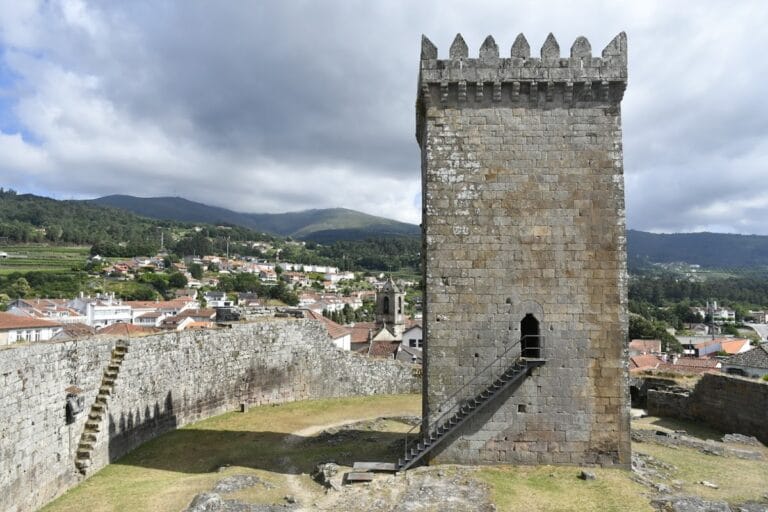
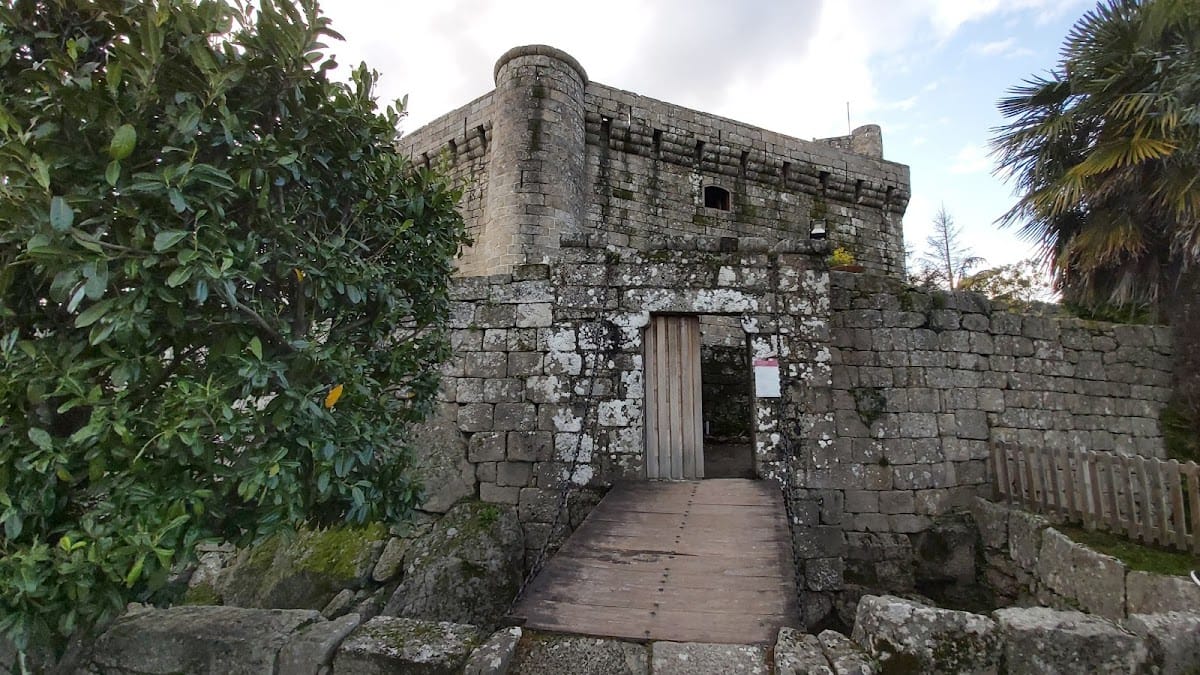
The castle’s structure is divided into three main parts: an outer curtain wall that encloses the complex, a residential section, and the prominent keep, also called the tower of homage. The curtain wall follows an oval form on its northern side, corresponding with the original medieval plan, while other sections reflect later polygonal modifications characteristic of the 15th-century rebuilding. Remnants of circular defensive towers remain integrated into the curtain wall, complemented by a steep sloping talus or base that strengthens weaker sections of the defense.
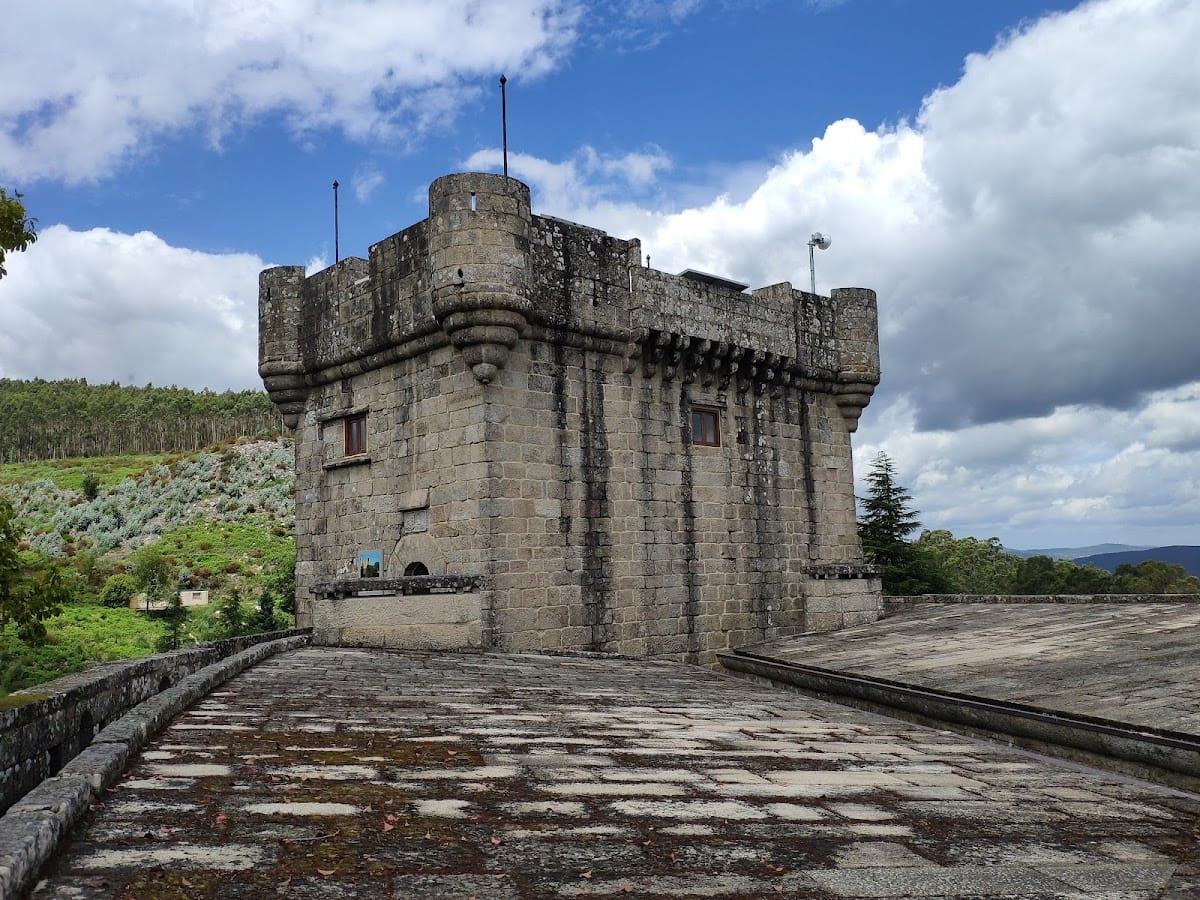
The keep stands on the western side adjoining the polygonal residential building, rising to 13 meters with walls reaching 1.5 meters in thickness. It features a pronounced parapet that projects outward, adorned with cylindrical turrets at each corner supported by stepped conical corbels, which are stone brackets shaped like stepped cones providing both support and decorative effect. Atop the parapet are crenellations—regularly spaced openings used for defense—that sit on a solid wall called a blind parapet. The tower also includes medieval latrines at its base, a design influenced by Castilian castle architecture seen elsewhere in Galicia. Numerous mason’s marks and coats of arms decorate the keep’s stonework, including heraldic symbols linked to the Sarmiento and Valladares families.
The residential quarter comprises two floors: the lower level once housed the guardhouse, equipped with defensive loopholes—narrow vertical openings for archers or firearms—while the upper floor contains the noble hall, now dedicated to Alejo Carrera Muñoz, a kitchen with an original fireplace, and a bedroom decorated to reflect the region’s linen production heritage. An internal staircase provides access to a wall walk inside the enclosure walls, interrupted by additional loopholes for defense. Notably, the northeast corner features a wide and steep chemin de ronde, or wall walk, supported by stone corbels that allowed defenders to patrol the perimeter while being protected.
Within the courtyard’s northern side lies a Romanesque chapel marked by a rectangular floor plan, aligning with the castle’s historical period and providing a spiritual space for its inhabitants. The main entrance is crowned with a shield bearing the emblem of the Galician kingdom, asserting the fortress’s historical alliances and status. Outside, the castle is surrounded by native trees such as oaks and cork oaks, which historically lent the site its name and contribute to the preservation of its character.
Today, the castle is in excellent condition due to 20th-century restoration initiatives. It functions as a cultural center and museum focusing on local ethnography, displaying traditional crafts and exhibits related to linen processing, including equipment like a fulling mill (batán), which was used in the cleaning and thickening of woven fabric. These features connect the castle’s medieval heritage with the region’s longstanding artisanal traditions.
Nearby sites