Rezi Castle: A Medieval Fortress in Hungary

Site at a Glance
- Rating
- 4.6
- Popularity
- Medium
- Country
- Hungary
- Primary era
- Medieval
- External website
- Open
- Eras represented
- Medieval
- Civilizations
- Hungarian
- Site type
- Military
- Remains
- Castle
On this page11 sections
History
Rezi Castle is a medieval stone-built fortress in Rezi, Hungary, constructed between 1292 and 1307. Its early development followed a dispute over the Rezi estate and probably began under Apor and Lukács of the Péc kindred, an extended noble lineage whose members could hold property and influence collectively. The castle served Apor’s efforts to control the estate.
From noble stronghold to royal possession
In 1282, King Ladislaus IV transferred the Rezi estate to Tiba of the Tomaj kindred in exchange for Boldogkő. Apor of the Péc kindred then seized the estate by force. Apor later died without a male heir, and the property returned to royal administration. Rezi was certainly in royal possession by 1333.
During the feudal civil wars, struggles between the Hungarian crown and powerful provincial noble families that weakened royal control in the late thirteenth and early fourteenth centuries, forces of the Kőszegi kindred occupied the castle. In 1321, Sándor Köcski, castellan of Szentmárton and a commander in King Charles I’s army, recovered Rezi by siege.
Royal grants and the Pethő family
King Louis I later granted Rezi to the Lackfi brothers, prominent supporters at his court. After Louis’s death, the Lackfis joined the Horváti–Paliszlani rebellion and eventually turned against King Sigismund after the defeat at Nicopolis. On 27 February 1397, Sigismund had István Lackfi executed and confiscated his estates, returning Rezi to royal ownership.
In 1401, Sigismund granted Rezi and its appurtenances to Eberhard Albeni, Bishop of Zagreb, and his brother Rudolf Albeni. They held Rezi together with neighbouring Tátika in 1415, but the castle reverted to the king after Eberhard’s death in 1416. In 1421, Sigismund pawned Rezi and its appurtenances for 10,000 gold florins to János Albeni, Bishop of Zagreb and the queen’s chancellor, and Rudolf Medvei.
Sigismund confiscated the castle from the Medvei family in June 1427, citing abuses of power in the surrounding area, and granted it to Péter Pethő and László Pethő of Gerse. The Medvei family renounced its claims in 1433. Rezi then remained with the Gerse Pethő family until the male line became extinct in 1729.
Conflict and sixteenth-century decline
During the civil war between King Vladislaus I of Hungary and Queen Elisabeth, the widow of King Albert, in 1440, Elisabeth formally confiscated Rezi from the Pethős and granted it to György Zágorhidai. The Pethős nevertheless retained possession in practice.
After the death of King Matthias Corvinus, mercenaries of Maximilian I captured the small castle in a brief siege in 1490 while attempting to enforce Maximilian’s claim to the Hungarian throne. Pál Kinizsi recaptured Rezi in 1491. This campaign was the final one in which Matthias’s Black Army, the professional mercenary force organized during his reign, fought.
Ottoman forces, belonging to the imperial state expanding into central Hungary during the sixteenth century, raided the central regions in 1554 and attacked castles in the Balaton Highlands. The Pethős strengthened Rezi’s walls afterward, but the castle remained a strategically limited private stronghold.
Following the Ottoman capture of nearby Hegyesd Castle in 1561, the Pethő family paid for a guard of twelve foot soldiers. A family council held at Rezi on 10 February provided for two watchmen and a castellan, the officer responsible for administering and defending a castle. Responsibility for the castle’s care went to János Pethő, a royal cupbearer, a high-ranking court official, because he had arranged work on the fortification.
By 1571, the loss of much of the Pethős’ property had weakened their finances. The family could no longer maintain the converted Keszthely monastery or the castles of Rezi and Tátika. In 1586, the county assembly decided to send envoys to Count Zrínyi to request the demolition of one of the two castles.
Rezi was still standing in 1588. In 1589, Ottoman soldiers occupied and burned neighbouring Tátika during a raid, exposing the vulnerability of poorly maintained and inadequately guarded mountain castles. A charter from 1592 states that Rezi had by then fallen into ruin. Its two gate towers had been blown up, making the castle unusable.
Ownership, excavation, and restoration
The ruins continued to deteriorate, although substantial remains survived during the first half of the twentieth century. After the Gerse Pethő male line ended in 1729, the Hungarian treasury acquired the ruin and its land. Festetics Kristóf purchased them in 1741, and the Festetics family retained ownership until 1945, when the property was nationalized after the Second World War.
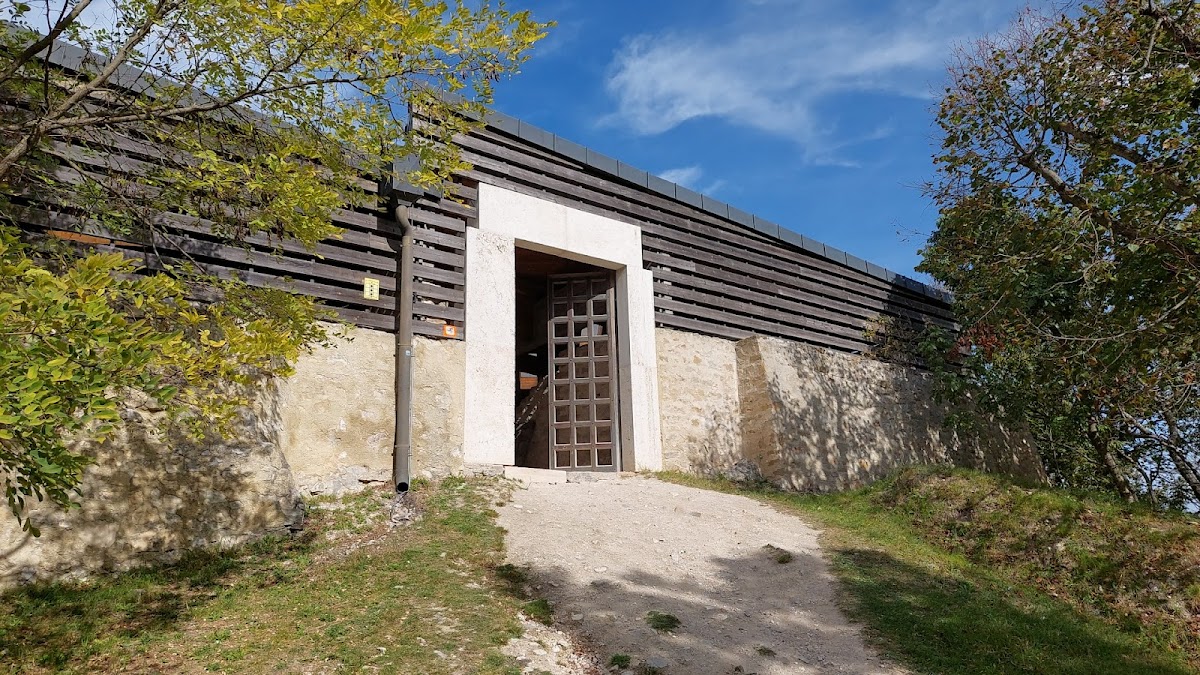
Archaeological excavation and restoration began in 2000, and reconstruction was completed in 2012. A traditional local mocking saying claims that the people of Zsid had “Rezi Castle sued” because it prevented the sun from shining on them. Zsid was a locality in the region, and the saying refers to its inhabitants.
Remains
Setting and overall layout
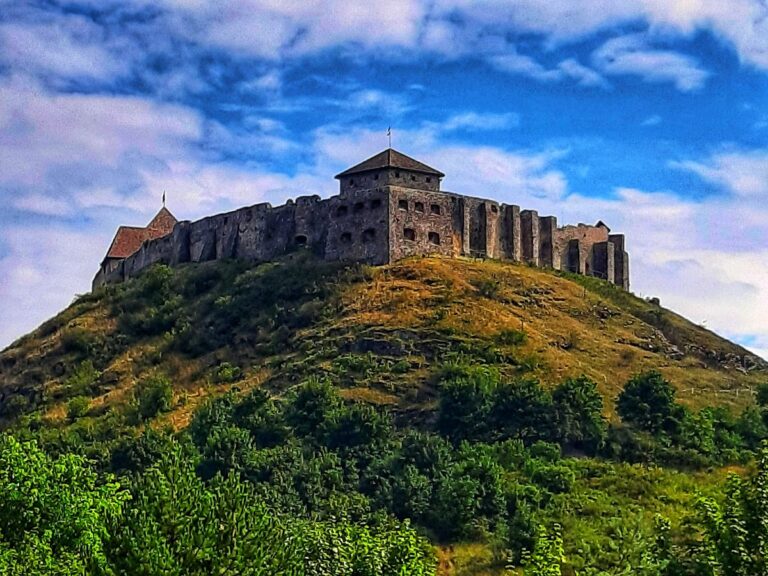
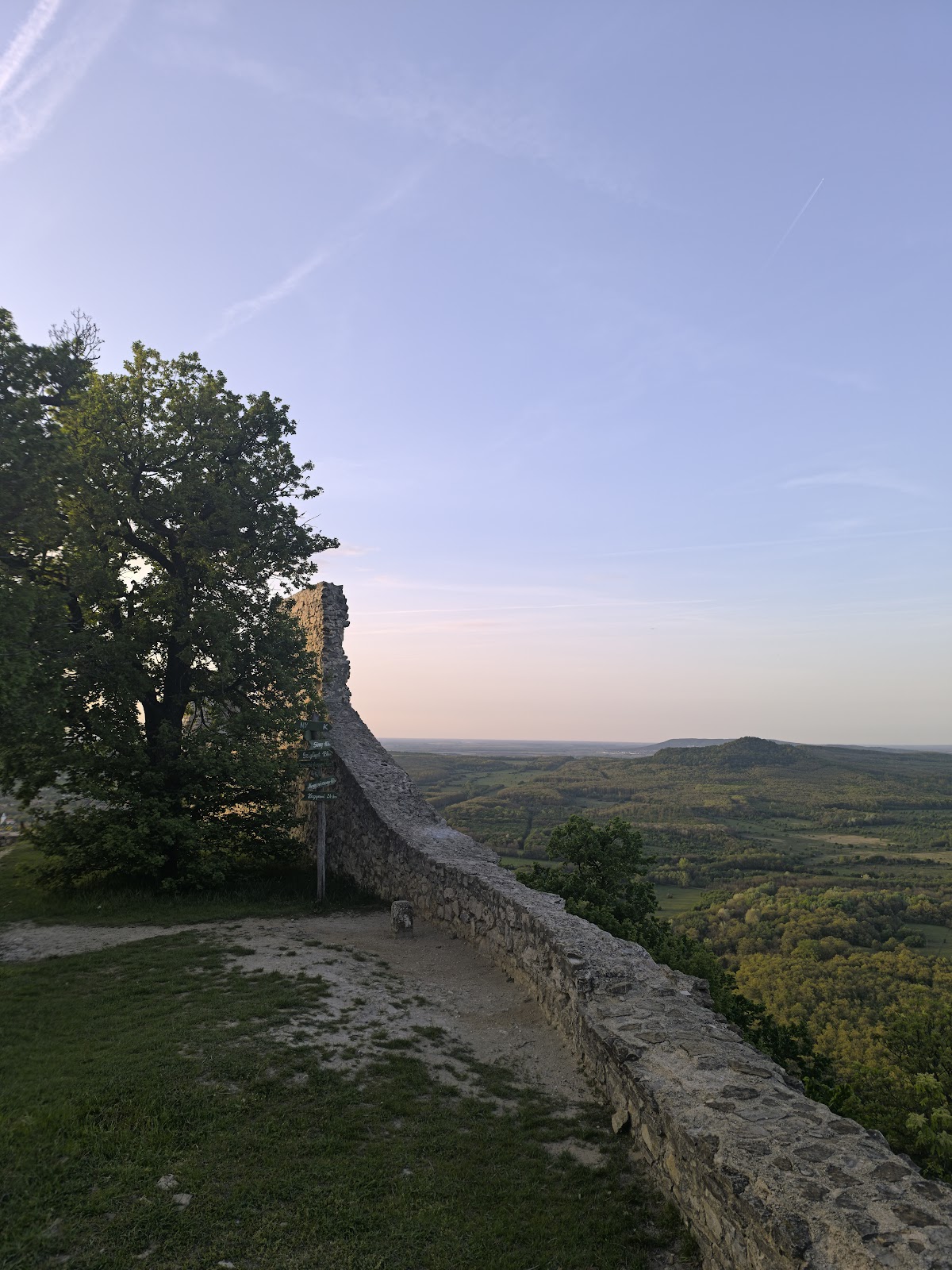
Rezi Castle stands on the steep-sided dolomite spur of Meleghegy, on the northern edge of the wooded Keszthely Plateau. At an elevation of approximately 418 to 427 metres, it overlooks the Szántó Basin and lies northeast of Rezi village, north of the western shore of Lake Balaton. The documented plan consisted of an elongated courtyard enclosed by a wall, with two towers, a deep dry moat, and a residential tower at the far end. A drawing by the Italian military engineer Giulio Turco shows this arrangement.
Courtyard and defensive structures
Courtyard and dry moat
The elongated courtyard formed the central space of the stone-built castle. Its enclosing wall was paired with a deep dry moat, a defensive ditch without standing water. Together, these features defined the castle’s compact defensive layout on the dolomite spur.
Gate towers
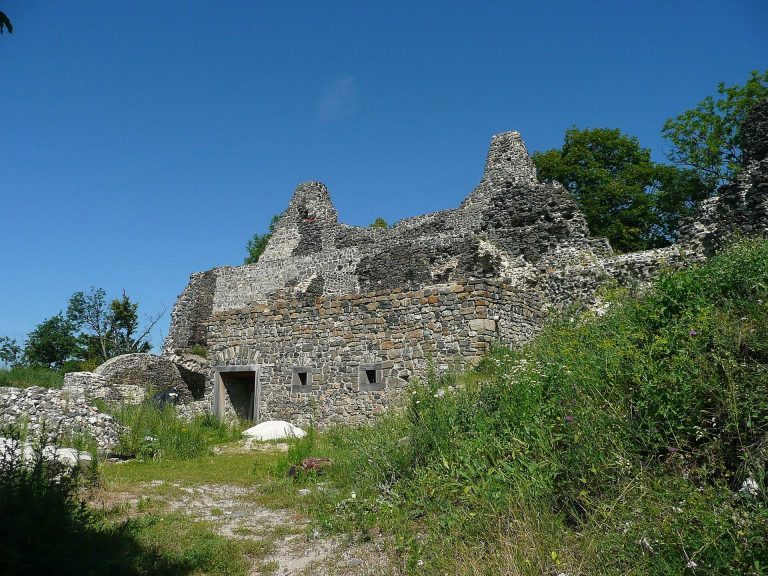
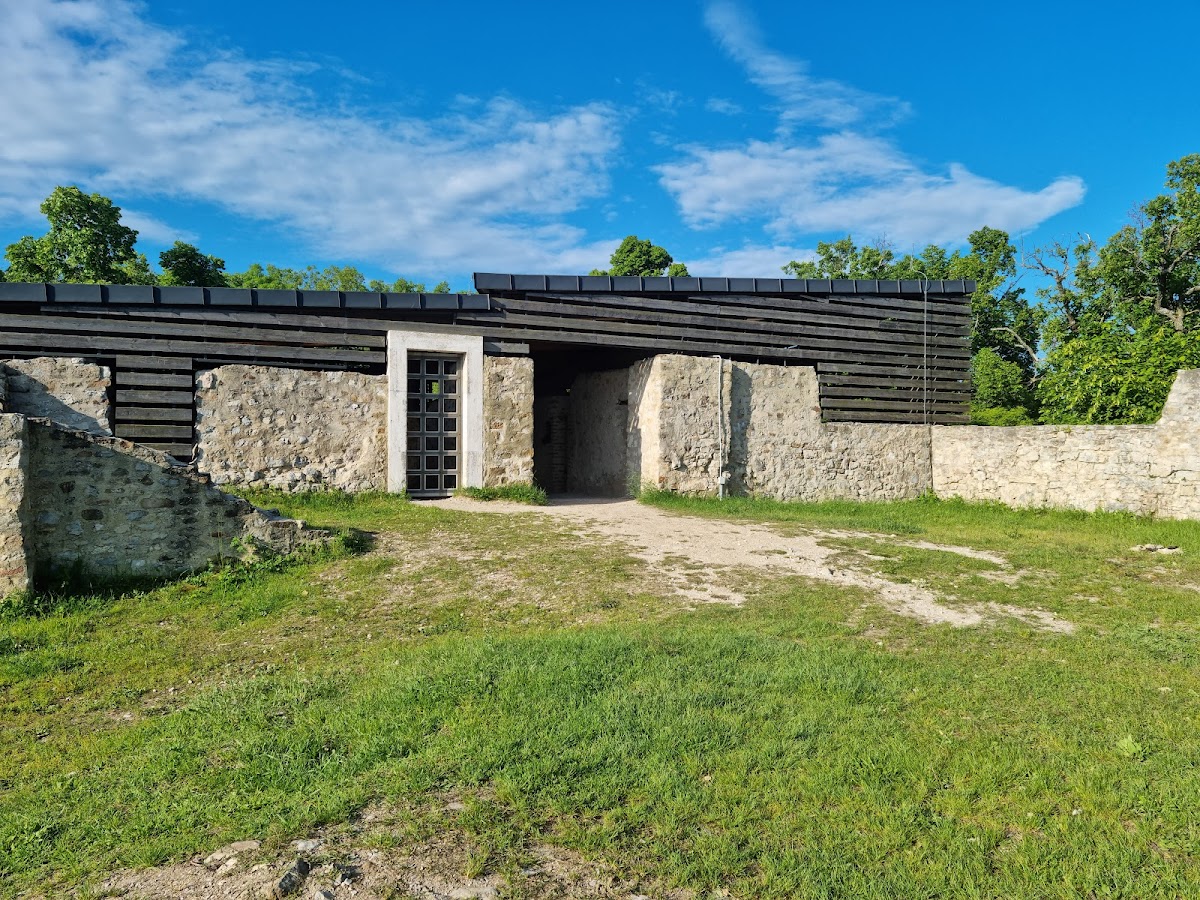
Two towers protected the entrance to the enclosure. When the castle was rendered unusable in the late sixteenth century, both gate towers were blown up. Their surviving remains form part of the restored and reconstructed ruin.
Residential tower
A residential tower rose at the far end of the courtyard. This was a fortified tower intended for living quarters and household use, completing the arrangement shown in Giulio Turco’s drawing. The castle is now preserved as a ruin, with substantial restoration and reconstruction carried out between 2000 and 2012.