Castle of Castro Laboreiro: A Portuguese Frontier Fortress


Site at a Glance
- Rating
- 4.6
- Popularity
- Medium
- Country
- Portugal
- Primary era
- Medieval
- Eras represented
- Medieval
- Civilizations
- Kingdom of León, Portuguese
- Site type
- Military
- Remains
- Castle
On this page12 sections
History
The Castle of Castro Laboreiro is a medieval frontier fortress in Portugal, standing above the village of Castro Laboreiro in the municipality of Melgaço. Built and repeatedly strengthened during the Christian reconquest of the Iberian Peninsula, it occupies a difficult and strategically important position between the basins of the Minho and Lima Rivers. Its surviving form is a Romanesque castle with Gothic elements, shaped especially by rebuilding around 1290 during the reign of Denis of Portugal.
Early Occupation and the Christian Reconquest
The region had been occupied since prehistoric times, as shown by the numerous megalithic monuments on the plateau northeast of Castro Laboreiro. Activity at the castle site was later connected with Roman roads and bridges crossing local waterways, including the Barreiro stream, the Laboreiro River, the Cainheiras River, and the Porto Seco River.
During the Christian reconquest, the long expansion of Christian-ruled states across lands held by Muslim rulers in the Iberian Peninsula, Alfonso III of León granted the domain of Castro Laboreiro to Count Hermenegildo in the first half of the tenth century. Hermenegildo had defeated the rebellious local leader Vitiza, and the existing fortified settlement, or castro, was reportedly adapted into a castle during his rule. The site later returned to Muslim control.
Formation of the Portuguese Frontier
Afonso Henriques, the first king of Portugal, conquered Castro Laboreiro in 1141 and began reinforcing its defenses in 1145. These works formed part of Portugal’s frontier system. An inscription states that the defensive construction was completed during the reign of Sancho I, although its precise details are unknown. Leonese forces severely damaged the castle during their invasion of 1212.
During the reign of Denis of Portugal, the defenses were rebuilt around 1290 and acquired their general present form. Castro Laboreiro was a village and municipal seat from 1271 until 1855. It belonged to the County of Barcelos until 1834 and became a commandery of the Order of Christ in 1319. This Portuguese military-religious order succeeded the Knights Templar in Portugal and held religious, military, and administrative properties.
Castellans and Military Conflict
In the late thirteenth century, the castellanies of Castro Laboreiro and Melgaço were united under the Gomes de Abreu family of Merufe. A castellany was the jurisdiction administered and defended by a castle’s castellan. During the reign of Ferdinand I, the office was later granted to Estevão Anes Marinho.
After Melgaço was conquered, John I used Castro Laboreiro in the fourteenth century as a base from which to stop incursions by Castilian forces entering from Galicia. In 1441, the senior castellan Martim de Castro was removed from office after complaints by the inhabitants of the town.
The castle was captured by surprise in May 1666 during the Portuguese Restoration War, the conflict in which Portugal fought to preserve its independence from the Spanish Habsburg monarchy. Baltazar Pantoja took the fortress after four hours of fighting and appointed Pedro Esteves Ricarte as governor. Ricarte later surrendered it to Francisco de Sousa, the third Count of Prado. A royal decision subsequently ordered the castle’s conservation because of its historical importance, despite opposition from Michel Lescole.
Decommissioning and Modern Investigation
After peace was restored, the fortress was decommissioned in 1715. From 1766 to 1778, the Count of Bobadela used it to detain men and women who refused to present their children for military service. About 400 people were held during this period. Manuel de Araújo Machado, Count of Bobadela, governed Castro Laboreiro from 1746 to 1779.
During the Peninsular War, the wider conflict against Napoleonic France and its allies, troops occupied and defended the castle in 1801 with four artillery pieces. It was decommissioned again after the peace, beginning a prolonged period of abandonment and ruin.
Archaeological investigations in the 1970s revealed evidence of occupation during the early Middle Ages. Vegetation was removed and the monument was consolidated between 1979 and 1981. The Castle of Castro Laboreiro has been classified as a National Monument since 1944, under a decree published on 27 March of that year.
Remains
Hilltop Layout and Walls
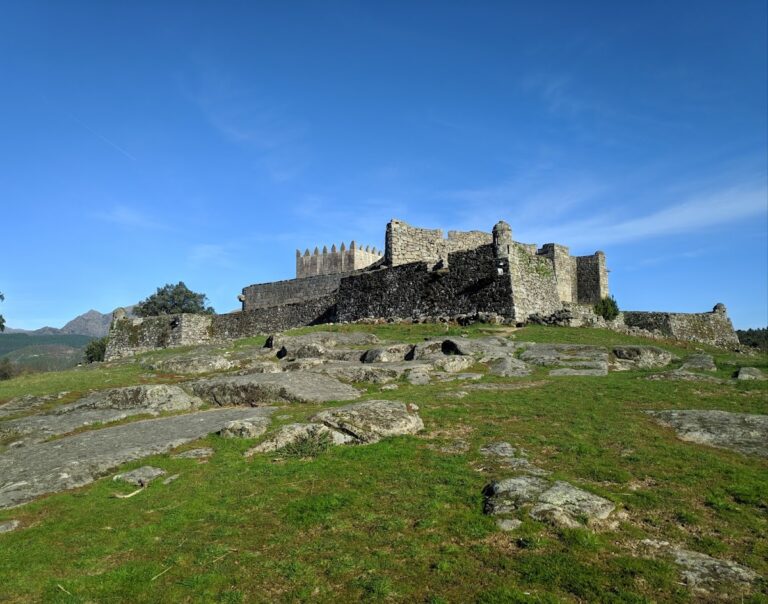
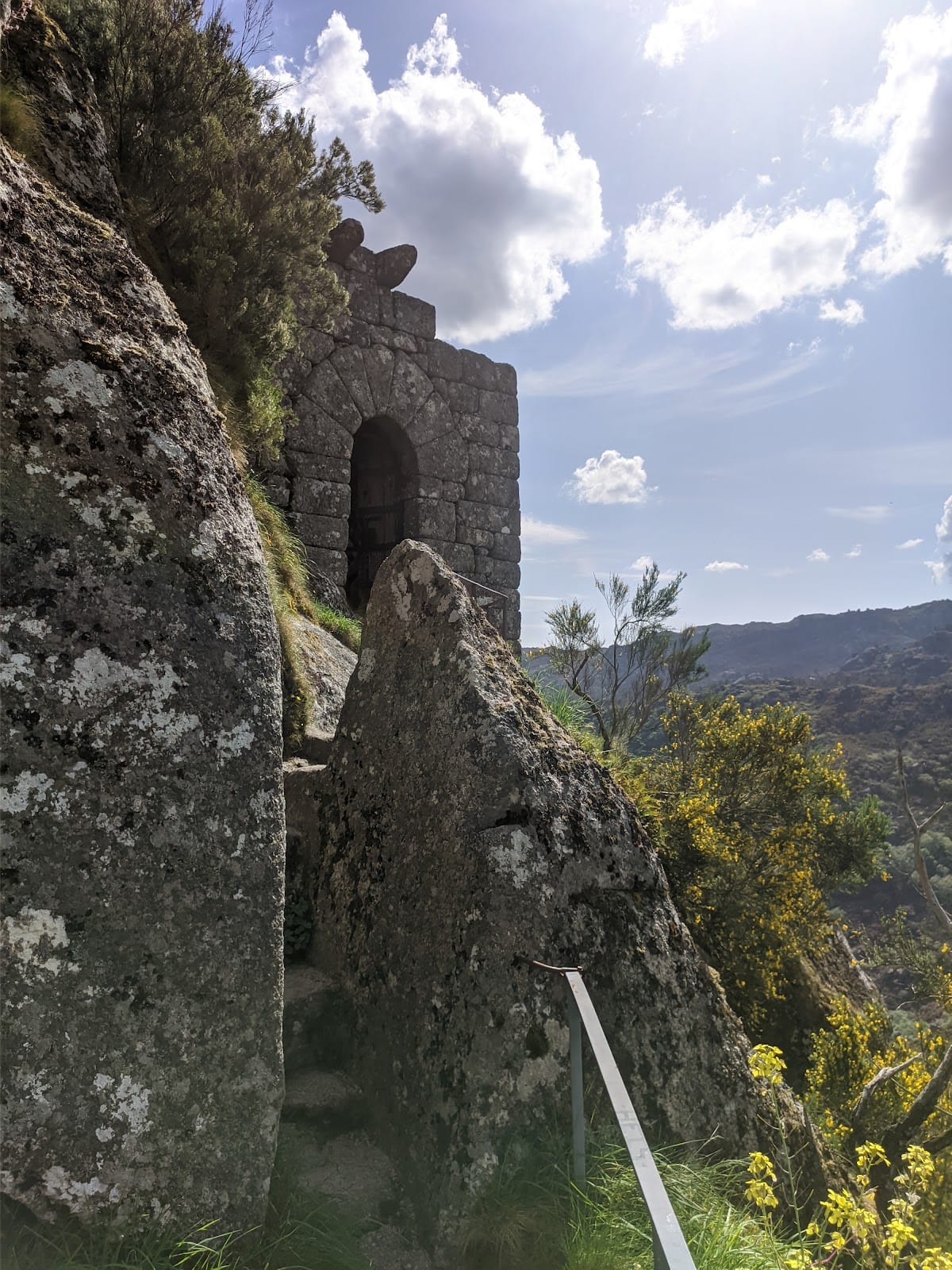
The fortress occupies an isolated hilltop at approximately 1,033 metres above sea level. Its roughly oval plan follows the terrain and runs along a north-south axis. Granite is the principal building material. The walls follow cliffs and rocky outcrops, while some sections form zigzags that correspond to the positions of earlier towers.
The surviving castle combines Romanesque construction, marked by massive masonry and robust forms, with Gothic features. Small projecting towers and turrets are incorporated into the walls of the citadel, the strongly fortified inner part of a castle or walled settlement. A drawing made by Duarte de Armas around 1506 to 1509 shows the enceinte, or main enclosing wall, reinforced by five square-plan towers.
Northern Military Enclosure
The northern and higher part of the fortress formed its military center. This enclosure functioned as the citadel and contained a square-plan keep in the middle of the parade ground. A cistern stood to the north of the keep, which was preceded by another construction whose identity is not specified.
Keep and Cistern
The square keep occupied the central position within the parade ground, while the cistern lay to its north. Together, these features belonged to the northern defensive core, whose position on the higher part of the hill supported the castle’s military function.
Gates
Two gates served the northern enclosure. The principal entrance, known as the Gate of the Sun, opens to the east. The northern Gate of Treason was also called the Gate of the Frog.
Southern Enclosure
A separate enclosure occupies the lower southern part of the site. Its surrounding wall runs from east to west, and access is provided by a full-arch bridge supported on vertical piers. This area was intended to shelter livestock and possessions during danger or invasion. The arrangement is regarded as unique in Portugal and reflects the importance of pastoral activity in the region.
Village and Present Condition
Duarte de Armas’s early sixteenth-century depiction shows the village isolated at a lower level outside the principal castle enclosure. The fortress is now ruinous. The intervention of 1979 to 1981 removed vegetation and consolidated the surviving monument, while the archaeological work of the 1970s exposed evidence of earlier occupation.